THE WAVES
  • Home
  • News
    • Recent Updates
    • Weekly Newsletter
    • Monthly Newsletter
    • Quarterly Newsletter
  • Topics
    • Technology
      • Internet
      • AR/VR & Digital twins
      • Robotics
      • AI & Data Analytics
      • IoT & Wearable
      • Blockchain
      • Computing
      • Sensors & Perception
      • 3D Printing
      • Energy Tech
      • Space
      • Gadgets
    • Transformation
      • Education
      • Health
      • Transportation
      • Farming
      • Energy
      • Security
      • Mining & Blue Economy
      • Food & Living
      • Communication
      • Entertainment
      • Manufacturing
      • Work & Management
      • Public Service
    • Startups
      • Culture
      • Country
      • New Entry
      • Accelerators
      • Incubators
      • Death Valley
      • Investments
      • Exit & IPO
      • Valuation & Financing
      • Idea & IP
    • Education & Research
      • School
      • University
      • Academic Research
      • Corporate Research
      • Public-funded Research
      • Economics of Innovation
      • Growth Economics
      • Training
      • Publications
      • Patents & IP
    • Industrial Revolutions
      • Future of Work
      • Sustainable Development
      • Smart Manufacturing
      • Job Transformation
      • Industry Transformation
      • Competition & Monopoly
      • National Response
      • Education & Skills
      • Social Change
    • Investment & Review
      • Public
      • Corporate
      • Venture Capital
      • Capital Market
      • Philanthropy
      • Personality
    • Inventions
    • Automation
  • Strategy
    • Value Proposition
      • Product
      • Process
      • Sustainability Goals
      • Business Model
      • Complementary
      • Externality
    • Innovation
      • Disruptive Innovation
      • Incremented Innovation
      • Sustaining
      • Schumpeter’s Creative Destruction
      • Redesign for Winning
    • Competition
      • Leading
      • Following
      • Blue Ocean
      • Monopolisation
      • Porter’s Five Forces
      • Business Cycle
    • Intangible Assets
      • Human Capital
      • R&D Management
      • Tripple Helix
      • Intellectual Property
      • Productive Knowledge
      • Technology Managment
    • Competence
      • Organization Agility
      • Innovation Culture
      • Infrastructure
      • R&D facility
      • Great by Choice
      • Build to Last
      • Good to Great
    • Technology Acquisition
      • Scientific discovery
      • Invention
      • Fusion
      • Adaptation & Refinement
      • Licensing
      • Start-up acquisition
  • Policy
    • Technology Development
    • Industry
    • Innovation Diffusion
    • Jobs, Privacy & Security
    • Regulation & Law
    • Sustainability
    • Equity & Inclusiveness
    • Climate Change
    • Environment
  • Opinion
    • Opinion
  • Megatrends
    • Individual Preferences
    • Planet and Society
    • Technology
    • Political Economy
    • Market Power & Monopoly
    • Globalisation
    • Schumpeter’s creative destruction
    • Startups & VC
    • Human Role in Work
    • Value of Natural Resources
    • Patents & Ideas for Redesign
  • Publication
    • Case Studies
    • Magazine
    • Books
    • Reports
    • White Papers
    • Journals
THE WAVES In-depth investigation on Technology, Society, and Policy dynamics for interpreting the past as well as present, and predicting the future so that success rate of pursuing ideas, start-ups, and innovation economy increases.

Technology, Society and Policy

Winning and Losing in Reinvention Race : keeps unfolding: --making America’s innovation bucket leaky, creating prosperity out of reinvention, and turning invention successes transitory
THE WAVES
  • Home
  • News
    • Recent Updates
    • Weekly Newsletter
    • Monthly Newsletter
    • Quarterly Newsletter
  • Topics
    • Technology
      • Internet
      • AR/VR & Digital twins
      • Robotics
      • AI & Data Analytics
      • IoT & Wearable
      • Blockchain
      • Computing
      • Sensors & Perception
      • 3D Printing
      • Energy Tech
      • Space
      • Gadgets
    • Transformation
      • Education
      • Health
      • Transportation
      • Farming
      • Energy
      • Security
      • Mining & Blue Economy
      • Food & Living
      • Communication
      • Entertainment
      • Manufacturing
      • Work & Management
      • Public Service
    • Startups
      • Culture
      • Country
      • New Entry
      • Accelerators
      • Incubators
      • Death Valley
      • Investments
      • Exit & IPO
      • Valuation & Financing
      • Idea & IP
    • Education & Research
      • School
      • University
      • Academic Research
      • Corporate Research
      • Public-funded Research
      • Economics of Innovation
      • Growth Economics
      • Training
      • Publications
      • Patents & IP
    • Industrial Revolutions
      • Future of Work
      • Sustainable Development
      • Smart Manufacturing
      • Job Transformation
      • Industry Transformation
      • Competition & Monopoly
      • National Response
      • Education & Skills
      • Social Change
    • Investment & Review
      • Public
      • Corporate
      • Venture Capital
      • Capital Market
      • Philanthropy
      • Personality
    • Inventions
    • Automation
  • Strategy
    • Value Proposition
      • Product
      • Process
      • Sustainability Goals
      • Business Model
      • Complementary
      • Externality
    • Innovation
      • Disruptive Innovation
      • Incremented Innovation
      • Sustaining
      • Schumpeter’s Creative Destruction
      • Redesign for Winning
    • Competition
      • Leading
      • Following
      • Blue Ocean
      • Monopolisation
      • Porter’s Five Forces
      • Business Cycle
    • Intangible Assets
      • Human Capital
      • R&D Management
      • Tripple Helix
      • Intellectual Property
      • Productive Knowledge
      • Technology Managment
    • Competence
      • Organization Agility
      • Innovation Culture
      • Infrastructure
      • R&D facility
      • Great by Choice
      • Build to Last
      • Good to Great
    • Technology Acquisition
      • Scientific discovery
      • Invention
      • Fusion
      • Adaptation & Refinement
      • Licensing
      • Start-up acquisition
  • Policy
    • Technology Development
    • Industry
    • Innovation Diffusion
    • Jobs, Privacy & Security
    • Regulation & Law
    • Sustainability
    • Equity & Inclusiveness
    • Climate Change
    • Environment
  • Opinion
    • Opinion
  • Megatrends
    • Individual Preferences
    • Planet and Society
    • Technology
    • Political Economy
    • Market Power & Monopoly
    • Globalisation
    • Schumpeter’s creative destruction
    • Startups & VC
    • Human Role in Work
    • Value of Natural Resources
    • Patents & Ideas for Redesign
  • Publication
    • Case Studies
    • Magazine
    • Books
    • Reports
    • White Papers
    • Journals

  • Education & Skills

Skill Development Process – mastering innovation ability

Focus on developing empathy, passion for perfection, Inductive&deductive reasoning, and R&D capacity

  • Md. Rokonuzzaman
  • Created: January 31, 2022
  • Last updated: December 17, 2022

The skill development process for Innovation is not limited to sharing Codified Knowledge. We should aim at helping the learner to master their abilities with knowledge, thinking, and skills. It must influence their own emotions, beliefs, and values. It should be far more than a conventional shallow learning situation where teachers or trainers presenting information think they have done their job. The skill development process should focus on developing capability, creating ability, motivating learners, and infusing provocation. Besides, it should focus on developing strong winning traits.  

The skill development process should begin by creating an awareness that something new needs to be done that they haven’t done before—changing (i) perception. It should proceed to make the learners ready (ii), followed by the guided response, (iii) giving instruction. It leads to the fourth stage: building mechanism – learning the basics of the skill. Many skill development exercises stop at the end of this fourth step. But it must proceed to a complex overt response – becoming more expert. For responding to evolving new situations, skill development should focus on developing adaptation capacity. The last step is about origination for creating new responses.

Among the learners, the skills grow through seven stages (i) imitating or copying an instructor or other skilled person, (ii) reproducing the actions from memory, (iii) becoming reliable in building speed and precision in repeating actions, (iv) being able to adapt skills to a new context, (v) getting skills naturalized so that they come into actions intuitively, (vi) developing self-skill learning capacity, and (vii) creating new skills. We should focus on knowledge, understanding, application, analysis, synthesis, and evaluation for cognitive skill development. For progressing through these stages, the skill development process may include the following steps:

Community engagement—empathy and Passion for Perfection

The skill development process should begin with building empathy and passion for perfection. Learners should get exposure to real-life situations during early childhood to observe and experience pains in Getting jobs done. Innovators should be exposed to the situations in which target customers will be using the envisioned products. For example, Jeffry Hawkins used to go to all conceivable situations where target customers would be using the envisioned handheld computer or personal digital assistant. They should be given exercise in observing, analyzing, summarizing, and pointing to imperfections in existing products.    

Apprenticeship–tinkering and Craftsmanship for the skill development process

Even in modern times, ideas start flowing through tinkering and craftsmanship. Hence, learners should be exposed to making things with their innate abilities—tinkering and craftsmanship. They should keep experimenting and finetuning. Hence, it’s no wonder that design thinking has rapid prototyping and testing. Hence, we need to focus on sharpening tinkering and craftsmanship capability, whether making physical products or writing software code. Furthermore, this exercise should be in association with a skilled person so that cultural traits transfer through observation, engagement, and quick feedback.

Classroom participation: cognitive, knowledge, and engineering

Learners should also engage in a classroom setting to absorb a body of existing knowledge for feeding the creative process for ideas. This knowledge is vital for scaling up ideation. Furthermore, mastering the skill of engineering is vital for scaling up tinkering and craftsmanship in implementing ideas with precision. This classroom exercise of knowledge sharing should develop the ability to comprehend and apply knowledge. The ability of analysis, synthesis, and evaluation should also get focused. In sharing, we should focus on creating curiosity, motivation, and the ability to think. Besides, we need to contextualize knowledge for increasing retention. Knowledge without context and the ability to think is hard to retain; besides, it is largely meaningless.

Laboratory and field experimentations, and capstone projects:

We should take learners to the laboratories and also fields for controlled experimentations. Experimenting with the validation of knowledge will lead to absorption in the thinking process, changing beliefs and values. They will figure out how theories explain real-life situations. Furthermore, analysis and interpretation of real-life evidence with the help of applicable theoretical farmworkers will develop imagination abilities.   

To sharpen empathy and passion for perfection, learners should observe usages of existing products and figure out the pains experienced by the users. They should get encouragement to generate ideas in addressing imperfection out of users’ knowledge and unfolding technology possibilities. We should also expose learners to implementing them, initially, through tinkering and craftsmanship. They should then proceed for optimum design and precision implementation. During the laboratory experimentation and capstone projects, we should expose learners to a team environment. We should also demand learners to gather and summarize insights, perform critical analysis for dealing with constraints, plan projects, manage teams and resources, and defend ideas of designs.   

Research and development: a key part of the skill development process

For innovation, the existing body of knowledge reaches the capacity of idea development very quickly. To scale up the ideation, we need a stream of knowledge. For example, Thomas Alva Edison had an intense passion for perfection, and sharp tinkering, craftsmanship, and testing skills. His famous example of 10,000 experimentation for finding suitable carbon filament for light bulb invention is quite intriguing. But his invention was primitive, creating very little willingness to pay among a very small group of people. Hence, he embarked on establishing a corporate R&D lab in 1899 for producing knowledge out of scientific investigation for the systematic advancement of the light bulb. Similarly, Sony had to perform 12 years of R&D to advance the Nobel Prize-winning CCD invention for making electronic image sensors suitable for digital camera innovations.

Hence, R&D capacity development should get an emphasis on developing the skills for systematically creating a Flow of Ideas. In addition to advancing knowledge, R&D capacity is vital for reviewing and assimilating relevant developments, driving self-learning, and skill enhancement.    

Developing inductive and deductive reasoning, and winning traits:

In addition to creating a flow of ideas and implementing them with high precision, innovators need to face the challenge of winning the competitive race. The dynamics of shaping ideas into Wealth or waste in the competitive market are quite dynamic and uncertain. To interpret the past dynamics and comprehend the present, they should have the skills to analyze pieces of evidence in discovering reoccurring patterns. They should be able to use those patterns to form or update theories. Besides, they should also have the capability of applying existing theories to interpret the unfolding dynamics.

In addition to inductive, the focus should be on developing deductive capacities for making an inference based on widely-accepted facts or premises for predicting the unfolding future. This deductive capacity is vital for making decisions to leverage unfolding possibilities and cope with likely threats.

Innovators need to continuously adapt to evolving situations and figure out new responses. Hence, the skill development process for improving innovation capability is far more than helping learners acquire imitation capability. We need to engage and challenge them so that they become a driver of creating and applying new knowledge for winning the innovation race in a competitive market.   

...welcome to join us. We are on a mission to develop an enlightened community by sharing the insights of wealth creation out of technology possibilities as reoccuring patters. If you like the article, you may encourage us by sharing it through social media to enlighten others. 
Enlighten others

Subscribe

Subscribe now to our newsletter

You May Also Like

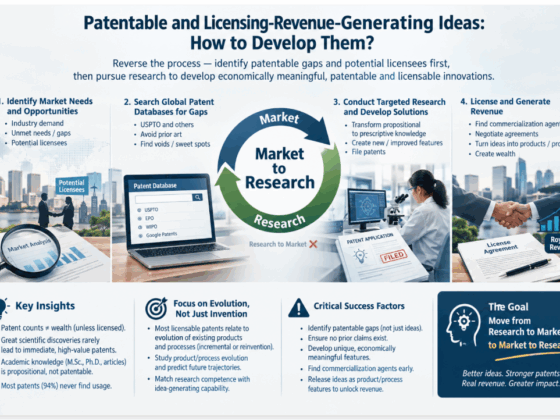
For producing patentable and licensable outputs, Universities should reverse the conventional research-to-commercialization process
View Post
  • 3 min

Patentable and Licensing-Revenue-Generating Ideas: How to Develop Them?

AI in education demands focus on empowering students to discover knowledge and ideate for advancing the evolution of inventions and innovations to drive prosperity.
View Post
  • 5 min

AI in Education–will AI render education obsolete?

STEM programs must focus on empowering graduates to win global race of innovation through technological ideas for driving economic prosperity and creating high-income jobs
View Post
  • 4 min

STEM Programs–not good enough for prosperity!

Leave a Reply Cancel reply

Your email address will not be published. Required fields are marked *

Subscribe

Subscribe now to our newsletter

Principles

  • Economics of Technology
  • Innovation Economics
  • Technology & Innovation Policy

History & Observations

  • Technology History
  • Innovation History
  • Strategy & Policy in retrospect
  • Entrepreneurs & Innovators
  • Startups & Corporations
  • Patents & Publications
  • Design & Redesign Thinking

About Us

  • Who we are
  • What we deliver
  • Genesis
  • Mission
  • Scope
  • Editorial & Advisory Board
THE WAVES
  • Contact
  • Advertise

Input your search keywords and press Enter.