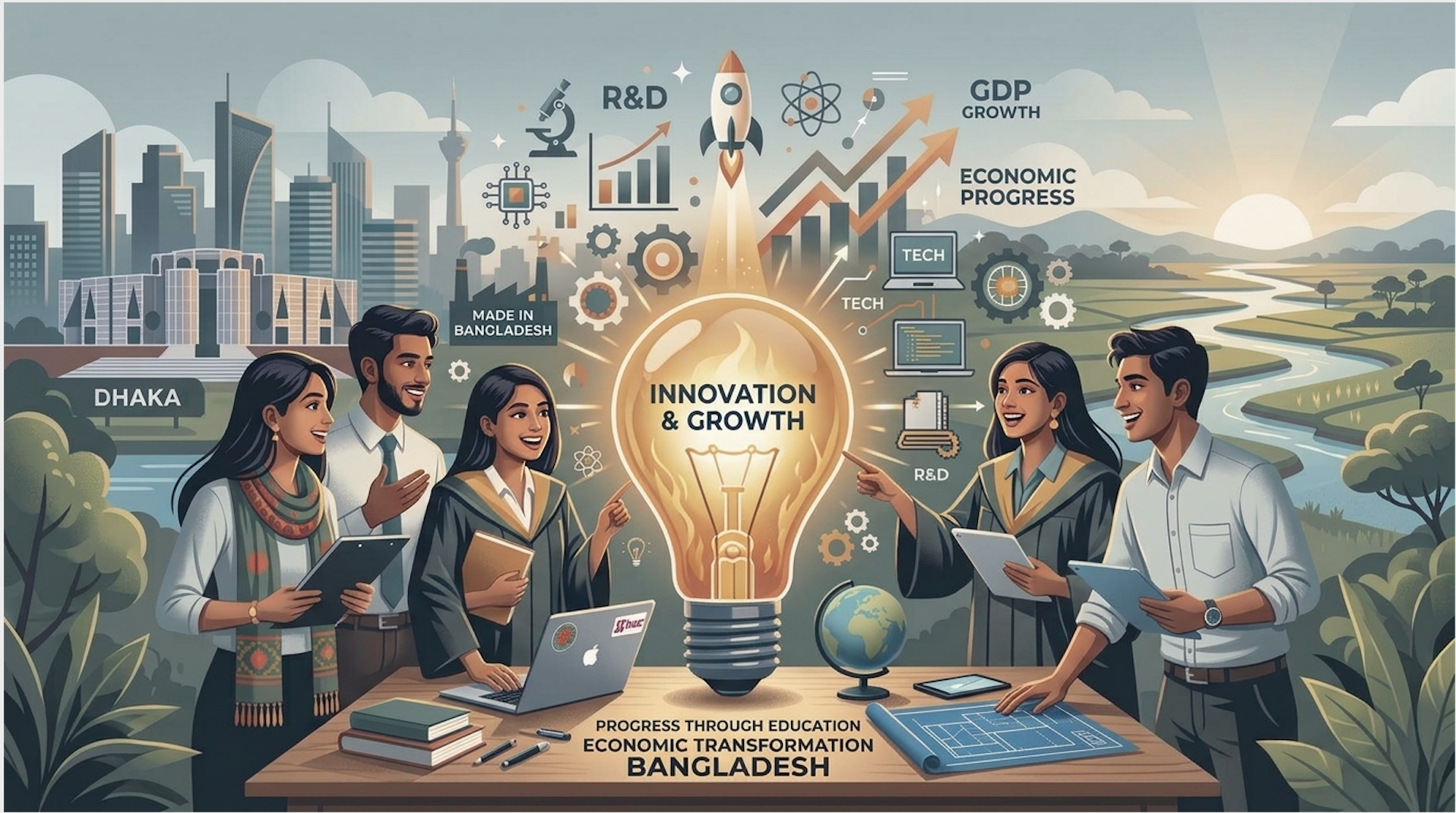
Bangladesh’s complex economic problems require a simple, homegrown solution: turning knowledge and ideas into Wealth by engaging graduates in the continuous evolution of locally produced products and production processes through education, R&D, incentives, and strong program management.
Bangladesh appears to be trapped in a very complex economic problem. But what if the problem is not as complicated as we think—and what if we are making it worse by applying the wrong solutions?
It begins with a troubling paradox: investment in education has increased the pool of unemployed graduates. More importantly, further investment in improving educational quality does not appear to be improving the employment situation. We are producing more human capital without creating the mechanisms needed to turn that capital into wealth.
The second problem is equally serious. Local value addition in the industrial economy has been declining, contributing to the rise of non-performing loans. At the same time, as economic growth has been slowing, the increasing tax collection burden required to finance growing public expenditure has been weakening the economy further. The Government has consequently been opting to print money, which has been contributing to inflation.
Then comes an even bigger problem: many of the conventional economic growth theories appear to be losing their explanatory power. Correlations that were once expected to hold between critical economic indicators are increasingly failing.
Infrastructure provides a striking example. Despite substantial progress in infrastructure, there has been no proportional contribution to job creation and economic growth. Similarly, the rise of human capital has become a burden rather than a driver of the economy.
So, are we facing a problem that is simply too complex to solve?
It may appear so. Experts seem to have no convincing answer. More borrowing, more infrastructure, more education, more foreign investment, and more public spending are repeatedly presented as solutions—yet the underlying problem persists.
Fortunately, there may be a much simpler way out.
Bangladesh does not necessarily need more foreign experts or more borrowing to solve this problem. It needs to learn how to create wealth from the knowledge and ideas it already has—and, more importantly, how to engage its growing pool of graduates in that process.
This could provide a homegrown, sustainable, and scalable pathway out of the current economic trap and toward a highly prosperous Bangladesh.
What should we do?
The solution should focus on developing a national capability to continuously improve locally produced products and production processes by mobilizing knowledge, ideas, and graduates.
1. Teach the mechanics of wealth creation.
Offer basic education on how wealth can be created by driving the evolution of products and production processes to (i) faculty members and students of science, business, and engineering schools; (ii) firms; (iii) Government employees; (iv) economists and development planners; and (v) all other major actors.
The objective should not simply be to produce more graduates. It should be to teach graduates—and those who employ, educate, and govern them—how knowledge and ideas can be converted into economic value.
2. Redirect university R&D toward the evolution of local production.
Adopt a policy of offering R&D grants to universities to drive the evolution of products being produced locally and the production processes used to make them.
Instead of measuring university success primarily through publications, rankings, or patents, we should ask a more fundamental question: How much additional value can university knowledge and ideas create in the economy?
3. Reward firms for creating more value with knowledge and ideas.
Offer incentives to producers for improving the quality and lowering the cost of their outputs by driving the evolution of their products and production processes through local R&D.
The objective should be to move producers beyond simply replicating imported technologies and toward continuously reinventing what they produce and how they produce it.
4. Build the capacity to execute, manage, and monitor the transformation.
Develop strong program management and monitoring capacity to ensure that these initiatives actually produce results.
The ultimate goal is not to spend more money on education, R&D, infrastructure, or incentives.
The goal is to create a mechanism through which knowledge and ideas continuously generate more value.
That is the missing link.
Bangladesh may not be suffering from a shortage of graduates, infrastructure, capital, or even knowledge. It may be suffering from a shortage of mechanisms for converting these resources into wealth.
Fix that mechanism—and a seemingly complex economic problem may suddenly become much simpler.