THE WAVES
  • Home
  • News
    • Recent Updates
    • Weekly Newsletter
    • Monthly Newsletter
    • Quarterly Newsletter
  • Topics
    • Technology
      • Internet
      • AR/VR & Digital twins
      • Robotics
      • AI & Data Analytics
      • IoT & Wearable
      • Blockchain
      • Computing
      • Sensors & Perception
      • 3D Printing
      • Energy Tech
      • Space
      • Gadgets
    • Transformation
      • Education
      • Health
      • Transportation
      • Farming
      • Energy
      • Security
      • Mining & Blue Economy
      • Food & Living
      • Communication
      • Entertainment
      • Manufacturing
      • Work & Management
      • Public Service
    • Startups
      • Culture
      • Country
      • New Entry
      • Accelerators
      • Incubators
      • Death Valley
      • Investments
      • Exit & IPO
      • Valuation & Financing
      • Idea & IP
    • Education & Research
      • School
      • University
      • Academic Research
      • Corporate Research
      • Public-funded Research
      • Economics of Innovation
      • Growth Economics
      • Training
      • Publications
      • Patents & IP
    • Industrial Revolutions
      • Future of Work
      • Sustainable Development
      • Smart Manufacturing
      • Job Transformation
      • Industry Transformation
      • Competition & Monopoly
      • National Response
      • Education & Skills
      • Social Change
    • Investment & Review
      • Public
      • Corporate
      • Venture Capital
      • Capital Market
      • Philanthropy
      • Personality
    • Inventions
    • Automation
  • Strategy
    • Value Proposition
      • Product
      • Process
      • Sustainability Goals
      • Business Model
      • Complementary
      • Externality
    • Innovation
      • Disruptive Innovation
      • Incremented Innovation
      • Sustaining
      • Schumpeter’s Creative Destruction
      • Redesign for Winning
    • Competition
      • Leading
      • Following
      • Blue Ocean
      • Monopolisation
      • Porter’s Five Forces
      • Business Cycle
    • Intangible Assets
      • Human Capital
      • R&D Management
      • Tripple Helix
      • Intellectual Property
      • Productive Knowledge
      • Technology Managment
    • Competence
      • Organization Agility
      • Innovation Culture
      • Infrastructure
      • R&D facility
      • Great by Choice
      • Build to Last
      • Good to Great
    • Technology Acquisition
      • Scientific discovery
      • Invention
      • Fusion
      • Adaptation & Refinement
      • Licensing
      • Start-up acquisition
  • Policy
    • Technology Development
    • Industry
    • Innovation Diffusion
    • Jobs, Privacy & Security
    • Regulation & Law
    • Sustainability
    • Equity & Inclusiveness
    • Climate Change
    • Environment
  • Opinion
    • Opinion
  • Megatrends
    • Individual Preferences
    • Planet and Society
    • Technology
    • Political Economy
    • Market Power & Monopoly
    • Globalisation
    • Schumpeter’s creative destruction
    • Startups & VC
    • Human Role in Work
    • Value of Natural Resources
    • Patents & Ideas for Redesign
  • Publication
    • Case Studies
    • Magazine
    • Books
    • Reports
    • White Papers
    • Journals
THE WAVES In-depth investigation on Technology, Society, and Policy dynamics for interpreting the past as well as present, and predicting the future so that success rate of pursuing ideas, start-ups, and innovation economy increases.

Technology, Society and Policy

Winning and Losing in Reinvention Race : keeps unfolding: --making America’s innovation bucket leaky, creating prosperity out of reinvention, and turning invention successes transitory
THE WAVES
  • Home
  • News
    • Recent Updates
    • Weekly Newsletter
    • Monthly Newsletter
    • Quarterly Newsletter
  • Topics
    • Technology
      • Internet
      • AR/VR & Digital twins
      • Robotics
      • AI & Data Analytics
      • IoT & Wearable
      • Blockchain
      • Computing
      • Sensors & Perception
      • 3D Printing
      • Energy Tech
      • Space
      • Gadgets
    • Transformation
      • Education
      • Health
      • Transportation
      • Farming
      • Energy
      • Security
      • Mining & Blue Economy
      • Food & Living
      • Communication
      • Entertainment
      • Manufacturing
      • Work & Management
      • Public Service
    • Startups
      • Culture
      • Country
      • New Entry
      • Accelerators
      • Incubators
      • Death Valley
      • Investments
      • Exit & IPO
      • Valuation & Financing
      • Idea & IP
    • Education & Research
      • School
      • University
      • Academic Research
      • Corporate Research
      • Public-funded Research
      • Economics of Innovation
      • Growth Economics
      • Training
      • Publications
      • Patents & IP
    • Industrial Revolutions
      • Future of Work
      • Sustainable Development
      • Smart Manufacturing
      • Job Transformation
      • Industry Transformation
      • Competition & Monopoly
      • National Response
      • Education & Skills
      • Social Change
    • Investment & Review
      • Public
      • Corporate
      • Venture Capital
      • Capital Market
      • Philanthropy
      • Personality
    • Inventions
    • Automation
  • Strategy
    • Value Proposition
      • Product
      • Process
      • Sustainability Goals
      • Business Model
      • Complementary
      • Externality
    • Innovation
      • Disruptive Innovation
      • Incremented Innovation
      • Sustaining
      • Schumpeter’s Creative Destruction
      • Redesign for Winning
    • Competition
      • Leading
      • Following
      • Blue Ocean
      • Monopolisation
      • Porter’s Five Forces
      • Business Cycle
    • Intangible Assets
      • Human Capital
      • R&D Management
      • Tripple Helix
      • Intellectual Property
      • Productive Knowledge
      • Technology Managment
    • Competence
      • Organization Agility
      • Innovation Culture
      • Infrastructure
      • R&D facility
      • Great by Choice
      • Build to Last
      • Good to Great
    • Technology Acquisition
      • Scientific discovery
      • Invention
      • Fusion
      • Adaptation & Refinement
      • Licensing
      • Start-up acquisition
  • Policy
    • Technology Development
    • Industry
    • Innovation Diffusion
    • Jobs, Privacy & Security
    • Regulation & Law
    • Sustainability
    • Equity & Inclusiveness
    • Climate Change
    • Environment
  • Opinion
    • Opinion
  • Megatrends
    • Individual Preferences
    • Planet and Society
    • Technology
    • Political Economy
    • Market Power & Monopoly
    • Globalisation
    • Schumpeter’s creative destruction
    • Startups & VC
    • Human Role in Work
    • Value of Natural Resources
    • Patents & Ideas for Redesign
  • Publication
    • Case Studies
    • Magazine
    • Books
    • Reports
    • White Papers
    • Journals

  • Education & Skills

Patentable and Licensing-Revenue-Generating Ideas: How to Develop Them?

  • Md. Rokonuzzaman
  • Created: September 15, 2026
  • Last updated: September 22, 2026
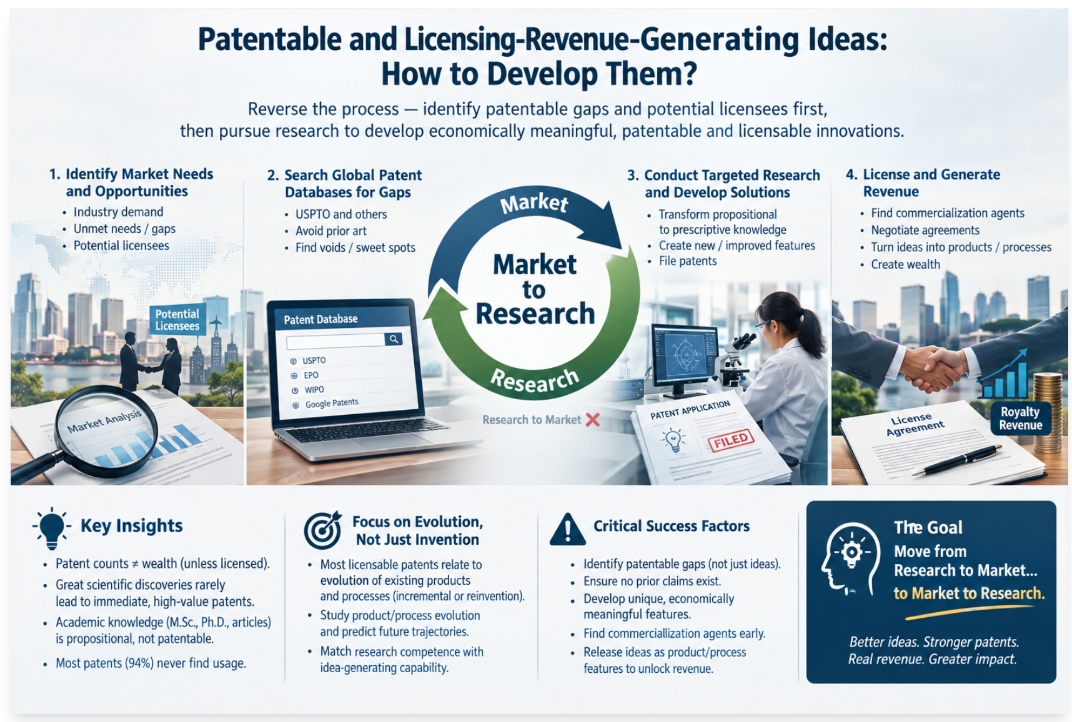
For producing patentable and licensable outputs, Universities should reverse the conventional research-to-commercialization process

Universities should reverse the conventional research-to-commercialization process by identifying patentable gaps and potential licensees first, then pursuing research to develop economically meaningful, patentable and licensable product or process innovations.

At the outset, let me disclose that my name is not on any patent. However, I worked at an institution whose business is conducting R&D to develop technologies, secure legal ownership, and license them.

Besides, I was part of a team that founded a firm in Canada. Unfortunately, I left that firm prematurely because I returned to my homeland. That firm developed image-interpretation technologies, obtained patents, and licensed them to globally known companies such as Sony.

Furthermore, I have been researching and teaching Wealth-creation mechanisms based on technology possibilities and the role of intellectual property portfolios and management.

Due to the increasing emphasis on rankings and incentives for research and technology transfer offices, there could be a new race for patent counting among universities in Bangladesh.

It is worth noting that patent counts themselves do not produce wealth unless the patents are licensed to generate income. Although obtaining a patent, particularly from the USPTO, is challenging, generating revenue by licensing patents is far more challenging.

There may be a temptation to believe that a major scientific discovery will lead to a patentable idea and that its licensing will generate high income. Unfortunately, this is unrealistic. Such great ideas begin their journey at a loss, and there is hardly any interest in licensing them.

Besides, knowledge produced through academic research, such as M.Sc. or Ph.D. theses and journal articles, could be termed propositional knowledge. Such knowledge is not patentable. It must be upgraded to a prescriptive form, providing know-how-type instructions for demonstrating an economically meaningful effect. Once this prescriptive knowledge is used to develop unique ideas for inventing new products or production processes, or for evolving existing ones further, those new ideas become candidates for claiming legal ownership—as patents.

However, to obtain patents, we need to ensure that no one has claimed them before. Hence, to increase the chance of success, we need to identify gaps or voids in the global idea or patent base.

Most licensable patents are related to the evolution of existing products and production processes, whether through incremental advancement or Reinvention.

Hence, we need to match the research competence of an individual or group with the capability to generate ideas that can drive the evolution of products and production processes. To do so, we need to study the evolution of candidate products and production processes and predict their future trajectories. This exercise will produce a set of candidate ideas. Upon doing so, we need to search patent databases, including the USPTO and others, to determine the voids, gaps, or sweet spots.

Subsequently, we need to engage in research to develop these ideas into technology solutions in the form of new or improved features, followed by filing patents.

The next issue concerns patent licensing. Conducting research and obtaining patents without finding commercialization agents creates a high risk of failing to license them, let alone generating revenue. For this reason, as many as 94% of patents never find usage. Hence, while identifying patentable ideas for research, we need to conduct a parallel exercise to identify candidate commercialization agents and reach initial agreements with them. It is worth noting that unless ideas are released as product or process features, the opportunity to generate revenue does not open up.

Hence, instead of conducting research and pursuing commercialization later, we need to reverse the steps. Upon identifying patentability and a commercialization opportunity, we should pursue research accordingly.

Hence, the focus should change from “Research to Market” to “Market to Research”
Enlighten others

Subscribe

Subscribe now to our newsletter

You May Also Like

For producing patentable and licensable outputs, Universities should reverse the conventional research-to-commercialization process
View Post
  • 3 min

Patentable and Licensing-Revenue-Generating Ideas: How to Develop Them?

AI in education demands focus on empowering students to discover knowledge and ideate for advancing the evolution of inventions and innovations to drive prosperity.
View Post
  • 5 min

AI in Education–will AI render education obsolete?

STEM programs must focus on empowering graduates to win global race of innovation through technological ideas for driving economic prosperity and creating high-income jobs
View Post
  • 4 min

STEM Programs–not good enough for prosperity!

Leave a Reply Cancel reply

Your email address will not be published. Required fields are marked *

Subscribe

Subscribe now to our newsletter

Principles

  • Economics of Technology
  • Innovation Economics
  • Technology & Innovation Policy

History & Observations

  • Technology History
  • Innovation History
  • Strategy & Policy in retrospect
  • Entrepreneurs & Innovators
  • Startups & Corporations
  • Patents & Publications
  • Design & Redesign Thinking

About Us

  • Who we are
  • What we deliver
  • Genesis
  • Mission
  • Scope
  • Editorial & Advisory Board
THE WAVES
  • Contact
  • Advertise

Input your search keywords and press Enter.