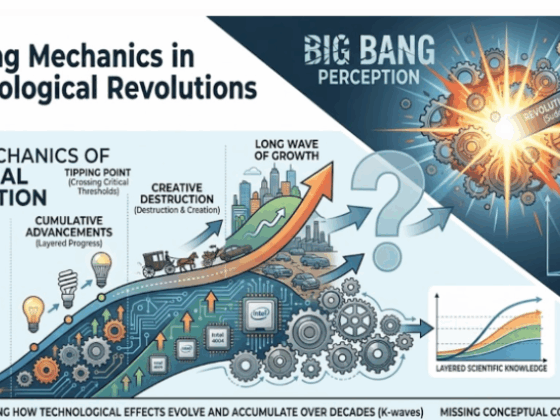
It may be surprising to many of us that pre-industrial age seeded industrial revolutions. For example, the hero engine or aeolipile invented in the 1st century AD is the precursor to the modern steam engine powering the first industrial revolution. Similarly, modern tablets’, like iPads, ancestorial history is rooted in the Greeks’ usage of the folding pair of wax tablets, along with the leather scroll, in the mid-8th century BC. Furthermore, our ancestors in pre industrial age also started making robots to reduce their roles in work.
Once we look into the pre-industrial age from the perspective of creativity, we observe the high-level creative performance of our ancestors. However, their creativity was based on knowledge residing in the art form, and inventive work was intuition-centric tinkering. They used to rely on Craftsmanship in making copies of their innovations. Hence, they could not scale up their inventions and innovations–powering waves of Creative Destruction. However, science in the medieval Islamic world started the formation of the scientific knowledge-creation capacity of the human race. Subsequently, that seeded the formation of industrial revolutions.

The pre-industrial age refers to the way our accessors used to execute their jobs before the advent of the first industrial revolution, which occurred from 1760 to 1850. Often, we are curious about our ancestors’ living in the pre-industrial age. Compared to the modern age, they lived in a primitive society. However, we have some obvious questions. Does it mean that they were less creative than us? Did they invent technology and innovate tools or products to perform their jobs better? Did they make any contribution to forming the foundation of subsequent industrial revolutions?
Key Takeaways of Pre-industrial Age
- Period--Pre-industrial age refers to the era prior to the beginning of the first Industrial Revolution in 1760, when our ancestors relied on intuition, tinkering, and craftsmanship for knowledge, invention, Innovation, and production.
- Lack of scalability of inventions and innovations–In the pre-industrial age, inventions and innovations were not scalable, resulting in early saturation and slow growth of economic value creation.
- Creativity in the pre-industrial age--Like us, our ancestors in the Pre Industrial Age were creative and they were after the relentless journey of reinventing in finding better means of Getting jobs done.
- Pre-industrial technology–production and shaping of metal for hunting, housing, transportation, and farming dominated the pre-industrial tech. The tinkering and craftsmanship approach dominated invention, innovation and production in the pre-industrial age.
- Seeding the Industrial Revolution–ideas like the steam engine and mechanization were born and demonstrated in the pre-industrial age. However, due to reliance on intuition, tinkering and craftsmanship, our ancestors could not scale them up. The first industrial revolution gained momentum due to the success of scaling up inventions of the pre-industrial age from the systematic knowledge and idea flow and profit-making competition.

Overview of Pre-industrial Age
The first industrial revolution occurred from 1750 to 1850. The pre-industrial age refers to the main era before the advent of the first industrial revolution. Examples of inventions and innovations of the pre-industrial Age are given below. They offer a clear indication that our ancestors were on a relentless journey to find increasingly better means. However, their inventions and innovations were not scalable due to reliance on intuition for knowledge gathering, tinkering for invention and innovation, and craftsmanship for making copies, manufacturing, or production.
- Cave paintings: these are painted drawings on cave walls or ceilings, dated to some 40,000 years ago (around 38,000 BCE) in Eurasia.
- Clay Tablet in Mesopotamia (2400 BC): they used to imprint wet clay tablets using stylus, and dried them in sun or air. Collections of these clay documents were the root of the first libraries found in the Middle East.
- Papyrus in Egypt (2500 BC): it is an era when ancient people used to write on thick paper, made from the pith of the papyrus plant. Sheets of such material, joined together side by side and rolled up into a scroll, form an early version of books.
- Acta Diurna in Rome (130 BC): Acta appeared around 131 BC during the Roman Republic with the content of results of legal proceedings and outcomes of trials. Subsequently, it was expanded to public notices, announcements, and other noteworthy information.
- dibao in China (2nd century): an era that introduced publications issued by central and local governments in imperial China. It is similar to Gazette notification in the Western world.
- Codex in the Mayan region (5th century): it refers to the age of the introduction of folding books. They were written by pre-Columbian Maya civilization in Maya hieroglyphic script on Mesoamerican bark cloth. Professional scribes working under the patronage of deities used to write them.
- Printing press using wood blocks (220 AD): this era introduced Woodblock printing technique. It was widely used for printing text, images or patterns.

Defining Pre Industrial Age
In retrospect, the pre-industrial age refers to the era prior to the first industrial revolution when inventions, innovations and production had very limited Economies of Scale and scope effects due to reliance on intuition, tinkering, and craftsmanship for knowledge gathering, invention, and innovation, and production, respectively. As a result, the market for innovations was very limited, resulting in limited diffusion of innovations and small size of firms. Consequently, high-paying jobs could not grow.
The Industrial Revolution began in 1760 due to the scale effect of inventions and innovations of the pre-industrial age due to the augmentation of intuition with modeling and empirical approach of knowledge gathering, replacement of tinkering or trial & error with systematic approach, and craftsmanship with engineering.
Invention and innovation for the urge to get jobs done better
This attribute of finding a better alternative is our core capability of invention and innovation. We invented the steam engine with this capability, triggering the first industrial revolution. We continued the invention of the internal combustion engine, electricity, the electric light bulb, and motors, which led to the transition to the 2nd industrial revolution. But our urge to find better means did not stop there. It led to the Transistor’s invention in 1947, forming the foundation of the 3rd industrial revolution. We are now at the dawn of the Fourth Industrial Revolution.
Human beings have the urge to generate ideas and transfer them into a means for serving purposes better than ever before. This fundamental characteristic differentiates us from other living creatures. Hence, our ancestors also had this characteristic, as noticed during different periods of pre industrial age. For example, in 2500 BC, they invented papyrus as a better alternative to clay tablets.

Like the past three industrial revolutions, we are all concerned about the fourth industrial revolution’s unfolding. Particularly, the uprising of robotics and the massive job loss threat is making us bewildered about the future. In retrospect, it appears that such apprehension is not new. It appears to be an integral phenomenon of the progression of human civilization. In fact, all these four industrial revolutions are the continuation of the pre-industrial age.
In the pre-industrial age–tinkering based invention and innovation could not lead to scalable progression
Our invention process begins with the formation of knowledge through observation of physical phenomena in the form of art. We use this knowledge to generate ideas of tools and techniques for performing different tasks better than before. With the help of tinkering, we transfer those ideas into products and processes to produce them. In modern times, it could be compared with ‘Jugaad’ in Hindi, which refers to the formation of improvised or makeshift means through intuition-centric tinkering.
In the pre-industrial age, our ancestors’ knowledge about natural resources was in the art form. Hence, through tinkering, they used to invent technologies and innovate solutions.
For example, they innovated an array of farming tools, like a scratch plow. They used to use animal energy to operate them. They also innovated a number of hunting tools, like arrows and bows. Their success in domesticating crops and animals,l and innovating farming tools and techniques significantly boosted their ability to produce food as per need. In fact, they were as creative as us. Nevertheless, their invention and innovation progress were very slow due to the formation of knowledge in the qualitative form and tinkering reliance.
Energy for production from water and wind led to the progression in the pre-industrial age
Upon succeeding with animals’ domestication and harvesting their energy in agriculture and transportation, they focused on extracting energy from wind and water. They invented water wheel technology for converting the energy continued in the flow of water to a rotating motion. As a matter of fact, we still use this technology to produce electricity by rotating turbines with steam and water flow. The earliest literary reference to a water-driven, compartmented wheel appears from 280−220 BC. Since its invention, this vital technology kept progressing through tinkering for fueling energy innovation. The human race began transitioning from human and animal muscle labor to mechanical labor with the advent of the water wheel. Hence, harnessing water power enabled gains in agricultural productivity, food surpluses, and large-scale urbanization starting in the 11th century.
Our ancestors in the pre-industrial age also made significant progress in inventing technology and innovating solutions for harnessing wind energy. As early as 5,000 BC, people used wind energy to propel boats along the Nile River. Wind-powered water pumps came into existence in China in 200 BC. Wind energy innovations in the form of windmills with woven-reed blades led to grinding grain in Persia and the Middle East. Like water, wind energy harvesting made a significant economic contribution. Particularly, the technology’s success in harnessing wind led to a revolution in transportation through waterways.
Tools and techniques in the pre-industrial age
In our recorded history, the journey started with the invention of a technique for producing fire through rock pieces’ friction. The Stone Age period lasted roughly 3.4 million years and ended between 8700 BCE and 2000 BCE. Our ancestors innovated stone tools with an edge, point, or percussion surface through stone-shaping technology during this period. They used those tools to get hunting and other jobs done better. Their progression of producing metal by processing ores led to the invention of metal tools, which became a far better substitute for stone tools. Among many other tools, the bow and arrow appear to be a remarkable achievement of our ancestors. The oldest known evidence of arrows comes from a South African site. In this site, remains of bone and stone arrowheads have been found dating to approximately 70,000–60,000 years ago.
Automata and Robotics in the pre-industrial age
Although we are unfolding the fourth industrial revolution with the advent of intelligent machines like Robots, our ancestors started the journey in the pre-industrial age. As early as the 10th century BC, mechanical automata were constructed in the Western Zhou Dynasty in ancient China. In the 7th century, the knowledge of how to construct automata was passed on to the Arabs. Among notable demonstrations, Harun al-Rashid built water clocks with complicated hydraulic jacks. Arab engineers Banu Musa and Al-Jazari published descriptions of hydraulics. They also further advanced the art of water clocks. Al-Jazari invented water wheels with cams on their axle, which led to operating automata used in automatic gates and doors. Subsequently, Europeans learned automata from the Muslims, perhaps, which was transmitted during Muslim-Christian contact in Sicily and Spain.
Muslim era of science and technology
As explained, the invention and innovation were based on the art form of knowledge and intuition-centric tinkering in the pre-industrial age. Due to the lack of scientific knowledge of the underlying phenomena, our ancestors faced the limit of scaling up their valuable inventions and innovations. Hence, despite numerous successes of creativity, the progress was slow. During the period roughly between 786 and 1258, the human race started making an entry into the era of science. This entry was pivotal for finding means of fine-tuning and scaling up the initial inventions of our ancestors. During this Islamic golden age, science in the medieval Islamic world unfolded.
Islamic scientific achievements made contributions and formed the foundation of many modern disciplines of science, especially astronomy, mathematics, and medicine. Some of the other disciplines are alchemy and chemistry, botany, and agronomy. The contributions of Muslim Scientists in geography and cartography, ophthalmology, pharmacology, physics, and zoology are also notable.
During this period, Muslims practiced science both for practical purposes and for the goal of understanding. For example, astronomy was useful for determining the direction in which to pray. Similarly, botany had practical applications in agriculture. Subsequently, Europeans learned from the Muslims in pursuing scientific knowledge. The human race’s success in developing scientific relations between underlying variables of physical phenomena opened the door to scaling up inventions, which led to remarkable growth. Such unprecedented high growth started showing up a sharp contrast between ages, giving birth to subsequent industrial revolutions. Hence, it does not sound unfair that Muslims’ golden age of science in the pre-industrial era seeded the first industrial revolution, raising Europe.
Human progression is like an S-curve– pre-industrial age seeded industrial revolution
Human progression could be modeled as an S-curve of a typical technology life cycle. In the beginning, there is a high level of uncertainty and a lack of scientific knowledge. As a result, the progress at the early stage is very slow. However, once progress is made in the theorization of observations through scientific knowledge, progress ramps up. In retrospect, it appears that our ancestors made significant contributions in our journey of uplifting our quality of living standards through inventions and innovations. However, their knowledge was in the form of art, and the methodology of creating better means out of it was based on tinkering. Hence the progress was extremely slow.
However, progress in science in the medieval Islamic world, roughly between 786 and 1258, was the beginning of transferring art into scientific knowledge. In fact, our ability to transfer art forms of understanding into scientific knowledge led to scaling up our inventing and innovating activities, subsequently giving birth to industrial revolutions. Hence, it’s not unfair to reason that the pre-industrial age seeded subsequent industrial revolutions.