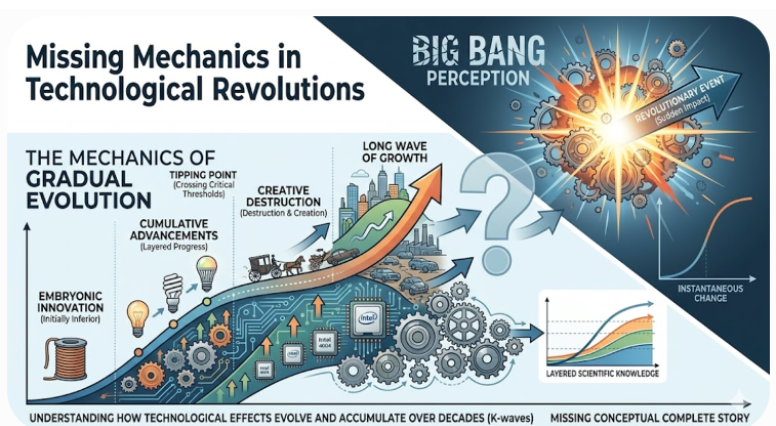
Technological or industrial revolutions generate long waves of economic growth while simultaneously destroying firms and industries that powered previous waves. This dual effect has attracted substantial scholarly interest. However, much of the analytical literature focuses on the revolutionary outcomes, often creating the impression that such transformations emerge as sudden “big bang” events. In reality, the underlying mechanics of industrial revolutions rarely conform to such abrupt dynamics. Instead, the transformative impact of Radical technologies unfolds gradually. Consequently, a significant portion of the literature on technological and industrial revolutions appears either misleading or conceptually incomplete.
In Technological Revolutions and Financial Capital, Carlota Perez characterizes Intel’s first microprocessor as a “big bang.” In practice, however, this characterization is inaccurate. Intel initially struggled to find a viable market for the Innovation. It was only later, when IBM adopted a more advanced version for its personal computer, that the commercial significance began to materialize. Even then, the revolutionary impact did not occur instantaneously. Rather, it emerged through cumulative advancements in semiconductor technology—particularly increasing chip density, enhanced performance, and declining costs.
This gradual, evolutionary process eventually reached a tipping point where its effects became revolutionary. Failure to account for this progression—from modest beginnings with latent potential to large-scale transformation—contributes to phenomena such as the productivity paradox, often referred to as the Solow paradox. As a result, while observers are frequently astonished by the eventual impact of technological revolutions, they remain largely unable to detect early signals of their emergence.
This analytical gap has important implications. Without a clear understanding of how revolutionary effects evolve over time, firms and nations struggle to position themselves strategically. Consequently, they often miss critical windows of opportunity to create and capture value from unfolding technological revolutions.
Long waves in economic literature
Long economic waves, commonly referred to as Kondratieff Waves (or K-waves), describe cyclical 40–60 year periods of capitalist expansion and contraction. First proposed by Russian economist Nikolai Kondratieff in 1926, these super-cycles are widely understood to be driven by major technological innovations and large-scale infrastructure investments that define eras of prosperity, followed by phases of structural adjustment.
Although these waves have often been associated with the S-curve life cycle of technologies, the mechanisms through which individual technological trajectories aggregate into long waves of economic transformation have not been clearly articulated. In the 1940s, Joseph Schumpeter introduced the concept of Creative Destruction, offering an initial explanation of how new innovations displace existing industries. However, this framework remained largely illustrative and lacked a rigorous account of the underlying mechanics.
Later, Clayton Christensen’s theory of Disruptive innovation provided additional clarity by explaining how new entrants can challenge incumbents through initially inferior but improving technologies. Nevertheless, this perspective does not sufficiently incorporate the full dynamics of technology life cycles and their cumulative macroeconomic effects.
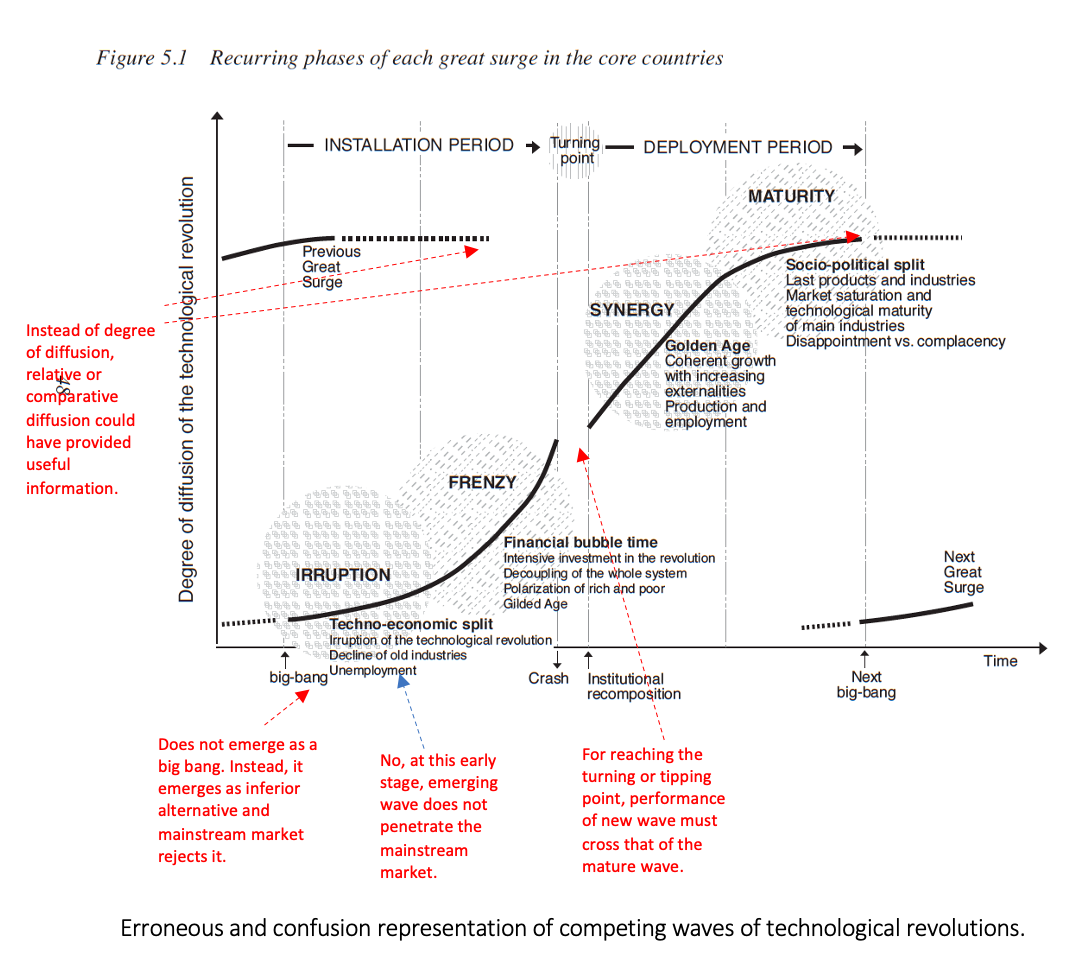
Among contemporary scholars, Carlota Perez has made a notable contribution by linking technological revolutions to financial and institutional cycles, thereby advancing a wave-based interpretation of economic development. However, due to limited attention to the micro-to-macro mechanics of how technological change evolves and accumulates, aspects of her framework risk conceptual inconsistency. For instance, key diagrams in Technological Revolutions and Financial Capital reveal such limitations, as they do not adequately capture the gradual and path-dependent processes through which long waves of growth are formed, as shown below. By the way, the degree of diffusion in the following figure needs clarification. Instead of stating the percentage of total diffusion, it should have referred to the portion of the population benefiting from each wave, resulting in deeper diffusion in the next wave.
More recently, the extension of the creative destruction framework by Philippe Aghion and Peter Howitt has gained significant attention, culminating in their recognition with the Nobel Prize in 2025. While their contributions advance the formalization of endogenous growth theory, their work still lacks sufficient clarity regarding the underlying mechanics through which creative destruction unfolds in practice.
Moreover, the broader economic literature has largely overlooked the connection between technological or industrial revolutions and the emergence of inventions from progressively deeper layers of scientific knowledge. This omission is critical, as such depth fundamentally influences scale effects, enabling successive technological waves to surpass and eventually displace preceding ones.
Even the influential work of Joel Mokyr, despite its recognition at the highest levels, remains largely focused on the industrial revolution as a social and economic phenomenon, without adequately incorporating the role of layered scientific advancement in shaping the dynamics of technological transformation.
Industrial Revolutions—underpinned by technological revolutions
Industrial revolutions are the economic manifestations of underlying technological revolutions. However, they do not emerge as sudden “big bang” events. Their formation is not driven by the immediate rollout of radical technologies. Rather, irrespective of their eventual impact, radical technologies typically originate in embryonic forms and often appear as inferior alternatives to established solutions. As a result, they are initially rejected by mainstream markets that are better served by more mature technologies.
Furthermore, industrial revolutions should not be interpreted primarily as social phenomena. They are fundamentally technological in nature, which subsequently manifests as economic transformations and, in turn, reshapes societal structures. The broad societal impact of these transformations often creates the impression that industrial revolutions are social in origin, when in fact they are technologically driven processes with cascading economic and social consequences.
Therefore, without careful attention to the underlying mechanisms through which these technological changes evolve and accumulate, analyses risk producing erroneous and confusing interpretations of their observable economic and social outcomes.
Mechanics of Technological Revolutions
At the root of economic and social outcomes lie the products we use to perform tasks, along with the firms and industries built around them. These products evolve over time through incremental improvements and periodic reinventions. This evolutionary process underpins technological revolutions, industrial revolutions, long waves of economic growth, creative destruction, and disruptive innovation. Driving this evolution requires not only the invention of new technologies but also their sustained advancement. As technologies become more powerful and scalable, progress increasingly depends on breakthroughs originating from deeper layers of scientific knowledge. Consequently, the economic and social impacts of technological and industrial revolutions are shaped by the underlying technologies and their relative economics in delivering Utility, reducing costs, and enabling Economies of Scale, scope, and network effects.
Most products in use today—including the light bulb and the camera—trace their origins to the pre-industrial era. Contrary to the common perception that each industrial revolution introduces entirely new categories of products, these transformations largely reflect the continued evolution of a relatively limited set of products. Over time, these products mutate and diversify as successive technological advances enable increasingly task-specific innovations. For example, modern LED lighting offers far greater variety and functionality than earlier compact fluorescent (CFL) technologies.
Importantly, this evolution is not linear. If it were, its effects would not be characterized as distinct industrial revolutions. Instead, the process unfolds episodically, with each episode following an S-curve trajectory. At maturity, each technological regime undergoes Reinvention, as dominant technological cores are replaced by emerging alternatives rooted in deeper scientific advances. For instance, the filament-based light bulb was reinvented as the CFL, which was subsequently reinvented as LED technology. Despite the significantly greater long-term impact of successive waves, each reinvention typically begins in an inferior form. As a result, these early-stage technologies are often rejected by mainstream markets and face substantial uncertainty regarding their future viability.
Only when such technologies cross critical performance and cost thresholds do they begin to penetrate mainstream markets, causing destruction to the demand of mature products and firms engaged in making them. Upon reaching this tipping point, the effects commonly described as creative destruction, disruptive innovation, or technological and industrial revolutions become visible.
The time required to reach such tipping points, as well as the duration of dominance, depends on the relative economics of competing technological trajectories. For example, the mobile phone took several decades—nearly 80 years—to achieve widespread adoption, while LED lighting required almost a century to cross the tipping point. In contrast, the automobile, after displacing horse-drawn transport in the early twentieth century, has continued to evolve for more than a century.
These observations suggest that, rather than treating industrial or technological revolutions as discrete, time-bounded events which unfold as big-bang, analysis should focus on the underlying evolutionary mechanics of products and technologies. Industrial revolutions are, in essence, simplified narratives that describe the cumulative effects of successive episodes of invention and innovation. Therefore, to achieve greater analytical clarity and avoid misinterpretation, greater emphasis should be placed on understanding the evolution of products and their broader economic and social implications. Moreover, such an approach would enable earlier detection of signals and support more rational decision-making, allowing actors to benefit from emerging shifts rather than suffer losses or engage in low value-added catch-up efforts.