In the dynamic world of technology Innovation, competing technologies vying to replace mature incumbents often lead to heightened uncertainty. This race, driven by the pursuit of superior performance, cost-efficiency, and scalability, amplifies innovation risks. Factors like quality, manufacturability, durability, infrastructure, and recyclability vary significantly across competing solutions, complicating decision-making and strategic planning. This article explores how managing innovation risks requires balancing the pursuit of multiple technological options and embracing uncertainties inherent in the Reinvention process.
The Complexity of Competing Technologies
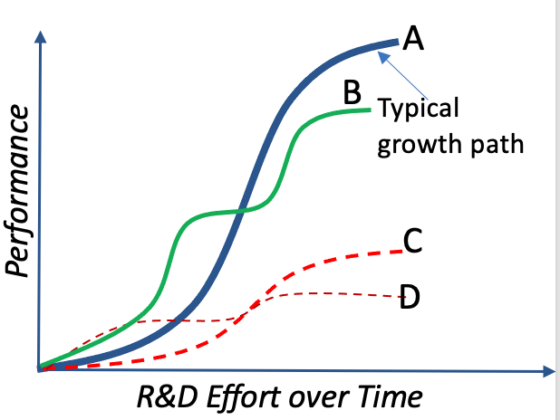
When multiple technologies emerge to replace a dominant incumbent, they do not evolve at the same pace. Each option may exhibit unique attributes and trade-offs, influencing its trajectory. This variation often results in a complex decision-making landscape. Companies face a Dilemma: should they focus on one promising technology or hedge their bets across several? Either path involves distinct risks:
- Pursuing a Single Technology: Concentrating resources on one technology reduces complexity but increases the risk of failure if that technology falls short in the market or faces unforeseen obstacles.
- Simultaneously Developing Multiple Technologies: While this strategy mitigates the risk of picking the “wrong” technology, it significantly increases costs, resource allocation challenges, and organizational strain.
These factors create a challenging environment for managers tasked with navigating technological uncertainty and guiding strategic investments.
Historical Case Study: The Race to Reinvent Display Technologies
The evolution of display technologies offers a compelling example of how competing innovations shape risk and uncertainty in the reinvention process.
The Rise of CRTs (Cathode Ray Tubes)
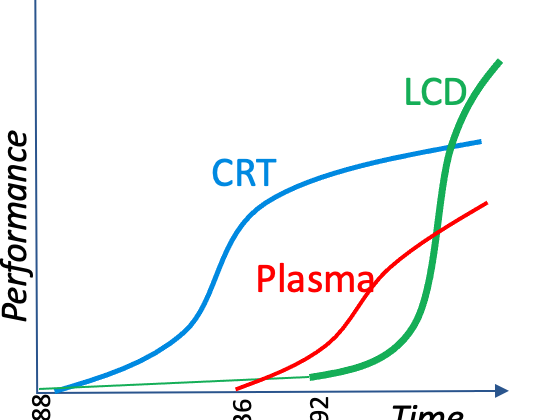
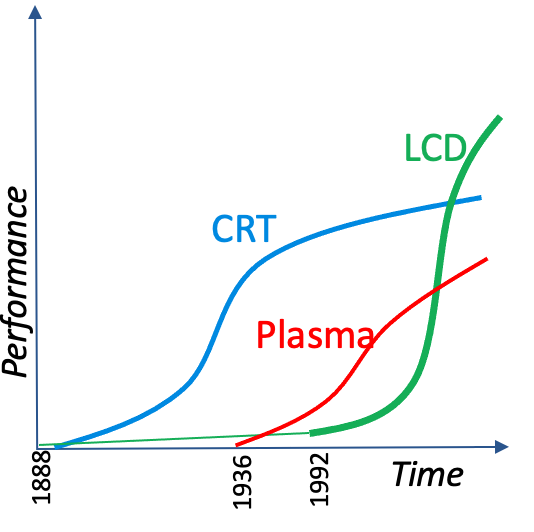
The cathode ray tube (CRT), invented in 1897, quickly became the dominant display technology, primarily due to its performance and cost-effectiveness. CRTs were widely adopted for television screens and scientific instruments, holding a competitive edge well into the mid-20th century. Despite the emergence of potential alternatives, CRTs benefited from incremental improvements and low production costs, extending their dominance until the early 1980s.
The Emergence of Plasma and LCD Technologies
In 1936, Hungarian engineer Kálmán Tihanyi proposed a flat-panel plasma display concept. Despite this early innovation, plasma displays struggled to compete with CRTs due to cost and manufacturability challenges. By the mid-1980s, both plasma and LCD (liquid crystal display) technologies began gaining traction, each offering unique advantages:
- Plasma Displays: Known for their superior performance in large-screen formats and better color reproduction, plasma screens showed early promise for high-end applications.
- LCD Displays: LCDs initially lagged in performance but had greater potential for energy efficiency, thinner profiles, and long-term cost reductions.
The Race for Market Supremacy
As both technologies raced to replace CRTs, the competition created a complex innovation landscape. Companies had to balance the following factors:
- Quality: Plasma offered better picture quality in large formats, but LCDs eventually caught up with incremental advancements.
- Manufacturability: LCDs benefited from more scalable production processes, making them more viable for mass-market adoption.
- Durability and Energy Efficiency: LCDs outperformed plasma in energy consumption and longevity, aligning with market demands for eco-friendly products.
- Cost Dynamics: The cost of manufacturing LCDs decreased significantly over time, enabling them to outcompete plasma displays.
By the dawn of the 21st century, LCD technology began accelerating in both performance and market share, ultimately overtaking plasma and rendering CRTs obsolete. The journey highlights how uncertainties associated with competing technologies can prolong the reinvention race and increase innovation risks.
Innovation Risks in the Reinvention Process
1. Technological Uncertainty
The uncertainty surrounding which technology will ultimately succeed is a significant risk factor. Companies must anticipate market trends, consumer preferences, and unforeseen technological breakthroughs. In the case of display technologies, LCD’s unexpected rapid improvement in quality and cost-efficiency blindsided proponents of plasma.
2. Cost Escalation
Simultaneously developing multiple technologies can lead to cost escalation, stretching R&D budgets and resource allocation. Balancing investment across competing innovations requires careful portfolio management to avoid overextension and financial strain.
3. Decision-Making Complexity
As technological options evolve, decision-makers face complex trade-offs. Choosing when to pivot or double down on a particular technology demands agility and strategic foresight. Misjudging market signals or technological potential can result in costly delays or failures.
4. Market Adoption Risks
Even if a technology is superior, market adoption may lag due to factors like consumer familiarity, regulatory hurdles, and ecosystem dependencies. The slow adoption of plasma displays, despite their early promise, underscores this risk.
Strategies for Managing Innovation Risks
To navigate the uncertainties posed by competing technologies, companies must adopt robust innovation management practices:
1. Diversified Innovation Portfolios
Rather than betting solely on one technology, firms can maintain a diversified portfolio of innovations. This approach spreads risk and increases the chances of success. For example, many display manufacturers invested in both plasma and LCD technologies before eventually pivoting toward LCD as it became the dominant standard.
2. Incremental Investment and Progressive Exploitation
As innovation is more than a Eureka moment, adopting an incremental investment strategy allows firms to scale their commitment based on performance milestones. This minimizes sunk costs and enables flexibility in redirecting resources. Progressive commercial exploitation also reduces innovation risks.
3. Strategic Partnerships
Collaborating with other firms, research institutions, and suppliers can accelerate technological progress and share the risks associated with high-cost innovation projects.
4. Scenario Planning
Engaging in scenario planning helps companies anticipate and prepare for multiple future outcomes. By mapping potential trajectories of competing technologies, firms can develop contingency plans to adapt to market shifts.
Conclusion
The reinvention of mature products through competing technologies is fraught with innovation risks. As demonstrated by the evolution of display technologies, navigating this landscape requires balancing multiple factors, including quality, cost, manufacturability, and Market Dynamics. The race between plasma and LCD to replace CRT exemplifies the uncertainties and strategic complexities involved.
Ultimately, managing these risks demands a nuanced approach that embraces technological uncertainty, fosters diversified investment, and leverages strategic foresight. Firms that master this balancing act are better positioned to thrive in an era of relentless innovation and disruption.
Five Key Takeaways about Competing Technologies
- Competing Technologies Increase Uncertainty
The presence of multiple technologies vying to replace a mature incumbent creates uncertainty due to variations in performance, cost, manufacturability, and recyclability. This complexity complicates decision-making and increases innovation risks. - Pursuing Multiple Technologies Balances Risk but Increases Costs
Simultaneously developing several competing technologies can mitigate the risk of betting on the wrong option but leads to higher costs and resource strain. Focusing on a single technology reduces costs but amplifies the risk of failure. - Historical Case Study Highlights Strategic Challenges
The evolution of display technologies—CRT, plasma, and LCD—illustrates how incremental advancements and changing cost dynamics can shift market dominance. LCD eventually outpaced both CRT and plasma due to superior manufacturability, cost efficiency, and scalability. - Innovation Risks Stem from Market and Technological Dynamics
Technological uncertainty, cost escalation, decision-making complexity, and market adoption risks are key challenges when managing innovation. These factors must be carefully balanced to ensure successful reinvention. - Diversification and Strategic Foresight Mitigate Risks
Companies can manage innovation risks by diversifying their portfolios, adopting incremental investment strategies, forming strategic partnerships, and engaging in scenario planning. These strategies help navigate uncertainty and increase the likelihood of long-term success.
Five Research Questions on Competing Technologies and Innovation Risks
- How do competing technologies impact innovation timelines in mature industries?
This question explores how competition among emerging technologies affects the speed of product reinvention and market adoption, focusing on factors like resource allocation and technological breakthroughs. - What role does manufacturability play in determining the success of competing technologies?
Examines how differences in production scalability and cost-efficiency influence which technology ultimately becomes dominant in the market. - How does uncertainty in technological performance affect strategic decision-making in innovation management?
Focuses on the challenges managers face in forecasting technological outcomes and making investment decisions amidst uncertainty. - What are the financial implications of pursuing multiple competing technologies simultaneously?
Investigates how diversified R&D strategies impact cost structures, resource allocation, and overall financial risk in innovation projects. - How do consumer adoption patterns influence the success of competing technologies in reinvention races?
Analyzes how consumer preferences, market readiness, and ecosystem dependencies shape the trajectory and eventual dominance of new technologies.