THE WAVES
  • Home
  • News
    • Recent Updates
    • Weekly Newsletter
    • Monthly Newsletter
    • Quarterly Newsletter
  • Topics
    • Technology
      • Internet
      • AR/VR & Digital twins
      • Robotics
      • AI & Data Analytics
      • IoT & Wearable
      • Blockchain
      • Computing
      • Sensors & Perception
      • 3D Printing
      • Energy Tech
      • Space
      • Gadgets
    • Transformation
      • Education
      • Health
      • Transportation
      • Farming
      • Energy
      • Security
      • Mining & Blue Economy
      • Food & Living
      • Communication
      • Entertainment
      • Manufacturing
      • Work & Management
      • Public Service
    • Startups
      • Culture
      • Country
      • New Entry
      • Accelerators
      • Incubators
      • Death Valley
      • Investments
      • Exit & IPO
      • Valuation & Financing
      • Idea & IP
    • Education & Research
      • School
      • University
      • Academic Research
      • Corporate Research
      • Public-funded Research
      • Economics of Innovation
      • Growth Economics
      • Training
      • Publications
      • Patents & IP
    • Industrial Revolutions
      • Future of Work
      • Sustainable Development
      • Smart Manufacturing
      • Job Transformation
      • Industry Transformation
      • Competition & Monopoly
      • National Response
      • Education & Skills
      • Social Change
    • Investment & Review
      • Public
      • Corporate
      • Venture Capital
      • Capital Market
      • Philanthropy
      • Personality
    • Inventions
    • Automation
  • Strategy
    • Value Proposition
      • Product
      • Process
      • Sustainability Goals
      • Business Model
      • Complementary
      • Externality
    • Innovation
      • Disruptive Innovation
      • Incremented Innovation
      • Sustaining
      • Schumpeter’s Creative Destruction
      • Redesign for Winning
    • Competition
      • Leading
      • Following
      • Blue Ocean
      • Monopolisation
      • Porter’s Five Forces
      • Business Cycle
    • Intangible Assets
      • Human Capital
      • R&D Management
      • Tripple Helix
      • Intellectual Property
      • Productive Knowledge
      • Technology Managment
    • Competence
      • Organization Agility
      • Innovation Culture
      • Infrastructure
      • R&D facility
      • Great by Choice
      • Build to Last
      • Good to Great
    • Technology Acquisition
      • Scientific discovery
      • Invention
      • Fusion
      • Adaptation & Refinement
      • Licensing
      • Start-up acquisition
  • Policy
    • Technology Development
    • Industry
    • Innovation Diffusion
    • Jobs, Privacy & Security
    • Regulation & Law
    • Sustainability
    • Equity & Inclusiveness
    • Climate Change
    • Environment
  • Opinion
    • Opinion
  • Megatrends
    • Individual Preferences
    • Planet and Society
    • Technology
    • Political Economy
    • Market Power & Monopoly
    • Globalisation
    • Schumpeter’s creative destruction
    • Startups & VC
    • Human Role in Work
    • Value of Natural Resources
    • Patents & Ideas for Redesign
  • Publication
    • Case Studies
    • Magazine
    • Books
    • Reports
    • White Papers
    • Journals
THE WAVES In-depth investigation on Technology, Society, and Policy dynamics for interpreting the past as well as present, and predicting the future so that success rate of pursuing ideas, start-ups, and innovation economy increases.

Technology, Society and Policy

Winning and Losing in Reinvention Race : keeps unfolding: --making America’s innovation bucket leaky, creating prosperity out of reinvention, and turning invention successes transitory
THE WAVES
  • Home
  • News
    • Recent Updates
    • Weekly Newsletter
    • Monthly Newsletter
    • Quarterly Newsletter
  • Topics
    • Technology
      • Internet
      • AR/VR & Digital twins
      • Robotics
      • AI & Data Analytics
      • IoT & Wearable
      • Blockchain
      • Computing
      • Sensors & Perception
      • 3D Printing
      • Energy Tech
      • Space
      • Gadgets
    • Transformation
      • Education
      • Health
      • Transportation
      • Farming
      • Energy
      • Security
      • Mining & Blue Economy
      • Food & Living
      • Communication
      • Entertainment
      • Manufacturing
      • Work & Management
      • Public Service
    • Startups
      • Culture
      • Country
      • New Entry
      • Accelerators
      • Incubators
      • Death Valley
      • Investments
      • Exit & IPO
      • Valuation & Financing
      • Idea & IP
    • Education & Research
      • School
      • University
      • Academic Research
      • Corporate Research
      • Public-funded Research
      • Economics of Innovation
      • Growth Economics
      • Training
      • Publications
      • Patents & IP
    • Industrial Revolutions
      • Future of Work
      • Sustainable Development
      • Smart Manufacturing
      • Job Transformation
      • Industry Transformation
      • Competition & Monopoly
      • National Response
      • Education & Skills
      • Social Change
    • Investment & Review
      • Public
      • Corporate
      • Venture Capital
      • Capital Market
      • Philanthropy
      • Personality
    • Inventions
    • Automation
  • Strategy
    • Value Proposition
      • Product
      • Process
      • Sustainability Goals
      • Business Model
      • Complementary
      • Externality
    • Innovation
      • Disruptive Innovation
      • Incremented Innovation
      • Sustaining
      • Schumpeter’s Creative Destruction
      • Redesign for Winning
    • Competition
      • Leading
      • Following
      • Blue Ocean
      • Monopolisation
      • Porter’s Five Forces
      • Business Cycle
    • Intangible Assets
      • Human Capital
      • R&D Management
      • Tripple Helix
      • Intellectual Property
      • Productive Knowledge
      • Technology Managment
    • Competence
      • Organization Agility
      • Innovation Culture
      • Infrastructure
      • R&D facility
      • Great by Choice
      • Build to Last
      • Good to Great
    • Technology Acquisition
      • Scientific discovery
      • Invention
      • Fusion
      • Adaptation & Refinement
      • Licensing
      • Start-up acquisition
  • Policy
    • Technology Development
    • Industry
    • Innovation Diffusion
    • Jobs, Privacy & Security
    • Regulation & Law
    • Sustainability
    • Equity & Inclusiveness
    • Climate Change
    • Environment
  • Opinion
    • Opinion
  • Megatrends
    • Individual Preferences
    • Planet and Society
    • Technology
    • Political Economy
    • Market Power & Monopoly
    • Globalisation
    • Schumpeter’s creative destruction
    • Startups & VC
    • Human Role in Work
    • Value of Natural Resources
    • Patents & Ideas for Redesign
  • Publication
    • Case Studies
    • Magazine
    • Books
    • Reports
    • White Papers
    • Journals

  • Editor's Pick
  • Strategy

Bangladesh’s High-Tech Park Owe: Can Low-Tech Be a Solution?

  • Md. Rokonuzzaman
  • Created: September 17, 2026
  • Last updated: September 17, 2026
Bangladesh can turn its high-tech parks into engines of prosperity by housing R&D wings of local producers

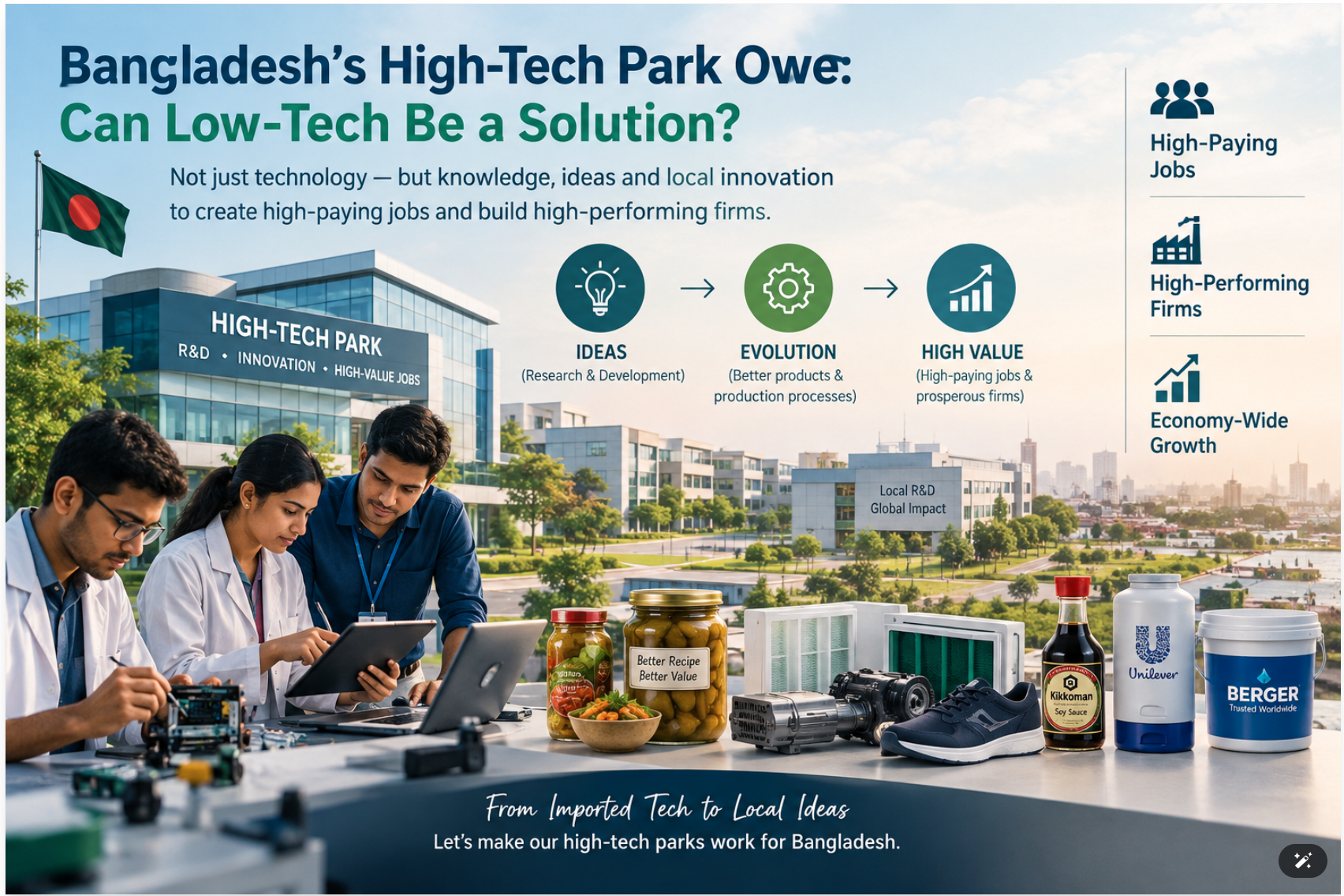
Bangladesh can turn its High-tech parks into engines of prosperity by housing R&D wings of local producers that use graduates’ knowledge and ideas to evolve products and production processes, resulting in creating high-value jobs, and building high-performing firms.

High-tech does not always mean writing code or connecting technology devices. Instead, it is about adding value through knowledge and ideas and opening a scalable growth path so that per-person value addition reaches high levels and high-performing firms begin to grow. High-tech success emerges from selling ideas rather than time.

For example, lens making does not appear to be high-tech. But lens maker Largan’s net margin is as high as 38%, far higher than even Apple’s net margin. On the other hand, the net margin of Foxconn, a well-known high-tech firm, is less than 5%. What is the difference?

As opposed to selling labor in manufacturing devices like Foxconn, Largan sells the idea of precision imaging for many high-end smartphone cameras as a lens. Even soy sauce maker Kikkoman’s net margin is far higher than that of Foxconn. Hence, for creating high value, should we target being Foxconn or Largan?

Besides, although we do not term Unilever or Berger as high-tech firms, their earnings per share in Bangladesh’s market are far higher than those of any technology firm in Bangladesh.

Are we after working with technology or adding high value through our graduates’ competence? Of course, in many cases, technology firms’ net margins are quite attractive. For example, TSMC’s net margin has reached almost 50%, and that of Nvidia is above 60%.

The underlying reason for the gulf in net margins hinges on whether we are selling ideas or time. Hence, to meet the aspiration of high-tech parks to create high-paying jobs, we should focus on selling ideas, whether we make shoes or software.

It appears that Bangladeshi technology firms are not known for being highly scalable or generating high net margins. The situation with Startups is even poorer. As opposed to reducing losses by driving evolution through idea flow, they are focused on pushing half-baked innovations with massive subsidies. On the other hand, foreign direct investments are demanding increasingly generous incentives and offering labor-intensive, low-paying, high-tech jobs. Hence, these three groups do not appear to be on the path to meeting the aspiration of creating high-paying jobs and building high-performing firms to make Bangladesh prosperous.

Hence, what is the alternative to addressing Bangladesh’s high-tech park owe?

Let’s restate our high-tech aspiration. It is about adding high value through knowledge and ideas so that we can succeed in creating high-paying jobs. Hence, as opposed to selling time or services, we need to sell ideas.

Let’s take an example of pickle making. If knowledge of food science leads to upgrading the recipe, for which customers are willing to pay an extra 5 taka, and the marginal cost increase of the improved recipe by Taka 2, the pickle maker will earn Taka 3 from each jar for the better recipe. Let’s assume that the pickle maker sells 10 million units over the next 10 years, resulting in Taka 30 million from that idea of recipe improvement. This is the power of selling an idea. A similar possibility exists in reducing costs by improving both the recipe and the production process. Hence, pickle Innovation may create high-paying jobs for graduates too.

Fortunately, Bangladeshi firms produce many products. For example, a single firm produces more than 8,000 products. However, most of these products are imitations of foreign products. They produce them by importing capital machinery and intermediary components. Good things is that from pickles to air filters, these products and their production processes are amenable to evolution through research and development. Hence, Bangladesh may take advantage of this opportunity to create high-paying jobs.

Therefore, those high-tech parks may be the home of the R&D wings of Bangladesh’s firms engaged in producing numerous products.

These R&D wings will drive the evolution of their products and capital machinery by engaging local graduates. Besides, we may tie up universities and polytechnic institutions to conduct R&D and implement R&D outputs. Such an approach will also address industry-academia collaboration.

This approach of populating high-tech parks with the R&D wings of local producers will likely meet the aspiration by creating high-paying jobs, building high-performing firms, and having economy-wide effects.
Enlighten others

Subscribe

Subscribe now to our newsletter

You May Also Like

Which Type of R&D Should Be the Focus of Bangladesh and many other less developed countries?
View Post
  • 3 min

Types of Research and Development

Bangladesh can turn its high-tech parks into engines of prosperity by housing R&D wings of local producers
View Post
  • 3 min

Bangladesh’s High-Tech Park Owe: Can Low-Tech Be a Solution?

angladesh's act of building high-tech parks appears to be driven by taking loans and spending money to create a sensation and a physical sign of a high-tech economy.
View Post
  • 3 min

Many Facets of High-Tech Parks: Has Bangladesh Created a Dark Face?

Leave a Reply Cancel reply

Your email address will not be published. Required fields are marked *

Subscribe

Subscribe now to our newsletter

Principles

  • Economics of Technology
  • Innovation Economics
  • Technology & Innovation Policy

History & Observations

  • Technology History
  • Innovation History
  • Strategy & Policy in retrospect
  • Entrepreneurs & Innovators
  • Startups & Corporations
  • Patents & Publications
  • Design & Redesign Thinking

About Us

  • Who we are
  • What we deliver
  • Genesis
  • Mission
  • Scope
  • Editorial & Advisory Board
THE WAVES
  • Contact
  • Advertise

Input your search keywords and press Enter.