Abstract
The Wave Framework of Innovation explains innovation not as a one-time invention, a linear sequence of research outputs, or a sudden entrepreneurial event, but as an unfolding process of successive improvements, technology-core transitions, Reinvention and market transformation. A new technology often begins as an imperfect and costly alternative. Through persistent refinement of products and production processes, it may become a compelling substitute for established solutions. When the underlying technology reaches maturity, further improvement becomes increasingly difficult; a new technology core can then initiate another wave. The resulting process creates value while also destroying the relevance of incumbent products, skills, jobs and firms. Drawing on the body of work published by The Waves, this article integrates innovation S-curves, diffusion wavelets, Creative Destruction, Disruptive innovation, competition, human competence and the economics of Wealth creation into one connected framework. It argues that the central challenge for firms and nations is not simply to adopt technology or increase research activity, but to build the competence to identify meaningful problems, generate economically relevant ideas, advance products and processes, and convert those advances into profitable firms, productive employment and broad-based prosperity.
1. Introduction: Innovation is a wave, not an event
Innovation is often described through celebrated moments: an invention is made, a startup is founded, a product is launched, or a new technology enters the market. Such descriptions are attractive because they make innovation appear simple and dramatic. Yet the economic significance of an innovation rarely lies in the moment of invention alone. It lies in the long journey through which an idea becomes a usable product, a product becomes progressively better and cheaper, a market forms, production scales, and firms learn to compete. This journey is uneven, uncertain and cumulative.
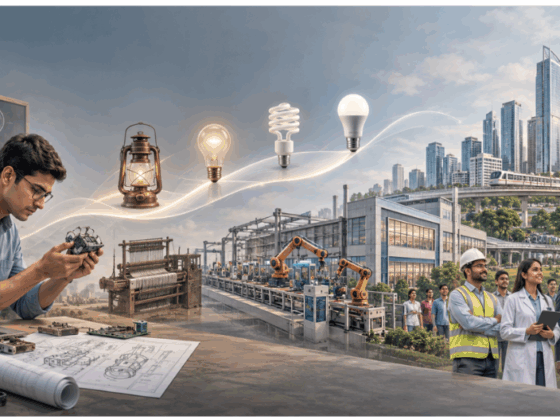
The Wave Framework begins with a different proposition: innovations unfold through recurring patterns. A new technology core opens a possibility for doing a job differently. Early products are often primitive, expensive and unreliable. Their appeal may be limited to a small group of users whose needs are not adequately served by existing solutions. If innovators continue to improve performance, reliability, usability and cost, the emerging alternative can cross a threshold and become a serious competitor. Its diffusion accelerates, complementary capabilities develop, and new business opportunities emerge. Eventually, however, the technology core itself may approach its limits. The pace of improvement slows, creating the conditions for reinvention and another wave.
This perspective is important because innovation is simultaneously a process of creation and destruction. Better ways of Getting jobs done create new Utility and economic value, but they can also reduce demand for older products, production methods, occupations and business models. The same wave that creates new firms and high-value work can undermine established firms and displace workers who remain tied to a mature technology. Understanding the pattern is therefore essential for entrepreneurs, managers, investors, educators and policymakers.
2. The basic architecture of an innovation wave
An innovation wave can be understood as the interaction of six connected movements: (1) an unmet or inadequately served job-to-be-done creates urgency; (2) human competence converts observations and knowledge into ideas; (3) a technology core makes a new solution technically possible; (4) repeated product and process improvements increase quality while reducing cost; (5) adoption and competition expand the market; and (6) saturation creates pressure for reinvention. These movements are not always sequential. They interact, overlap and feed back into one another.
2.1 Urgency and Jobs to be done
Innovation begins with a reason to improve how a task is performed. Users seek greater utility: better performance, lower cost, convenience, reliability, safety, accessibility or sustainability. The relevant starting point is not the technology that happens to be fashionable, but the job that people or organizations need to get done. A technically impressive solution without a sufficiently important user problem may fail to attract willingness to pay. Conversely, a persistent unmet need can motivate long and difficult journeys of invention and refinement.
2.2 Human competence and the Flow of Ideas
Urgency alone does not produce innovation. People must understand the problem, observe the limitations of existing solutions, connect knowledge from different domains, imagine alternatives and test whether those alternatives can work. The Waves emphasizes the role of empathy, creativity, a Passion for Perfection, and competence in science, technology and engineering. These capabilities help transform a general desire for improvement into specific, testable ideas.
Knowledge becomes economically consequential when it is translated into a solution that can be produced, delivered and used. Thus, the pathway from education and research to prosperity is not automatic. It depends on the capacity to convert learned knowledge and skills into economically meaningful ideas, and then to turn those ideas into better products and processes.
2.3 Technology core and the possibility of reinvention
A technology core is the underlying technical principle or platform that enables a product or process to perform its function. A change in features or design does not necessarily change the core. Incremental improvement can extend the performance of an existing core, while a radical change in the core can open a fundamentally different path. The new core may initially be inferior on conventional measures, but it can offer a different cost structure, capability or trajectory of improvement. If it is sufficiently scalable and amenable to advancement, it may support a new innovation wave.
3. Innovation S-curves: From emergence to maturity
The S-curve provides a useful representation of how a technology or innovation progresses. In its early phase, progress is slow because the science, engineering, design and production system are not yet fully understood. The product may be costly and perform poorly compared with established alternatives. As knowledge accumulates and design problems are solved, improvement accelerates. Performance rises, cost falls, reliability improves and adoption expands. Eventually, the rate of improvement slows as the technology approaches practical, physical or economic limits.
The S-curve is not merely a diagram of sales growth. It can describe the advancement of the underlying technology, the improvement of a product, the productivity of research and development, and the diffusion of an innovation. These curves are related but not identical. A technology may improve before a market forms; a product may be technically capable but lack complementary infrastructure; adoption may accelerate only after prices fall or standards emerge. The framework therefore requires attention to the relationship between technological progress, product performance, cost and market acceptance.
Maturity is a strategic signal. When additional research and development effort produces progressively smaller improvements, the incumbent technology may be approaching saturation. Continuing to invest in incremental advancement can still be valuable, but it may no longer be sufficient to sustain growth. Firms need to search for emerging technology cores and assess whether a new trajectory can eventually outperform the mature one. The strategic question is not simply whether the current product is successful, but how much room remains for its underlying core to advance.
4. From wavelets to a larger diffusion wave
Innovation diffusion is rarely a single, smooth movement from launch to universal adoption. Each improved version can attract another group of users or make the product relevant to a new use case. These successive releases create smaller diffusion movements—wavelets—that collectively form a larger adoption wave. Feature improvements, lower prices, greater reliability, new applications, complementary products and expanding distribution can each renew the momentum.
This explains why the first commercial version of an innovation may have little resemblance to the mature product that eventually transforms an industry. A new product may begin in a narrow niche, where a small group of users values a unique capability despite high cost or limited performance. Refinement then broadens its appeal. The growth of complementary technologies and supporting infrastructure can further increase its usefulness. Adoption feeds learning, learning improves the product, and improvement supports additional adoption.
The wave perspective cautions against judging an emerging technology solely by its first market offering. It also cautions against assuming that every new technology will become a mass-market success. The relevant questions concern the direction and rate of improvement, the size and urgency of the initial use case, the economics of production, and the possibility of crossing the performance and cost thresholds required for wider adoption.
5. Incremental innovation, Process innovation and sustaining competition
Once a product enters the market, innovation does not stop. Firms must keep making it more attractive and less expensive. Incremental innovation adds or improves features, increases performance, enhances reliability and improves the user experience. Process innovation changes how the product is made or delivered, often lowering cost, improving consistency, reducing waste or increasing throughput. Sustaining innovation helps a firm defend and strengthen its position among customers who already value the product.
These forms of innovation are mutually reinforcing. Product improvements may increase demand, while process improvements make those improvements affordable and profitable. Greater production volume can generate learning and Economies of Scale; competition can force firms to improve quality and price. The economic outcome depends on the combined effect: customers receive greater utility, while firms seek a sustainable margin from delivering it.
However, incremental advancement has limits. If the technology core is maturing, adding features may produce diminishing returns. A firm can become highly efficient at improving a product whose underlying trajectory is losing momentum. The Wave Framework therefore treats incremental innovation as essential but not sufficient. It must be connected to a search for the next reinvention opportunity.
6. Reinvention and the emergence of a new wave
Reinvention occurs when a mature product or process is recreated around a different technology core, architecture or business model. It is more than a cosmetic redesign. It changes the foundation from which future improvements can be made. The new alternative often begins with disadvantages: lower performance on familiar measures, higher cost, limited reliability or an immature supply chain. Its potential lies in the possibility of a different and more scalable improvement path.
The transition from an emerging alternative to a powerful new wave requires sustained refinement. The new technology must be capable of improvement; the product must become better and cheaper; and an initial market must provide a reason to continue development. The early market may consist of nonconsumers—users for whom the established solution is unavailable, impractical or inadequate—or customers willing to pay for a distinctive new capability. Such users can provide the first revenue, feedback and learning needed to improve the alternative.
An important implication follows: the success of reinvention cannot be inferred from novelty alone. It depends on the economics of the emerging solution and its capacity to cross a threshold where it becomes a compelling substitute. The initially inferior alternative must evolve. Without that journey, a promising invention may remain a technical curiosity rather than becoming a creative force in the market.
7. Creative destruction and disruptive innovation
When a new wave becomes a better alternative for an expanding set of jobs, it reduces demand for products built around the previous technology core. This is the process commonly described as Schumpeterian creative destruction. The destruction is not an accidental side effect; it is part of the mechanism through which an economy reallocates resources toward more effective ways of creating value. Customers migrate because the new solution offers a better combination of utility, performance, convenience and cost.
Disruptive consequences for firms arise when an incumbent fails to recognize or respond to the emerging wave. Established firms may be committed to their existing customers, assets, skills, revenue models and performance metrics. The new alternative may initially appear unattractive to their mainstream market. A new entrant, less constrained by the incumbent business, may be willing to serve an overlooked niche and improve the product over time. If the new wave advances, the entrant can move into the incumbent’s market, while the incumbent struggles to switch.
Creative destruction and disruption should therefore be distinguished. Creative destruction describes the broader reallocation of demand and economic activity as better alternatives emerge. Disruption describes a particular pattern in which entrants and emerging solutions undermine established firms, often because incumbents fail to adapt in time. Both are connected to the transition between innovation waves, but they are not interchangeable labels.
8. Competition, market power and the migration of innovation
Competition is not only a contest over price. It is also a race to generate and implement ideas that make products better, cheaper and more attractive. Firms that repeatedly improve the value proposition can gain customers, scale production, accumulate data and experience, develop complementary assets and strengthen their market position. Successful innovation can therefore produce significant market power. In some settings, a firm that leads a technology wave may approach a dominant or monopolistic position.
Such dominance is not necessarily permanent. As the underlying core matures, opportunities for further differentiation may narrow. A new core can create an opening for entrants and shift the centre of innovation to another firm, industry or country. The geography of innovation is consequently dynamic. Leadership depends on the ability to identify, develop and scale successive waves—not simply on past industrial strength, the possession of capital, or the size of an existing market.
This perspective also explains why firms that are strong in one generation of technology can become weak in the next. Capabilities, supplier networks and production assets accumulated around a mature core may become liabilities if they prevent timely reinvention. Conversely, new entrants can gain an advantage by building competence around an emerging trajectory before it becomes commercially obvious.
9. The economics of innovation: From utility to wealth
The purpose of innovation is to improve the way people and organizations get jobs done. Better products create utility for users; lower production and delivery costs can make that utility accessible to more people. In economic terms, value is reflected not only in the revenue received by producers but also in the benefits users obtain relative to what they pay. The combined gains can expand as innovation makes goods and services more capable, affordable and widely available.
Yet the creation of social value does not automatically produce a profitable firm. A product can be useful but too costly to manufacture; it can attract users but fail to generate sufficient willingness to pay; or it can be technically successful without a scalable production process. Innovation must therefore connect user value with viable unit economics, production competence, distribution and a business model that can sustain continued refinement.
The Wave Framework links wealth creation to the cumulative evolution of products and processes. A new idea opens a possibility; engineering and organizational effort turn it into a product; process innovation reduces the resources required to produce it; market adoption creates revenue and learning; and successive improvements expand the value delivered. Profitable firms can reinvest in further advancement, creating a reinforcing cycle. This is the basis of a productive innovation flywheel.
From this perspective, wealth is not created merely by accumulating money, buildings, machines or financial valuations. Those assets can support wealth creation, but the underlying mechanism is the sustained ability to generate greater utility from available resources. Ideas and competence change the productivity and usefulness of resources. This is why the innovation process can produce nonlinear economic outcomes: a relatively small change in a technology core or production method can open a large new market, while substantial investment in a mature or poorly conceived trajectory may yield limited returns.
10. Human competence as the engine of the wave
Technology does not evolve by itself. Human beings identify problems, formulate hypotheses, conduct experiments, design systems, interpret failures, improve processes and organize production. The Wave Framework therefore places human competence at the centre of innovation. Relevant competence includes scientific understanding, engineering judgment, creativity, critical thinking, empathy with users, attention to detail, practical dexterity, collaboration and the ability to learn from evidence.
These capabilities operate at different stages. Empathy and observation help identify unmet needs. Scientific and technical knowledge reveal what may be possible. Creativity generates alternative approaches. Engineering converts possibilities into workable designs. Production and process competence make the solution reliable and affordable. Market understanding connects the solution to users and willingness to pay. Organizational capabilities coordinate these activities over time.
The implications for education and workforce development are substantial. Degrees, publications, patents and training certificates are inputs or intermediate outputs; they do not by themselves demonstrate that knowledge has been converted into economically meaningful products, processes or jobs. A stronger measure is whether education develops the competence to solve consequential problems and contribute to the evolution of products and production systems. In an era of AI and robotics, the priority should be to sharpen human capabilities that complement technological tools and remain difficult to automate, rather than treating familiarity with the latest tools as the final objective.
11. Firms: Managing more than one wave
Firms face a dual challenge. They must continue improving the products and processes that generate current revenue while also exploring the technology cores that may underpin future growth. Concentrating exclusively on the present wave risks being trapped by maturity. Concentrating exclusively on speculative future technologies risks neglecting customers, cash flow and the discipline of commercial refinement.
A practical approach is to manage a portfolio of innovation horizons. The first horizon improves existing products and processes. The second develops adjacent applications, capabilities and market extensions. The third investigates possible reinvention around emerging technology cores. Each horizon requires different evidence and expectations. Mature products can be assessed through cost, quality, market share and productivity. Emerging alternatives require learning milestones, technical progress, early-customer validation and evidence that performance and cost can improve.
Managers should monitor warning signals: slowing performance gains despite rising R&D effort; increasing complexity in the incumbent product; a change in customer priorities; a new technology with a steeper improvement trajectory; the emergence of complementary infrastructure; and early adoption by users underserved by the incumbent. These signals do not prove that a new wave will win, but they justify disciplined investigation.
12. Investors and entrepreneurs: Funding the journey, not the story
The wave perspective changes how innovation opportunities should be evaluated. A compelling narrative, a large addressable market or a novel prototype is not enough. Investors and entrepreneurs need to understand the job being served, the technology core, the improvement path, the economics of production, the early market and the milestones required to cross the threshold into wider adoption.
Early-stage innovation often involves uncertainty and losses. That is not necessarily evidence of failure: a new product may require years of engineering and process refinement before it becomes competitive. But losses are meaningful only when they purchase learning that improves the probability of reaching a viable product-market and production position. Repeated spending without measurable progress in performance, reliability, cost or customer value can become an expensive substitute for innovation.
Funding should therefore be connected to the technical and economic logic of the wave. Does the core have room to advance? Can the product become substantially better or cheaper? Is there an initial customer group with a strong reason to adopt? Can production scale without destroying the economics? What complementary capabilities are missing? What evidence would indicate that the emerging solution is approaching a threshold? These questions help distinguish a plausible innovation journey from valuation-led optimism.
13. National development: Building the capacity to create waves
For a nation, innovation-led development requires more than importing advanced equipment, establishing technology parks, funding Startups or expanding university enrolment. These measures may provide useful infrastructure, but they do not guarantee the ability to create and sustain innovation waves. The decisive capability is the conversion of local human competence into ideas that improve products and production processes, strengthen firms and generate high-productivity employment.
Countries can participate in global technology waves in different ways. They may primarily consume imported products, operate imported machinery, assemble products designed elsewhere, or develop the competence to improve and reinvent products and processes. These roles can coexist, but they do not generate the same learning, value capture or strategic position. A development strategy centred only on adoption and replication can create employment and productivity gains, yet it may leave the country dependent on external sources for the next generation of products and technologies.
A stronger national strategy would connect education, research, industry and markets around measurable economic outcomes. Universities would work with firms on specific product and process challenges. Research funding would consider not only publications and patents but also validated designs, prototypes, process improvements, cost reductions, product upgrades, new revenue and skilled jobs. Firms would be encouraged to build internal engineering and R&D capabilities. Public procurement and standards could support learning while preserving competition and avoiding permanent protection of inefficient producers.
The objective is not technological self-sufficiency in every field. It is the development of sufficient competence to select, absorb, adapt, improve and, where feasible, originate technologies in areas where local firms can become competitive. Participation in global value chains should become a platform for learning and product evolution, not a permanent ceiling on domestic capability.
14. A practical diagnostic: Is a new wave emerging?
The framework can be used as a diagnostic rather than a deterministic forecasting formula. It cannot predict with certainty which invention will succeed, when a market will tip, or which firm will dominate. It can, however, organize the evidence that decision-makers should examine.
- Job and urgency: What important task is not being served well, and for whom?
- User value: What measurable improvement in utility, quality, cost, convenience or reliability is being pursued?
- Technology core: What is fundamentally different from the incumbent solution?
- Improvement potential: Is the new core amenable to sustained advancement?
- Early market: Who has a strong reason to adopt an imperfect early version?
- Product and process: What must improve in design, manufacturing, service and delivery?
- Economics: Can quality rise and total cost fall sufficiently to create viable margins and wider affordability?
- Diffusion: What complementary technologies, infrastructure, standards and skills are required?
- Competition: How are incumbents responding, and what advantages do entrants possess?
- Maturity and reinvention: What evidence suggests that the current core is approaching diminishing returns?
15. Conclusion: From understanding waves to creating prosperity
The Wave Framework of Innovation offers a way to understand the recurring dynamics through which technologies, products, firms and industries evolve. Innovation begins with the urgency to perform jobs better. Human competence turns that urgency into ideas and technical possibilities. A new technology core creates a path for reinvention, but the emerging product must be refined through sustained product and process innovation. Successive improvements form diffusion wavelets; together, they can produce a larger market wave. As the technology matures, improvement slows and the search for a new core becomes critical. When an emerging alternative crosses the threshold of performance, cost and usefulness, creative destruction reshapes markets and reallocates economic activity.
The framework also makes clear that innovation is not automatically synonymous with prosperity. The economic gains depend on the ability to translate ideas into useful products, produce them competitively, build firms capable of continuous improvement, and develop people whose competence advances the next wave. This is the link between innovation dynamics and wealth creation: human competence generates economically meaningful ideas; ideas enable product and process evolution; evolution creates competitive advantage; competitive firms create profitable activity and productive jobs; and the cumulative outcome can raise national prosperity.
The central challenge for firms and nations is therefore not simply to ride a technology wave after it becomes visible. It is to understand the forces that form waves, develop the competence to participate in them, recognize when established trajectories are maturing, and build the capacity to initiate and sustain the next wave. Innovation should not remain a mysterious event or a matter of technological fashion. It should become a disciplined process of learning, refinement, reinvention and value creation.
Selected readings from The Waves
- Rokonuzzaman, M. (2020; updated 2022). “Waves of Innovation Theory.” https://www.the-waves.org/2020/10/03/waves-of-innovation-theory/
- Rokonuzzaman, M. (2020; updated 2022). “Wave Theory of Innovation Diffusion.” https://www.the-waves.org/2020/10/05/wave-theory-of-innovation-diffusion/
- Rokonuzzaman, M. (2020). “Unified Theory of Innovation and Transformation.” https://www.the-waves.org/2020/08/10/unified-theory-of-innovation-and-transformation/
- Rokonuzzaman, M. (2022; updated 2023). “Innovation S-curve – episodic evolution.” https://www.the-waves.org/2022/03/13/innovation-s-curve-episodic-innovation-evolution/
- Rokonuzzaman, M. (2022; updated 2022). “Product lifecycle – evolution through creation and destruction.” https://www.the-waves.org/2022/02/04/product-lifecycle-evolution-through-creation-and-destruction/
- Rokonuzzaman, M. (2023). “Innovation waves–prosperity through creative destruction.” https://www.the-waves.org/2023/11/15/innovation-waves-prosperity-through-creative-destruction/
- Rokonuzzaman, M. (2024). “Beyond Schumpeter and Christensen: Mechanics of Creative Destruction and Principles for Predicting Innovation Waves.” https://www.the-waves.org/2024/11/12/beyond-schumpeter-and-christensen-mechanics-of-creative-destruction-and-principles-for-predicting-innovation-waves/
- Rokonuzzaman, M. (2026). “Evolution of Innovations: Underlying Driving Forces.” https://www.the-waves.org/2026/05/22/evolution-of-innovations-underlying-driving-forces/
Editorial note: This article synthesizes and organizes concepts developed across the cited essays on The Waves. It is a conceptual framework, not a claim that innovation follows an invariant or precisely predictable sequence.