THE WAVES
  • Home
  • News
    • Recent Updates
    • Weekly Newsletter
    • Monthly Newsletter
    • Quarterly Newsletter
  • Topics
    • Technology
      • Internet
      • AR/VR & Digital twins
      • Robotics
      • AI & Data Analytics
      • IoT & Wearable
      • Blockchain
      • Computing
      • Sensors & Perception
      • 3D Printing
      • Energy Tech
      • Space
      • Gadgets
    • Transformation
      • Education
      • Health
      • Transportation
      • Farming
      • Energy
      • Security
      • Mining & Blue Economy
      • Food & Living
      • Communication
      • Entertainment
      • Manufacturing
      • Work & Management
      • Public Service
    • Startups
      • Culture
      • Country
      • New Entry
      • Accelerators
      • Incubators
      • Death Valley
      • Investments
      • Exit & IPO
      • Valuation & Financing
      • Idea & IP
    • Education & Research
      • School
      • University
      • Academic Research
      • Corporate Research
      • Public-funded Research
      • Economics of Innovation
      • Growth Economics
      • Training
      • Publications
      • Patents & IP
    • Industrial Revolutions
      • Future of Work
      • Sustainable Development
      • Smart Manufacturing
      • Job Transformation
      • Industry Transformation
      • Competition & Monopoly
      • National Response
      • Education & Skills
      • Social Change
    • Investment & Review
      • Public
      • Corporate
      • Venture Capital
      • Capital Market
      • Philanthropy
      • Personality
    • Inventions
    • Automation
  • Strategy
    • Value Proposition
      • Product
      • Process
      • Sustainability Goals
      • Business Model
      • Complementary
      • Externality
    • Innovation
      • Disruptive Innovation
      • Incremented Innovation
      • Sustaining
      • Schumpeter’s Creative Destruction
      • Redesign for Winning
    • Competition
      • Leading
      • Following
      • Blue Ocean
      • Monopolisation
      • Porter’s Five Forces
      • Business Cycle
    • Intangible Assets
      • Human Capital
      • R&D Management
      • Tripple Helix
      • Intellectual Property
      • Productive Knowledge
      • Technology Managment
    • Competence
      • Organization Agility
      • Innovation Culture
      • Infrastructure
      • R&D facility
      • Great by Choice
      • Build to Last
      • Good to Great
    • Technology Acquisition
      • Scientific discovery
      • Invention
      • Fusion
      • Adaptation & Refinement
      • Licensing
      • Start-up acquisition
  • Policy
    • Technology Development
    • Industry
    • Innovation Diffusion
    • Jobs, Privacy & Security
    • Regulation & Law
    • Sustainability
    • Equity & Inclusiveness
    • Climate Change
    • Environment
  • Opinion
    • Opinion
  • Megatrends
    • Individual Preferences
    • Planet and Society
    • Technology
    • Political Economy
    • Market Power & Monopoly
    • Globalisation
    • Schumpeter’s creative destruction
    • Startups & VC
    • Human Role in Work
    • Value of Natural Resources
    • Patents & Ideas for Redesign
  • Publication
    • Case Studies
    • Magazine
    • Books
    • Reports
    • White Papers
    • Journals
THE WAVES In-depth investigation on Technology, Society, and Policy dynamics for interpreting the past as well as present, and predicting the future so that success rate of pursuing ideas, start-ups, and innovation economy increases.

Technology, Society and Policy

Winning and Losing in Reinvention Race : keeps unfolding: --making America’s innovation bucket leaky, creating prosperity out of reinvention, and turning invention successes transitory
THE WAVES
  • Home
  • News
    • Recent Updates
    • Weekly Newsletter
    • Monthly Newsletter
    • Quarterly Newsletter
  • Topics
    • Technology
      • Internet
      • AR/VR & Digital twins
      • Robotics
      • AI & Data Analytics
      • IoT & Wearable
      • Blockchain
      • Computing
      • Sensors & Perception
      • 3D Printing
      • Energy Tech
      • Space
      • Gadgets
    • Transformation
      • Education
      • Health
      • Transportation
      • Farming
      • Energy
      • Security
      • Mining & Blue Economy
      • Food & Living
      • Communication
      • Entertainment
      • Manufacturing
      • Work & Management
      • Public Service
    • Startups
      • Culture
      • Country
      • New Entry
      • Accelerators
      • Incubators
      • Death Valley
      • Investments
      • Exit & IPO
      • Valuation & Financing
      • Idea & IP
    • Education & Research
      • School
      • University
      • Academic Research
      • Corporate Research
      • Public-funded Research
      • Economics of Innovation
      • Growth Economics
      • Training
      • Publications
      • Patents & IP
    • Industrial Revolutions
      • Future of Work
      • Sustainable Development
      • Smart Manufacturing
      • Job Transformation
      • Industry Transformation
      • Competition & Monopoly
      • National Response
      • Education & Skills
      • Social Change
    • Investment & Review
      • Public
      • Corporate
      • Venture Capital
      • Capital Market
      • Philanthropy
      • Personality
    • Inventions
    • Automation
  • Strategy
    • Value Proposition
      • Product
      • Process
      • Sustainability Goals
      • Business Model
      • Complementary
      • Externality
    • Innovation
      • Disruptive Innovation
      • Incremented Innovation
      • Sustaining
      • Schumpeter’s Creative Destruction
      • Redesign for Winning
    • Competition
      • Leading
      • Following
      • Blue Ocean
      • Monopolisation
      • Porter’s Five Forces
      • Business Cycle
    • Intangible Assets
      • Human Capital
      • R&D Management
      • Tripple Helix
      • Intellectual Property
      • Productive Knowledge
      • Technology Managment
    • Competence
      • Organization Agility
      • Innovation Culture
      • Infrastructure
      • R&D facility
      • Great by Choice
      • Build to Last
      • Good to Great
    • Technology Acquisition
      • Scientific discovery
      • Invention
      • Fusion
      • Adaptation & Refinement
      • Licensing
      • Start-up acquisition
  • Policy
    • Technology Development
    • Industry
    • Innovation Diffusion
    • Jobs, Privacy & Security
    • Regulation & Law
    • Sustainability
    • Equity & Inclusiveness
    • Climate Change
    • Environment
  • Opinion
    • Opinion
  • Megatrends
    • Individual Preferences
    • Planet and Society
    • Technology
    • Political Economy
    • Market Power & Monopoly
    • Globalisation
    • Schumpeter’s creative destruction
    • Startups & VC
    • Human Role in Work
    • Value of Natural Resources
    • Patents & Ideas for Redesign
  • Publication
    • Case Studies
    • Magazine
    • Books
    • Reports
    • White Papers
    • Journals

  • Editor's Pick
  • Market Power & Monopoly

High-tech Marketing–what is it and where is uniqueness?

Marketing plays a central role in creating and positioning in new market out of technology possibilities

  • Md. Rokonuzzaman
  • Created: February 5, 2024
  • Last updated: February 5, 2024
High-tech marketing is the nerve centre in detecting, envisioning and coordinating the process of creating a new market and position in it by leveraging rapidly advancing technology possibilities.

High-tech marketing refers to creating a market of high-tech innovations and profitable position in it. Unlike conventional products, irrespective of their greatness, invariably, all high-tech innovations begin the journey with little or no market. Besides, due to the scope of improving high-tech innovations, making them increasingly better and cheaper simultaneously, profiting from high-tech market creation demands attaining market power. Hence, high-tech marketing differs from marketing of conventional products.

Typically, marketing is defined as the act of satisfying and retaining customers. It’s an activity for creating, communicating, delivering, and exchanging offerings that have value. The critical building blocks in high-tech marketing are: (i) detecting latent high-tech potential for creating scale, scope, and positive externality effects, (ii) figuring out the scope in helping customers to get their jobs done better with the latent potential,  (iii) assessing the technology readiness and timing for making an entry, (iv) evolving products through Incremental Innovation and Reinvention, (v) segmenting the market and communicating the value, and (vi) extracting profitable revenue by exceeding expectations of customers, (vii) sustaining the innovation, winning the competition and gaining market power. 

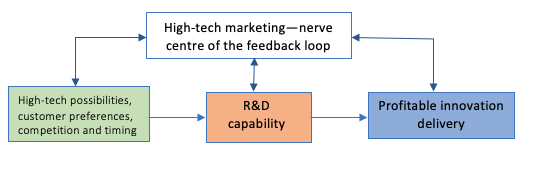
High-tech marketing as a nerve center of the feedback loop

Unlike the conventional approach of promoting and advertising or reorganizing the sales force, high-tech marketing begins with assessing technology possibilities for profitably delivering innovations. Hence, high-tech marketing becomes a nerve center in coordinating three building blocks of high-tech business:

  1. Profitable technology possibilities—one of the core tasks of the marketing team is to scan and assess technology possibilities that could be harnessed in the profitable delivery of innovations. For example, Steve Jobs detected possibilities in Xerox’s discarded graphical user interface technologies. Similarly, Sony’s management saw potential in Bell Lab’s invention of the Transistor and Electronic Image Sensor. 
  2. R&D capability—R&D capability should be aligned and tasked with advancing and developing technologies and innovating products so that customers would find better alternatives than ever before in getting target jobs done.  
  3. Profitable innovation delivery possibilities—high-tech marketing aligns and directs product and competition strategy so that innovations can be profitably delivered and sustained in the competitive space. Besides, high-tech marketing also considers gaining market power by leveraging technology possibilities, winning competition, and crafting product evolution strategy.

Although R&D capability plays a vital role in leveraging technology possibilities, high-tech marketing sits at the center of the feedback loop for developing and directing three major organizational building blocks: (i) technology, customer preferences, and competition assessment, (ii) R&D capability, and (iii) delivery of innovations in the market. 
High-tech marketing is a process comprising of seven steps.
High-tech marketing is a process comprising seven steps.


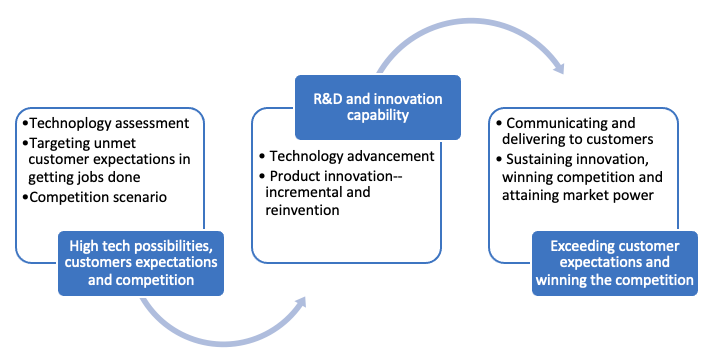
High-tech innovation delivering process

Of course, technology triggers a high-tech innovation journey; marketing plays the central role. As shown, high-tech marketing controls the process, which is comprised of three major building blocks.

  • the process begins with technology assessment, targeting desired customer expectations in Getting jobs done better and assessing the competition. Selecting the suitable timing is also very important in high-tech marketing. For example, although many .com failed in the video-on-demand innovation journey, Netflix succeeded because of the proper entry timing. 
  • the next step has been guiding R&D for technology advancement and Product innovation. For example, Steve Jobs focused on guiding the engineering team about what to develop. Of course, the ‘how’ part of R&D is left with scientists and engineers.   
  • the 3rd step is about delivering innovation, sustaining and winning competition, and gaining market power by leveraging technology possibilities.

Seven steps process of high-tech marketing

Step 1: Detecting latent high-tech potential for creating scale, scope, and positive externality effects

As high-tech innovations begin the journey in a primitive form at a loss, the challenge of high-tech marketing has been detecting the latent scale, scope, and positive externality possibilities. For turning loss-making beginning into a profit, sustaining in the competition space, and winning the innovation race, prudent assessment of these three parameters is vital.

Step 2: Figuring out the scope in helping customers to get their jobs done better

Upon detecting the technology potential of creating the required scale, scope, and positive externalities, high-tech marketing faces the challenge of finding suitable customers’ jobs that can be done better. How much customers will be willing to pay and how many of them are there need to be assessed. Besides, how far scale, scope, and positive externalities need to be harnessed to make them customers should also be estimated.  Such an exercise should lead to an assessment of profitability.

Step 3: Assessing the technology readiness and timing for making an entry

Assessing technology readiness, whether for reinvention or incremental innovation, is an essential exercise of high-tech marketing. Besides, timing plays an important role, primarily for leveraging positive externalities.

Step 4: Evolving products through incremental innovation and reinvention

As high-tech innovations begin the journey at a loss, marketing should focus on the evolution of products through technological advancement to better meet consumer preferences and synchronize with externalities.

Step 5: Segmenting the market and communicating the value to customers

Of course, value must be communicated. In this case, additional means such as fermium need to be figured out in addition to the advertisement so that customers can try to know the unique value. 

Step 6: Extracting profitable revenue by exceeding the expectations of customers

Extracting profitable revenue itself may demand innovation and optimum pricing. For example, the three-party business model has played a vital role in Google, Facebook, and many other Internet success stories.

Step 7: Sustaining the innovation, winning the competition, and gaining market power

Innovation must be sustained in the competition space. Besides, the competition must be won to attain price-setting capability by showing superior performance in the innovation race. Hence, high-tech marketing must strive to achieve it.

As explained, profiting from high-tech innovation is far more than having technology and R&D capability. Hence, high-tech marketing plays a vital role in detecting the possibility, orchestrating the game, and coordinating multiple units to respond in a coordinated way.    

Examples of notable attributes of high-tech marketing

  • Netflix—customers’ habits of watching video clips and externalities like Internet infrastructure played a vital role in Netflix’s take-off. Marketing decisions about timing were crucial in harnessing technology possibilities in delivering videos as digital content.    
  • Microsoft—Microsoft was not the first to develop an operating system for personal computers, word processors, and spreadsheet software applications. Microsoft was not also at the top of computer technology capability. Despite this, Microsoft became highly successful due to its marketing acumen in winning the competition race.  
  • Apple—yes, Steve Jobs did not have a technology background. Despite this, he was highly successful in leveraging technology possibilities.  The underlying reason was Steve’s intuitive, brilliant marketing role in linking technology possibilities, R&D, and winning competition in delivering innovations. 
  • Uber–despite pumping billions of dollars in subsidies, Uber is an apparent failure story. The underlying reason has been the non-scalability of its app-based innovations. Before pumping billions in subsidies, Uber’s marketing team had to do better marketing jobs in assessing the scale, scope, and externalities of the technology possibilities they targeted to leverage. 
  • Sony—Sony’s radio or digital camera did not emerge as a profit-making business. Instead, they started the journey at a loss. Besides, incumbent radio and camera makers avoided reinventing their innovation as, unlike Sony, they failed to detect the latent potential of the underlying technology cores.

Summing up

Technology possibilities, great ideas, unserved customer requirements, R&D capability, seed financing, and complementary assets like manufacturing and logistics are not sufficient to profit from high technology. To leverage the possibility, marketing plays a vital role. However, unlike conventional marketing, high-tech marketing becomes the nerve center in detecting, assessing, envisioning, strategizing, and communicating to create and position in a new market. Besides in addition to people working in the marketing department, CEOs, R&D managers, salespeople, and many others play a bigger role in high-tech marketing—detecting the latent potential and creating and positioning in a new market by leveraging rapidly growing technology possibilities.  
Enlighten others

Subscribe

Subscribe now to our newsletter

You May Also Like

Which Type of R&D Should Be the Focus of Bangladesh and many other less developed countries?
View Post
  • 3 min

Types of Research and Development

Bangladesh can turn its high-tech parks into engines of prosperity by housing R&D wings of local producers
View Post
  • 3 min

Bangladesh’s High-Tech Park Owe: Can Low-Tech Be a Solution?

How speculative markets and continuous storytelling combine to decouple asset valuation from delivery of innovations
View Post
  • 8 min

The Rise of Muskism Turning Musk a Trillionaire: Narrative-Driven Capital Accumulation and the Illusion of Disruptive Innovation

Leave a Reply Cancel reply

Your email address will not be published. Required fields are marked *

Subscribe

Subscribe now to our newsletter

Principles

  • Economics of Technology
  • Innovation Economics
  • Technology & Innovation Policy

History & Observations

  • Technology History
  • Innovation History
  • Strategy & Policy in retrospect
  • Entrepreneurs & Innovators
  • Startups & Corporations
  • Patents & Publications
  • Design & Redesign Thinking

About Us

  • Who we are
  • What we deliver
  • Genesis
  • Mission
  • Scope
  • Editorial & Advisory Board
THE WAVES
  • Contact
  • Advertise

Input your search keywords and press Enter.