
THE WAVES
  • Home
  • News
    • Recent Updates
    • Weekly Newsletter
    • Monthly Newsletter
    • Quarterly Newsletter
  • Topics
    • Technology
      • Internet
      • AR/VR & Digital twins
      • Robotics
      • AI & Data Analytics
      • IoT & Wearable
      • Blockchain
      • Computing
      • Sensors & Perception
      • 3D Printing
      • Energy Tech
      • Space
      • Gadgets
    • Transformation
      • Education
      • Health
      • Transportation
      • Farming
      • Energy
      • Security
      • Mining & Blue Economy
      • Food & Living
      • Communication
      • Entertainment
      • Manufacturing
      • Work & Management
      • Public Service
    • Startups
      • Culture
      • Country
      • New Entry
      • Accelerators
      • Incubators
      • Death Valley
      • Investments
      • Exit & IPO
      • Valuation & Financing
      • Idea & IP
    • Education & Research
      • School
      • University
      • Academic Research
      • Corporate Research
      • Public-funded Research
      • Economics of Innovation
      • Growth Economics
      • Training
      • Publications
      • Patents & IP
    • Industrial Revolutions
      • Future of Work
      • Sustainable Development
      • Smart Manufacturing
      • Job Transformation
      • Industry Transformation
      • Competition & Monopoly
      • National Response
      • Education & Skills
      • Social Change
    • Investment & Review
      • Public
      • Corporate
      • Venture Capital
      • Capital Market
      • Philanthropy
      • Personality
    • Inventions
    • Automation
  • Strategy
    • Value Proposition
      • Product
      • Process
      • Sustainability Goals
      • Business Model
      • Complementary
      • Externality
    • Innovation
      • Disruptive Innovation
      • Incremented Innovation
      • Sustaining
      • Schumpeter’s Creative Destruction
      • Redesign for Winning
    • Competition
      • Leading
      • Following
      • Blue Ocean
      • Monopolisation
      • Porter’s Five Forces
      • Business Cycle
    • Intangible Assets
      • Human Capital
      • R&D Management
      • Tripple Helix
      • Intellectual Property
      • Productive Knowledge
      • Technology Managment
    • Competence
      • Organization Agility
      • Innovation Culture
      • Infrastructure
      • R&D facility
      • Great by Choice
      • Build to Last
      • Good to Great
    • Technology Acquisition
      • Scientific discovery
      • Invention
      • Fusion
      • Adaptation & Refinement
      • Licensing
      • Start-up acquisition
  • Policy
    • Technology Development
    • Industry
    • Innovation Diffusion
    • Jobs, Privacy & Security
    • Regulation & Law
    • Sustainability
    • Equity & Inclusiveness
    • Climate Change
    • Environment
  • Opinion
    • Opinion
  • Megatrends
    • Individual Preferences
    • Planet and Society
    • Technology
    • Political Economy
    • Market Power & Monopoly
    • Globalisation
    • Schumpeter’s creative destruction
    • Startups & VC
    • Human Role in Work
    • Value of Natural Resources
    • Patents & Ideas for Redesign
  • Publication
    • Case Studies
    • Magazine
    • Books
    • Reports
    • White Papers
    • Journals
THE WAVES In-depth investigation on Technology, Society, and Policy dynamics for interpreting the past as well as present, and predicting the future so that success rate of pursuing ideas, start-ups, and innovation economy increases.

Technology, Society and Policy

Winning and Losing in Reinvention Race : keeps unfolding: --making America’s innovation bucket leaky, creating prosperity out of reinvention, and turning invention successes transitory
THE WAVES
  • Home
  • News
    • Recent Updates
    • Weekly Newsletter
    • Monthly Newsletter
    • Quarterly Newsletter
  • Topics
    • Technology
      • Internet
      • AR/VR & Digital twins
      • Robotics
      • AI & Data Analytics
      • IoT & Wearable
      • Blockchain
      • Computing
      • Sensors & Perception
      • 3D Printing
      • Energy Tech
      • Space
      • Gadgets
    • Transformation
      • Education
      • Health
      • Transportation
      • Farming
      • Energy
      • Security
      • Mining & Blue Economy
      • Food & Living
      • Communication
      • Entertainment
      • Manufacturing
      • Work & Management
      • Public Service
    • Startups
      • Culture
      • Country
      • New Entry
      • Accelerators
      • Incubators
      • Death Valley
      • Investments
      • Exit & IPO
      • Valuation & Financing
      • Idea & IP
    • Education & Research
      • School
      • University
      • Academic Research
      • Corporate Research
      • Public-funded Research
      • Economics of Innovation
      • Growth Economics
      • Training
      • Publications
      • Patents & IP
    • Industrial Revolutions
      • Future of Work
      • Sustainable Development
      • Smart Manufacturing
      • Job Transformation
      • Industry Transformation
      • Competition & Monopoly
      • National Response
      • Education & Skills
      • Social Change
    • Investment & Review
      • Public
      • Corporate
      • Venture Capital
      • Capital Market
      • Philanthropy
      • Personality
    • Inventions
    • Automation
  • Strategy
    • Value Proposition
      • Product
      • Process
      • Sustainability Goals
      • Business Model
      • Complementary
      • Externality
    • Innovation
      • Disruptive Innovation
      • Incremented Innovation
      • Sustaining
      • Schumpeter’s Creative Destruction
      • Redesign for Winning
    • Competition
      • Leading
      • Following
      • Blue Ocean
      • Monopolisation
      • Porter’s Five Forces
      • Business Cycle
    • Intangible Assets
      • Human Capital
      • R&D Management
      • Tripple Helix
      • Intellectual Property
      • Productive Knowledge
      • Technology Managment
    • Competence
      • Organization Agility
      • Innovation Culture
      • Infrastructure
      • R&D facility
      • Great by Choice
      • Build to Last
      • Good to Great
    • Technology Acquisition
      • Scientific discovery
      • Invention
      • Fusion
      • Adaptation & Refinement
      • Licensing
      • Start-up acquisition
  • Policy
    • Technology Development
    • Industry
    • Innovation Diffusion
    • Jobs, Privacy & Security
    • Regulation & Law
    • Sustainability
    • Equity & Inclusiveness
    • Climate Change
    • Environment
  • Opinion
    • Opinion
  • Megatrends
    • Individual Preferences
    • Planet and Society
    • Technology
    • Political Economy
    • Market Power & Monopoly
    • Globalisation
    • Schumpeter’s creative destruction
    • Startups & VC
    • Human Role in Work
    • Value of Natural Resources
    • Patents & Ideas for Redesign
  • Publication
    • Case Studies
    • Magazine
    • Books
    • Reports
    • White Papers
    • Journals

  • Editor's Pick
  • Startups & VC

Startup Growth Suffers from Deception: Collapsing VC-backed unicorns!  

Instead of subsidy led push, the focus should be on unlocking the hidden potential to turn the foal into a race horse for winning the battle

  • Md. Rokonuzzaman
  • Created: July 9, 2024
  • Last updated: December 26, 2024
Startup growth has been suffering from deception as VCs have pumped tons of money to promote premature reinventions in taking over the mainstream market of matured products

In the age of digital disruption, are investors caught in deceptive startup growth? There seems to be an unhealthy race among the Venture capital funds (VCs) for fueling unsustainable startup growth. VCs are in the business of raising funds from net-worth individuals and institutions and investing them in Startups to collect commission and success fees. For tempting investors, they show past examples of exponential growth of valuation of startups such as Amazon, Apple, Microsoft, Google, Netflix, Facebook, Nvidia, TSMC, and a few more. Most importantly, they cite valuation examples of recent Unicorns—startups having more than a billion-dollar valuation. However, most of those loss-making unicorns suffer from sudden valuation fall, leading to collapse. Surprisingly, despite revenue growth and loss reduction, such a valuation avalanche has been taking place in the VC-backed startup space, raising concerns about deceptive startup growth.

For example, the valuation of India’s microblogging startup Koo came down from $5 billion to zero within three years (Economic Times of India). Similarly, once valued at $22 billion, HSBC recently estimated the valuation of EdTech startup icon Byju to zero (Source: TECHNASIA). Such a reality raises a vital question: are VCs fueling misleading startup growth? Subsequent questions are: why and how are VCs misleading startup growth?

Unicorn Situation in India—giving a deceptive startup growth scenario

In 2022, among 74 Indian unicorns, 55 were incurring losses–the remaining 19 were just operationally profitable. To generate $13.3 billion aggregated revenue, these unicorns incurred $18 billion in expenditure and $2 billion in advertisement (source: top 200 Financial Index Report 2023). Hence, it’s evident that once VCs stop giving subsidies, their staggering valuation suddenly disappears, and unicorns collapse.   

Global inflated startup growth—the age of unicorns is over!

In 2024, The Economist published an article titled: “The age of unicorn is over.” Despite propelling the combined market value of Alphabet, Amazon, Apple, Meta, and Microsoft by 70% to over $10trn, from the start of 2023 to the middle of 2024, venture capital fund invested only $170b in the USA in 2023–down by half from 2021 (according to PitchBook). Such a contrast raises a critical question: despite staggering growth of market capitalization in the secondary market, why are VCs not increasing funding to create future tech giants?  

Wrong thesis of creating scale effect

Startups pursue taking over the mainstream market of incumbent products and creating new markets by reinventing matured products by changing the technology core. Hence, startups are supposed to scale up rapidly. However, despite the uniqueness of digital technology, their reinventions have not shown up as far better alternatives. For example, despite the possibility, digitizing medical images and developing AI tools to inspect them have yet to become better alternatives than expert radiologists. Similarly, online education has yet to be a better alternative to physical campus-based education. Hence, the mainstream market still rejects the initial emergence of reinventions made through the digital technology core.

However, to show the scale effect, venture capital fund managers have come up with a massive subsidy that has led to the push for premature reinventions. Besides, they take into consideration increasing valuation based on subsidy-based customer acquisitions. As a result, although valuation has increased, those startups cannot sustain their operations. Hence, once the subsidy is withdrawn, those high-growth startups face an inevitable reality—bankruptcy. Consequentially, VC-backed startup growth has been caught up in the wrong thesis of creating a scale effect.

Why and how have VCs backed deceptive startup growth

Due to ignorance, maliciousness, or both, venture capital fund managers have been fueling deceptive startup growth. Here is further detail:

  • Selling temptation of high capital growth—for raising funds from high-net-worth institutions and individuals, VC fund managers created the temptation of rapidly growing investment by investing in startups pursuing digital possibilities. On the other hand, by developing and demonstrating minimum viable products (MVPs) out of digital technologies, startups created the belief that those MVPs would take over the mainstream market of matured products and develop new markets. Hence, by promoting those premature products,  VC managers succeeded in raising funds. For example, in 2016, SoftBank secured a $45 billion commitment from Saudi Prince for its $100 billion tech funding. Unfortunately, in 2023, the Saudi Wealth fund got a $16 billion hit from SoftBank tech fund.     
  • Incorrect understudying of digital possibilities—initial demonstration of digital options created the impression of imminent takeover of the mainstream market of matured products. For example, Elon Musk predicted in 2015 that self-driving cars would be mass-adopted within two years. Similarly, experts predicted in 2016 that radiologists would be obsolete within five years.  
  • Deceptive promotion of digital disruption—upon demonstrating initial success, startups started prematurely promoting digital disruption in various products, from EdTech and autonomous Driving to Digital Health. Due to ignorance, maliciousness, or both, VC fund managers began believing in the deceptive promotion of digital disruption. Consequentially, they started pumping tons of money into pushing premature digital alternatives in the mainstream market of matured products.      
  • Earning commission—the immediate incentive for the VC fund managers has been to earn a certain percentage (say 2%) commission on the invested fund. Hence, the race started among the VCs to pump tons of money to startups to capture the growing market shares through subsidies.   
  • Pocketing success fees by passing hot potatoes—passing shareholding of loss-making startups at an inflated valuation to follower VCs has become a lucrative exercise to earn success fees for existing.

By pursuing Reinvention, startups offer opportunities to find high-growth firms. However, their reinventions must grow as Creative waves of destruction—taking over the mainstream market and creating new ones due to offering higher quality at less cost. However, to attain such success, the primitive emergence of startup reinventions must be grown through a Flow of Ideas. Initially, those reinventions are like foals of racehorses. They have hidden potential. Hence, instead of pushing foals with VC-backed subsidies to create deceptive scale effects for startup growth, the focus should be on developing the hidden potential and pursuing a suitable attack strategy.
Enlighten others

Subscribe

Subscribe now to our newsletter

You May Also Like

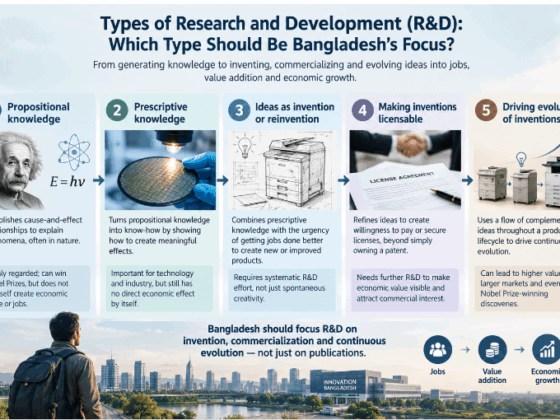
Which Type of R&D Should Be the Focus of Bangladesh and many other less developed countries?
View Post
  • 3 min

Types of Research and Development

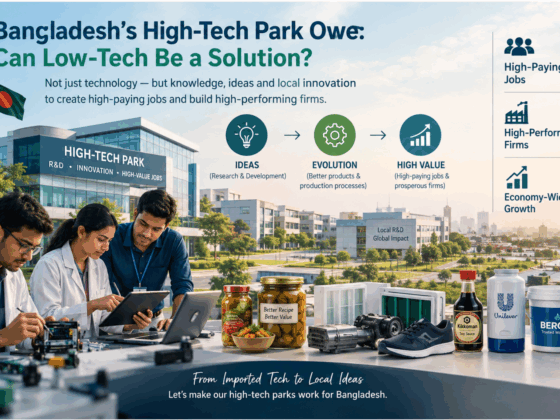
Bangladesh can turn its high-tech parks into engines of prosperity by housing R&D wings of local producers
View Post
  • 3 min

Bangladesh’s High-Tech Park Owe: Can Low-Tech Be a Solution?

How speculative markets and continuous storytelling combine to decouple asset valuation from delivery of innovations
View Post
  • 8 min

The Rise of Muskism Turning Musk a Trillionaire: Narrative-Driven Capital Accumulation and the Illusion of Disruptive Innovation

Leave a Reply Cancel reply

Your email address will not be published. Required fields are marked *

Subscribe

Subscribe now to our newsletter

Principles

  • Economics of Technology
  • Innovation Economics
  • Technology & Innovation Policy

History & Observations

  • Technology History
  • Innovation History
  • Strategy & Policy in retrospect
  • Entrepreneurs & Innovators
  • Startups & Corporations
  • Patents & Publications
  • Design & Redesign Thinking

About Us

  • Who we are
  • What we deliver
  • Genesis
  • Mission
  • Scope
  • Editorial & Advisory Board
THE WAVES
  • Contact
  • Advertise

Input your search keywords and press Enter.