
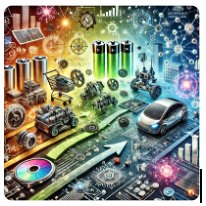
Technological innovations frequently begin with a narrow and specific purpose, but their potential returns can expand in unexpected ways, causing uncertainty and complicating decision-making. This uncertainty is often rooted in the multidimensional implications or spillover effects that technologies create—effects that can influence not only their direct applications but also the broader economic and social landscapes. As these possibilities unfold, their implications are often difficult to predict, and technology spillover effects can be both positive and negative, further amplifying the uncertainty. This makes investment decisions and public support for emerging technologies difficult to justify and mobilize.
In the early stages of technology development, it is common to focus on a single product or application. However, the full potential of a technology is rarely confined to a single use. It can evolve and spill over into multiple sectors, creating new opportunities that were not anticipated at the outset. These developments make it challenging to assess both the financial returns from a loss-making beginning and the social implications of an emerging technology, especially when the technology is still in its nascent stages. This uncertainty is particularly relevant when it comes to government policy and investment decisions.
The Case of Lithium-Ion Batteries: A Story of Evolving Technology Spillover Effects
One clear example of how technological possibilities unfold in unpredictable ways is the development of lithium-ion batteries. Initially, these batteries were designed with a specific purpose in mind: to provide high-density storage for portable digital cameras, subsequently mobile phones. However, the potential of lithium-ion technology extended beyond that initial purpose, eventually creating significant spillover effects that were difficult to predict at the outset.
At the time of its introduction, lithium-ion technology was seen as a promising but narrowly defined Innovation. In the early stages, concerns were raised about its environmental impact, particularly in terms of contributing to e-waste. The batteries, although essential for powering portable electronics, raised alarms about their disposal and recycling. These negative implications overshadowed the potential benefits of the technology, and the broader social implications were largely ignored.
However, as the technology matured and was adopted for electric vehicles (EVs), its potential to contribute to climate change mitigation became more apparent. The spillover effects of lithium-ion batteries shifted from negative environmental impacts to positive ones, with the technology now seen as a critical component in the shift to sustainable energy. Governments around the world recognized the potential of lithium-ion batteries in driving the electric vehicle revolution and addressing the climate crisis, leading to substantial policy support and incentives for their use.
This unfolding of technological possibilities—where a narrow initial application transformed into a broader environmental solution—had significant economic implications. Early investments in lithium-ion battery technology, which might have seemed risky or speculative at the time, have proven to be immensely profitable as the technology’s spilled-over applications created new markets. These developments demonstrate how the potential return on a technology is not limited to its original use but can expand and evolve over time.
The Evolution of LCD Technology: From Niche to Mainstream
Another example of uncertainty and spillover effects in technology development can be seen in the history of LCD (Liquid Crystal Display) technology. In the 1980s, LCDs were primarily used in simple applications such as seven-segment displays for calculators or watches. At that point, the potential for LCD technology was not particularly clear, and its applications seemed limited. However, by the 1990s, LCD technology underwent a significant transformation, emerging as a high-quality display solution for mobile phones and later for flat-panel TVs.
The growth of LCD technology was not only rapid but also unpredictable. It evolved to offer higher resolutions, lower production costs, and better energy efficiency, positioning it as a superior alternative to plasma technology for large-sized flat-panel displays. The spillover effects of LCD technology were evident not only in its transformation into a mainstream consumer product but also in its adoption across industries. For instance, the increased demand for high-resolution displays led to improvements in manufacturing processes, supply chains, and even the development of new materials.
Yet, much like lithium-ion batteries, LCD technology’s journey was not entirely smooth. The uncertainty surrounding LCD’s future possibilities in the 1980s could have led to hesitation among investors, especially given the niche applications at the time. However, as its spillover effects unfolded—leading to its dominance in multiple markets—the initial uncertainty turned into certainty, and the technology became a cornerstone of the consumer electronics industry.
Technologies Stuck in Limbo: Autonomous Vehicles and Household Robots
While many technologies experience positive spillover effects, not all innovations enjoy this kind of growth. Technologies like autonomous vehicles and household robots, which initially promised to revolutionize entire industries, are now facing uncertainty and slowed progress. These technologies are still far from achieving their transformative potential, leading to losses in investment and frustration among stakeholders.
Autonomous vehicles were expected to bring about a fundamental shift in the transportation sector, reducing traffic accidents, lowering emissions, and transforming urban planning. However, despite years of development, the technology has yet to achieve the level of reliability and cost-effectiveness required to drive widespread adoption. Similarly, household robots, which were envisioned as capable of taking over mundane and dangerous tasks, have not yet been able to meet expectations in terms of performance, cost, or user acceptance.
The failure of these technologies to live up to their early promises creates uncertainty around their future. Investors who poured money into autonomous vehicles and robotics Startups in the early 2000s are now grappling with uncertainty about whether their investments will pay off. This situation highlights the difficulty of predicting spillover effects and unfolding possibilities in technology, particularly when a transformative impact is expected but not yet realized.
The Uncertainty of Technological Development: A Challenge for Decision-Makers
The examples of lithium-ion batteries, LCD technology, and autonomous vehicles illustrate the unpredictable nature of technological progress and its spillover effects. In each case, the full potential of the technology was not clear at the outset, and its economic and social implications unfolded over time in ways that were difficult to predict. This uncertainty adds a layer of complexity to investment decisions and policy formulation, making it challenging to justify support for emerging technologies.
The multidimensional implications of technologies—spanning economic, social, and environmental factors—make it difficult to assess their true value in the early stages. Moreover, the spillover effects of a technology can be both positive and negative, which further complicates decision-making. The uncertainty surrounding technological possibilities creates a risk premium that investors must account for, while governments must consider the potential public benefits and costs when supporting or regulating new innovations.
Conclusion
Technological advancements are often characterized by uncertainty, unpredictability, and unfolding possibilities that make it difficult to assess their full potential. The spillover effects of these technologies can shape not only their direct applications but also broader economic and social landscapes. While some technologies, like lithium-ion batteries and LCDs, have produced significant positive spillover effects, others, like autonomous vehicles and household robots, are still struggling to achieve their promised transformations. As a result, the decision-making process surrounding technology investment and public policy must account for this uncertainty, making it a complex and challenging task.
Key takeaways about technology spillover effects:
- Technological Potential Expands Over Time: Technologies often start with a narrow application, but their full potential is not immediately clear. Over time, they can spill over into multiple sectors, creating unexpected opportunities and challenges.
- Unpredictability of technology Spillover Effects: The spillover effects of technologies—both positive and negative—are difficult to predict. These effects can significantly influence not only the technology’s market success but also broader economic and social outcomes.
- Investment Uncertainty: The evolving nature of technology makes it challenging for investors to assess potential returns in the early stages. The risk associated with unpredictable outcomes often creates hesitation, especially when spillover effects are uncertain or negative.
- Government Policy Challenges: Governments face difficulties in justifying support for emerging technologies because their broader implications and societal impacts are hard to foresee. However, early-stage support can be crucial if positive spillover effects eventually emerge.
- Technologies Can Fail to Live Up to Expectations: Not all technologies experience continuous growth. Innovations like autonomous vehicles and household robots highlight the risks of technologies that fail to meet their expected potential, resulting in losses and uncertainty for both investors and policymakers.
Research questions about technology spillover effects:
- How do early-stage technological innovations influence long-term economic growth, and what role do spillover effects play in this process?
- This question explores the connection between initial technology applications and their broader economic impacts over time, focusing on both positive and negative spillover effects.
- What factors contribute to the unpredictability of spillover effects in emerging technologies, and how can these be modeled or mitigated in decision-making?
- This question seeks to identify the elements that make spillover effects difficult to predict, exploring potential frameworks or methods to assess and manage these uncertainties.
- What are the key determinants that influence the successful transition of a technology from niche applications to widespread adoption across industries?
- Focusing on technologies like LCDs and lithium-ion batteries, this question examines what factors allow a technology to move beyond its initial application and achieve broader commercial success.
- How do negative spillover effects, such as environmental damage or market disruptions, affect the long-term viability and public support of a technology?
- This question addresses the challenge of managing technologies that may have adverse societal or environmental consequences, and how these effects impact their sustained development.
- What are the critical barriers to the commercialization of high-potential technologies, such as autonomous vehicles and household robots, and how can these barriers be overcome?
- This research question investigates the obstacles that prevent certain transformative technologies from achieving their promised impact, focusing on technical, regulatory, and market-related barriers.

