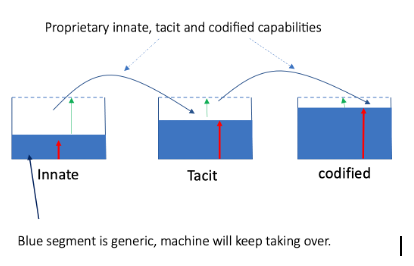
The future of work is a concern. Of course, we want jobs to earn a living and to make a contribution. We also want jobs that are not dull, dirty, and dangerous. More specifically, we want desk jobs instead of working in factories or outdoors. Hence, the human race started developing robots to perform dull, dirty, and dangerous tasks. Those robots are already in operation in factories. We also do not like repetitive, boring jobs. Therefore, we developed automation. Robots and automation kept taking over undesirable tasks, while white-collar jobs requiring knowledge for humans kept growing. Many of those white-collar jobs require knowledge of what we earn through education and training. Unfortunately, the situation is changing. Automation is taking over white-collar jobs. On the other hand, our efforts to develop robots to take over dull jobs are not making progress. Hence, dull jobs for human is getting a reality.
Disappearing middle layers jobs
Job loss concern due to technology uprising is not new. Although the Luddites were wrong, we are losing jobs to technology. For example, Banks no longer employ clerks to log every transaction in ledgers with pens. According to the US census bureau, the share of employment requiring middle-skill has decreased from 75% in 1980 to 68% in 2009. On the other hand, the low-skilled share has grown from 13% to 17% during the same period. The high-skill segment gained the remaining 3%. Such numbers indicate that white-collar clerical, administrative, accounting, and sales job opportunities are declining. Blue-collar production, craft, and operative occupations jobs requiring middle skill are also declining.
There is also another effect—juniorization. Middle management jobs for seniors are disappearing due to juniorization. To reduce salary expenditure, organizations also replace senior middle-layer positions like salespeople with younger, less expensive talent. Perhaps, due to increasing automation, Tacit Knowledge and skills earned through experience are losing demand.
The comparative advantage between humans and robots—whom to assign tasks?
In task allocation, there has been an ongoing comparison between man and machine capabilities for better quality at a lower cost. Hence, increasingly we are building better machines to increase their comparative advantage. Unlike human beings, machines or robots are made of inanimate materials. Technology advancement allows us to make machines eligible for executing tasks. Once they become capable and less costly than humans in performing certain tasks, we assign those tasks to machines. The continued advancement of information technology has enabled innovators to build machine capability to automate tasks that require mostly Codified Knowledge and skill. Of course, such machine capabilities are in the form of software, searchable database, and communication. For example, we spend years in schools qualifying to learn how to solve differential equations or calculate the trajectory of a projected object. Still, developing software to perform those tasks accurately is quite easy.
The continued progression of software-based automation has led to the continued erosion of the comparative advantage of middle-layer jobs. As the focus is on getting those jobs done at less cost, machines or software is taking over those tasks.
On the other hand, jobs at the bottom layer requiring far less codified knowledge and skill face different realities. We often get impressed by observing computers exhibiting adult-level performance on intelligence tests or playing checkers. But it’s extremely difficult or impossible to give them the skills of a one-year-old when it comes to perception and mobility. Those one-year-olds rely on innate abilities as opposed to codified capabilities earned through education and training. Unlike middle-layer desk jobs, low-level dull jobs require high-level innate abilities like sensing, perception, and mobility. Hence, we face a high barrier to building robots to take over dull jobs from humans.
Innate abilities are creating barriers to robots taking over dull jobs from human
By birth, we have 52 innate abilities in four categories: i. Cognitive, ii, Physical, iii. Sensory and iv. Psychomotor. Detailed analysis indicates that many of the tasks, often termed as low-skilled ones, demand the application of many of those of innate abilities. It happens to be that we apply those abilities subconsciously. Due to it, we do not understand their roles. But designers have found them extremely difficult, or impossible, to build them in machines to make them eligible for low-skilled tasks. Hence, the high complexity of imitating human-like innate abilities in robots is leaving dull jobs for humans.
White-collar jobs– easy to automate
White-collar desk jobs demand codified knowledge and skill. For example, an accountant needs to know how to record numbers, perform analysis, and generate reports on financial matters. Similarly, human resource management professionals need to perform tasks with the help of knowledge and skill acquired in universities. Over the years, software firms have developed applications to automate the execution of the needed knowledge and skills. Moreover, as the cost of copying software is zero, and software could be shared over the Internet, it can be deployed to numerous organizations without facing many difficulties. Hence, white-collar jobs requiring mostly codified knowledge and skills are rapidly disappearing. On the other hand, the searchable database and knowledge management systems are also automating Tacit capability earned through job experience.
Dull jobs demand innate abilities—suitable for human
Many jobs that appear to be dull, routine, or boring often require high-level innate abilities. For example, a home health aide requires the application of 17 innate abilities. Some of them are far vision, fluency of ideas, and selective attention. We often do not sharpen, let alone build them in offering training to graduate future home health aides. We instead focus on knowledge and skills. But in the absence of those innate abilities, robots having the capability of automated application of needed knowledge and skill do not qualify for those jobs.
For example, Honda’s ASIMO failed to qualify for the job of offering elderly care services as engineers found it quite difficult or impossible to build them in ASIMO. Similarly, upon investing more than $80 billion in R & D, Silicon Valley High-tech firms find their autonomous vehicles unfit for the road, as they lack the needed human drivers’ innate abilities.
Dead Robots redefine the future of work
Recently, The Financial Times published an article on Robots—“Dead robots raise questions on how far home technology has come.” They have investigated three robots that failed to roll out in the market.
The first one is Kuri of Mayfield Robotics. Despite having many high-end technology capabilities like touch sensors, cameras, gestural mechanics, microphones, heart lights, speakers, charging pads, and mapping sensors, Bosch killed it before rolling it out. The underlying reason is that the company could not figure out how to justify its robot’s cost and functionalities to succeed.
The next dead robot is Jibo–the world’s first social robot for the home. However, failure in developing robots to perform household chores is not new. For example, in the 1980s, Atari failed to make an acceptably functional robot, although it accomplished fetching a drink for its owner from the fridge.
The next dead robot is Honda’s ASIMO. Upon conducting R&D over 32 years at an approximate cost of $500 million, Honda management decided to stop the program in 2018. Among accomplishments, ASIMO did well in showing spectacular performances in conducting a symphony orchestra and playing soccer with visiting the US president. But ASIMO failed to qualify for elderly care jobs. Primarily, the Honda R&D team found it difficult or impossible to build needed human-like innate abilities in ASIMO. Moreover, in addition to ASIMO’s failure, many other Humanoid robots are failing to qualify for household or nursing care jobs. Hence, dull jobs for humans as robots fail to take them over.
Automation takes office jobs, and Robots fail to take over dull jobs
It’s a disappointment in need. At the end of the office work, we hardly enjoy driving back home. Upon reaching home, we do not enjoy cleaning and preparing food. Instead, we want robot home aides to take over those jobs. We also want them to look after kids, offer needed services to elderly parents, and take care of us when we are sick. Unfortunately, the reality is the opposite.
Unlike in the past, robots do not take over dull, dirty, and dangerous jobs and offer desk jobs for us. Instead, dead robots give us the message that dull jobs for human beings, at least for the near future. On the other hand, office jobs are for software agents or bots. Such an unfolding reality raises the question about the role of education and training in preparing the workforce for responding to the future of work dynamics.
Related articles:
Job Polarization – technology shaping future of work
Future of Work – persistent uncertainty
Future of Work from Home – Robotic process automation takes over
Honda’s ASIMO ends lifecycle —before causing Creative Destruction