In 1997, in his book “Innovator’s Dilemma,” Prof. Clayton explained the reality of suffering from the sudden disappearance of demand for mature products, causing disruption to the businesses of incumbent Innovation leaders. It happens due to the rise of alternative products around emerging technology cores. He termed them Disruptive innovation. For example, digital cameras caused a sudden disruption to film cameras, and Transistor radios had a similar effect on their vacuum tube-based, mature counterparts. Hence, he termed such innovations “disruptive innovations.” However, at the root of his disruptive innovations has been Creative Destruction caused by Reinvention. Although Carl Marks and Schumpeter referred to such a phenomenon long before, unfortunately, Prof. Clayton did not give credit to them. Besides, why innovators suffer from a dilemma deserves further clarity.
Additionally, instead of using the term “creative destruction,” he opted for “disruptive innovation.” Furthermore, he did not dig into technology uncertainty issues, creating innovator’s dilemma. Hence, this article takes a deeper look at the perspective of technological uncertainty to identify the causes behind the innovator’s dilemma of pursuing creative destruction.
Genesis of Creative Destruction
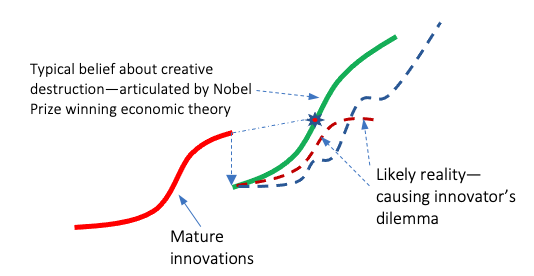
All successful inventions and products have evolved through an episodic form. In each episode, they grow through incremental advancements around the same core technology, following a typical S-curve-like trajectory. At the maturity of the technology core, incremental advancements in quality and cost cease. Consequently, innovators are encouraged to reinvent them by replacing mature technology cores with emerging ones. If the emerging technology core is sufficiently scalable, reinvented alternatives emerge as a far bigger and better S-curve-like life cycle. As a result, the demand for products around mature technology cores suffers from destruction, generating an effect called creative destruction.
For example, the LED light bulb has been a reinvention of the filament light bulb, as it replaces the filament with a semiconductor junction. As the LED light bulb has emerged as a better alternative, the demand for filament light bulbs has suffered from destruction. And light bulb makers who could not successfully switch to LED suffered from disruption. Hence, at the core of the success of creative destruction has been the technology core. The underlying reason for the innovator’s dilemma has been the relative economics of competing technology cores and their life cycles.
Characteristics of Creative Destruction
Despite unleashing the creative destruction effect in early adulthood, regardless of greatness, all reinventions of mature innovations emerge in a primitive form, as inferior alternatives to the mainstream market of mature innovations. Besides, their growth in performance and quality depends on the progression of unproven emerging technology cores. Furthermore, due to its uniqueness, although the non-consumption market shows an appetite, its size in childhood is tiny.
Innovator’s Dilemma—Mentioned by Prof. Clayton
As companies depend on resources offered by customers and investors, management focuses on incrementally advancing mature innovations. The underlying reason has been that mainstream customers pay an additional amount for such advancements, generating a profit that investors like. Additionally, the small market of reinvented alternatives offered by the nonconsumption segment is too limited to support the necessary growth of large corporations. Hence, incumbent innovation leaders are incentivized to keep driving the current wave. On the other hand, the future market of reinventions lacks supportive data to inform management decision-making, as taught by business schools. Furthermore, due to the incompatibility of existing organizational capabilities, incumbent innovation leaders face a significant barrier to adapting to the emerging creative destruction waves.
Technology Characteristics Underpin Innovator’s Dilemma of Pursuing Creative Destruction
Although Prof. Clayton referred to the role of emerging technology as a core for disruptive innovation, he did not delve further into the pervasive uncertainties that are fraught with technological possibilities. Hence, many of the reasons that create the innovator’s dilemma of pursuing creative destruction have remained unexplained. Therefore, this article presents the following salient technology uncertainties that create an innovator’s dilemma.
Primitive emergence and rejection by the mainstream market:
Irrespective of the greatness, all technologies powering creative destruction emerge in a primitive form. As we know, in the 1980s, mobile phones were far inferior to landline phones. Similarly, in the 1980s, the LED light bulb was significantly less advanced compared to CFL or filament lamps. Hence, the mainstream market rejects them. Such a reality poses decision-making challenges to incumbent innovation leaders of mature products.
Loss-making beginning:
Due to rejection by the mainstream market and the small size of the non-consumption market, creative destruction waves begin their journey at a loss in the early days. Hence, marginal cost-benefit analysis-based decision-making discourages resource allocation for pursuing reinventions to fuel creative destruction.
Unpredictable life cycle:
As explained, creative destruction waves out of reinvention emerge as primitive alternatives, generating loss-making revenue. Hence, the success of being a better and profitable alternative depends on the advancement of the emerging technology cores. Unfortunately, although we model their lifecycles as a typical S-curve, they do not follow it closely. In reality, they exhibit a wide range of variation in their growth dynamics. As a result, the prediction of future performance based on the extrapolation of past data runs the risk of being misguided. Hence, innovators face a decision-making dilemma in pursuing creative destruction.
Misleading early progress:
For reinvention waves to succeed as creative destruction, they must cross a certain threshold level of performance and cost set by the incumbent mature innovations. Although after infancy, reinvention waves show an exponential nature of ramping up, they pose the risk of Premature Saturation, failing to cross the threshold. For example, despite recent rapid progress, the battery technology core of electric vehicles has been showing signs of premature saturation. Similarly, most AI applications, including autonomous vehicles, have been suffering from misleading early progress. As a result, massive investments in pursuing such reinvention waves run the risk of getting sour.
High failure rate and competing technologies:
Although we hail the rise of reinventions as creative destruction waves, the failure rate is very high. Hence, considering the statistical failure rate, it appears safer not to pursue them. Furthermore, competing technologies exacerbate the situation. For example, once plasma displays started showing signs of overtaking CRTs, LCDs began to grow in market share rapidly. Eventually, LCD emerged as the winner, rendering investments in plasma as sunk costs for many.
Innovator’s dilemma of pursuing creative destruction is due to the complex reality
Statistics suggest that seven out of ten innovation leaders fail to lead the next wave of reinvention, unfolding as creative destruction. Such a failure is not due to a lack of resources or technological competence. Instead, pervasive technological uncertainties, loss-making start, and rejection by the mainstream market in the early stage of the lifecycle are among the significant factors creating a decision-making dilemma for innovators. Hence, overcoming them appears to be a key challenge for sustaining innovation success through perpetually pursuing creative destruction.