A Development Thesis, articulated by AI (Gemini) from the opinion writings (360+) of Md. Rokonuzzaman
Abstract
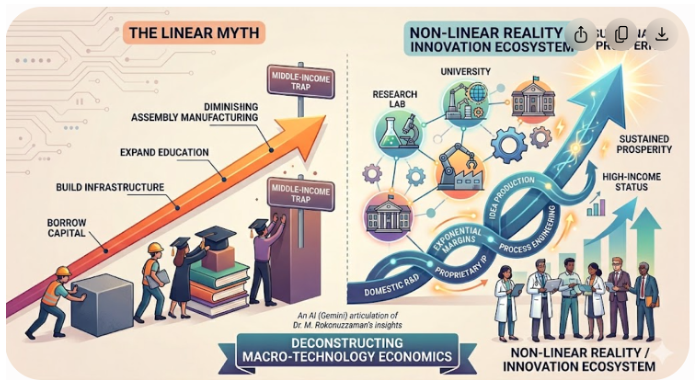
The dominant policy discourse in developing nations often functions like a simple arithmetic problem. It operates on a linear, neoclassical presupposition: if a nation builds enough highways, expands university enrollment by a fixed percentage, and doubles down on low-cost labor-based manufacturing, economic graduation to high-income status will inevitably follow.
However, in his extensive analytical body of work published in The Financial Express, Dr. M. Rokonuzzaman systematically dismantles this paradigm. By demonstrating that technology, infrastructure, and human capital do not possess a linear relationship with sustained prosperity, his macro-technology frameworks expose a critical reality: standard growth pathways frequently guide developing economies straight into the Middle-Income Trap (MIT).
When we deconstruct these linear myths, we can see how Rokonuzzaman’s insights intersect with—and challenge—the major schools of thought in development economics.
1. The Infrastructure Illusion: Linear Corridors vs. The Solow Residual
A cornerstone of modern development budgets is loan-centric physical infrastructure, a practice heavily rooted in the Harrod-Domar model and early Neoclassical growth theories (Solow, 1956), which assume that output is a direct, linear function of capital accumulation ($K$). Linear growth theory argues that connecting economic hubs via mega-projects automatically yields a proportional spike in macroeconomic productivity.
Rokonuzzaman challenges this capital-determinism in pieces such as “Strategic perspectives on the Teknaf-Tentulia growth corridor”. He observes that physical infrastructure is merely a facilitator, not an intrinsic driver, of economic value creation. In the language of Solow, infrastructure belongs to factor inputs ($K$), but sustainable growth relies on the “Solow Residual”—the total factor productivity ($A$) driven by technological progress and Innovation.
For a resource-constrained nation, borrowing heavily from global lenders to outsource physical infrastructure projects to foreign firms does not guarantee sustainable returns. If the economic activity moving along a newly constructed corridor is restricted to transporting low-margin, third-party blueprinted goods, the infrastructure will fail to generate the non-linear returns required to service the debt, leaving the state burdened with liabilities rather than structural progress.
Linear Accumulation (Solow K): [Borrow Capital] ──> [Build Infrastructure] ──> [Diminishing Returns]
Heterodox Innovation (Solow A): [Infrastructure] ──> [Domestic Innovation] ──> [Non-Linear Growth]
2. The Fallacy of Education Scaling: Human Capital Theory vs. The Demand Vacuum
Few development axioms are as universally accepted as Human Capital Theory (Schultz, 1961; Becker, 1964), which posits that increasing formal education and STEM enrollment linearly upgrades national productivity and automatically drives Wealth creation.
Rokonuzzaman reveals this as a dangerous systemic miscalculation under static industrial architectures in columns such as “Academic curricula, jobs and growth” and “Finding cure to jobless growth”. The breakdown in this linear logic manifests as the “Jobless Graduate Paradox“. When an economy aggressively expands High-tech university enrollment without a corresponding evolution in private sector technology demand, a profound structural mismatch occurs.
Because domestic industries function largely as technology-adoption assembly plants rather than intellectual property creators, they require low-cost manual operators rather than high-skilled innovation engineers. This demand vacuum forces elite engineering and computer science minds to either emigrate (Brain Drain) or pivot to unrelated administrative positions within the national civil service. The public capital invested in expanding education yields a net-zero return because human capital accumulation cannot scale in isolation from native industrial research and development.
3. The Assembly Ceiling: GVC Smile Curves and Dependency Theory
Mid-term national planning strategies routinely decree targets like “increasing industrial value addition by fixed percentage margins”. Neoclassical trade theories (such as the Heckscher-Ohlin model) suggest that developing nations should specialize in their comparative advantage, which, for LDCs, is typically low-cost, abundant labor.
Rokonuzzaman shatters this assumption in articles like “Opening scalable value addition path,” analyzing Global Value Chains (GVCs) through a lens that mirrors Stan Shih’s “Smile Curve” and modern Structuralist/Dependency economics (Prebisch, 1950).
The GVC Smile Curve:
[Upstream: Proprietary Design/IP] ───> EXPONENTIAL MARGINS (Advanced Economies)
[Midstream: Sourcing & Parts] ───> RIGID COST BASELINE
[Downstream: Factory Floor Labor] ───> RAZOR-THIN MARGINS (Assembling LDCs)
When domestic manufacturing relies entirely on imported capital machinery, imported component blueprints, and imported software, the actual contribution of local factory floor labor remains compressed into the lower boundary of local wages. Furthermore, as advanced automation technologies are integrated into these assembly lines, the labor required per unit of output drops sharply.
Without a domestic sector to design or modify those automated systems, expanding production capacity via imported turnkey tech paradoxically accelerates the “jobless growth” cycle. As argued in “Proven technology policy risks development progression,” value addition does not grow linearly with factory size; it shifts exponentially based on who owns the market power, the proprietary process innovations, and the initial design ideas.
4. The Path Forward: Endogenous Growth and Technological Sovereignty
By exposing the limits of linear scaling across infrastructure, higher education, and assembly-driven industrial policy, Rokonuzzaman arrives at a core thesis that strongly aligns with Endogenous Growth Theory (Romer, 1990): a nation cannot borrow or assemble its way to high-income status. Romer demonstrated that ideas, unlike physical capital and labor, are non-rivalrous goods that generate non-linear, increasing returns to scale. However, he warned of the limitations of Romer’s idea and object theory as it tends to promote linearity between R&D investment and prosperity.
To escape the middle-income trap, an economy must deliberately transition from a technology consumer to a producer of ideas. Drawing on the historical trajectories of late-industrializing East Asian economies (Amsden, 1989; Chang, 2002), Rokonuzzaman’s commentary highlights that economic graduation requires building a non-linear ecosystem where:
- Universities transition from teaching-focused institutions to research hubs that co-generate marketable intellectual property through a tight Triple Helix model with government and industry.
- Industrial strategies, as explored in “Sustaining and scaling up import substitution,” incentivize local process engineering and proprietary design rather than simple assembly capacity behind tariff walls.
- Trade and import-substitution policies mandate genuine technological learning and tool creation over legacy tech consumption.
Conclusion
The observation that linear growth models are structural myths captures the core of Dr. M. Rokonuzzaman’s economic commentary. In an era defined by automation, robotics, and shifting innovation epicenters, emerging economies can no longer rely on the passive factor-accumulation strategies of the past. Wealth creation is fundamentally non-linear. It scales exponentially only when a country abandons the illusion of linear scaling and restructures its institutions to capture market power through intellectual property, process engineering, and native technology ownership.
References
Solow, R. M. (1956). A contribution to the theory of economic growth. The Quarterly Journal of Economics, 70(1), 65-94.
Amsden, A. H. (1989). Asia’s Next Giant: South Korea and Late Industrialization. Oxford University Press.
Becker, G. S. (1964). Human Capital. National Bureau of Economic Research.
Chang, H J. (2002). Kicking Away the Ladder: Development Strategy in Historical Perspective. Anthem Press.
Prebisch, R. (1950). The Economic Development of Latin America and its Principal Problems. United Nations.
Romer, P. M. (1990). Endogenous technological change. Journal of Political Economy, 98(5, Part 2), S71-S102.
Rokonuzzaman, M. (n.d.). Op-ed columns including “Strategic perspectives on the Teknaf-Tentulia growth corridor,” “Academic curricula, jobs and growth,” “Finding cure to jobless growth,” “Opening scalable value addition path,” “Proven technology policy risks development progression,” and “Sustaining and scaling up import substitution.” The Financial Express.
Schultz, T. W. (1961). Investment in human capital. The American Economic Review, 51(1), 1-17.