THE WAVES
  • Home
  • News
    • Recent Updates
    • Weekly Newsletter
    • Monthly Newsletter
    • Quarterly Newsletter
  • Topics
    • Technology
      • Internet
      • AR/VR & Digital twins
      • Robotics
      • AI & Data Analytics
      • IoT & Wearable
      • Blockchain
      • Computing
      • Sensors & Perception
      • 3D Printing
      • Energy Tech
      • Space
      • Gadgets
    • Transformation
      • Education
      • Health
      • Transportation
      • Farming
      • Energy
      • Security
      • Mining & Blue Economy
      • Food & Living
      • Communication
      • Entertainment
      • Manufacturing
      • Work & Management
      • Public Service
    • Startups
      • Culture
      • Country
      • New Entry
      • Accelerators
      • Incubators
      • Death Valley
      • Investments
      • Exit & IPO
      • Valuation & Financing
      • Idea & IP
    • Education & Research
      • School
      • University
      • Academic Research
      • Corporate Research
      • Public-funded Research
      • Economics of Innovation
      • Growth Economics
      • Training
      • Publications
      • Patents & IP
    • Industrial Revolutions
      • Future of Work
      • Sustainable Development
      • Smart Manufacturing
      • Job Transformation
      • Industry Transformation
      • Competition & Monopoly
      • National Response
      • Education & Skills
      • Social Change
    • Investment & Review
      • Public
      • Corporate
      • Venture Capital
      • Capital Market
      • Philanthropy
      • Personality
    • Inventions
    • Automation
  • Strategy
    • Value Proposition
      • Product
      • Process
      • Sustainability Goals
      • Business Model
      • Complementary
      • Externality
    • Innovation
      • Disruptive Innovation
      • Incremented Innovation
      • Sustaining
      • Schumpeter’s Creative Destruction
      • Redesign for Winning
    • Competition
      • Leading
      • Following
      • Blue Ocean
      • Monopolisation
      • Porter’s Five Forces
      • Business Cycle
    • Intangible Assets
      • Human Capital
      • R&D Management
      • Tripple Helix
      • Intellectual Property
      • Productive Knowledge
      • Technology Managment
    • Competence
      • Organization Agility
      • Innovation Culture
      • Infrastructure
      • R&D facility
      • Great by Choice
      • Build to Last
      • Good to Great
    • Technology Acquisition
      • Scientific discovery
      • Invention
      • Fusion
      • Adaptation & Refinement
      • Licensing
      • Start-up acquisition
  • Policy
    • Technology Development
    • Industry
    • Innovation Diffusion
    • Jobs, Privacy & Security
    • Regulation & Law
    • Sustainability
    • Equity & Inclusiveness
    • Climate Change
    • Environment
  • Opinion
    • Opinion
  • Megatrends
    • Individual Preferences
    • Planet and Society
    • Technology
    • Political Economy
    • Market Power & Monopoly
    • Globalisation
    • Schumpeter’s creative destruction
    • Startups & VC
    • Human Role in Work
    • Value of Natural Resources
    • Patents & Ideas for Redesign
  • Publication
    • Case Studies
    • Magazine
    • Books
    • Reports
    • White Papers
    • Journals
THE WAVES In-depth investigation on Technology, Society, and Policy dynamics for interpreting the past as well as present, and predicting the future so that success rate of pursuing ideas, start-ups, and innovation economy increases.

Technology, Society and Policy

Winning and Losing in Reinvention Race : keeps unfolding: --making America’s innovation bucket leaky, creating prosperity out of reinvention, and turning invention successes transitory
THE WAVES
  • Home
  • News
    • Recent Updates
    • Weekly Newsletter
    • Monthly Newsletter
    • Quarterly Newsletter
  • Topics
    • Technology
      • Internet
      • AR/VR & Digital twins
      • Robotics
      • AI & Data Analytics
      • IoT & Wearable
      • Blockchain
      • Computing
      • Sensors & Perception
      • 3D Printing
      • Energy Tech
      • Space
      • Gadgets
    • Transformation
      • Education
      • Health
      • Transportation
      • Farming
      • Energy
      • Security
      • Mining & Blue Economy
      • Food & Living
      • Communication
      • Entertainment
      • Manufacturing
      • Work & Management
      • Public Service
    • Startups
      • Culture
      • Country
      • New Entry
      • Accelerators
      • Incubators
      • Death Valley
      • Investments
      • Exit & IPO
      • Valuation & Financing
      • Idea & IP
    • Education & Research
      • School
      • University
      • Academic Research
      • Corporate Research
      • Public-funded Research
      • Economics of Innovation
      • Growth Economics
      • Training
      • Publications
      • Patents & IP
    • Industrial Revolutions
      • Future of Work
      • Sustainable Development
      • Smart Manufacturing
      • Job Transformation
      • Industry Transformation
      • Competition & Monopoly
      • National Response
      • Education & Skills
      • Social Change
    • Investment & Review
      • Public
      • Corporate
      • Venture Capital
      • Capital Market
      • Philanthropy
      • Personality
    • Inventions
    • Automation
  • Strategy
    • Value Proposition
      • Product
      • Process
      • Sustainability Goals
      • Business Model
      • Complementary
      • Externality
    • Innovation
      • Disruptive Innovation
      • Incremented Innovation
      • Sustaining
      • Schumpeter’s Creative Destruction
      • Redesign for Winning
    • Competition
      • Leading
      • Following
      • Blue Ocean
      • Monopolisation
      • Porter’s Five Forces
      • Business Cycle
    • Intangible Assets
      • Human Capital
      • R&D Management
      • Tripple Helix
      • Intellectual Property
      • Productive Knowledge
      • Technology Managment
    • Competence
      • Organization Agility
      • Innovation Culture
      • Infrastructure
      • R&D facility
      • Great by Choice
      • Build to Last
      • Good to Great
    • Technology Acquisition
      • Scientific discovery
      • Invention
      • Fusion
      • Adaptation & Refinement
      • Licensing
      • Start-up acquisition
  • Policy
    • Technology Development
    • Industry
    • Innovation Diffusion
    • Jobs, Privacy & Security
    • Regulation & Law
    • Sustainability
    • Equity & Inclusiveness
    • Climate Change
    • Environment
  • Opinion
    • Opinion
  • Megatrends
    • Individual Preferences
    • Planet and Society
    • Technology
    • Political Economy
    • Market Power & Monopoly
    • Globalisation
    • Schumpeter’s creative destruction
    • Startups & VC
    • Human Role in Work
    • Value of Natural Resources
    • Patents & Ideas for Redesign
  • Publication
    • Case Studies
    • Magazine
    • Books
    • Reports
    • White Papers
    • Journals

  • Innovation Economics
  • Strategy

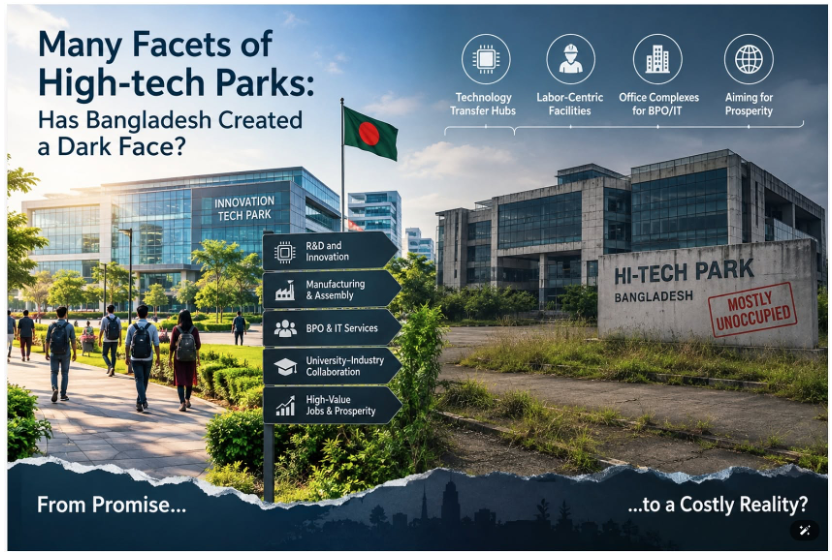
Many Facets of High-Tech Parks: Has Bangladesh Created a Dark Face?

  • Md. Rokonuzzaman
  • Created: September 17, 2026
  • Last updated: September 22, 2026
angladesh's act of building high-tech parks appears to be driven by taking loans and spending money to create a sensation and a physical sign of a high-tech economy.
angladesh’s act of building high-tech parks appears to be driven by taking loans and spending money to create a sensation and a physical sign of a high-tech economy.

High-tech products, whether hardware, software, or services, are highly knowledge- and idea-centric. They offer the potential for high value addition and a scalable growth path for building high-performing firms and driving natural-resource-poor economies toward high-income status.

A cluster of high-tech firms occupying a geographic area or a large building is known as a high-tech park. Often, such parks are regarded as symbols of national prosperity and high-paying jobs. Hence, there is a natural temptation to establish High-tech parks.

The high-tech park concept has its roots in California, the USA. During World War II, the Engineering Faculty of Stanford University was awarded several research grants to develop military technologies, and these grants continued after the war. As a result, prototypes of a few products, including low-frequency amplifiers, generated interest within the US military. As existing companies were not interested in low-volume production, Stanford University, in partnership with the City of Palo Alto, developed an adjacent area to house newly formed firms (Startups) for further refinement and small-scale manufacturing.

This was the first high-tech park, established in 1951. Its initial tenants included HP and Varian Associates.

It is worth noting that the founders of HP were Stanford graduate students, and they established a firm to produce their research outputs for the US Air Force. Hence, this high-tech park served as a buffer between the university and mainstream industry, facilitating the transfer of research outputs into the economy.

This humble beginning—a physical facility to support technology transfer from university research—scaled up into the miraculous success of Silicon Valley over 50 years.

However, Asian governments, lenders, and industry created many facets of high-tech parks. For example, to house companies engaged in the design, development, and fabrication of technology-centric products, Taiwan established its flagship high-tech park, Hsinchu Science Park. A similar model can be observed in South Korea.

Labor-centric high-tech testing, assembly, and manufacturing activities started in the farmland of Penang with the entry of Intel into the paddy fields. To house such facilities, the surrounding area was developed as a high-tech park. Hence, rather than transferring technology from universities, Malaysia’s high-tech parks emerged to provide physical facilities for more than 300 MNCs to source low-cost labor for low-end high-tech assembly, testing, and manufacturing.

In India and the Philippines, high-tech parks are office complexes that rent space to BPO, call-center, software, and IT service companies.

To join the league of nations with high-tech parks, Bangladesh gave the name “high-tech park” to a remote forested area in 2004, 30 km away from any university. Other than the name, it showed no signs of high-tech tenants. Despite this, in 2009, the Bangladesh Government entered the race to set up as many as 39 physical facilities, naming them high-tech parks, software technology parks, and incubation centers.

According to media reports, those facilities were built at a cost of more than a billion dollars and are mostly unoccupied. Besides, the private sector also named business buildings high-tech parks to obtain tax and other incentives. In some cases, those facilities are leased for wedding receptions and many other social gatherings.

Bangladesh’s act of building high-tech parks appears to be driven by taking loans and spending money to create a sensation and a physical sign of a high-tech economy. Perhaps, it is a dark face of wasteful investment and a wrong perception of what high-tech parks are.
Enlighten others

Subscribe

Subscribe now to our newsletter

You May Also Like

Bangladesh can turn its high-tech parks into engines of prosperity by housing R&D wings of local producers
View Post
  • 3 min

Bangladesh’s High-Tech Park Owe: Can Low-Tech Be a Solution?

angladesh's act of building high-tech parks appears to be driven by taking loans and spending money to create a sensation and a physical sign of a high-tech economy.
View Post
  • 3 min

Many Facets of High-Tech Parks: Has Bangladesh Created a Dark Face?

Engineering Investor FOMO and Capital Accumulation through Disruptive Innovation Narratives
View Post
  • 6 min

Mechanisms of rapid wealth accumulation: Elon Musk’s Secret Recipe

Leave a Reply Cancel reply

Your email address will not be published. Required fields are marked *

Subscribe

Subscribe now to our newsletter

Principles

  • Economics of Technology
  • Innovation Economics
  • Technology & Innovation Policy

History & Observations

  • Technology History
  • Innovation History
  • Strategy & Policy in retrospect
  • Entrepreneurs & Innovators
  • Startups & Corporations
  • Patents & Publications
  • Design & Redesign Thinking

About Us

  • Who we are
  • What we deliver
  • Genesis
  • Mission
  • Scope
  • Editorial & Advisory Board
THE WAVES
  • Contact
  • Advertise

Input your search keywords and press Enter.