THE WAVES
  • Home
  • News
    • Recent Updates
    • Weekly Newsletter
    • Monthly Newsletter
    • Quarterly Newsletter
  • Topics
    • Technology
      • Internet
      • AR/VR & Digital twins
      • Robotics
      • AI & Data Analytics
      • IoT & Wearable
      • Blockchain
      • Computing
      • Sensors & Perception
      • 3D Printing
      • Energy Tech
      • Space
      • Gadgets
    • Transformation
      • Education
      • Health
      • Transportation
      • Farming
      • Energy
      • Security
      • Mining & Blue Economy
      • Food & Living
      • Communication
      • Entertainment
      • Manufacturing
      • Work & Management
      • Public Service
    • Startups
      • Culture
      • Country
      • New Entry
      • Accelerators
      • Incubators
      • Death Valley
      • Investments
      • Exit & IPO
      • Valuation & Financing
      • Idea & IP
    • Education & Research
      • School
      • University
      • Academic Research
      • Corporate Research
      • Public-funded Research
      • Economics of Innovation
      • Growth Economics
      • Training
      • Publications
      • Patents & IP
    • Industrial Revolutions
      • Future of Work
      • Sustainable Development
      • Smart Manufacturing
      • Job Transformation
      • Industry Transformation
      • Competition & Monopoly
      • National Response
      • Education & Skills
      • Social Change
    • Investment & Review
      • Public
      • Corporate
      • Venture Capital
      • Capital Market
      • Philanthropy
      • Personality
    • Inventions
    • Automation
  • Strategy
    • Value Proposition
      • Product
      • Process
      • Sustainability Goals
      • Business Model
      • Complementary
      • Externality
    • Innovation
      • Disruptive Innovation
      • Incremented Innovation
      • Sustaining
      • Schumpeter’s Creative Destruction
      • Redesign for Winning
    • Competition
      • Leading
      • Following
      • Blue Ocean
      • Monopolisation
      • Porter’s Five Forces
      • Business Cycle
    • Intangible Assets
      • Human Capital
      • R&D Management
      • Tripple Helix
      • Intellectual Property
      • Productive Knowledge
      • Technology Managment
    • Competence
      • Organization Agility
      • Innovation Culture
      • Infrastructure
      • R&D facility
      • Great by Choice
      • Build to Last
      • Good to Great
    • Technology Acquisition
      • Scientific discovery
      • Invention
      • Fusion
      • Adaptation & Refinement
      • Licensing
      • Start-up acquisition
  • Policy
    • Technology Development
    • Industry
    • Innovation Diffusion
    • Jobs, Privacy & Security
    • Regulation & Law
    • Sustainability
    • Equity & Inclusiveness
    • Climate Change
    • Environment
  • Opinion
    • Opinion
  • Megatrends
    • Individual Preferences
    • Planet and Society
    • Technology
    • Political Economy
    • Market Power & Monopoly
    • Globalisation
    • Schumpeter’s creative destruction
    • Startups & VC
    • Human Role in Work
    • Value of Natural Resources
    • Patents & Ideas for Redesign
  • Publication
    • Case Studies
    • Magazine
    • Books
    • Reports
    • White Papers
    • Journals
THE WAVES In-depth investigation on Technology, Society, and Policy dynamics for interpreting the past as well as present, and predicting the future so that success rate of pursuing ideas, start-ups, and innovation economy increases.

Technology, Society and Policy

Winning and Losing in Reinvention Race : keeps unfolding: --making America’s innovation bucket leaky, creating prosperity out of reinvention, and turning invention successes transitory
THE WAVES
  • Home
  • News
    • Recent Updates
    • Weekly Newsletter
    • Monthly Newsletter
    • Quarterly Newsletter
  • Topics
    • Technology
      • Internet
      • AR/VR & Digital twins
      • Robotics
      • AI & Data Analytics
      • IoT & Wearable
      • Blockchain
      • Computing
      • Sensors & Perception
      • 3D Printing
      • Energy Tech
      • Space
      • Gadgets
    • Transformation
      • Education
      • Health
      • Transportation
      • Farming
      • Energy
      • Security
      • Mining & Blue Economy
      • Food & Living
      • Communication
      • Entertainment
      • Manufacturing
      • Work & Management
      • Public Service
    • Startups
      • Culture
      • Country
      • New Entry
      • Accelerators
      • Incubators
      • Death Valley
      • Investments
      • Exit & IPO
      • Valuation & Financing
      • Idea & IP
    • Education & Research
      • School
      • University
      • Academic Research
      • Corporate Research
      • Public-funded Research
      • Economics of Innovation
      • Growth Economics
      • Training
      • Publications
      • Patents & IP
    • Industrial Revolutions
      • Future of Work
      • Sustainable Development
      • Smart Manufacturing
      • Job Transformation
      • Industry Transformation
      • Competition & Monopoly
      • National Response
      • Education & Skills
      • Social Change
    • Investment & Review
      • Public
      • Corporate
      • Venture Capital
      • Capital Market
      • Philanthropy
      • Personality
    • Inventions
    • Automation
  • Strategy
    • Value Proposition
      • Product
      • Process
      • Sustainability Goals
      • Business Model
      • Complementary
      • Externality
    • Innovation
      • Disruptive Innovation
      • Incremented Innovation
      • Sustaining
      • Schumpeter’s Creative Destruction
      • Redesign for Winning
    • Competition
      • Leading
      • Following
      • Blue Ocean
      • Monopolisation
      • Porter’s Five Forces
      • Business Cycle
    • Intangible Assets
      • Human Capital
      • R&D Management
      • Tripple Helix
      • Intellectual Property
      • Productive Knowledge
      • Technology Managment
    • Competence
      • Organization Agility
      • Innovation Culture
      • Infrastructure
      • R&D facility
      • Great by Choice
      • Build to Last
      • Good to Great
    • Technology Acquisition
      • Scientific discovery
      • Invention
      • Fusion
      • Adaptation & Refinement
      • Licensing
      • Start-up acquisition
  • Policy
    • Technology Development
    • Industry
    • Innovation Diffusion
    • Jobs, Privacy & Security
    • Regulation & Law
    • Sustainability
    • Equity & Inclusiveness
    • Climate Change
    • Environment
  • Opinion
    • Opinion
  • Megatrends
    • Individual Preferences
    • Planet and Society
    • Technology
    • Political Economy
    • Market Power & Monopoly
    • Globalisation
    • Schumpeter’s creative destruction
    • Startups & VC
    • Human Role in Work
    • Value of Natural Resources
    • Patents & Ideas for Redesign
  • Publication
    • Case Studies
    • Magazine
    • Books
    • Reports
    • White Papers
    • Journals

  • Editor's Pick
  • Technology & Innovation Policy

Types of Research and Development

  • Md. Rokonuzzaman
  • Created: September 18, 2026
  • Last updated: September 18, 2026
Which Type of R&D Should Be the Focus of Bangladesh and many other less developed countries?

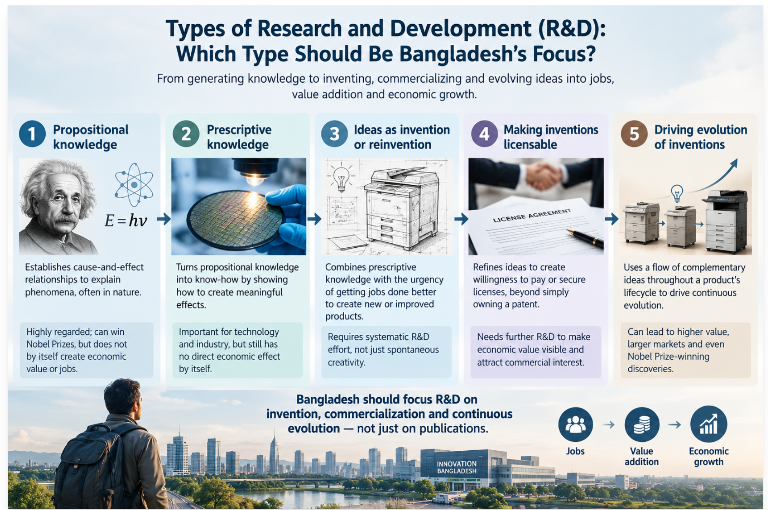
Types of Research and Development (R&D): Which Type Should Be Bangladesh’s Focus?

Bangladesh, like many other less developed countries, faces criticism for its low allocation of funding to R&D. However, to justify additional funding, we need to establish a strong correlation among R&D, jobs, value addition, and economic growth.

Although R&D has been at the core of the rise of advanced countries, not all types of R&D have similar prospects for contributing to Bangladesh’s prosperity. Hence, let’s look at five types of R&D. This classification is based on R&D outputs and their economic implications.

1. Propositional knowledge: This is about establishing relationships between cause and effect to explain phenomena of interest, often in nature. For example, Albert Einstein discovered the relationship between light packets (photons) and the energy levels of electrons, which led to the photoelectric effect. Although propositional knowledge is highly regarded and scientists receive Nobel Prizes for such discoveries, it does not, by itself, have a positive effect on the economic well-being of individuals, firms, and nations.

2. Prescriptive knowledge: Applied R&D investigates how to create meaningful effects—know-how—from propositional knowledge. For example, making selective areas of a metal surface positively charged and producing a checkerboard-type effect through controlled exposure of the surface to a light source is an example of conducting R&D to produce prescriptive knowledge. Despite its importance in producing economically meaningful knowledge, it has no positive economic effect by itself.

3. Ideas as the invention or Reinvention of new products: Once prescriptive knowledge is fused with the urgency of Getting jobs done better, creative minds come up with the invention or reinvention of products. However, spontaneous creativity is not sufficient. It requires systematic R&D effort to generate and develop such ideas. For example, Mr. Carlson developed the idea of photocopying from the prescriptive knowledge of the photoelectric effect, turning his kitchen into an R&D lab.

4. Refining ideas to create willingness to pay or make them licensable: R&D for inventing ideas may lead to owning patents, but that is not sufficient to generate revenue or secure licenses. It requires further R&D effort. For example, although Mr. Carlson’s idea for inventing a photocopier received a patent, it failed to attract commercial interest, leading as many as 20 technology firms, including IBM and GE, to reject his licensing proposals. Hence, there was a need for further R&D efforts over the next five years to make the extractable economic value potential visible, leading to a license to Haloid Corporation and the subsequent rollout of a photocopier (Xerox machine).

5. R&D for driving the evolution of inventions and innovations: Irrespective of its greatness, a single idea is not sufficient to exploit its full economic potential. It requires a flow of complementary ideas. Hence, there is an R&D need throughout a product’s lifecycle to drive evolution. For example, to exploit the full potential of Carlson’s photocopying idea, Xerox had to pursue an additional 50,000 ideas. Besides, although Mr. Carlson’s year-long solo effort in his kitchen lab conceived the photocopier idea, its journey to full economic potential required hundreds of researchers working in a well-organized R&D lab at Xerox’s famous Palo Alto lab. By the way, in some cases, such a journey of refinement in driving evolution may even lead to a Nobel Prize-winning discovery.

Hence, here are five different types of R&D: (i) R&D for propositional knowledge, (ii) prescriptive knowledge generation R&D, (iii) R&D for inventing and reinventing, (iv) R&D for making inventions or reinventions licensable, and (v) R&D for driving the evolution of products and production processes.

By the way, in less-developed countries like Bangladesh, researchers are often tempted to conduct R&D aimed at producing propositional knowledge, which mostly ends up as article publications. However, its implications for job creation, high-performing firm formation, and economic growth are largely absent. Hence, although Bangladesh produced scientists like Prof. Jamal Nazrul Islam and Sir Jagadish Chandra Bose, this country’s economy is deprived of the research outputs of these scientists.

Therefore, Bangladeshis and citizens of other less-developed countries, as well as their governments, should consciously consider the role of R&D and the kind of R&D they intend to promote and support.

While I was having coffee this morning with a well-respected economist, Sajjad Zohir, Executive Director of Economic Research Group (ERG), I was inspired to pen this clarification. Hence, please allow me to acknowledge him.

Let me invite you to share your observations.
Enlighten others

Subscribe

Subscribe now to our newsletter

You May Also Like

Which Type of R&D Should Be the Focus of Bangladesh and many other less developed countries?
View Post
  • 3 min

Types of Research and Development

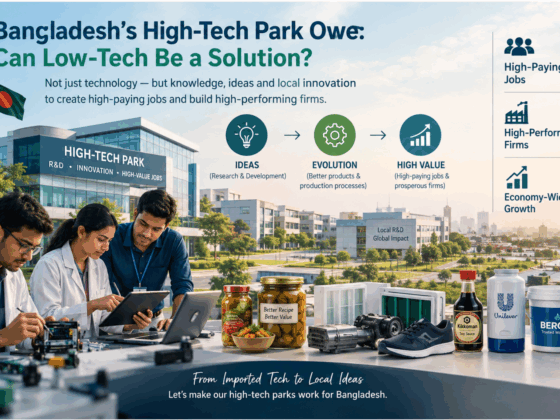
Bangladesh can turn its high-tech parks into engines of prosperity by housing R&D wings of local producers
View Post
  • 3 min

Bangladesh’s High-Tech Park Owe: Can Low-Tech Be a Solution?

How speculative markets and continuous storytelling combine to decouple asset valuation from delivery of innovations
View Post
  • 8 min

The Rise of Muskism Turning Musk a Trillionaire: Narrative-Driven Capital Accumulation and the Illusion of Disruptive Innovation

Leave a Reply Cancel reply

Your email address will not be published. Required fields are marked *

Subscribe

Subscribe now to our newsletter

Principles

  • Economics of Technology
  • Innovation Economics
  • Technology & Innovation Policy

History & Observations

  • Technology History
  • Innovation History
  • Strategy & Policy in retrospect
  • Entrepreneurs & Innovators
  • Startups & Corporations
  • Patents & Publications
  • Design & Redesign Thinking

About Us

  • Who we are
  • What we deliver
  • Genesis
  • Mission
  • Scope
  • Editorial & Advisory Board
THE WAVES
  • Contact
  • Advertise

Input your search keywords and press Enter.