Abstract
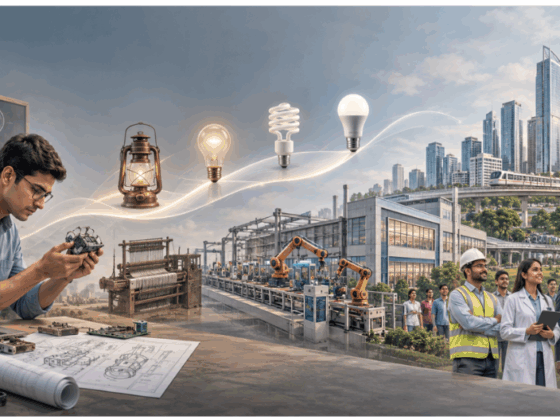
Economic prosperity is often explained through the accumulation of capital, natural resources, infrastructure, trade, or the expansion of employment. These factors matter, but they do not fully explain why some firms and nations repeatedly create high-value products, productive industries and high-paying jobs, while others remain dependent on low-cost labour, imported technologies and temporary advantages. A deeper explanation begins with the human capacity to understand nature, identify unmet needs, and convert scientific and technological possibilities into better ways of Getting jobs done. This article presents an integrated account of that process. It brings together the Waves framework, the Unified Theory of Innovation and Transformation, the STEM Transfer Function and the Wealth-creation thesis as complementary components of one explanatory framework. Its central chain is: STEM competence → economically meaningful ideas → product and process evolution → competitive advantage → profitable firms → high-paying jobs → national prosperity. The framework explains not only how wealth is created, but also why it is destroyed, why prosperity migrates across firms and industries, and why nations must continually develop the competence to participate in new waves of Reinvention.
1. Wealth is the expanding ability to get jobs done
Wealth is commonly associated with money, financial assets, land, minerals, factories or the size of an economy. These are important means and measures, but they are not the ultimate source of prosperity. Their economic significance depends on what people can do with them. A resource becomes wealth when knowledge, skills, technologies, institutions and productive systems turn it into useful outcomes. In this sense, wealth is the Utility people derive from getting jobs done—communicating, travelling, producing, learning, healing, building and satisfying other human needs.
The same job can be done with very different levels of quality, cost, convenience, reliability, safety and accessibility. A better product or service can deliver greater utility; a better production process can deliver that utility with fewer resources, less waste and lower cost. Economic progress therefore depends on continually expanding the value delivered per unit of resource and effort. The creation of wealth is not simply the production of more output. It is the evolution of the means by which human purposes are served.
This perspective places ideas at the centre of economic value creation. Natural resources and labour are essential, but ideas enable people to use them differently, combine them in new ways, substitute knowledge for scarce inputs, and overcome limitations. As ideas become embodied in products, production processes and business systems, they expand the supply of useful outcomes. The Market Economy provides a mechanism through which competing ideas are tested, refined, diffused and rewarded—although success is uncertain and unevenly distributed.
2. Human competence: the engine that converts possibility into ideas
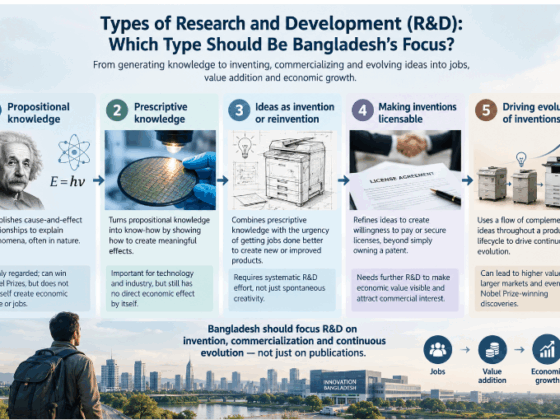
Science and technology create economic possibilities; human competence turns those possibilities into wealth. Scientific knowledge explains phenomena and relationships in nature. Technology applies knowledge and engineering principles to create means of performing tasks. Invention gives form to a new technical possibility, while innovation develops and diffuses that possibility as a product, process or system that people and organizations can use. These activities are connected, but they are not interchangeable.
The conversion is neither automatic nor linear. A scientific discovery may have no immediate commercial application. A technically workable invention may be too costly, unreliable or inconvenient to attract users. A promising product may fail to reach the quality and cost thresholds required for adoption. A commercially successful innovation may subsequently lose its advantage as competitors imitate it or a new technological core emerges. At every stage, competence is needed to recognize constraints, generate ideas, test alternatives, solve technical problems, integrate components, scale production and respond to market feedback.
Human competence is therefore broader than possessing a degree, operating imported machinery or following established procedures. It includes the ability to understand scientific principles, formulate problems, design and experiment, learn from failure, improve processes, integrate technologies, make decisions under uncertainty, and organize the development of successive generations of products. It also includes the entrepreneurial and managerial competence to mobilize resources around ideas and bring them to market.
STEM education—science, technology, engineering and mathematics—can build a critical part of this capability. But the number of graduates, research publications, patents or laboratories is not by itself a measure of economic success. The decisive question is whether a society can transfer STEM competence into economically meaningful ideas and then into competitive products and production systems. Education becomes an engine of prosperity when it develops this transfer capability, rather than merely supplying credentials or workers for existing production arrangements.
3. The STEM Transfer Function: connecting education to economic outcomes
The STEM Transfer Function (H) expresses the effectiveness with which a firm or nation converts its STEM competence into economic outcomes. Conceptually, H links the knowledge and skills developed through education, research and experience to the capacity to generate ideas, evolve products and processes, and compete in markets. It is not a claim that every input can be reduced to one simple numerical coefficient. It is a way to focus attention on the missing conversion mechanism between investment in STEM and the creation of wealth.
A high STEM Transfer Function is reflected in the ability to create and sustain high-performing firms, high-value products, globally competitive production processes and high-paying jobs. A low transfer function can coexist with substantial spending on education, research infrastructure and technology acquisition. In that situation, graduates may be underemployed, research may remain disconnected from production, and industries may depend on imported technologies without developing the competence to evolve them.
The function depends on a connected system: relevant scientific and engineering capability; firms with a commitment to product and process development; institutions that support experimentation and learning; entrepreneurial capacity to commercialize ideas; access to demanding markets; and incentives that reward measurable improvements in quality, cost and usefulness. Weakness in any of these links can prevent knowledge from becoming economic value. The policy objective should therefore be to strengthen the entire transfer mechanism, not to maximize isolated indicators.
4. Product and production-process evolution: the mechanisms of value creation
Ideas create economic value when they change what a product can do, how well it performs, how much it costs, or how efficiently it can be produced and delivered. Product innovation improves the user’s experience and the utility derived from getting a job done. Process innovation improves the means of production: it can raise precision, reliability, throughput and yield while reducing defects, waste, energy use, material consumption and labour required per unit.
These two dimensions reinforce each other. A superior product may command greater willingness to pay, but its commercial viability can depend on a production process that brings its cost down. A more efficient process may improve profitability, but lasting competitive advantage may require using the resulting capability to offer better features, higher reliability or new product configurations. Sustainable value creation thus requires a continuing search for a better balance between utility delivered and resources consumed.
The evolution of a technology product is typically a long journey rather than a single Breakthrough. An early version may be expensive, unreliable or inferior to an established alternative. Through successive rounds of engineering, experimentation, learning and investment, its performance improves and its cost declines. Complementary infrastructure, standards, supplier capabilities and user familiarity may further increase its usefulness. As adoption expands, the product can move from a niche application to a mainstream solution.
Yet success creates a new challenge. Competitors imitate, improve and substitute. Customer expectations rise, and the original technology core may approach physical, economic or architectural limits. The scope for incremental improvement narrows. A firm that once led the market may find that further investment in the same design produces diminishing returns. Continued prosperity then requires more than doing the same thing better: it may require changing the underlying technology, product architecture or business model.
5. The Unified Theory of Innovation: how waves form and evolve
The Unified Theory of Innovation and Transformation provides the dynamic structure for understanding how ideas evolve into waves of economic change. It brings together several forms of innovation that are often discussed separately. Incremental innovation improves existing product features. Process innovation improves the way products are made. Sustaining innovation combines these improvements to defend and extend a product’s competitive position. More radical innovation changes the technology core, the product architecture or the business model, opening the possibility of a new trajectory.
A new technology core rarely begins as a fully competitive replacement. It may initially deliver lower performance, higher cost or limited functionality. Its proponents must improve it until it becomes a credible substitute for the incumbent solution. If the new approach crosses the required thresholds of usefulness, quality, reliability and cost, adoption can accelerate. Investment, supplier development, learning and market expansion reinforce one another. A new innovation wave takes shape.
The Waves framework describes this unfolding process as a sequence: an urgency to perform a task better; the accumulation and application of knowledge; invention and early experimentation; product and process evolution; market diffusion; saturation of the established trajectory; and reinvention around a new technological core. The sequence is not mechanically predictable. It is a framework for interpreting the forces, uncertainties and feedback loops that shape the rise, growth and decline of products, firms and industries.
The Unified Theory and the Waves framework are therefore complementary. The Unified Theory clarifies the types and progression of innovation; the Waves framework places those dynamics in a broader historical and economic cycle. The STEM Transfer Function explains the human and institutional capability needed to participate in those dynamics. The wealth-creation thesis explains why the process matters: it expands the utility society can obtain from its resources and creates the basis for higher productivity, profits, wages and prosperity.
6. Creative Destruction and reinvention: the renewal of the industrial economy
No product, production process or technological advantage remains permanently superior. As alternatives improve, demand can move away from established solutions. Facilities, skills, supplier networks and business models built around the old technology may lose value. New products can displace old ones; new processes can make established factories uncompetitive; and new firms can overtake incumbents. This is creative destruction: the simultaneous creation of new economic possibilities and the erosion of value embodied in older arrangements.
Creative destruction is not simply the disappearance of obsolete products. It is a reallocation of resources, capabilities and market opportunities. The process can create substantial gains for users through better performance, lower prices or entirely new ways of getting jobs done. It can also impose real costs on workers, firms, communities and regions whose capabilities are tied to declining technologies. The aggregate promise of progress does not remove the need to manage the transition.
Reinvention is central because mature products and processes often cannot sustain growth through incremental improvement alone. A new technological core can enable a product to be redesigned, a factory to be reorganized and an industry to develop new capabilities. Reinvention may also change the boundaries between industries: a technological advance developed in one field can become the foundation of products and services in another.
Incumbent firms face a difficult choice. Their existing assets, expertise, customer relationships and revenue streams are optimized for the established wave. Investing in an emerging alternative may initially weaken performance and threaten the economics of the existing business. New entrants may have fewer legacy constraints and greater freedom to pursue the uncertain path. This helps explain why technological leadership does not guarantee leadership in the next wave. The ability to abandon, recombine and rebuild can matter as much as the ability to optimize.
7. Prosperity migrates across firms, industries and nations
The geography of wealth creation changes as innovation waves unfold. A firm may lead one generation of a product and become a follower in the next. An industry may lose its central position when a new technology changes the basis of competition. A nation that once hosted the leading firms and production systems may become dependent on importing the next generation of products and technologies, while another nation becomes the centre of reinvention and value capture.
This migration is more than the movement of factories or investment. It is the movement of the capabilities that generate ideas, solve technical problems, evolve products, improve production processes and capture market value. When a new wave emerges, prosperity tends to accumulate where firms and institutions can convert the new knowledge into commercially superior solutions. The location of low-cost production may change, but durable leadership depends on the ability to shape the product and process trajectory.
The historical movement from mechanical to electrical technologies illustrates the principle. The first Industrial Revolution established powerful mechanical production systems, particularly in Britain and Europe. The later rise of electrical technologies required new products, factory layouts, skills and organizational arrangements. The United States was able to capture a substantial part of the subsequent industrial opportunity. The lesson is not that every incumbent must fail or every latecomer must win. It is that accumulated success can create both capability and inertia, and that the next wave rewards those able to reinvent.
For nations, the implication is profound. Importing mature technologies can raise output and productivity in the short term, but it does not necessarily build the competence required to create the next generation of products and processes. If local firms remain assemblers, licensees or users of technologies developed elsewhere, much of the high-value idea work—and the associated high-paying jobs, intellectual property and strategic control—may remain abroad. A country can expand production without becoming a centre of innovation.
A nation seeking lasting prosperity must therefore develop the capacity to participate in, and eventually lead, reinvention waves. This requires a pipeline from scientific understanding to engineering development, from engineering to commercially viable products, and from product success to globally competitive firms. It also requires the ability to recognize when an established advantage is approaching saturation and to prepare for the next technological core before the old one loses its value.
8. The integrated framework: one chain, four explanatory layers
The four concepts in this article should not be treated as independent theories competing to explain the same phenomenon. They describe different layers of one process. The wealth-creation thesis defines the outcome and the economic purpose: expanding the utility people derive from getting jobs done. The STEM Transfer Function explains the capability required to convert knowledge and skills into economic results. The Unified Theory of Innovation explains the mechanisms through which ideas improve existing solutions or create new technological trajectories. The Waves framework explains how those trajectories rise, mature, trigger creative destruction and cause prosperity to migrate.
Together, they form a coherent explanatory chain:
- STEM competence — The human ability to understand scientific principles, use technologies, engineer solutions and learn.
- Economically meaningful ideas — The formulation of solutions that improve how people perform tasks or how producers create value.
- Product and process evolution — The conversion of ideas into better products and more capable, efficient production systems.
- Competitive advantage — The achievement of superior utility, quality, reliability, cost or other valued performance.
- Profitable firms — The ability to capture sufficient market value to finance continued development and reinvention.
- High-paying jobs — The demand for people who create, improve, integrate and scale valuable products and processes.
- National prosperity — The broadening of productive capabilities, incomes, firms and the supply of useful goods and services.
The chain is cumulative but not automatic. Each arrow represents a transfer problem that must be solved. Competence may fail to generate relevant ideas; ideas may fail technically; working inventions may fail commercially; profitable products may be copied; and successful firms may fail to reinvent. The STEM Transfer Function is effective only when the whole system supports these transitions. The framework is thus useful not only for explaining success, but also for diagnosing where wealth-creation systems break down.
9. Implications for education, industry and public policy
Reorient education towards the economics of ideas
Education policy should ask what graduates will be capable of inventing, improving and producing—not only whether they have completed a curriculum or acquired credentials. Students need foundations in science and engineering, but also exposure to product architecture, production systems, technology evolution, cost and quality trade-offs, markets, intellectual property and the uncertainty of innovation. The aim is not to turn every graduate into an entrepreneur. It is to develop people who can contribute to the evolution of products, processes and firms.
Make firms active producers of ideas
Industrial policy should distinguish between firms that merely operate or assemble established technologies and firms that systematically improve products and production processes. Incentives and institutional support should reward demonstrated capability development: better products, lower production costs, higher quality, new process technologies, export competitiveness and the creation of skilled work. Research collaboration should be connected to the technical problems and evolution pathways of firms, rather than measured only by publications, patents or formal partnerships.
Build a bridge between research and production
Universities, research organizations and industry need mechanisms for moving from scientific understanding to engineering prototypes, industrial trials, manufacturable designs and market adoption. This bridge requires shared problem definition, technical staff mobility, testing facilities, patient development funding and organizations able to manage the long journey from invention to competitive substitution. Counting research inputs without examining their contribution to products, processes, firms and jobs risks rewarding activity rather than wealth creation.
Prepare for reinvention, not only incremental productivity
Firms and governments should monitor the maturity of important products and technologies, the emergence of alternative technological cores, and changes in the global location of innovation capabilities. Incremental improvement remains essential, but it cannot be the only strategy. A resilient industrial economy needs experimentation with emerging technologies, the capacity to retire obsolete arrangements, and plans to retrain and redeploy people whose skills are affected by creative destruction.
Measure the transfer of competence into value
A more meaningful scorecard would connect education and research investments to product performance, process productivity, local engineering responsibility, firm profitability, export sophistication, skilled employment and the ability to generate successive product generations. No single indicator captures the whole system. The important shift is from measuring isolated inputs to examining whether knowledge is being converted into competitive economic outcomes.
10. Conclusion: prosperity belongs to those who keep reinventing
Science and technology expand the frontier of what is possible, but the existence of possibility is not the same as the creation of wealth. Wealth emerges when human competence identifies economically meaningful opportunities and turns them into products, processes and systems that serve human purposes more effectively. The process requires invention, continuous refinement, commercial discipline and the ability to reinvent when established technological trajectories approach their limits.
The Waves framework, Unified Theory of Innovation, STEM Transfer Function and wealth-creation thesis together explain this process from capability to outcome, and from the birth of an idea to the migration of prosperity. They show why education and research matter, why firms must become engines of product and process evolution, why creative destruction is inseparable from progress, and why national prosperity cannot be secured by relying indefinitely on low-cost labour, imported technologies or advantages inherited from an earlier wave.
The central challenge for every firm and nation is therefore not simply to acquire more technology or produce more graduates. It is to develop the human and institutional competence to convert knowledge into successive waves of economically meaningful ideas. Those who do so can create competitive firms, high-paying jobs and lasting prosperity. Those who do not may continue to participate in production, but risk becoming dependent on the ideas, technologies and reinvention capabilities of others.
Selected writings from The Waves
Economic Theories for Development Policies—Do They Risk a Dead End? (2024)
https://www.the-waves.org/2024/10/19/economic-theories-for-development-policies-do-they-risk-a-dead-end/
Mechanics of Wealth Creation and the Migration (2026)
https://www.the-waves.org/2026/01/30/mechanics-of-wealth-creation-and-the-migration/
Unified Theory of Innovation and Transformation (2020; updated 2022)
https://www.the-waves.org/2020/08/10/unified-theory-of-innovation-and-transformation/
Product Lifecycle – Evolution through Creation and Destruction (2022)
https://www.the-waves.org/2022/02/04/product-lifecycle-evolution-through-creation-and-destruction/
Idea–Genesis, Evolution, Diffusion and Wealth Creation (2024)
https://www.the-waves.org/2024/01/07/idea-genesis-evolution-diffusion-and-wealth-creation/
Science, Technology, Invention, and Innovation (2020; updated 2022)
https://www.the-waves.org/2020/09/23/science-technology-invention-and-innovation/
History of STEM-Powering Rise of Nations by Creating Idea Economy (2023)
https://www.the-waves.org/2023/10/10/history-of-stem-powering-rise-of-nations-by-creating-idea-economy/
Industrial Revolutions: Waves of Creative Destruction and Transformation (2024)
https://www.the-waves.org/2024/11/25/industrial-revolutions-waves-of-creative-destruction-and-transformation/
Innovation Skills – Turning Ideas into Wealth (2022)
https://www.the-waves.org/2022/01/26/innovation-skills-turning-ideas-into-wealth/
Prosperity Migrated from Britain to America: Rethinking Mokyr’s Industrial Enlightenment Thesis (2026)
https://www.the-waves.org/2026/01/29/prosperity-migrated-from-britain-to-america-rethinking-mokyrs-industrial-enlightenment-thesis/