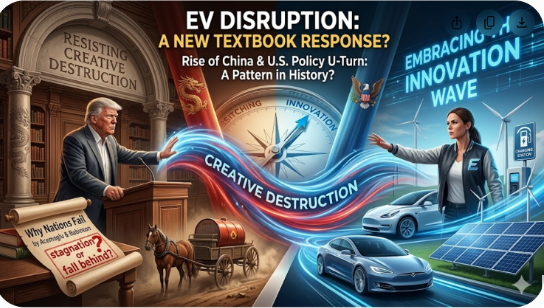
Megatrends are formed due to the rise of Reinvention waves with the potential of unleashing Creative Destruction effects, transforming innovations, jobs, businesses and the economy. has become a catchword in the discussion of technology and Innovation. Often, megatrends grow in creating both new opportunities and also causing destruction to existing products, firms, and industries. Disruptive technologies drive such transformation. Due to the primitive emergence, it’s often difficult to spot. Moreover, some of the technologies showing early signs of high potential fade away before causing creative destruction. Detecting and nurturing such trends at an early stage is crucial. On the other hand, early detection and entry open huge opportunities down the road. Failure in doing so not only ends up in lost opportunity. But most importantly, it results in suffering from the destruction of existing products, firms, and jobs. Such reality demands us to pay attention to the megatrends of creative destruction. How to turn megatrends into friends as opposed to foes is a daunting challenge.
Genesis of megatrends
To meet our high expectations, jobs, firms, and profit should grow. On the other hand, we demand increasingly better-quality products at decreasing prices. This is the promise of the free Market Economy. To deliver it, the growth is shifting from a mature megatrend to a newly emerging one. Emerging megatrends create new business opportunities, jobs, and firms. They also disrupt incumbent products, firms, jobs, and also industries. This messy phenomenon is known as Schumpeter’s creative destruction. It’s also termed Christensen’s Disruptive innovation. Such creative, as well as destructive unfolding effects of megatrends, demand us to spot, cope up, and, most importantly, leverage them. Due to human beings’ relentless journey of profiting from ideas, these megatrends keep unfolding. However, each of them does not unfold as disruptive innovation. Hence, it demands careful monitoring and analysis.
Technology underpins megatrends of creative destruction
Technological developments that are slow to form but have buried high potential can influence a wide range of activities, processes, and perceptions. It often lasts, possibly for decades. They are the underlying forces driving changes in global markets, products, jobs, profitability, and our living standards. The analysis shows that riding the right waves of change, created by megatrends of creative destruction, is the most important contributor to business results. Alarmingly, missing it could lead to catastrophic destruction. For example, Sony made a fortune by spotting and investing in digital imaging. On the other hand, Kodak got bankrupt as it failed to respond. However, Canon survived.
Past megatrends of creative destruction
Some of the past megatrends are 1. Steam Engines and Automation in Textile, 2. Automobile, Airplane, and Railway, 3. Electricity and light bulbs, 4. Telecommunication and Wireless communication, 5. Sound & Video recording, broadcasting and reproduction, 6. Refrigeration and microwave heating, 7. Transistor, lithography, and microprocessors, 8. Graphical and multitouch user interfaces, 9. Internal combustion engines, Electric motors, and 10. Industrial automation.
Unfolding megatrends of creative destruction
Here are ten megatrends that will like to cause creative destruction over the next decade: 1. Artificial intelligence (AI) and machine learning, 2. The Internet of Things (IoT), 3. Wearables and augmented humans, 4. Blockchains and distributed ledgers, 5. Digitally extended realities and Digital twins, 6. Natural language processing, Voice interfaces, and chatbots, 7. Computer vision and facial recognition, 8. Unmanned aerial vehicles, 9. Cloud, Edge, and Quantum computing, and 10. Robotics, 3D printing, Process Automation, and Personal care.
Artificial intelligence (AI), and machine learning
The increasing availability of sensors, processors, and connectivity will enable designers to develop machine capability to automate the execution of knowledge. Moreover, autonomous learning capability will enable them to keep acquiring additional capabilities from experience. As a result, the comparative advantage of machines will keep increasing, particularly in performing knowledge-intensive tasks. In fact, there has been an indication that there is net job loss in the middle layer.
The Internet of Things (IoT)
This capability will offer increasing connectivity between physical space and human beings. This connectivity will keep powering innovations for better monitoring, supervision, and control. It will also provide real-time data for gathering intelligence and automating knowledge-intensive service delivery. Consequentially, resource wastage will be minimized, and productivity will be increased. For example, IoT-based Wearhouse is already reducing to locate objects. Similarly, real-time data from wearable health monitoring devices could be used to adapt the dieting prescription by an intelligent agent. In general, it will have increasing implications on the effectiveness and efficiency of our economic outputs. However, it will not cause disruption in all sectors.
Wearables and augmented humans
The continued progression of augmented reality and virtual reality technologies will significantly impact diverse areas. Online education is supposed to experience significant implications. Similarly, remote service delivery will reach a new height. The teletransportation of human consciousness will make semiautonomous machines behave like human beings. Instead of transferring human beings or factories, consciousness could be transported over the net. Some of the promises which are being made in the age of intelligent machines will likely significantly benefit from this trend.
Blockchains and distributed ledgers
Among many applications, this technology will likely play a role in transforming us into a cashless society. Already, exponentiation has started. Cryptocurrency is one of the examples. Such experimentations show the possibility of forming a megatrend in having creative destruction in financial services. However, will it form a megatrend of transformation yet to be answered?
Digitally extended realities and Digital twins
Digital twins are already transforming manufacturing sectors. Detailed 3D models of both products and machines are being used to program machines to adapt movement and operation in making different products. For example, major automobile companies are using technology to reconfigure factories in days as opposed to months to start producing new models of cars using the same production line. This technology will power innovations in having a transformational effect in diverse sectors starting from manufacturing to healthcare.
Natural language processing, voice interfaces, and chatbots
The progress in natural language processing is expanding the scope of interactions between machines and humans. From customer care to healthcare, the list of application areas appears to be endless. Already business process outsourcing is experiencing transformation due to the increasing human-like performance of chatbots. AI chatbots with natural language processing (NLP) and machine learning capability have an intuitive conversational interface for different types of business activities.
Computer vision and facial recognition
The development of high-resolution image sensors, particularly for meeting the growing imaging need of smartphones, is making computer vision a disruptive technology. Due to the high scale advantage, the cost of megapixel image sensors has come down to less than $10. On the other hand, low-cost, high-performing processors powering high-end smartphones are capable of performing very sophisticated algorithms in real-time. Starting from face recognition to industrial inspection, application areas of this technology appears to be endless.
Unmanned aerial vehicles
This technology has been in development for the last more or less than 100 years. Recently, the design and fabrication of the craft have been commoditized. The emergence of high-performing motors, rotor design, lithium-ion battery, and 5G connectivity has powered UAVs to fuel high-value innovations. Starting from parcel delivery to precise fertilizer spraying, there appear to be enormous opportunities.
Cloud, Edge and Quantum computing
Cloud computing took off with the promise of offering a scale advantage and a higher utilization factor than conventional computers. But the emergence of quantum computing is taking it to new heights. On the other hand, high-performance, low-cost computing is also making onboard computing often a better option. The optimum combination of these three is making many AI innovation potentials a reality.
Robotics, 3D printing, process automation, and personal care
Robots have come out of the case. They are now having flexible, intelligent behavior. As a result, they can now safely collaborate with human workers to perform complex operations. 3D printing is a specialized application area of robotics. This technology offers the opportunity to transform manufacturing, particularly for small-scale production of high-precision components. 3D printing will also transform spare parts supply chains. Robots, coupled with other technologies like digital twins and transportation of human consciousness, will likely make personal care-providing robots a reality.
Creative destruction abilities of these megatrends
There is no denying that all those megatrends in technology will keep driving innovations over the next decade. But will they cause destruction–killing jobs and destroying firms as well as industries? For example, will 3D printing make manufacturing human-free? That depends. For example, AI algorithms reach 90 to 95 percent accuracy in mimicking human-like intelligence. But the last 5% often require innate ability, which is yet to codify. Like, the role of eye contact in coordinating driving in sharing busy intersections appears to be subtle, intuitive.
But it has been found to be highly difficult to automate. Often such fine aspects may limit the pursuit of some of these megatrends to cause creative destruction. But there is no doubt that they will keep finding increasing application areas, often for incremental or sustaining innovations as opposed to disruptive ones. Further, in-depth case-specific analysis is required to have further clarity about their potential.
Illusive nature of Megatrends to cause creative destruction
In some cases, megatrends are elusive in nature. Upon showing high growth at the beginning, they saturate before taking over the performance of incumbent options. For example, autonomous driving showed very high potential to overtake human drivers’ role in making our roads safer. But before being more capable than a human driver, the AI engine has been showing signs of saturation. Such a reality often risks huge investments. For instance, more than $80 billion in investment made for autonomous vehicles is now in an uncertain state.
Uncertainties of megatrends of creative destruction
There have been multiple uncertainties in profiting from megatrends. Some of them are 1. Technology, 2. Customer preferences, 3. The response of competition, 4. Availability of complementary products and infrastructure, 5. Teams capability and culture, 6. The flow of risk capital, and 7. The Natural tendency of monopoly. On top of these, there is an issue of synchronization.
How to detect megatrends of creative destruction?
This has been a serious question. There appears to be a definite methodology as well as indicators to track for detecting and predicting. Some of them are patents, Startups, and the underlying science. The patent filing is public information. It offers some clues about megatrends. But that does offer sufficient information to predict whether underlying technology megatrend will make innovations disruptive. For example, the lithium-ion battery’s growth trend is not enough to predict whether the electric vehicle will disrupt conventional ones.
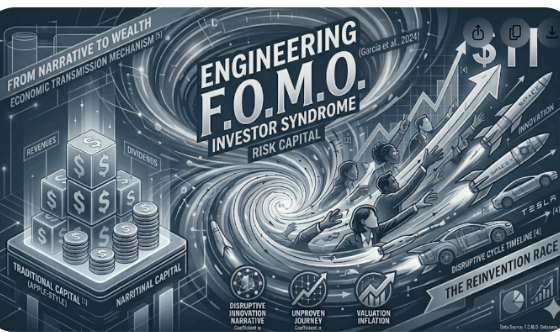
Monitoring of startups and venture capital financing offers some clues. But the current practice of predatory pricing through a flush of VC funds appears to provide misleading signals. Analysis of the publication content, as opposed to mere numbers, provides some insight into the strength of underlying science. Such insight could be useful in predicting the likely maturity in a performance gain. For example, the scientific weakness of deep learning powering AI innovations appears to be the cause of the early saturation of autonomous driving innovation.
Related articles:
An emerging megatrend: Metaverse Technology–challenges to creative destruction
Chiplet trend shaping semiconductor industry: Chiplet–for IDMs’ winning, survival or death?