THE WAVES
  • Home
  • News
    • Recent Updates
    • Weekly Newsletter
    • Monthly Newsletter
    • Quarterly Newsletter
  • Topics
    • Technology
      • Internet
      • AR/VR & Digital twins
      • Robotics
      • AI & Data Analytics
      • IoT & Wearable
      • Blockchain
      • Computing
      • Sensors & Perception
      • 3D Printing
      • Energy Tech
      • Space
      • Gadgets
    • Transformation
      • Education
      • Health
      • Transportation
      • Farming
      • Energy
      • Security
      • Mining & Blue Economy
      • Food & Living
      • Communication
      • Entertainment
      • Manufacturing
      • Work & Management
      • Public Service
    • Startups
      • Culture
      • Country
      • New Entry
      • Accelerators
      • Incubators
      • Death Valley
      • Investments
      • Exit & IPO
      • Valuation & Financing
      • Idea & IP
    • Education & Research
      • School
      • University
      • Academic Research
      • Corporate Research
      • Public-funded Research
      • Economics of Innovation
      • Growth Economics
      • Training
      • Publications
      • Patents & IP
    • Industrial Revolutions
      • Future of Work
      • Sustainable Development
      • Smart Manufacturing
      • Job Transformation
      • Industry Transformation
      • Competition & Monopoly
      • National Response
      • Education & Skills
      • Social Change
    • Investment & Review
      • Public
      • Corporate
      • Venture Capital
      • Capital Market
      • Philanthropy
      • Personality
    • Inventions
    • Automation
  • Strategy
    • Value Proposition
      • Product
      • Process
      • Sustainability Goals
      • Business Model
      • Complementary
      • Externality
    • Innovation
      • Disruptive Innovation
      • Incremented Innovation
      • Sustaining
      • Schumpeter’s Creative Destruction
      • Redesign for Winning
    • Competition
      • Leading
      • Following
      • Blue Ocean
      • Monopolisation
      • Porter’s Five Forces
      • Business Cycle
    • Intangible Assets
      • Human Capital
      • R&D Management
      • Tripple Helix
      • Intellectual Property
      • Productive Knowledge
      • Technology Managment
    • Competence
      • Organization Agility
      • Innovation Culture
      • Infrastructure
      • R&D facility
      • Great by Choice
      • Build to Last
      • Good to Great
    • Technology Acquisition
      • Scientific discovery
      • Invention
      • Fusion
      • Adaptation & Refinement
      • Licensing
      • Start-up acquisition
  • Policy
    • Technology Development
    • Industry
    • Innovation Diffusion
    • Jobs, Privacy & Security
    • Regulation & Law
    • Sustainability
    • Equity & Inclusiveness
    • Climate Change
    • Environment
  • Opinion
    • Opinion
  • Megatrends
    • Individual Preferences
    • Planet and Society
    • Technology
    • Political Economy
    • Market Power & Monopoly
    • Globalisation
    • Schumpeter’s creative destruction
    • Startups & VC
    • Human Role in Work
    • Value of Natural Resources
    • Patents & Ideas for Redesign
  • Publication
    • Case Studies
    • Magazine
    • Books
    • Reports
    • White Papers
    • Journals
THE WAVES In-depth investigation on Technology, Society, and Policy dynamics for interpreting the past as well as present, and predicting the future so that success rate of pursuing ideas, start-ups, and innovation economy increases.

Technology, Society and Policy

Winning and Losing in Reinvention Race : keeps unfolding: --making America’s innovation bucket leaky, creating prosperity out of reinvention, and turning invention successes transitory
THE WAVES
  • Home
  • News
    • Recent Updates
    • Weekly Newsletter
    • Monthly Newsletter
    • Quarterly Newsletter
  • Topics
    • Technology
      • Internet
      • AR/VR & Digital twins
      • Robotics
      • AI & Data Analytics
      • IoT & Wearable
      • Blockchain
      • Computing
      • Sensors & Perception
      • 3D Printing
      • Energy Tech
      • Space
      • Gadgets
    • Transformation
      • Education
      • Health
      • Transportation
      • Farming
      • Energy
      • Security
      • Mining & Blue Economy
      • Food & Living
      • Communication
      • Entertainment
      • Manufacturing
      • Work & Management
      • Public Service
    • Startups
      • Culture
      • Country
      • New Entry
      • Accelerators
      • Incubators
      • Death Valley
      • Investments
      • Exit & IPO
      • Valuation & Financing
      • Idea & IP
    • Education & Research
      • School
      • University
      • Academic Research
      • Corporate Research
      • Public-funded Research
      • Economics of Innovation
      • Growth Economics
      • Training
      • Publications
      • Patents & IP
    • Industrial Revolutions
      • Future of Work
      • Sustainable Development
      • Smart Manufacturing
      • Job Transformation
      • Industry Transformation
      • Competition & Monopoly
      • National Response
      • Education & Skills
      • Social Change
    • Investment & Review
      • Public
      • Corporate
      • Venture Capital
      • Capital Market
      • Philanthropy
      • Personality
    • Inventions
    • Automation
  • Strategy
    • Value Proposition
      • Product
      • Process
      • Sustainability Goals
      • Business Model
      • Complementary
      • Externality
    • Innovation
      • Disruptive Innovation
      • Incremented Innovation
      • Sustaining
      • Schumpeter’s Creative Destruction
      • Redesign for Winning
    • Competition
      • Leading
      • Following
      • Blue Ocean
      • Monopolisation
      • Porter’s Five Forces
      • Business Cycle
    • Intangible Assets
      • Human Capital
      • R&D Management
      • Tripple Helix
      • Intellectual Property
      • Productive Knowledge
      • Technology Managment
    • Competence
      • Organization Agility
      • Innovation Culture
      • Infrastructure
      • R&D facility
      • Great by Choice
      • Build to Last
      • Good to Great
    • Technology Acquisition
      • Scientific discovery
      • Invention
      • Fusion
      • Adaptation & Refinement
      • Licensing
      • Start-up acquisition
  • Policy
    • Technology Development
    • Industry
    • Innovation Diffusion
    • Jobs, Privacy & Security
    • Regulation & Law
    • Sustainability
    • Equity & Inclusiveness
    • Climate Change
    • Environment
  • Opinion
    • Opinion
  • Megatrends
    • Individual Preferences
    • Planet and Society
    • Technology
    • Political Economy
    • Market Power & Monopoly
    • Globalisation
    • Schumpeter’s creative destruction
    • Startups & VC
    • Human Role in Work
    • Value of Natural Resources
    • Patents & Ideas for Redesign
  • Publication
    • Case Studies
    • Magazine
    • Books
    • Reports
    • White Papers
    • Journals

  • Automation

Automation Technologies: from mechanical to software

Sensors, software and wireless connectivity centric automation technologies have been fuelling creative waves of destructions

  • Md. Rokonuzzaman
  • Created: December 31, 2021
  • Last updated: January 12, 2022
Uplifting of automation technologies to software has been powering creative waves of destruction in both products and production processes

Automation technologies are at the core of the advancement of products and systems. The advancement of electronics, computers, and software has been enriching automation technologies since the birth of Transistor in 1947. Sensors, microprocessors and microcontrollers, software, controllers and actuating devices, programmable logic controller, connectivity, computer vision, machine learning, and AI are core members of automation technologies

The automation journey started with rudimentary mechanical technology, known as mechanization. The mechanical force was the primary means of mechanical devices to sense and interact to show automation behavior. Hence, early automation was in a primitive form.  But over the last more than a hundred years, there has been technology development encompassing all significant automation segments. Electronic sensors and software are now at the core of detecting signals, understanding the situation, making decisions, and taking actions. As a result, starting from the toaster, smartphone to airplane and oil refinery, every product and system is getting increasingly more intelligent. Hence, automation benefits have been growing.  Some of the familiar members of modern automation technologies are explained below.  

Sensors: a critical member of automation technologies

Why are our mobile handsets smart? How do they know the environment and adjust behavior autonomously? At the core of smartness is a set of sensors.  A sensor is a signal detection device. It detects events or changes in its environment in the form of electrical signals, and subsequently, it sends them to signal processors. A signal processor could be as simple as an electronic comparator; it could also be highly complex software detecting moving objects in fog. Some of the standard sensors are the thermostat, thermocouple, anemometer, gyroscope, and cameras. It’s a critical building block of automation systems. Due to its importance, industrial products have a growing number of them.

For example, a state-of-the-art smartphone contains close to twenty different types of sensors. Some of the common sensors of smartphones are an accelerometer, gyroscope, magnetometer, GPS, biometric sensors, and ambient light sensor. These sensors provide the signal to smartphone software to perform an array of tasks autonomously. For example, based on the signal of the accelerometer sensor, the smartphone automatically detects phone orientation and changes the presentation of contents from landscape to portrait and vice versa. Similarly, industrial automation systems or autonomous cars rely on an array of sensors to provide signals for understanding the processing states, detecting defects, and many more.

Microprocessors and Microcontrollers:

Since the unveiling of the microprocessor 8080 chip by Intel, in 1974, automation technologies have been advancing in a rapid space. Soon after, low-cost single-board computers emerged for processing automation algorithms. Before it, engineers had to rely on numerous discrete components and small-scale integrated circuits for processing sensor signals in digital space. Or, they had to rely on expensive minicomputers. Subsequently, many input and output devices have been added to microprocessors turning a single-board computer into a microcontroller. Microcontroller began the journey with the shipping of Intel 8048 chips in 1977, targeting the control applications. A typical microcontroller is a single-chip computer containing one or more central processing units, both RAM and ROM memory, and programmable input and output peripherals.

Automation technologies: Software

In automation applications, the software runs on microcontrollers or single-board computers. In certain instances, it also runs on a general-purpose computer. The job of the software is to process data provided by the sensors to gather information to detect the changes in the operating environment and understand the situation.  Software varies from operating system to application. Even for control applications, real-time operating systems have been developed. QNX is a very popular commercial Unix-like real-time operating system for automation system engineering.

Controllers and actuating devices:

Centering around the controller, a closed-loop feedback system comprises (1) input, (2) process being controlled, (3) output, (4) sensing elements, and (5) controller and actuating devices. The basic approach of automation is to compare the measured output value with the reference input value and reduce the difference between them. In response to control signals, actuating devices perform operations for reducing the difference. Significant types of controllers are analog, digital, and discrete events. One of the common controllers is proportional integral derivative (PID). It’s a common control technique for regulating temperature, flow, pressure, speed, and other process variables. 

In manufacturing, higher-level tasks should be executed in a particular sequence. Often, a ladder logic type controller is suitable. Hence, the development of a programmable logic controller (PLC) or programmable controller started in the 1960s. This is an industrial computer for the control of manufacturing processes. Based on inputs provided by sensors, it controls the execution of a set of tasks in a programmable sequence by directing machines and robotic devices.

Numerical control (NC) is a valuable automation technology for controlling machines by means of numbers. Its development started during the late 1940s and early 1950s. There are also several other techniques for developing controllers. Some of them are fuzzy and neuro-fuzzy control, adaptive control, and discrete event control.

SCADA is an automation technology for supervisory control and data acquisition (SCADA). It comprises computers and networked data communications. It also offers graphical user interfaces for high-level supervision of machines and processes.

Actuating devices are in charge of taking actions in response to control signals. Some of the common actuating devices are switches, motors, valves, relays, power screws, and solenoid switches.

Connectivity: increasing flexibility of automation technologies

Connectivity is another essential member of automation technologies. So far, wire and cables are used to connect individual devices to a wireline connectivity network.  But the situation is changing with 5G cellular connectivity. Very low latency, high reliability, and vast capacity make 5G technology suitable for connecting sensors, controllers, and actuators wirelessly. As a result, complexity and rigidity in industrial automation will sharply fall.   

End effectors and Computer vision:

The application of robots has taken automation to a new height. For leveraging robots, the development of both end effectors and computer vision has been crucial for automation technologies. An end effector is a device at the end of a robotic arm. For robots, this is an actuating device to perform an operation in the environment. There is a long list of end effectors starting from a human hand-like device to a screwdriver. Computer vision is another member of automation technologies. This technology offers human-like vision capability to the automation system. The advancement of end effectors and commuter vision is critical for enabling robots to take over increasing roles from humans, making the production process human free.   

Machine learning and AI: making automation technologies human-like smart

Machine learning and artificial intelligence technologies are progressing in advancing automation technologies further. Some of the typical desires like teaching by showing is getting closer to reducing the cost of development and complexity of reconfiguration of automation solutions. Furthermore, current automation system capabilities are limited by design. But we would like to have them grow by gaining knowledge and skill from experience. Hence, the advancement of machine learning algorithms has been nurturing new technology to develop self-growing automation systems.   

In a nutshell, modern technologies have been progressing to advance automation for turning products and production systems smarter. Hence, the description of automation technologies encompasses a vast subject. Their progress has been reducing and also accentuating automation disadvantages. The urgency of addressing the automation issue has been the driver of the invention and advancement of technologies.  Furthermore, the unfolding of the Fourth Industrial Revolution is about the progression of automation technologies, fueling a creative wave of destruction for hyper-performance.  
Enlighten others

Subscribe

Subscribe now to our newsletter

You May Also Like

Evolving machines due to humanity’s quest for smarter machines to get jobs done better
View Post
  • 7 min

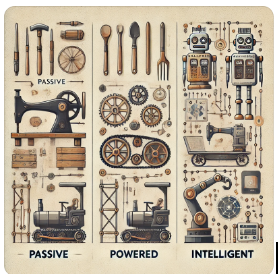
Evolving Machines: From Passive Tools to Autonomous Agents

Employment Trends in the Age of Automation tend to favor advanced countries due to wealth from R&D jobs and reshoring of manufacturing jobs
View Post
  • 6 min

Employment Trends in the Age of Automation: A Tale of Two Worlds

Disappearing middle jobs has been due to ease of automation and education and training earned codified knoweldeg and skills of college graduates
View Post
  • 8 min

Disappearing Middle Jobs: Why Automation Hits College Graduates Hardest in a Replication Economy?

Leave a Reply Cancel reply

Your email address will not be published. Required fields are marked *

Subscribe

Subscribe now to our newsletter

Principles

  • Economics of Technology
  • Innovation Economics
  • Technology & Innovation Policy

History & Observations

  • Technology History
  • Innovation History
  • Strategy & Policy in retrospect
  • Entrepreneurs & Innovators
  • Startups & Corporations
  • Patents & Publications
  • Design & Redesign Thinking

About Us

  • Who we are
  • What we deliver
  • Genesis
  • Mission
  • Scope
  • Editorial & Advisory Board
THE WAVES
  • Contact
  • Advertise

Input your search keywords and press Enter.