How to define industrial revolutions? Why are there some start and end dates, and birthplaces of industrial revolutions? Furthermore, what is the role of industrial revolution technologies? An industrial revolution is defined by a burst of inventions and reinventions of products and production processes—creating and destroying firms, jobs, and industries. But to make it happen, we need emerging technologies. Hence, industrial revolution technologies play a critical role. Their emergence starts the process of inventions and reinventions. Like living things, they grow and saturate. Besides, at maturity, they are taken over. As a result, industrial revolutions also begin, grow, and mature—having dates for the beginning and maturity. As entrepreneurial activities of inventions and reinventions occur near the vicinity of emerging technologies, industrial revolutions also have a birthplace. Furthermore, the speed, depth, and breadth of industrial revolutions depend on the potential of underlying technologies and entrepreneurial activities.
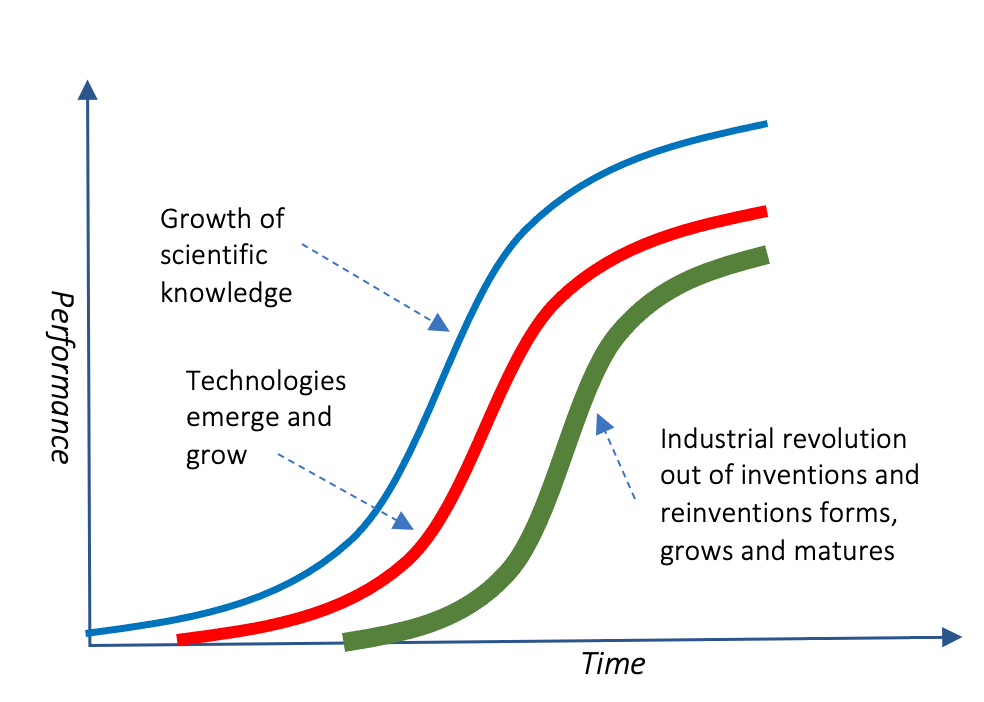
To understand the role of technologies in defining industrial revolutions, we should pay attention to the technology life cycle. Technologies are like living things. Irrespective of the firepower in fueling industrial revolutions, they emerge in a primitive form. In the beginning, they are frail. Their growth demands the supply of nutrients—scientific knowledge. Once the initial uncertainty is overcome and latent profit-making potential out of invention and Reinvention becomes visible, the scientific research race for supplying the knowledge rapidly grows. During this ramp-up phase, the burst of inventions and reinventions also originate and grow—forming an industrial revolution. But like living things, technologies also mature. Consequentially, inventions and reinventions also mature—resulting in maturity and the end of an industrial revolution. Hence, both industrial revolutions and technologies fueling them have a typical S-curve-like life cycle. Some of the industrial revolution technologies are defined below.
First Industrial Revolution Technologies:

The first industrial revolution started in the 1760s. This is due to the reinvention of energy providing means in productive activities and mechanization. As we know, the steam engine took over the role of humans, animals, windmills, and water wheels. Interestingly, the steam engine was invented long before 1760. It got birth as aeolipile, aeolipyle, eolipile, or hero engine in the 1st century AD. The hero engine inventor relied on intuitive knowledge and Craftsmanship. Hence, it remained stunted for almost 1500 years. Due to frail capability, it could not fuel inventions or reinventions. Hence industrial revolution did not take place due to its birth.
However, with the work of Thomas Newcomen, James Watt, and others, the Steam engine started to leave behind its 1500 years old infancy period. In 1712, Newcomen made a notable contribution to the growth of steam engines. His designed engine could transmit continuous power. Subsequently, James Watt improved the Newcomen steam engine into the Watt steam engine in 1776. To reduce energy wastage due to the need for repeatedly cooling and reheating the cylinder, Watt introduced a design enhancement, the separate condenser. It avoided the waste of energy and radically improved the power, efficiency, and cost-effectiveness of steam engines. The steam engine started powering reinventions of energy supply to productive activities along the way.
Craftsmanship to mechanical engineering
In addition to the advancement of the steam engine, graduation of the practice of constructing machines from craftsmanship to mechanical engineering played a key role in introducing mechanization in production. It also helped optimize the design and construction of steam engines. The knowledge of physics and mathematics developed by Sir Isaac Newton and others contributed to this important engineering capability.
Furthermore, the development of thermodynamics played a key role in the further advance of steam engines. The advancement of this science by Nicolas Léonard Sadi Carnot (1824) and William Thomson is quite notable. Through such advancements, the Steam engine grew from infancy to adulthood by the 1840s. By the 1860s, both the steam engine and mechanization started to reach maturity, slowing down the advancement of invention and reinvention race, marking the end of the first industrial revolution by the 1870s.
Second Industrial Revolution Technologies:
Two important technologies played a vital role in fueling inventions and reinventions to unfold the second industrial revolution. The first is the internal combustion engine (ICE), and the next one is electricity. In the 1600s, internal combustion was invented as a gunpowder engine, also known as an explosion engine or Huygens’ engine. However, it could not supply continuous energy. The formation of mechanical engineering, scientific knowledge about thermodynamics, and the development of metallurgical science by Josiah Willard Gibbs and others led to the invention of the modern internal combustion engine. Notable contributions came from Étienne Lenoir around 1860 and Nicolaus Otto in 1876.
On the electricity front, the development of electrical science and the formation of electrical engineering over 1752-1865 led to another important technology core invention. During the 2nd half of the 19th century, the latest potential of these two technologies started beckoning inventors to invent and reinvent.
Kick start of Creative waves of destruction
In the transportation sector, Carl Benz embarked on reinventing horse wagons and steam cars with the internal combustion engine. The filling of a patent by Carl Benz for a “gas-powered vehicle” in 1886 started the reinvention of the transportation sector. Its growth kept creating and destroying jobs, firms, and industries. On the other hand, the reinvention of Robert Hooke’s lover phone by Alexander Graham Bell by changing the acoustic technology core with electrical, in 1876, gave birth to the modern telephone industry.
Furthermore, among others, Thomas Alva Edison embarked on inventions of many products and systems like light bulbs and power systems for harnessing the latent potential of electricity technology. Hence by the 1870s, the human race was ready to witness another round of weaves of inventions and reinventions out of ICE and electricity—giving birth to the second industrial revolution. Along the way, Radio and Television also got invented out of electricity.
Besides, the fusion of mechanical engineering with electrical inventions like motors and electromagnets led to electro-mechanical engineering. Hence, inventors started leveraging it by reinventing manufacturing activities into a production line—opening the path of benefiting from automation and job division.
Third Industrial Revolution Technologies:
Over 1900-1950, significant advancements took place in our scientific knowledge in understanding material and energy. A new branch of science emerged. This is about understanding material as atoms, electrons, protons, and neutrons and their interactions. Understanding of energy and light took the form of quanta and photons and their waveform propagation model. It is about quantum mechanics. Like the way Newtonian mechanics powered mechanical engineering, steam engines, and the first industrial revolution, quantum mechanics became ready to power another wave of inventions and reinventions, the unfolding of the third industrial revolution.
In 1947, scientists at Bell Laboratories invented a new technology—the Transistor. This is a device having no moving mechanical components. Through voltage, it controls the flow of electronics—making it able to amplify signals and turn on or off the flow of electrons or current. Very soon, inventors found this technology core to invent and reinvent products. For example, the telephone, Radio, Television, and computer—among others—got reinvented. As a result, waves of Creative Destruction started unfolding, giving birth to the third industrial revolution. Besides, quantum mechanics and our knowledge of other branches led to the invention of sensors, fiber optics, and photolithography processes. Hence, the human race witnessed the growth of the Internet, computer, communication, software, laser, mobile phones, smartphones, and machines with sensing and perceiving capabilities.
Fourth Industrial Revolution Technologies:
The advancement of sensors and software for capturing and interpreting data has been forming a new technology core. We call it artificial intelligence and machine learning. This technology core is empowering inventors to reinvent machines having human-like intelligence. Furthermore, our knowledge about quantum chemistry has been advancing electric batteries—making them suitable to reinvent gasoline automobiles. Besides, the advancement of micro machines, speech processing, natural language processing, and computer vision is leading to mimick human-hand, voice, vision, and skin-like features in machines. Hence, we are under the impression that a new wave of inventions and reinventions in the form of intelligent battery-powered machines will likely unfold shortly—giving birth to the fourth industrial revolution.
It seems that each industrial revolution is about the unfolding of a bust of creative waves of destruction—in the form of inventions and reinventions. To fuel them, we need industrial revolution technologies. But is there a way to predict? Is it just a random phenomenon? Before the emergence of those technologies, we need to form a science base. Hence, to predict the beginning and growth, we should keep monitoring the undercurrent—science base and emerging technology base.
Of course, upon kick-starting, both science base and invented technologies will keep progressing. Along the way, the speed, intensity, and breadth of the unfolding industrial revolution will also keep expanding. However, they will slow down and saturate—reaching the point for another wave to take off.
...welcome to join us. We are on a mission to develop an enlightened community by sharing the insights of Wealth creation out of technology possibilities as reoccuring patters. If you like the article, you may encourage us by sharing it through social media to enlighten others.