Innovations are too important to remain as a magical act. They are vital for creating increasing Wealth from depleting sources. However, often, they unfold as waves of the tsunami–causing devastation to jobs, firms, industries, and economies. They catch us off guard. Hence Waves of Innovation theory detect underlying patterns for offering us the science of predicting, coping up, and leveraging innovations.
Waves of innovation are like a tsunami. Despite their transformational effects, both in creating and destroying opportunities, we are helpless to interpret and predict them. The unfolding of innovations as Creative Destruction to products, jobs, firms, and industries is often mystical to us. In addition to creating new opportunities, it also causes pain due to the disordered transformation. Apart from job loss and the disappearance of firms, creative destructions of innovation run the risk of destabilizing countries and economies. It’s too expensive for us to accept them as a magical outcome—leaving no room for predicting, preparing, and leveraging. Hence, waves of innovation theory dig down to detect structure in the form of reoccurring patterns. It also looks into interrelationship, and flux of change of different attributes of technologies and innovations, being shaped in the competitive Market Economy.
Underlying forces and characteristics forming the foundation of waves of innovation theory
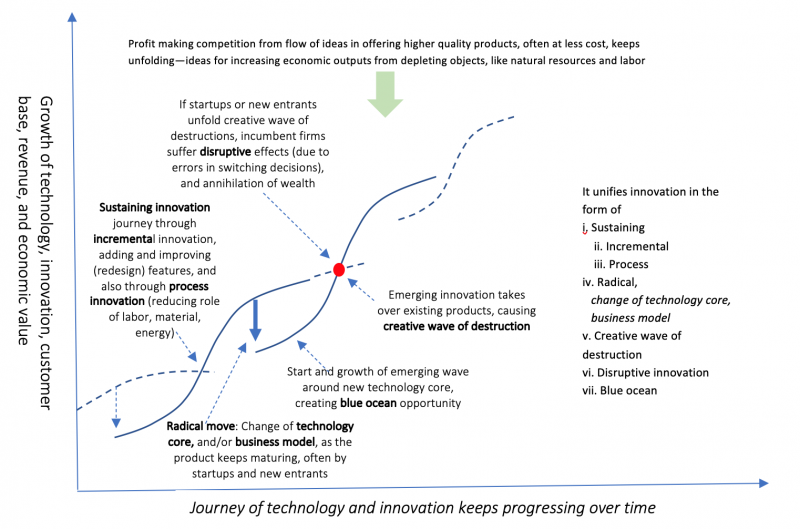
We are after better products for our increasing the quality of living standards. In serving our purposes better in a sustainable way, we should also consume fewer resources. Hence, we need ideas for innovating increasingly better products at less cost. The continuum Flow of Ideas depends on the progression of underlying technology cores. Subsequently, innovators succeed in making incremental advancements of innovation. For example, we are getting increasingly better microwave ovens or automobiles with added features and enhanced fuel efficiency. There appears to be no creative destruction or disruption due to Incremental innovation. However, there is a limit to how far we keep advancing underlying technologies for pursuing incremental innovation. Eventually, the technology life cycle keeps flattening, and advancement starts slowing down.
To overcome the limitation of maturing technology core, we embark on scientific discoveries and technological inventions. We use newly invented technologies to change matured products’ technology cores for creating another stream of ideas. However, the change of technology cores, invariably, leads to the formation of new waves of innovation in embryonic form. Neither innovations around emerging technology cores are better, nor are they attractive to existing customers. To nurture these embryonic waves of innovation, the relentless journey of technology advancement starts. On the one hand, targeted technologies should be amenable to advancement to make the products incrementally better and cheaper. To leverage it, innovators must be on the course of pursuing the journey of perfection. The challenge has been in understanding the underlying structure of innovation waves around new technology cores, and relentlessly pursuing the journey, often required to last over years and decades.
Creative destruction and Disruptive innovation demand the formation of the theory of waves of innovation
If technologies are adequately amenable to progression and innovators remain on course for a sufficient period, embryonic innovation waves emerge as a creative destruction force. Once primitive products grow as a strong substitute for existing products. Subsequently, the demand for incumbent products suffers from creative destruction. Jobs in producing and consuming incumbent products, around mature technology core, start disappearing. By the way, we call this effect of innovation waves Schumpeter’s creative destruction. Furthermore, among the firms enjoying the success of innovating and producing incumbent products, who fail to make switching to emerging waves of innovation fail at the appropriate time will suffer from disruptive effects. Prof. Clayton term this effect of Schumpeter’s creative destruction as disruptive innovation.
Due to the huge transformational effect, we badly need to detect underlying structure forming waves of innovation theory. Let’s analyze some examples in detecting patterns or structures residing beneath the innovation waves.
The light bulb’s long life is unfolding as innovation waves
The perfection of the invention of producing light by heating carbon filament with electric current led to filament light bulb innovation. Like many other great innovations, this new wave of innovation in producing light emerged in primitive form. Thomas Alpha Edison’s light bulb began the journey having only a few hours of light production capacity. The long journey kept perfecting the light bulb, extending life over 200 hours, led to destroying candles, oil lamps. However, by 1950, the incremental progression of filament lamps reached saturation. This led to changing the technology core of the light bulb, giving birth to the fluorescent light bulb. It started another wave of light bulb innovation. However, by the 1970s, a sign of saturation of fluorescent lighting started getting visible.
As opposed to perceiving it as a barrier, a small Japanese company Nichia perceived it as an entry opportunity to the lucrative global lighting business. Hence, Nichia started sponsoring R&D for making LED a better technology core for the light bulb. This journey led to the Nobel prize-winning scientific discovery in making LED light bulbs as a better and cheaper alternative. It has created a great entry opportunity for Nichia. However, the uprising of LED’s innovation wave disrupted Edison’s GE’s lighting business. This remarkable light bulb innovation has been unfolding as waves of innovation.
Examples from the digital space
One of the most talked-about news in the digital era is the uprising of Bill Gates as the world’s richest person. To many, it is a miracle. To his wealth accumulation success, word processing played an important role. This journey of word processing began by changing the technology of the core of writing in 1867. It’s a typewriter—purely a mechanical machine. To grow as creative destruction to handwriting for office work, this wave of innovation took 20-years long incremental advancement. Subsequently, a major wave of innovation came from changing the technology core with software. The uprising of this wave led to the monopolization of the word processing industry by Microsoft, the emergence of Bill Gates as the richest person, and the loss of millions of typists’ jobs all across the world.
Another remarkable wave of innovation is the uprising of cellular phones in general, and smartphones in particular. Of course, the cellular service rolled out in Sweden in 1956 was too primitive. It was an automated mobile phone system for private vehicles. After 30 years, although Motorola’s Dynatac 8000X weighing 2lbs was also primitive in today’s standard. However, it was far better than a vacuum tube technology-based device weighing 40kg in 1956. The uprising of cell phones as waves of innovation has caused creative destruction to landline phones. Moreover, waves of innovation of smartphones caused destruction to many products and disruption to numerous firms. Besides, Apple has emerged as the most valuable company in the world by leveraging the iPhone’s waves of innovation.
Digital camera innovation is a remarkable example
Among many other innovation waves in the digital space, the digital camera’s uprising is a remarkable one. In the early 1970s, Sony embarked on changing the technology core of the camera. However, an 8×8 image sensor-based digital camera was extremely primitive. Sony’s decade-long R&D led to the release of a portable video camera in the market. Subsequently, the wave of digital camera innovation emerged as creative destruction to the film-based camera. Due to failing to switch at the right time, America’s Kodak suffered from disruption—subsequently filing bankruptcy.
Waves of innovation shaping the automobiles
Over the whole period of the 19th century, innovators experimented with different technology cores, like the steam engine, hydrogen, electric battery, and internal combustion, to replace horses in transportation. Subsequently, the wave of the internal combustion engine (ICE) automobile innovation started gaining momentum. Consequentially, ICE automobile innovations caused destruction to the horse wagon industry. Due to the maturity of ICE, innovators embarked on changing the technology core. It led to the emergence of hydrogen-powered automobiles in the later 1990s. However, the fuel cell technology does not appear to be highly amenable for making hydrogen vehicles a creative wave of destruction to ICE automobiles in a reasonable short period.
On the other hand, the lithium-ion battery’s continued progression opened the opportunity to use a battery instead of the fuel cell to change the ICE. Hence, innovators have boarded this journey. However, battery technology needs to progress further to make the electric vehicle wave strong enough to cause destruction to ICE automobiles. On the other hand, the uprising of the wave of electric vehicle innovation will perhaps have a devastating effect on many economies.
Waves of innovation theory offer the frame of reference for systematically ferreting out value
There are numerous other examples of innovation waves, starting from computer storage to printer, in transforming the way we get our jobs done. The unfolding of these waves of innovation progress through uncertainty and messy transformation. Jobs, firms, industries, and even economies suffer from turbulence. With the given gravity, we cannot rely on the magical outcome. Fortunately, there are underlying patterns forming waves of innovation theory. This Theory of Innovation offers guidance to innovators to systematically ferret out value from ideas instead of getting puzzled and randomly experimenting with one after another.
On the other hand, policymakers and development planners can predict and respond with appropriate policies and investments. Startups, angel investors, and VC fund managers also get the guidance to figure out where the investment should fuel successful waves of innovation. Moreover, future generations will be empowered to steer innovation-led growth more predictably.