THE WAVES
  • Home
  • News
    • Recent Updates
    • Weekly Newsletter
    • Monthly Newsletter
    • Quarterly Newsletter
  • Topics
    • Technology
      • Internet
      • AR/VR & Digital twins
      • Robotics
      • AI & Data Analytics
      • IoT & Wearable
      • Blockchain
      • Computing
      • Sensors & Perception
      • 3D Printing
      • Energy Tech
      • Space
      • Gadgets
    • Transformation
      • Education
      • Health
      • Transportation
      • Farming
      • Energy
      • Security
      • Mining & Blue Economy
      • Food & Living
      • Communication
      • Entertainment
      • Manufacturing
      • Work & Management
      • Public Service
    • Startups
      • Culture
      • Country
      • New Entry
      • Accelerators
      • Incubators
      • Death Valley
      • Investments
      • Exit & IPO
      • Valuation & Financing
      • Idea & IP
    • Education & Research
      • School
      • University
      • Academic Research
      • Corporate Research
      • Public-funded Research
      • Economics of Innovation
      • Growth Economics
      • Training
      • Publications
      • Patents & IP
    • Industrial Revolutions
      • Future of Work
      • Sustainable Development
      • Smart Manufacturing
      • Job Transformation
      • Industry Transformation
      • Competition & Monopoly
      • National Response
      • Education & Skills
      • Social Change
    • Investment & Review
      • Public
      • Corporate
      • Venture Capital
      • Capital Market
      • Philanthropy
      • Personality
    • Inventions
    • Automation
  • Strategy
    • Value Proposition
      • Product
      • Process
      • Sustainability Goals
      • Business Model
      • Complementary
      • Externality
    • Innovation
      • Disruptive Innovation
      • Incremented Innovation
      • Sustaining
      • Schumpeter’s Creative Destruction
      • Redesign for Winning
    • Competition
      • Leading
      • Following
      • Blue Ocean
      • Monopolisation
      • Porter’s Five Forces
      • Business Cycle
    • Intangible Assets
      • Human Capital
      • R&D Management
      • Tripple Helix
      • Intellectual Property
      • Productive Knowledge
      • Technology Managment
    • Competence
      • Organization Agility
      • Innovation Culture
      • Infrastructure
      • R&D facility
      • Great by Choice
      • Build to Last
      • Good to Great
    • Technology Acquisition
      • Scientific discovery
      • Invention
      • Fusion
      • Adaptation & Refinement
      • Licensing
      • Start-up acquisition
  • Policy
    • Technology Development
    • Industry
    • Innovation Diffusion
    • Jobs, Privacy & Security
    • Regulation & Law
    • Sustainability
    • Equity & Inclusiveness
    • Climate Change
    • Environment
  • Opinion
    • Opinion
  • Megatrends
    • Individual Preferences
    • Planet and Society
    • Technology
    • Political Economy
    • Market Power & Monopoly
    • Globalisation
    • Schumpeter’s creative destruction
    • Startups & VC
    • Human Role in Work
    • Value of Natural Resources
    • Patents & Ideas for Redesign
  • Publication
    • Case Studies
    • Magazine
    • Books
    • Reports
    • White Papers
    • Journals
THE WAVES In-depth investigation on Technology, Society, and Policy dynamics for interpreting the past as well as present, and predicting the future so that success rate of pursuing ideas, start-ups, and innovation economy increases.

Technology, Society and Policy

Winning and Losing in Reinvention Race : keeps unfolding: --making America’s innovation bucket leaky, creating prosperity out of reinvention, and turning invention successes transitory
THE WAVES
  • Home
  • News
    • Recent Updates
    • Weekly Newsletter
    • Monthly Newsletter
    • Quarterly Newsletter
  • Topics
    • Technology
      • Internet
      • AR/VR & Digital twins
      • Robotics
      • AI & Data Analytics
      • IoT & Wearable
      • Blockchain
      • Computing
      • Sensors & Perception
      • 3D Printing
      • Energy Tech
      • Space
      • Gadgets
    • Transformation
      • Education
      • Health
      • Transportation
      • Farming
      • Energy
      • Security
      • Mining & Blue Economy
      • Food & Living
      • Communication
      • Entertainment
      • Manufacturing
      • Work & Management
      • Public Service
    • Startups
      • Culture
      • Country
      • New Entry
      • Accelerators
      • Incubators
      • Death Valley
      • Investments
      • Exit & IPO
      • Valuation & Financing
      • Idea & IP
    • Education & Research
      • School
      • University
      • Academic Research
      • Corporate Research
      • Public-funded Research
      • Economics of Innovation
      • Growth Economics
      • Training
      • Publications
      • Patents & IP
    • Industrial Revolutions
      • Future of Work
      • Sustainable Development
      • Smart Manufacturing
      • Job Transformation
      • Industry Transformation
      • Competition & Monopoly
      • National Response
      • Education & Skills
      • Social Change
    • Investment & Review
      • Public
      • Corporate
      • Venture Capital
      • Capital Market
      • Philanthropy
      • Personality
    • Inventions
    • Automation
  • Strategy
    • Value Proposition
      • Product
      • Process
      • Sustainability Goals
      • Business Model
      • Complementary
      • Externality
    • Innovation
      • Disruptive Innovation
      • Incremented Innovation
      • Sustaining
      • Schumpeter’s Creative Destruction
      • Redesign for Winning
    • Competition
      • Leading
      • Following
      • Blue Ocean
      • Monopolisation
      • Porter’s Five Forces
      • Business Cycle
    • Intangible Assets
      • Human Capital
      • R&D Management
      • Tripple Helix
      • Intellectual Property
      • Productive Knowledge
      • Technology Managment
    • Competence
      • Organization Agility
      • Innovation Culture
      • Infrastructure
      • R&D facility
      • Great by Choice
      • Build to Last
      • Good to Great
    • Technology Acquisition
      • Scientific discovery
      • Invention
      • Fusion
      • Adaptation & Refinement
      • Licensing
      • Start-up acquisition
  • Policy
    • Technology Development
    • Industry
    • Innovation Diffusion
    • Jobs, Privacy & Security
    • Regulation & Law
    • Sustainability
    • Equity & Inclusiveness
    • Climate Change
    • Environment
  • Opinion
    • Opinion
  • Megatrends
    • Individual Preferences
    • Planet and Society
    • Technology
    • Political Economy
    • Market Power & Monopoly
    • Globalisation
    • Schumpeter’s creative destruction
    • Startups & VC
    • Human Role in Work
    • Value of Natural Resources
    • Patents & Ideas for Redesign
  • Publication
    • Case Studies
    • Magazine
    • Books
    • Reports
    • White Papers
    • Journals

  • Design & Redesign Thinking
  • Editor's Pick
  • Good to Great

Incremental Innovation of Smartphone Camera—grown as sustaining and disruptive innovation

Evolution of smartphone camera from incremental innovation feature to core area for sustaining and disruptive innovation offers pattern for systematic ideas

  • Md. Rokonuzzaman
  • Created: October 22, 2020
  • Last updated: January 17, 2022
Incremental innovation of smartphone camera has grown as the core area for sustaining smartphones in competition, and to cause disruption

The challenge for winning with Innovation is not about generating a Flow of Ideas and engaging in random experimentation. Instead, the challenge is systematically ferreting out value from the market out of ideas. The evolution of Incremental innovation of smartphone cameras to sustaining and Disruptive innovation offers a pattern of systematic idea generation. In absence of such patterns, often innovators come up with a flow of ideas creating screening challenges. Hence, we should look for such patterns for systematically generating ideas for extracting value from the market.

Since the description of the mobile phone’s camera feature in the March 1995 Business Week article, there has been a race in improving the camera feature. It emerged just as a simple incremental innovation. Eventually, it became a core module of smartphones. In fact, the initial camera of the mobile phone was of no use. However, over time, this incremental innovation of the smartphone camera has grown as a strong force of sustaining and disruptive innovation. 

From incremental innovation of smartphones to the core of sustaining innovation

In the early days, smartphone cameras were used to capture low-resolution, highly noisy images. But it was good to have features. Particularly, children were more interested in it than adults. However, the addition of a front-facing camera jumped the attractiveness of having a good mobile phone camera. In fact, it created a new selfie culture. On top of it, the ease of sharing those selfies over social networks created a new craze of using mobile phone cameras. Hence, mobile phone makers got into the race of releasing successive better versions with improved cameras. On the other hand, users were badly waiting for a higher quality camera too. Hence, it emerged as a core area of innovation for sustaining the mobile phone handsets in the competition.          

For sustaining smartphones in competition—the camera has emerged as a powerful technology core

In the competition space, smartphones are like a seasonal crop. At regular intervals, successive versions must be realized for sustaining in the competition space. Hence, likely many other smartphone makers, for sustaining the iPhone in the competitive market, Apple has been using camera advancement as the core area for releasing successive better versions. For example, in 2010, Apple added high dynamic range imaging to iPhone. To sustain this seasonal crop in the market, Apple kept going back to the camera again and again to release subsequent better versions. Examples are panorama photos (2012), True Tone flash (2013), optical image stabilization (2015), the dual-lens camera (2016), portrait mode (2016), portrait lighting (2017), and night mode (2019).

However, feature addition strategy or war for sustaining innovation in the competition, sometimes, leads to adding irrelevant features. For example, a Chinese phone maker OnePlus has added an ‘X-ray’ vision feature. The addition of an infrared sensor in its camera module produces see-through images. Of course, it’s another new feature. But’s its usage raises social and cultural concerns. Hence, OnePlus was forced to disable the feature.  Hence, in addition to exploiting technology’s capability of adding another feature, we should also look for the purpose it serves.

Disruptive effects emerged from incremental innovation of smartphone camera 

Still & Video camera 

The digital camera emerged in the late 1980s as Creative Destruction to the film camera. However, Sony’s success in causing disruption to Kodiak did not last long. At the dawn of the 21st century, the smartphone camera started growing. On the one hand, the pixel count was increasing. Furthermore, the speed of capturing each frame was also improving. By 2010, both still and portable video cameras suffered the burn of creative destruction from the smartphone. Hence, those camera makers suffered from disruptive effects.  

DSLR 

So far, it appears to us that it’s not feasible for smartphone cameras to produce some of the image features which we get through different effects of lenses with DSLR cameras. However, high-end smartphone cameras are gathering distance data. They are fusing them with visual data collected by the phone’s other camera sensors. Hence, the camera gets a much better understanding of the objects in front of it. Such development is opening computational means to produce interesting effects. For example, it can make objects in the foreground appear sharp and distinct from the background features. Dialing in those nuances leads to an autofocus function that creates far more true-to-life photographs. This is closer to those captured by a conventional DSLR camera with a full-sized lens. 

The depth effect offered by smartphone cameras gives photos the “bokeh” effect that blurs the background layer and places the foreground subject in sharp focus. The addition of the depth camera data will go a long way, even making it possible to adjust the focus or blur of more than two layers in a photo. Hence, this computational means is opening the opportunity to imitate DSLR camera features in smartphones. This path of development will likely lead to a rise as a creative wave of destruction to the DSLR camera. 

Robots 3D eye—a new era of disruptive innovation emerging from incremental innovation of smartphone camera

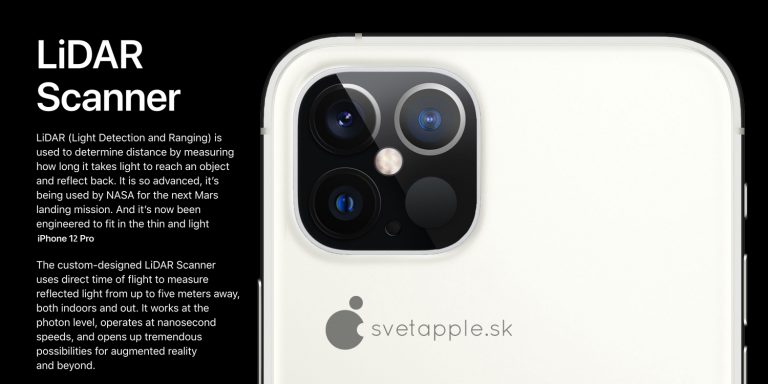
Sustaining competition force around the camera has been advancing from high resolution still and video images to depth data points—gathered through laser. For example, iPhone 12 usages Sony’s Lidar technology. This camera system propjets 30,000 infrared dots on the surface of the user’s face to form a 3D map of its contours. For measuring the depth of each of these dots, it usages the direct time-of-flight” approach. The laser sends out bursts of photons. Upon being deflected off objects or surfaces within the camera’s view, some of them bounce back to a small sensor housed near the camera. The software uses the time of their round trip to derive the objects’ distance or surfaces from the camera lens. 

Miniaturization of this LIDAR capability at a couple of hundred-dollar costs is opening a new possibility for Robot innovation. The LIDAR system offering more accuracy to tasks such as measuring spaces, objects, or people is an immense help for Robots to understand and manipulate the physical world, like the way a human does. Robots equipped with the high-resolution 3D eye will be able to undertake many jobs which they could not do before. Hence, this camera technology development for the smartphone will likely lead to a series of creative destruction, even causing disruptive effects. 

The LIDAR effect will also make AR experiences on the phone better. The depth data, along with additional data from the other camera sensors and motion sensors, will help the AR software more accurately place digital images. Such development could be leveraged in developing AR-based user interfaces in diverse areas starting from medical surgery to eLearning.  

Innovation pattern—from incremental to forming the core of sustaining and disruptive innovation

In the late 1990s, sustaining innovation of mobile phones was centered around aesthetic design. It rapidly moved to imitate PDA-like features, turning mobile phone handsets into the smartphone. Sustaining innovation race was to release successive better versions with increasing PDA-like features. With the release of the iPhone in 2007, the sustaining innovation race switched to multi-touch-based user interfaces. Increasing the screen size also emerged as a sustaining innovation strategy.

In the evolution of mobile phones, cameras emerged as an incremental feature. Over time, it has grown as a strong force for sustaining innovation. Along the way, it has caused creative destruction to both still and video cameras. With its computational imaging capability out of depth feature, the smartphone camera is progressing to cause destruction to DSLR cameras. Moreover, LIDAR-based 3D imaging cameras of smartphones will likely power robots to take over many jobs that they could not perform before.      

The changing role of camera features in mobile phones offers us an innovation pattern. In certain cases, a feature may emerge as just an incrementable advancement. However, if the technology core of that incremental feature is amenable to rapid progression, that feature may change the role. Subsequently, it may take the role of sustaining the main product, in this case, it is the smartphone, in the competition space. Along with its progression for playing the role of sustaining innovation, this incremental feature may even grow as a creative destruction force to other products. Detection and exploitation of such a pattern offer help in systematic idea generation for extracting value from the market. 
Enlighten others

Subscribe

Subscribe now to our newsletter

You May Also Like

Which Type of R&D Should Be the Focus of Bangladesh and many other less developed countries?
View Post
  • 3 min

Types of Research and Development

Bangladesh can turn its high-tech parks into engines of prosperity by housing R&D wings of local producers
View Post
  • 3 min

Bangladesh’s High-Tech Park Owe: Can Low-Tech Be a Solution?

How speculative markets and continuous storytelling combine to decouple asset valuation from delivery of innovations
View Post
  • 8 min

The Rise of Muskism Turning Musk a Trillionaire: Narrative-Driven Capital Accumulation and the Illusion of Disruptive Innovation

Leave a Reply Cancel reply

Your email address will not be published. Required fields are marked *

Subscribe

Subscribe now to our newsletter

Principles

  • Economics of Technology
  • Innovation Economics
  • Technology & Innovation Policy

History & Observations

  • Technology History
  • Innovation History
  • Strategy & Policy in retrospect
  • Entrepreneurs & Innovators
  • Startups & Corporations
  • Patents & Publications
  • Design & Redesign Thinking

About Us

  • Who we are
  • What we deliver
  • Genesis
  • Mission
  • Scope
  • Editorial & Advisory Board
THE WAVES
  • Contact
  • Advertise

Input your search keywords and press Enter.