THE WAVES
  • Home
  • News
    • Recent Updates
    • Weekly Newsletter
    • Monthly Newsletter
    • Quarterly Newsletter
  • Topics
    • Technology
      • Internet
      • AR/VR & Digital twins
      • Robotics
      • AI & Data Analytics
      • IoT & Wearable
      • Blockchain
      • Computing
      • Sensors & Perception
      • 3D Printing
      • Energy Tech
      • Space
      • Gadgets
    • Transformation
      • Education
      • Health
      • Transportation
      • Farming
      • Energy
      • Security
      • Mining & Blue Economy
      • Food & Living
      • Communication
      • Entertainment
      • Manufacturing
      • Work & Management
      • Public Service
    • Startups
      • Culture
      • Country
      • New Entry
      • Accelerators
      • Incubators
      • Death Valley
      • Investments
      • Exit & IPO
      • Valuation & Financing
      • Idea & IP
    • Education & Research
      • School
      • University
      • Academic Research
      • Corporate Research
      • Public-funded Research
      • Economics of Innovation
      • Growth Economics
      • Training
      • Publications
      • Patents & IP
    • Industrial Revolutions
      • Future of Work
      • Sustainable Development
      • Smart Manufacturing
      • Job Transformation
      • Industry Transformation
      • Competition & Monopoly
      • National Response
      • Education & Skills
      • Social Change
    • Investment & Review
      • Public
      • Corporate
      • Venture Capital
      • Capital Market
      • Philanthropy
      • Personality
    • Inventions
    • Automation
  • Strategy
    • Value Proposition
      • Product
      • Process
      • Sustainability Goals
      • Business Model
      • Complementary
      • Externality
    • Innovation
      • Disruptive Innovation
      • Incremented Innovation
      • Sustaining
      • Schumpeter’s Creative Destruction
      • Redesign for Winning
    • Competition
      • Leading
      • Following
      • Blue Ocean
      • Monopolisation
      • Porter’s Five Forces
      • Business Cycle
    • Intangible Assets
      • Human Capital
      • R&D Management
      • Tripple Helix
      • Intellectual Property
      • Productive Knowledge
      • Technology Managment
    • Competence
      • Organization Agility
      • Innovation Culture
      • Infrastructure
      • R&D facility
      • Great by Choice
      • Build to Last
      • Good to Great
    • Technology Acquisition
      • Scientific discovery
      • Invention
      • Fusion
      • Adaptation & Refinement
      • Licensing
      • Start-up acquisition
  • Policy
    • Technology Development
    • Industry
    • Innovation Diffusion
    • Jobs, Privacy & Security
    • Regulation & Law
    • Sustainability
    • Equity & Inclusiveness
    • Climate Change
    • Environment
  • Opinion
    • Opinion
  • Megatrends
    • Individual Preferences
    • Planet and Society
    • Technology
    • Political Economy
    • Market Power & Monopoly
    • Globalisation
    • Schumpeter’s creative destruction
    • Startups & VC
    • Human Role in Work
    • Value of Natural Resources
    • Patents & Ideas for Redesign
  • Publication
    • Case Studies
    • Magazine
    • Books
    • Reports
    • White Papers
    • Journals
THE WAVES In-depth investigation on Technology, Society, and Policy dynamics for interpreting the past as well as present, and predicting the future so that success rate of pursuing ideas, start-ups, and innovation economy increases.

Technology, Society and Policy

Winning and Losing in Reinvention Race : keeps unfolding: --making America’s innovation bucket leaky, creating prosperity out of reinvention, and turning invention successes transitory
THE WAVES
  • Home
  • News
    • Recent Updates
    • Weekly Newsletter
    • Monthly Newsletter
    • Quarterly Newsletter
  • Topics
    • Technology
      • Internet
      • AR/VR & Digital twins
      • Robotics
      • AI & Data Analytics
      • IoT & Wearable
      • Blockchain
      • Computing
      • Sensors & Perception
      • 3D Printing
      • Energy Tech
      • Space
      • Gadgets
    • Transformation
      • Education
      • Health
      • Transportation
      • Farming
      • Energy
      • Security
      • Mining & Blue Economy
      • Food & Living
      • Communication
      • Entertainment
      • Manufacturing
      • Work & Management
      • Public Service
    • Startups
      • Culture
      • Country
      • New Entry
      • Accelerators
      • Incubators
      • Death Valley
      • Investments
      • Exit & IPO
      • Valuation & Financing
      • Idea & IP
    • Education & Research
      • School
      • University
      • Academic Research
      • Corporate Research
      • Public-funded Research
      • Economics of Innovation
      • Growth Economics
      • Training
      • Publications
      • Patents & IP
    • Industrial Revolutions
      • Future of Work
      • Sustainable Development
      • Smart Manufacturing
      • Job Transformation
      • Industry Transformation
      • Competition & Monopoly
      • National Response
      • Education & Skills
      • Social Change
    • Investment & Review
      • Public
      • Corporate
      • Venture Capital
      • Capital Market
      • Philanthropy
      • Personality
    • Inventions
    • Automation
  • Strategy
    • Value Proposition
      • Product
      • Process
      • Sustainability Goals
      • Business Model
      • Complementary
      • Externality
    • Innovation
      • Disruptive Innovation
      • Incremented Innovation
      • Sustaining
      • Schumpeter’s Creative Destruction
      • Redesign for Winning
    • Competition
      • Leading
      • Following
      • Blue Ocean
      • Monopolisation
      • Porter’s Five Forces
      • Business Cycle
    • Intangible Assets
      • Human Capital
      • R&D Management
      • Tripple Helix
      • Intellectual Property
      • Productive Knowledge
      • Technology Managment
    • Competence
      • Organization Agility
      • Innovation Culture
      • Infrastructure
      • R&D facility
      • Great by Choice
      • Build to Last
      • Good to Great
    • Technology Acquisition
      • Scientific discovery
      • Invention
      • Fusion
      • Adaptation & Refinement
      • Licensing
      • Start-up acquisition
  • Policy
    • Technology Development
    • Industry
    • Innovation Diffusion
    • Jobs, Privacy & Security
    • Regulation & Law
    • Sustainability
    • Equity & Inclusiveness
    • Climate Change
    • Environment
  • Opinion
    • Opinion
  • Megatrends
    • Individual Preferences
    • Planet and Society
    • Technology
    • Political Economy
    • Market Power & Monopoly
    • Globalisation
    • Schumpeter’s creative destruction
    • Startups & VC
    • Human Role in Work
    • Value of Natural Resources
    • Patents & Ideas for Redesign
  • Publication
    • Case Studies
    • Magazine
    • Books
    • Reports
    • White Papers
    • Journals

  • Editor's Pick
  • Strategy

China’s AI Strategy for Winning the Race—getting jobs done better

In contrast to inflating valuation, China has been focusing on improving and leveraging AI for performance gain

  • Md. Rokonuzzaman
  • Created: November 13, 2025
  • Last updated: November 14, 2025
China's AI strategy has a winning chance as it focuses on incremental advancement for performance gain as opposed to inflating valuation of firms and driving GDP growth out of AI expenditure
China’s AI strategy has a winning chance as it focuses on incremental advancement for performance gain as opposed to inflating valuation of firms and driving GDP growth out of AI expenditure

In addition to lower energy costs, looser regulations, and higher subsidies, what else has been in China’s AI strategy to win the global AI race? Upon getting frustrated with the US restriction on selling its most advanced chips to Beijing, Nvidia chief executive Jensen Huang might have told the Financial Times: “China is going to win the AI race.” However, we should investigate it further to gain deeper insights and assess the validity of such a claim.

US companies, including OpenAI, Anthropic, Microsoft, Google, and Tesla, have made a multi-trillion-dollar bet on winning the global AI race. To give further momentum, the White House has been using its influence to marshal global resources, notably from sovereign funds of Gulf states, to fuel energy-hungry, hugely expensive data centers that power the learning of the language model. Although notable AI players have been reporting a growing loss-to-revenue ratio, the GPU gear supplier Nvidia has been reporting record-breaking profits. As a result, it became the first company in the world to attain $5 trillion valuation on Oct 29, 2025. Along with the ballooning stock prices of the so-called “magnificent seven” companies, the US economy as a whole received a significant boost from AI. It’s presumed that more than two-thirds of U.S. annualized GDP growth in the first half of 2025 came from AI-related spending. There is no doubt that, in financial numbers, the USA has the most lucrative AI success to report.

Despite it, why did Jensen Huang make that remark? Is it just a claim to influence US policies towards the export restriction of Nvidia’s high-end GPUs to China? Or has there been a deeper underlying cause due to China’s AI strategy, which may lead to China’s victory in the long-term AI race?

AI Race from the Perspective of the Evolution of Inventions and Creating a Market

Artificial intelligence has been a technology that enables the creation of machines with human-like intelligence, with the potential to unleash Creative Destruction. People also claim that the progression of AI may lead to the development of machines surpassing human intelligence, known as Artificial Superintelligence (ASI).  Such machines operate in both cognitive and physical space. For example, ChatGPT-like generative AI chatbots mimic humans’ knowledge-gathering, compilation, and production capabilities. On the other hand, Humanoid robots attempt to imitate humans in performing tasks in physical space, such as serving coffee, performing surgery, or caring for elderly people.  

Like all great technologies, AI has also started its journey in a primitive form. Despite enormous potential, AI innovations, whether as generative tools like ChatGPT or a humanoid robot, are yet to qualify for taking over humans in mainstream jobs. What should be the strategy to address this reality? There is a significant difference between the USA and China. The US companies have been after promoting the potential and scaling up premature solutions with massive subsidies to inflate the valuation of firms. On the other hand, China has been focusing on refining those tools and applying them in jobs that deliver immediate economic returns. For example, instead of investing vast amounts of money in hyper-scalar, energy-hungry GPU-populated data centers to fuel language models for claiming General AI or super AI lead, Chinese companies have been focusing on less computationally intensive, more innovative models to assist humans in performing real-life tasks.  

Similarly, as opposed to targeting the development of humanoid robots to perform any jobs that humans can do (as claimed by Elon Musk), China has been pursuing robotics to improve the quality and reduce the cost of factory and farm outputs. For example, in 2024, with nearly 300,000, China deployed almost 54 percent of global robot installations. On the other hand, US companies installed only 34,200 units in 2024, 9% decline from the previous year.

Sharp Contrast Between the USA’s and China’s AI Strategy

As explained, China’s AI strategy in physical space has been to improve the quality and reduce the cost of factory or farm outputs through precision operations, thereby improving quality and reducing waste. Hence, in contrast to the decline in the USA, China’s factory robot installation has accelerated. On the other hand, rather than claiming how far they have progressed towards artificial general or super intelligence, booming Chatbot use in China has been driven by the integration of AI into daily life and business.

China’s AI strategy has been an incremental advancement of AI’s role in helping people accomplish their real-world tasks more effectively at a decreasing cost. Therefore, they need steady advancements in AI chips and algorithms. As we know, DeepSeek stunned the world with the smartness of its algorithm, a large language model that requires far less computing power and energy to achieve performance similar to that of giants like OpenAI or Anthropic. Perhaps that is the reason China has expressed no interest in Nvidia’s high-end GPUs or AI chips. Instead, AI in China strategy prefers to keep supporting local GPU innovators like Huawei, Cambricon, and others.

Unlike China’s AI strategy of improving Jobs to be done better by leveraging AI, whether in cognitive or physical space, American firms have been developing disruptive, innovative narratives and promoting them through massive subsidies to inflate the valuation of firms that are suffering from enormous investment and increasing losses in AI revenue. While China’s AI strategy has been delivering steady progress in performance growth, the USA’s strategy has been providing valuation gain, making billionaires, and pushing the US GDP up out of loss-making revenue. Essentially, rather than improving real-life jobs, US companies are focused on spreading hype to inflate valuation. For example, Elon Musk has been spreading the hype that Tesla’s valuation will reach $25 trillion due to the company’s humanoid robot, Optimus.  

Winning AI Race—what really matters

As said, every technological possibility emerges in a primitive form. Early demonstration creates excitement, but that is not sufficient to cross the threshold and win the race. It appears that AI has yet to cross the threshold for generating profitable revenue from the mainstream market. Besides, there are issues of chasms or local maxima that may require significant scientific discoveries, as opposed to a costly brute-force method. Like in many other creative destruction races, having an early lead is not the only challenge. Instead, winning the AI race requires steady improvement and leveraging scientific discoveries to cross the threshold. Besides, along the way, profitable revenue should be generated from different segments, starting from nonconsumption, rather than pumping subsidies for pushing half-baked alternatives into the mainstream market.      

Instead of racing to be the first and creating barriers for others to enter the race, winning the race demands observing, learning, and building quietly. It seems that US companies have been reporting early progress and pursuing the brute force method to increase valuation. Such an approach creates billionaires overnight by leveraging the money of others, without creating new Wealth. On the contrary, China has been making steady progress, focusing on improving people’s lives from the social sphere to the factory. While Wall Street is lauding Elon Musk’s mission to achieve a $25 trillion valuation for Tesla following the teleoperated Optimus demonstration, China has been quietly populating its factories with robots.

Hence, there is a possibility that the USA may suffer from an AI bubble, leaving the opportunity to followers like China. Therefore, China’s AI strategy has a real chance of winning. By the way, if it happens, it would not be the first time the USA has lost after having an early lead. In retrospect, the USA lost many such early leads, resulting in the outmigration of several industries, including camera, data storage, display, lithium-ion battery, and consumer electronics, among others.
Enlighten others

Subscribe

Subscribe now to our newsletter

You May Also Like

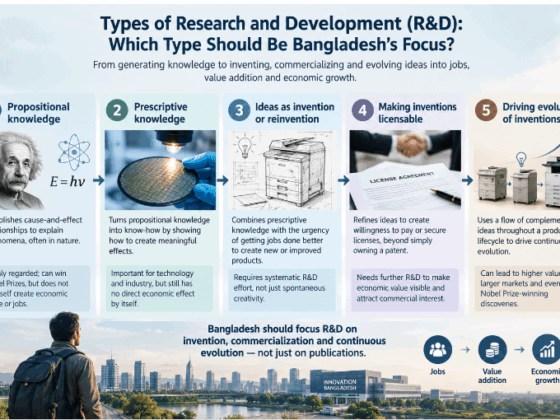
Which Type of R&D Should Be the Focus of Bangladesh and many other less developed countries?
View Post
  • 3 min

Types of Research and Development

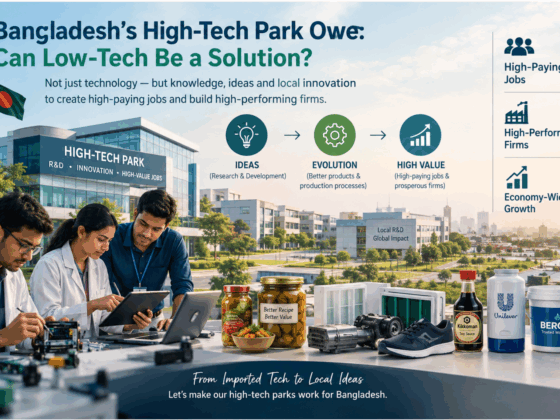
Bangladesh can turn its high-tech parks into engines of prosperity by housing R&D wings of local producers
View Post
  • 3 min

Bangladesh’s High-Tech Park Owe: Can Low-Tech Be a Solution?

angladesh's act of building high-tech parks appears to be driven by taking loans and spending money to create a sensation and a physical sign of a high-tech economy.
View Post
  • 3 min

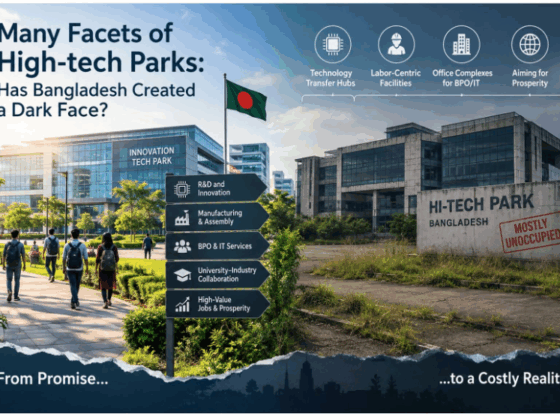
Many Facets of High-Tech Parks: Has Bangladesh Created a Dark Face?

Leave a Reply Cancel reply

Your email address will not be published. Required fields are marked *

Subscribe

Subscribe now to our newsletter

Principles

  • Economics of Technology
  • Innovation Economics
  • Technology & Innovation Policy

History & Observations

  • Technology History
  • Innovation History
  • Strategy & Policy in retrospect
  • Entrepreneurs & Innovators
  • Startups & Corporations
  • Patents & Publications
  • Design & Redesign Thinking

About Us

  • Who we are
  • What we deliver
  • Genesis
  • Mission
  • Scope
  • Editorial & Advisory Board
THE WAVES
  • Contact
  • Advertise

Input your search keywords and press Enter.