As we all know, ideas are at the core of creating Wealth from natural resources and labor. In the absence of ideas, all other production inputs are of no use. Hence, how to make a firm or a nation rich depends on how ideas are generated and utilized to enhance products and processes. Besides, as new ideas render mature ideas obsolete and competition exists, the production and adoption of ideas alone do not ensure economic prosperity. Furthermore, it does not ensure the sustainability of prosperity due to the effect of Creative Destruction. Hence, the pressing issues for prosperity are how to leverage ideas to evolve products that continue to expand the market and how to win in competition to extract value from the growing market. Therefore, making rational decisions in the face of pervasive uncertainties to capitalize on the next wave of growth through Reinvention is highly critical. The question is how far Nobel Prize-winning economic theories can help inform rational decisions for making firms and nations rich through innovative ideas. Besides, keeping them rich is equally essential.
Genesis of Economic Growth Theories Developed by the Economists
As economics is a subject of study that examines the production, distribution, and consumption of economic outputs, we tend to listen to them to drive economic prosperity. Economists are not involved in producing economic outputs. Instead, they theorize how people make economic outputs as a set of variables and their relations. Hence, their advice on shaping strategies and policies to drive economic prosperity is based on their theories. Such a theorization began with the Cobb-Douglas production function. It’s an economic model that establishes a relationship between output and two inputs, such as labor and capital. Although it includes a constant, known as total factor productivity, it is unable to describe the role of ideas in producing better quality outputs at a lower cost. This theory is rooted in the model of American manufacturing outputs from 1899 to 1922.
However, it did not take into consideration the role of ideas in innovating outputs and capital machinery, leaving the role of ideas unrecognized in the creation of wealth or economic output. Over time, economists adopted it as a dominant theory to design strategies and policies to guide less developed countries in increasing their economic output. Eventually, it formed the foundation of developing an industrial economy in less developed countries.
Missing Dimension of Theorizing Economic Prosperity out of the Production Function
The production function-based approach tends to assume a linear correlation between economic prosperity and the outputs we produce. Therefore, the challenge is to continually increase the supply of labor and capital, thereby making a firm or nation increasingly more prosperous. The underlying assumption seems to be that there has been an infinite demand for such outputs. Unfortunately, reality tells a different story. Consumption of outputs depends not only on supply. More importantly, it depends on the fitness for purpose and the price to be paid.
For example, Motorola’s mobile phone handset in 1984 weighed 3 pounds; that product was not suitable for use by farmers or students. Besides, it was priced at $ 3,995, as the cost of materials and labor to produce them was very high. Hence, scaling up production resulted in an accumulation of unsold inventory. Unfortunately, economic theories have failed to adequately cover the evolution of products, such as mobile handsets, and their implications for expanding the market and creating increasing wealth.
For the same reason, although India focused on continuing to grow a passenger car, designed by the UK’s Morris Motors, India could not scale it up to drive economic growth. Instead, it faced obsolescence.
Therefore, the production function-based economic growth model encounters a barrier, resulting in diminishing returns on capital and labor. Besides, such a model has been tempting less developed countries to pursue import substitution, encouraging infringement of intellectual properties. As a result, less developed countries did not pay attention to value ideas and create a market for them, and therefore did not participate in the race of evolution for expanding the market and winning the global competition.
Nobel Prize-winning Solow Residual Theory
Despite the dominance of the Cobb-Douglas production function, which articulates the roles of labor and capital, it was unable to adequately explain the rapid economic growth in the USA during the 1950s, 1960s, and 1970s. Hence, in Robert Solow’s analysis, the growth beyond the role of capital and labor emerged as a significant factor. He termed it a Residual. He pointed to the rapid progress of science and technology, notably due to the massive investment made by the USA during World War II for science and technology research aimed at sharpening weapons, as the underlying reason for the Solow residual. He considered it an exogenous factor that somehow affects economic output. Hence, he suggested investing in science and technology (S&T) education and research, in addition to increasing the supply of labor and capital, to drive economic growth.
However, he did not provide insights about how S&T investment creates economic value. Despite it, Robert Solow was given the Nobel Prize in 1987. Unfortunately, upon following such advice, most less developed countries have yet to produce economic outputs from the expansion of S&T education.
Nobel Prizes for Human Capital Theory
Several economists have received Nobel Prizes in Economics for their work on human capital theory. Notable ones are Gary Becker, Theodore Schultz, and Jacob Mincer. Through this theory, they promoted the belief that there is a strong linear correlation between learning and earning. Hence, people and nations saved and borrowed to invest in offering education. Despite early signs of prosperity in education, there has been a steady decline in return on education. Notably, in less developed countries, the higher the level of education, the more unemployment has become the norm. Besides, the salary difference between university graduates and primary school dropouts in many less developed countries has dropped to almost zero. In explaining this situation, economists tend to invoke the arguments of demand and supply, the quality of education, and diminishing returns as a natural phenomenon.
Nobel Prize Winning Idea and Object Theory
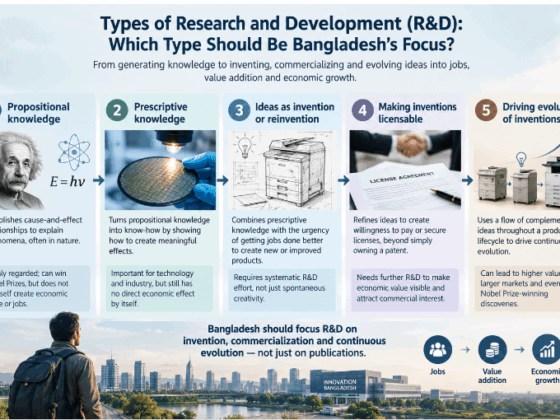
In the 1980s, the development of endogenous growth theory began to offer greater insights into how economic outputs are created and how they can be scaled up. Among many others, Paul Romer’s idea and object theory is notable, for which he won the Nobel Prize in 2018. He has argued that as we supply ideas, we produce more economic outputs from the same amount of material, energy, labor, and other inputs. Hence, firms and nations should invest more in research to drive the production of ideas and foster growth, as if there were a linear correlation between the supply of ideas and economic development. In reality, does it not happen? No.
It’s worth noting that more than 97% of patents do not generate a profit, and more than 90% of Startups fail within three years. Besides, the successes and failures are not uniformly distributed. However, his theory shed no light on this reality. Besides, he assumed that ideas have an ending life. But in fact, that is not. Hence, this Nobel Prize-winning economic theory runs the risk of misguiding firms and nations into driving growth by investing in the supply of ideas or research.
Theory of Institutions Facilitating the Idea for Growth
Daron Acemoglu, Simon Johnson, and James Robinson won the Nobel Prize in Economics in 2021 for their work on the importance of societal institutions in facilitating the flow of new ideas, thereby undermining the market for older ones. Does it mean that facilitation of the flow of new ideas is sufficient for growth? If that were the case, why can’t Canada and many other countries, despite having outstanding social institutions, continue to grow? Why can’t they repeat the past? Unfortunately, their work, aside from referencing historical lessons, did not offer clarity on how to influence wealth creation from new ideas. Hence, their work runs the risk of yielding no growth from the investment in institutions.
Nobel Prize for the Theory of Creative Destruction
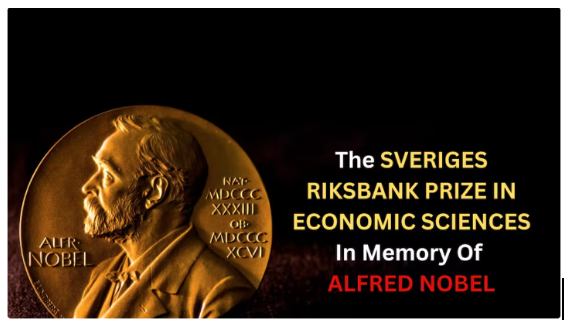
Due to an attempt to theorize the role of new ideas in destroying the demand for mature ones, coined as “creative destruction” by Prof. Schumpeter, Philippe Aghion and Peter Howitt won half of the Nobel Prize money in Economics in 2025. Joel Mokyr received the other half due to his contributions to explaining historical references about the role of creative destruction in the unfolding of the industrial revolutions. However, this phenomenon of creative destruction is not unknown to the human race, which has been pursuing it for ages as an inherent aspect of achieving better results, as reported by Carl Marx. The challenge of driving the growth of firms and nations has been in dealing with decision-making dilemmas, as explained by Prof. Clayton. Due to pervasive uncertainties, seven out of ten Innovation leaders fail to make rational decisions.
Hence, the theorization of creative destruction dynamics for reducing decision-making dilemmas is urged by the innovators. Unfortunately, this Nobel prize-winning theory did not contribute to addressing this issue. It’s worth noting that although this Nobel Prize-winning theory promotes research for new ideas, ideas of creative destruction are often free or discarded. The challenge is about making rational decisions on whether to pursue or not. Besides, by pursuing creative destruction ideas, firms and nations may get poorer. For example, the premature adoption of the Electric vehicle idea resulted in major automobile makers reporting losses, leading to the abandonment of the plan.
It appears that there have been numerous Nobel Prizes in Economics awarded for theorizing wealth creation through the expansion of economic outputs. By referring to past anecdotal references, although these theories have acknowledged the growing role of ideas, the importance of idea supply, and the role of institutions, they are ineffective in making rational decisions to create economic prosperity from investments in ideas. Due to high failure rates and non-uniform distribution of successes and failures, such theories run the risk of misguiding economic development and the growth of firms.
Nobel Prize Winning Economic Theories—can they make firms and nations poorer?
All economic theories that recognize the role of ideas as a driver of growth have promoted the thesis that there is a linear correlation between investment in research and development (R&D) or the number of researchers working in R&D and economic growth. Hence, firms and nations are being advised to adopt a policy of increasing R&D investment. However, reality suggests that the flow of research is insufficient in generating profitable revenue.
The primary challenge is making informed decisions to drive product evolution through incremental advancements and reinvention, thereby expanding the market and outperforming the competition. Unfortunately, all these Nobel prize-winning theories have not provided any clarity about the evolutionary dynamics, let alone offering insights for improving decision-making accuracy. Hence, in addition to their inefficacy, these theories have become a source of misguided beliefs and wrong guidance. In reality, most less developed countries have begun to suffer from these theories due to policy adoption as prescribed by the economists of the lending institutions.