THE WAVES
  • Home
  • News
    • Recent Updates
    • Weekly Newsletter
    • Monthly Newsletter
    • Quarterly Newsletter
  • Topics
    • Technology
      • Internet
      • AR/VR & Digital twins
      • Robotics
      • AI & Data Analytics
      • IoT & Wearable
      • Blockchain
      • Computing
      • Sensors & Perception
      • 3D Printing
      • Energy Tech
      • Space
      • Gadgets
    • Transformation
      • Education
      • Health
      • Transportation
      • Farming
      • Energy
      • Security
      • Mining & Blue Economy
      • Food & Living
      • Communication
      • Entertainment
      • Manufacturing
      • Work & Management
      • Public Service
    • Startups
      • Culture
      • Country
      • New Entry
      • Accelerators
      • Incubators
      • Death Valley
      • Investments
      • Exit & IPO
      • Valuation & Financing
      • Idea & IP
    • Education & Research
      • School
      • University
      • Academic Research
      • Corporate Research
      • Public-funded Research
      • Economics of Innovation
      • Growth Economics
      • Training
      • Publications
      • Patents & IP
    • Industrial Revolutions
      • Future of Work
      • Sustainable Development
      • Smart Manufacturing
      • Job Transformation
      • Industry Transformation
      • Competition & Monopoly
      • National Response
      • Education & Skills
      • Social Change
    • Investment & Review
      • Public
      • Corporate
      • Venture Capital
      • Capital Market
      • Philanthropy
      • Personality
    • Inventions
    • Automation
  • Strategy
    • Value Proposition
      • Product
      • Process
      • Sustainability Goals
      • Business Model
      • Complementary
      • Externality
    • Innovation
      • Disruptive Innovation
      • Incremented Innovation
      • Sustaining
      • Schumpeter’s Creative Destruction
      • Redesign for Winning
    • Competition
      • Leading
      • Following
      • Blue Ocean
      • Monopolisation
      • Porter’s Five Forces
      • Business Cycle
    • Intangible Assets
      • Human Capital
      • R&D Management
      • Tripple Helix
      • Intellectual Property
      • Productive Knowledge
      • Technology Managment
    • Competence
      • Organization Agility
      • Innovation Culture
      • Infrastructure
      • R&D facility
      • Great by Choice
      • Build to Last
      • Good to Great
    • Technology Acquisition
      • Scientific discovery
      • Invention
      • Fusion
      • Adaptation & Refinement
      • Licensing
      • Start-up acquisition
  • Policy
    • Technology Development
    • Industry
    • Innovation Diffusion
    • Jobs, Privacy & Security
    • Regulation & Law
    • Sustainability
    • Equity & Inclusiveness
    • Climate Change
    • Environment
  • Opinion
    • Opinion
  • Megatrends
    • Individual Preferences
    • Planet and Society
    • Technology
    • Political Economy
    • Market Power & Monopoly
    • Globalisation
    • Schumpeter’s creative destruction
    • Startups & VC
    • Human Role in Work
    • Value of Natural Resources
    • Patents & Ideas for Redesign
  • Publication
    • Case Studies
    • Magazine
    • Books
    • Reports
    • White Papers
    • Journals
THE WAVES In-depth investigation on Technology, Society, and Policy dynamics for interpreting the past as well as present, and predicting the future so that success rate of pursuing ideas, start-ups, and innovation economy increases.

Technology, Society and Policy

Winning and Losing in Reinvention Race : keeps unfolding: --making America’s innovation bucket leaky, creating prosperity out of reinvention, and turning invention successes transitory
THE WAVES
  • Home
  • News
    • Recent Updates
    • Weekly Newsletter
    • Monthly Newsletter
    • Quarterly Newsletter
  • Topics
    • Technology
      • Internet
      • AR/VR & Digital twins
      • Robotics
      • AI & Data Analytics
      • IoT & Wearable
      • Blockchain
      • Computing
      • Sensors & Perception
      • 3D Printing
      • Energy Tech
      • Space
      • Gadgets
    • Transformation
      • Education
      • Health
      • Transportation
      • Farming
      • Energy
      • Security
      • Mining & Blue Economy
      • Food & Living
      • Communication
      • Entertainment
      • Manufacturing
      • Work & Management
      • Public Service
    • Startups
      • Culture
      • Country
      • New Entry
      • Accelerators
      • Incubators
      • Death Valley
      • Investments
      • Exit & IPO
      • Valuation & Financing
      • Idea & IP
    • Education & Research
      • School
      • University
      • Academic Research
      • Corporate Research
      • Public-funded Research
      • Economics of Innovation
      • Growth Economics
      • Training
      • Publications
      • Patents & IP
    • Industrial Revolutions
      • Future of Work
      • Sustainable Development
      • Smart Manufacturing
      • Job Transformation
      • Industry Transformation
      • Competition & Monopoly
      • National Response
      • Education & Skills
      • Social Change
    • Investment & Review
      • Public
      • Corporate
      • Venture Capital
      • Capital Market
      • Philanthropy
      • Personality
    • Inventions
    • Automation
  • Strategy
    • Value Proposition
      • Product
      • Process
      • Sustainability Goals
      • Business Model
      • Complementary
      • Externality
    • Innovation
      • Disruptive Innovation
      • Incremented Innovation
      • Sustaining
      • Schumpeter’s Creative Destruction
      • Redesign for Winning
    • Competition
      • Leading
      • Following
      • Blue Ocean
      • Monopolisation
      • Porter’s Five Forces
      • Business Cycle
    • Intangible Assets
      • Human Capital
      • R&D Management
      • Tripple Helix
      • Intellectual Property
      • Productive Knowledge
      • Technology Managment
    • Competence
      • Organization Agility
      • Innovation Culture
      • Infrastructure
      • R&D facility
      • Great by Choice
      • Build to Last
      • Good to Great
    • Technology Acquisition
      • Scientific discovery
      • Invention
      • Fusion
      • Adaptation & Refinement
      • Licensing
      • Start-up acquisition
  • Policy
    • Technology Development
    • Industry
    • Innovation Diffusion
    • Jobs, Privacy & Security
    • Regulation & Law
    • Sustainability
    • Equity & Inclusiveness
    • Climate Change
    • Environment
  • Opinion
    • Opinion
  • Megatrends
    • Individual Preferences
    • Planet and Society
    • Technology
    • Political Economy
    • Market Power & Monopoly
    • Globalisation
    • Schumpeter’s creative destruction
    • Startups & VC
    • Human Role in Work
    • Value of Natural Resources
    • Patents & Ideas for Redesign
  • Publication
    • Case Studies
    • Magazine
    • Books
    • Reports
    • White Papers
    • Journals

  • Editor's Pick
  • Future of Work

Robots Take My Job —seven tactics for remaining relevant in the job market

Leveraging innate ability for sharpening competencies to increase barrier and offer a moving target to machine innovators

  • Md. Rokonuzzaman
  • Created: November 22, 2025
  • Last updated: November 23, 2025
Robots take my job has been a serious concern that could be dealt with by seven tactics of innate ability-centric competence sharpening

Will robots take my job? How to remain employable in an AI-driven world has been a question for all. Do we need to know how to use AI or how to behave more humanely? In the era of AI and robotics, we face a significant challenge to the future of jobs.

Big tech companies and governments have been spending trillions of dollars to develop AI and robots that can replace us in jobs. They have even been making public claims: “AI will render all jobs obsolete.” Additionally, the capital market has been rewarding them by inflating the valuation of firms that advance AI and Robots. For example, as reported by CNBC in September 2025, “led by OpenAI, seven tech Startups reach combined $1.3 trillion valuation.” Besides, Nvidia became the first company to reach $5 trillion valuation for its role in supplying AI gears, GPUs.

On the other hand, Tesla’s shareholders have offered its CEO, Elon Musk, a one-trillion-dollar pay package for selling millions of robots and autonomous vehicles so that Tesla’s valuation reaches $8.5 trillion over the next decade, up from $1.3 trillion in 2025. And Elon Musk has been claiming that Tesla’s Humanoid Optimus robot will do “anything you want.” Hence, it will effectively eliminate all physical work as a necessity for humans. Furthermore, OpenAI’s Sam Altman has been claiming Artificial general and super intelligence in the cognitive space.

Alarmingly, there has been real progress on the ground. For example, many students are learning from ChatGPT. Junior programmers’ jobs are already under threat due to ChatGPT’s code-writing capability. Robo-taxis are running on the streets. There have been demonstrations of robots performing surgeries, underscoring Musk’s claim: “Tesla’s Optimus will have superhuman surgical skills.”

It appears that AI and Robots have been advancing in both cognitive and physical domains to assume all kinds of human roles in the workplace. Hence, there has been genuine concern about whether robots will take our jobs. Staying relevant in the job market has been a growing concern. Therefore, this article presents rational analysis and advice about how to maintain an edge over machines in the job market.

Nature of jobs and human competence to play roles

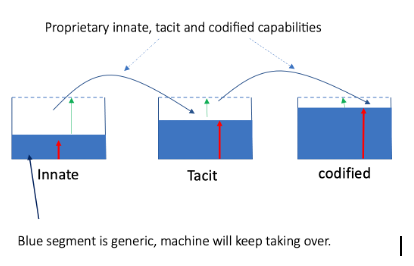
With respect to technology, there have been three kinds of jobs: (i) using products in Getting jobs done, (ii) making copies of products, and (iii) inventing, innovating, and evolving products. To perform roles in these jobs, human beings apply three types of competences: (i) innate abilities, (ii) Tacit capability, and (iii) Codified Knowledge and skills. Tech companies pursuing AI and robots have been aiming to automate these competencies so that machines can replace human roles in work. Hence, we should look into relevant competences and their degree of automation complexities, and sharpen them so that machine innovators face increasing barriers and moving targets to take our jobs.

Although we spend a few decades gathering codified knowledge and skill by attending schools, colleges, and universities, this type of human competence is highly amenable to automation, due to the progress of software, databases, and learning algorithms. The experience-earned tacit capability poses moderate complexity. Surprisingly, innovators pursuing AI and robotics face the highest complexity in imitating our fifty-two innate abilities, such as empathy, Passion for Perfection, dexterity, or hand-eye coordination.

Interestingly, every job, from teaching to serving a cup of tea or performing surgeries, requires all three types of competencies. Our challenge is to relate, execute, and refine them to increase our delivery efficiency, so that AI and robots will find moving targets to take our jobs. Here are seven tactics to leverage this opportunity to deal with the threat of robots taking our jobs.

Seven Tactics to Prevent the Threat of Robots Taking Your Jobs

1. Competence-intensive jobs: Pursue a profession requiring highly scalable innate abilities and rich codified knowledge and skill. Additionally, there should be scope for improving performance through acquiring experience earned Tacit Knowledge and skill. So, machines will face high barrier to innate abilities and need to keep evolving to take over those jobs.

2. Focus on innate ability: Find relevance of innate abilities to improve performance in getting jobs done. For example, attention to detail will enhance the prescription accuracy of a medical doctor. Similarly, finger dexterity improves performance in many jobs, like doing surgery or handling flexible materials. Additionally, those innate abilities can be further sharpened. Hence, to deal with robots taking over your job, we should focus on applying and refining our innate abilities to improve job performance continually. Besides, it will also keep increasing automation barriers.

3. Leverage innate abilities: Experience-earned tacit capability plays a vital role in our jobs. However, not everyone gathers tacit capability at the same pace. Acquiring tacit capability could be augmented by sharpening innate abilities. For example, attention to detail will improve tacit capability in almost any job. Similarly, selective attention will play a similar role in improving tacit capability at a faster rate. Hence, leveraging innate abilities to enhance the value of tacit capability and transferring it to proprietary codified knowledge and skill should be a priority.

4. Making competence as a moving target: Due to the continued advancement of innate, tacit, and codified competence, machine designers will face a moving target. Besides, the development of proprietary tacit and codified knowledge and skill base will make it relatively harder for machine designers to imitate.

5. Building proprietary competence: Machine designers have been after taking over generic competence. As explained earlier, by leveraging innate abilities, it’s feasible to develop proprietary tacit and codified capabilities. Hence, to continue to grow as a professional, having unique and non-replicable or challenging-to-replicate competencies gained through leveraging innate abilities could be a valuable tactic. More importantly, it will empower us to cope with the threat of “robots take my job.”

6. Monitoring progress: Despite the scope of sharpening innate abilities and improving tacit and codified knowledge and skills through them, their scalability is not infinite. Besides, machines have been continuously improving to imitate them. Hence, there has been a real chance that machines will eventually surpass us in the jobs we currently hold. Therefore, we should continue to monitor the progress of machines and the trend of saturation of job-specific innate abilities.

7. Switching jobs requiring more scalable innate abilities: As explained, despite our progress in sharpening and applying innate abilities and improving tacit and codified knowledge and skills, machines may become eligible to outperform us in the current jobs. Hence, do not wait to switch to the next level, offering higher scalability of your innate abilities, while maintaining the relevance of your current competence.

Robots Take My Job: Focus on seven tactics to slow down

Unlike in the past, we should not solely rely on codified knowledge and skills to secure a job and remain relevant in the job market for the rest of life. Instead, we should make a conscious effort to find, sharpen, and apply relevant innate abilities to augment our tacit and codified knowledge and skills, thereby improving job performance. As explained, if we remain focused on those seven tactics, we will continue to advance our performance and make ourselves relevant to job opportunities.  Hence, the possibility of robots taking my job will be far less than usual.   
Enlighten others

Subscribe

Subscribe now to our newsletter

You May Also Like

Which Type of R&D Should Be the Focus of Bangladesh and many other less developed countries?
View Post
  • 3 min

Types of Research and Development

Bangladesh can turn its high-tech parks into engines of prosperity by housing R&D wings of local producers
View Post
  • 3 min

Bangladesh’s High-Tech Park Owe: Can Low-Tech Be a Solution?

How speculative markets and continuous storytelling combine to decouple asset valuation from delivery of innovations
View Post
  • 8 min

The Rise of Muskism Turning Musk a Trillionaire: Narrative-Driven Capital Accumulation and the Illusion of Disruptive Innovation

Leave a Reply Cancel reply

Your email address will not be published. Required fields are marked *

Subscribe

Subscribe now to our newsletter

Principles

  • Economics of Technology
  • Innovation Economics
  • Technology & Innovation Policy

History & Observations

  • Technology History
  • Innovation History
  • Strategy & Policy in retrospect
  • Entrepreneurs & Innovators
  • Startups & Corporations
  • Patents & Publications
  • Design & Redesign Thinking

About Us

  • Who we are
  • What we deliver
  • Genesis
  • Mission
  • Scope
  • Editorial & Advisory Board
THE WAVES
  • Contact
  • Advertise

Input your search keywords and press Enter.