Abstract
This article examines the trajectory of Donald Trump’s “Make America Great Again” (MAGA) agenda through the lens of product life-cycle and industrial Reinvention theories. Using Trump’s renewed focus on Greenland and natural resources as a starting point, it argues that MAGA’s core economic promise—restoring good-paying jobs through manufacturing revival—has faltered due to a misunderstanding of how modern Wealth is created. Tariffs and reshoring efforts failed because most imported products are already in mature stages of their life cycle, where competitiveness depends on deeply embedded manufacturing ecosystems rather than protectionist policies. The article further critiques valuation-driven Innovation culture and publication-centric academia for their inability to translate invention into scalable industrial leadership. It concludes that territorial expansion or resource acquisition cannot substitute for capability-driven industrial reinvention. Sustainable American prosperity depends on winning future product cycles through skills, ecosystems, and continuous industrial renewal, not on nostalgia or geopolitical theatrics.
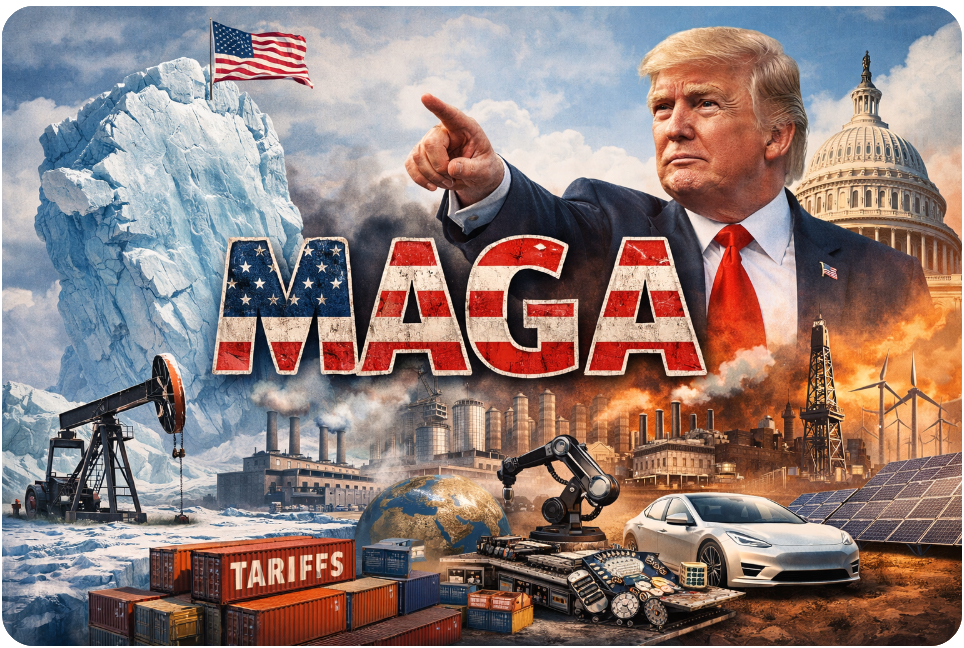
When President Donald Trump spoke at Davos and floated—yet again—the idea of acquiring Greenland, much of the world reacted with disbelief mixed with relief. Relief, because he ruled out the use of force. Disbelief, because territorial expansion has little to do with the core promise that twice carried him to the White House: Make America Great Again by restoring good-paying jobs for middle- and low-income Americans.
The Greenland episode is not an isolated eccentricity. It reflects a deeper confusion about what actually makes nations prosperous in the 21st century—and why MAGA’s industrial promise has repeatedly fallen short.
Trump’s political success rests on a real economic grievance. Large parts of America were hollowed out by decades of deindustrialization. Manufacturing jobs disappeared, wages stagnated, and communities lost their economic anchor. Trump’s answer, beginning in his first term, was straightforward: bring manufacturing back to U.S. soil through tariffs and pressure on firms to reshore production.
That strategy was cheered by many think tanks and opinion writers. Dan Breznitz famously argued that “America can’t even produce the things it invented,” implying that restoring manufacturing would restore prosperity. Yet after years of tariffs and trade wars, the results have been underwhelming. Manufacturing did not return at scale, and the promised wave of high-quality jobs never materialized.
The reason is not ideology. It is economics—and more specifically, the logic of the product life cycle.
Modern industries evolve through stages. New products are invented, then scaled, then standardized, and finally commoditized. The United States remains exceptionally strong in the earliest stages: research, invention, and frontier science. But most of the products Americans import today are already in the mature or standardized phase of their life cycle. At that stage, competitiveness depends less on tariffs and more on manufacturing ecosystems: skilled technicians, dense supplier networks, process engineering expertise, and continuous incremental improvement.
Those ecosystems no longer exist in much of the United States. They migrated to East Asia and parts of Europe over decades. Tariffs cannot recreate them overnight. Nor can political pressure substitute for missing skills, weak supplier bases, or fragmented production systems. This is why “bringing manufacturing back” proved far harder than MAGA rhetoric suggested.
Crucially, Asian competitors did not win simply through cheap labor, subsidies, or intellectual property theft. They won by industrial reinvention—taking existing products, improving them, scaling them, and dominating global markets. Flat-panel displays, consumer electronics, batteries, and now electric vehicles were not conquered by inventing first, but by reinventing better and faster. One of the notable examples has been West’s attempt to take over battery edge from CATL through the Northvolt Initiative.
During Trump’s second term, frustrated by the limits of tariffs, he turned to another promised savior: Silicon Valley. He allied with venture capitalists and tech evangelists who spoke endlessly about “disruption” and “innovation.” But here too, the results disappointed. Much of America’s venture ecosystem is optimized for valuation inflation, not industrial capability. Loss-making firms chase speculative growth, financial engineering, and market hype, while avoiding the hard, capital-intensive work of building globally competitive production.
When neither tariffs nor tech hype delivered, Trump’s focus drifted elsewhere—toward natural resources and territory. Venezuela’s oil, Greenland’s minerals, even rhetorical threats against Canada entered the conversation. But this turn misunderstands modern wealth creation. Natural resources play a diminishing role in advanced economies. Oil did not make Japan, Germany, or South Korea prosperous. Industrial capability did.
Ironically, by emphasizing oil and territory, Trump risks undermining the very industries that could secure America’s future. While the U.S. doubles down on fossil fuels, China has surged ahead in electric vehicles, batteries, and renewable energy supply chains—industries at an earlier, more dynamic stage of the product life cycle. Winning those races requires reinvention, not extraction.
Greenland, even if it were somehow acquired, would not make America great again. Nor would absorbing Canada, which itself no longer leads global innovation in major product categories. Greatness today is not measured in square miles or resource reserves. It is measured in the ability to continuously reinvent industries and capture value as technologies evolve.
So what should MAGA mean if it is to become more than a slogan?
First, the United States must abandon the illusion that yesterday’s manufacturing jobs can simply be resurrected. Mature industries rarely migrate back. Prosperity comes from creating leadership in new product cycles.
Second, America needs a capability-driven industrial strategy. That means investing in skills, production engineering, and supplier ecosystems—not just research papers or startup valuations. Innovation must be linked to manufacturing, not divorced from it.
Third, policymakers must stop relying on economists whose models reduce growth to labor, capital, and abstract “total factor productivity.” Those frameworks explain little about why nations win or lose specific industries. Industrial reinvention is messy, path-dependent, and ecosystem-driven—but it is where real wealth is created.
Finally, the country must refocus on competing where the future is being shaped: semiconductors, advanced materials, robotics, energy systems, and AI-enabled manufacturing. These are not sectors that can be secured by tariffs, territory, or hype. They require long-term coordination between industry, government, and skills institutions.
Trump was right about one thing: America’s industrial decline is real, and it matters. But greatness will not be restored by chasing Greenland or squeezing allies. It will be restored only if the United States learns how to win the global reinvention race—product by product, industry by industry.
Until then, MAGA risks drifting from an economic promise into a geopolitical distraction, loud in rhetoric but hollow in results.
Key Messages:
1. Tariffs cannot resurrect mature industries; product life cycles determine where production happens.
Once industries reach maturity and standardization, competitiveness depends on dense manufacturing ecosystems—not border taxes. MAGA’s tariff strategy failed because the U.S. no longer hosts the skills, suppliers, and process know-how required at that stage.
2. America’s industrial problem is not offshoring—it is the loss of reinvention capability.
Asian economies did not win by cheap labor or IP theft alone; they won by continuously improving, scaling, and reinventing existing products. U.S. policy focuses on invention and protection, but neglects the harder work of industrial renewal.
3. Financialized “innovation” cannot substitute for industrial capability.
Venture capital and tech hype have inflated valuations without building globally competitive production systems. Growth driven by speculation rather than manufacturing depth fails to deliver durable jobs or trade competitiveness.
4. Natural resources and territory are declining sources of national power in advanced economies.
Oil, minerals, and land acquisition do not create prosperity without industrial ecosystems. Emphasizing fossil fuels and resource extraction risks delaying leadership in EVs, batteries, renewables, and AI-enabled manufacturing—where future value will be created.
5. A credible MAGA strategy requires a capability-driven industrial policy, not symbolic geopolitics.
Restoring prosperity means linking science to production, investing in skills and supplier networks, and coordinating industry–state–education systems in emerging sectors. Without this shift, MAGA becomes a geopolitical spectacle rather than an economic program.