THE WAVES
  • Home
  • News
    • Recent Updates
    • Weekly Newsletter
    • Monthly Newsletter
    • Quarterly Newsletter
  • Topics
    • Technology
      • Internet
      • AR/VR & Digital twins
      • Robotics
      • AI & Data Analytics
      • IoT & Wearable
      • Blockchain
      • Computing
      • Sensors & Perception
      • 3D Printing
      • Energy Tech
      • Space
      • Gadgets
    • Transformation
      • Education
      • Health
      • Transportation
      • Farming
      • Energy
      • Security
      • Mining & Blue Economy
      • Food & Living
      • Communication
      • Entertainment
      • Manufacturing
      • Work & Management
      • Public Service
    • Startups
      • Culture
      • Country
      • New Entry
      • Accelerators
      • Incubators
      • Death Valley
      • Investments
      • Exit & IPO
      • Valuation & Financing
      • Idea & IP
    • Education & Research
      • School
      • University
      • Academic Research
      • Corporate Research
      • Public-funded Research
      • Economics of Innovation
      • Growth Economics
      • Training
      • Publications
      • Patents & IP
    • Industrial Revolutions
      • Future of Work
      • Sustainable Development
      • Smart Manufacturing
      • Job Transformation
      • Industry Transformation
      • Competition & Monopoly
      • National Response
      • Education & Skills
      • Social Change
    • Investment & Review
      • Public
      • Corporate
      • Venture Capital
      • Capital Market
      • Philanthropy
      • Personality
    • Inventions
    • Automation
  • Strategy
    • Value Proposition
      • Product
      • Process
      • Sustainability Goals
      • Business Model
      • Complementary
      • Externality
    • Innovation
      • Disruptive Innovation
      • Incremented Innovation
      • Sustaining
      • Schumpeter’s Creative Destruction
      • Redesign for Winning
    • Competition
      • Leading
      • Following
      • Blue Ocean
      • Monopolisation
      • Porter’s Five Forces
      • Business Cycle
    • Intangible Assets
      • Human Capital
      • R&D Management
      • Tripple Helix
      • Intellectual Property
      • Productive Knowledge
      • Technology Managment
    • Competence
      • Organization Agility
      • Innovation Culture
      • Infrastructure
      • R&D facility
      • Great by Choice
      • Build to Last
      • Good to Great
    • Technology Acquisition
      • Scientific discovery
      • Invention
      • Fusion
      • Adaptation & Refinement
      • Licensing
      • Start-up acquisition
  • Policy
    • Technology Development
    • Industry
    • Innovation Diffusion
    • Jobs, Privacy & Security
    • Regulation & Law
    • Sustainability
    • Equity & Inclusiveness
    • Climate Change
    • Environment
  • Opinion
    • Opinion
  • Megatrends
    • Individual Preferences
    • Planet and Society
    • Technology
    • Political Economy
    • Market Power & Monopoly
    • Globalisation
    • Schumpeter’s creative destruction
    • Startups & VC
    • Human Role in Work
    • Value of Natural Resources
    • Patents & Ideas for Redesign
  • Publication
    • Case Studies
    • Magazine
    • Books
    • Reports
    • White Papers
    • Journals
THE WAVES In-depth investigation on Technology, Society, and Policy dynamics for interpreting the past as well as present, and predicting the future so that success rate of pursuing ideas, start-ups, and innovation economy increases.

Technology, Society and Policy

Winning and Losing in Reinvention Race : keeps unfolding: --making America’s innovation bucket leaky, creating prosperity out of reinvention, and turning invention successes transitory
THE WAVES
  • Home
  • News
    • Recent Updates
    • Weekly Newsletter
    • Monthly Newsletter
    • Quarterly Newsletter
  • Topics
    • Technology
      • Internet
      • AR/VR & Digital twins
      • Robotics
      • AI & Data Analytics
      • IoT & Wearable
      • Blockchain
      • Computing
      • Sensors & Perception
      • 3D Printing
      • Energy Tech
      • Space
      • Gadgets
    • Transformation
      • Education
      • Health
      • Transportation
      • Farming
      • Energy
      • Security
      • Mining & Blue Economy
      • Food & Living
      • Communication
      • Entertainment
      • Manufacturing
      • Work & Management
      • Public Service
    • Startups
      • Culture
      • Country
      • New Entry
      • Accelerators
      • Incubators
      • Death Valley
      • Investments
      • Exit & IPO
      • Valuation & Financing
      • Idea & IP
    • Education & Research
      • School
      • University
      • Academic Research
      • Corporate Research
      • Public-funded Research
      • Economics of Innovation
      • Growth Economics
      • Training
      • Publications
      • Patents & IP
    • Industrial Revolutions
      • Future of Work
      • Sustainable Development
      • Smart Manufacturing
      • Job Transformation
      • Industry Transformation
      • Competition & Monopoly
      • National Response
      • Education & Skills
      • Social Change
    • Investment & Review
      • Public
      • Corporate
      • Venture Capital
      • Capital Market
      • Philanthropy
      • Personality
    • Inventions
    • Automation
  • Strategy
    • Value Proposition
      • Product
      • Process
      • Sustainability Goals
      • Business Model
      • Complementary
      • Externality
    • Innovation
      • Disruptive Innovation
      • Incremented Innovation
      • Sustaining
      • Schumpeter’s Creative Destruction
      • Redesign for Winning
    • Competition
      • Leading
      • Following
      • Blue Ocean
      • Monopolisation
      • Porter’s Five Forces
      • Business Cycle
    • Intangible Assets
      • Human Capital
      • R&D Management
      • Tripple Helix
      • Intellectual Property
      • Productive Knowledge
      • Technology Managment
    • Competence
      • Organization Agility
      • Innovation Culture
      • Infrastructure
      • R&D facility
      • Great by Choice
      • Build to Last
      • Good to Great
    • Technology Acquisition
      • Scientific discovery
      • Invention
      • Fusion
      • Adaptation & Refinement
      • Licensing
      • Start-up acquisition
  • Policy
    • Technology Development
    • Industry
    • Innovation Diffusion
    • Jobs, Privacy & Security
    • Regulation & Law
    • Sustainability
    • Equity & Inclusiveness
    • Climate Change
    • Environment
  • Opinion
    • Opinion
  • Megatrends
    • Individual Preferences
    • Planet and Society
    • Technology
    • Political Economy
    • Market Power & Monopoly
    • Globalisation
    • Schumpeter’s creative destruction
    • Startups & VC
    • Human Role in Work
    • Value of Natural Resources
    • Patents & Ideas for Redesign
  • Publication
    • Case Studies
    • Magazine
    • Books
    • Reports
    • White Papers
    • Journals

  • Editor's Pick
  • Growth Economics
  • Productive Knowledge

Missing Mechanics of Growth in Mokyr’s Quest of Finding Intellectual Origins

Most knowledge and ideas fail, growth comes from surviving substitutes

  • Md. Rokonuzzaman
  • Created: January 26, 2026
  • Last updated: January 27, 2026
Due to missing mechanics of wealth creation, Mokyr's thesis offers misleading perception about the role of knowledge in creating wealth and jobs
Due to missing mechanics of wealth creation, Mokyr’s thesis offers misleading perception about the role of knowledge in creating wealth and jobs

Abstract: This write-up challenges the dominant knowledge-centric explanation of economic growth by explicitly contrasting Joel Mokyr’s “useful knowledge” thesis with insights from the evolutionary economics of the invention lifecycle. The underlying reason has been the missing mechanics of growth. While Mokyr rightly emphasizes that society’s knowledge shapes its production possibilities, this perspective under-theorizes the mechanisms by which knowledge is transformed into Wealth in competitive markets. Historical evidence shows that many pathbreaking inventions—such as paper, mechanical clocks, and navigational instruments—failed to generate sustained growth for centuries, despite widespread awareness. On the other hand, the high mortality rate of Startups and innovations underscores this reality even in modern times. Evolutionary economics explains this puzzle by focusing on how technologies must evolve into superior substitutes, survive market competition, and scale due to scientific advancement under supportive institutional conditions. Growth, therefore, is not driven by knowledge accumulation alone, but by selection mechanisms that reward Reinvention and allow incumbents to be displaced. The abstract argues that policies in less developed countries, often inspired by knowledge-first thinking, have expanded education without generating productivity or employment. Sustainable prosperity requires competitive evolutionary pressure, not merely the diffusion of ideas.

For decades, economists have searched for the intellectual origins of modern economic growth. Among the most influential contributors is Nobel laureate Joel Mokyr, who forcefully argued that societies grow richer because they know more. In his account, the expansion and diffusion of “useful knowledge” relax production constraints, enabling technological progress and long-run prosperity. It is an elegant thesis—and an incomplete one.

The problem is not that Mokyr overstates the importance of knowledge. It is that he under-theorizes how knowledge becomes wealth in competitive markets. By stopping at what societies know, rather than how technologies evolve, compete, and substitute, Mokyr’s framework risks confusing intellectual possibility with economic reality. This confusion matters—not only for historical interpretation, but for the policy choices of less developed countries today.

Mainstream economics shares this weakness. Technology is still treated largely as an exogenous factor, hidden inside residuals such as Total Factor Productivity. Even endogenous growth theories, despite internalizing R&D and human capital, fail to explain the mechanics by which inventions mature into economically dominant technologies. Knowledge is modeled as accumulation; wealth creation, as if automatic.

Mokyr’s contribution, while richer historically, remains conceptually adjacent to this tradition. His central claim—that production possibilities are bounded by what societies know—implicitly assumes that once knowledge exists and spreads, growth follows. The Enlightenment, in this telling, unleashed prosperity by accelerating the generation and transmission of useful knowledge.

Yet history stubbornly refuses to cooperate with this logic.

Many transformative inventions—paper, mechanical clocks, navigational instruments, water-driven machinery—appeared centuries before the Industrial Revolution. Knowledge existed. Ingenious devices existed. What did not exist was sustained economic growth. If knowledge diffusion were sufficient, pre-industrial societies should have industrialized long before they did. Besides, due to the expansion of STEM education and the easy access to knowledge on the Internet, less developed countries should have experienced sustained growth, reaching high-income status. Mokyr acknowledges this puzzle, but his framework lacks the analytical tools to resolve it.

This is where evolutionary economics offers a fundamentally different—and more powerful—lens.

From an evolutionary perspective, technologies do not drive growth simply because they exist or because knowledge spreads. They drive growth only when they evolve into superior substitutes that outperform incumbent solutions under real market conditions. This process is slow, uncertain, and competitive. Most inventions fail. Many stagnate. Only a few survive long enough to reduce costs, improve reliability, integrate with complementary systems, and scale.

Schumpeter’s notion of Creative Destruction gestures toward this reality but stops short. It emphasizes destruction—how new ideas displace old ones—without fully theorizing creation: the evolutionary struggle through which technologies become viable replacements in the first place. Creative destruction describes the endpoint, not the journey.

Evolutionary economics, by contrast, treats Innovation as a selection process. Inventions must pass through stages of variation, experimentation, and market selection. They must compete globally, not just technically but economically. Crucially, institutions and policies shape this selection environment—determining whether firms are rewarded for reinvention or protected for incumbency.

This distinction exposes the policy blind spot embedded in Mokyr-inspired thinking.

Believing that knowledge expansion leads to growth, many less developed countries have poured resources into science, technology, and engineering education. Universities have expanded. Graduation numbers have soared. The stock of formal knowledge has undeniably increased. Yet productivity growth has lagged, and unemployment among science and engineering graduates has risen. The promised transformation has not arrived.

This outcome is not paradoxical—it is predictable. Knowledge accumulation without evolutionary pressure produces educated labor without competitive technologies. Engineers without firms that can experiment, fail, substitute, and scale are reduced to job seekers rather than wealth creators. When local policies protect mature industries, suppress competition, or prioritize resource allocation over technological reinvention, knowledge becomes economically idle.

Mokyr’s framework cannot fully explain this failure because it lacks a theory of technological evolution under competition. Evolutionary economics can. It shows that growth depends not on how much a society knows, but on how ruthlessly it allows technologies to compete, fail, and replace incumbents. Knowledge expands the menu of possibilities; markets and institutions decide which possibilities become realities.

The Industrial Revolution was not merely a knowledge explosion. It was a structural shift in how inventions evolved into substitutes—how machines outperformed skilled labor, how factories outcompeted workshops, and how firms continuously reinvested in improvement rather than preservation. Growth emerged not from knowing more, but from selecting better.

Until economists integrate this evolutionary logic into growth theory, confusion will persist. Knowledge will continue to be mistaken for wealth, education for productivity, and invention for innovation. And less developed countries will continue to be advised to accumulate what they already have—knowledge—while lacking what they desperately need: competitive mechanisms that turn ideas into economically dominant technologies.

Growth is not a consequence of knowing. It is a consequence of evolving.

Key Messages

Knowledge expands possibilities; competition selects wealth.
What societies know does not determine growth—what markets allow to evolve and substitute does.

Mokyr explains intellectual origins, not economic outcomes.
Useful knowledge matters, but without evolutionary selection, it remains historically impressive yet economically inert.

Most inventions fail; growth comes from surviving substitutes.
Economic progress depends on technologies that evolve into cost-effective replacements, not on invention counts.

Education without reinvention produces unemployment, not prosperity.
Expanding STEM knowledge alone creates graduates, not competitive industries.

Growth requires evolutionary pressure, not resource allocation.
Protecting incumbents and allocating capital undermines the very selection mechanisms that turn ideas into wealth.
Enlighten others

Subscribe

Subscribe now to our newsletter

You May Also Like

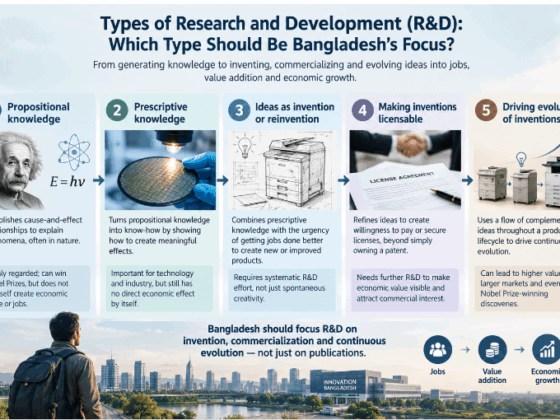
Which Type of R&D Should Be the Focus of Bangladesh and many other less developed countries?
View Post
  • 3 min

Types of Research and Development

Bangladesh can turn its high-tech parks into engines of prosperity by housing R&D wings of local producers
View Post
  • 3 min

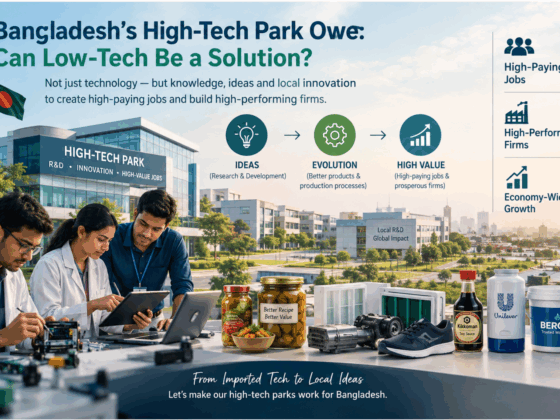
Bangladesh’s High-Tech Park Owe: Can Low-Tech Be a Solution?

Bangladesh's complex development problem could be solved by driving the evolution of products and production processes through engaging local graduates in R&D
View Post
  • 3 min

Bangladesh Suffers from a Very Complex Problem: Is There a Simple Solution?

Leave a Reply Cancel reply

Your email address will not be published. Required fields are marked *

Subscribe

Subscribe now to our newsletter

Principles

  • Economics of Technology
  • Innovation Economics
  • Technology & Innovation Policy

History & Observations

  • Technology History
  • Innovation History
  • Strategy & Policy in retrospect
  • Entrepreneurs & Innovators
  • Startups & Corporations
  • Patents & Publications
  • Design & Redesign Thinking

About Us

  • Who we are
  • What we deliver
  • Genesis
  • Mission
  • Scope
  • Editorial & Advisory Board
THE WAVES
  • Contact
  • Advertise

Input your search keywords and press Enter.