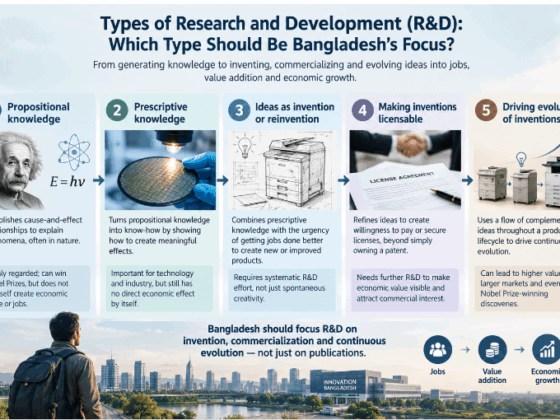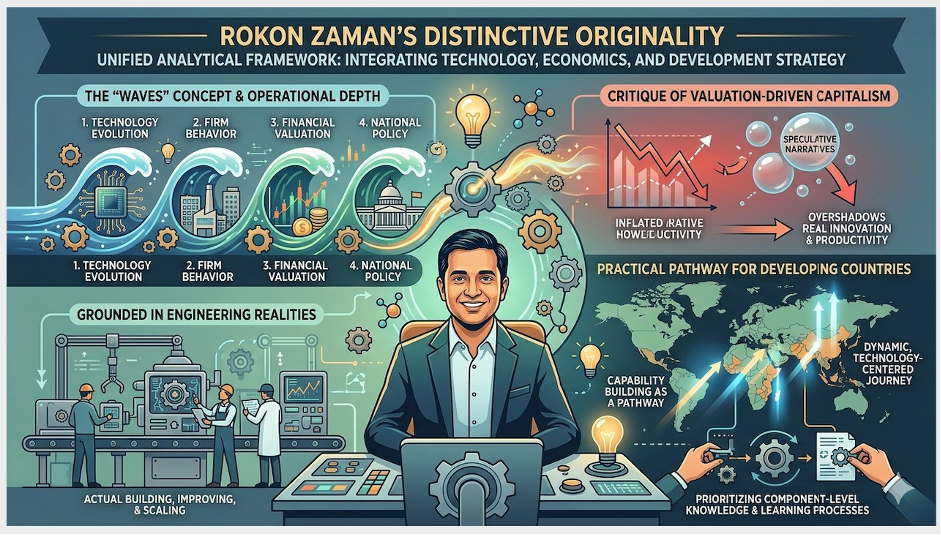
Abstract: This paper analyzes Rokon Zaman’s “waves” framework, which integrates technological change, firm dynamics, financial valuation, and development economics into a unified analytical system. The framework conceptualizes economic development as a sequence of technological waves that reshape production systems, competitive structures, and national capabilities. The paper argues that Zaman’s central contribution lies in shifting the focus of development analysis from macroeconomic aggregates to engineering-level capability formation and system-level technological mastery. It further highlights his critique of valuation-driven Capitalism, where financial expectations increasingly diverge from underlying productive Innovation. The study situates his work within established theories of innovation and development, including Schumpeterian Creative Destruction, Disruptive innovation theory, and techno-economic paradigm theory. The conclusion suggests that Zaman’s framework provides a synthetic and capability-centered perspective on modern capitalism and industrial transformation. Rokon Zaman’s work at The Waves can be understood as an attempt to reframe economic development and capitalism around the dynamics of technological waves, real innovation capability, and strategic competition—while warning against the growing dominance of hype-driven valuation over genuine Wealth creation.
Keywords: technological waves, capability building, innovation theory, development economics, valuation, industrial transformation
Part 1: Intellectual Background and Core Questions
- Origin of his “waves” thinking
- Problems he tries to solve in development economics
- Core assumptions about technology and growth
Part 2: The “Waves” Framework
- What constitutes a technological wave
- Lifecycle of waves (emergence → expansion → maturity)
- Economic implications of shifting waves
Part 3: Innovation, Competition, and Firms
- Incumbents vs new entrants
- Replication, imitation, substitution dynamics
- Role of capability building in competition
Part 4: Critique of Modern Capitalism
- Valuation-driven vs productivity-driven systems
- Financial markets and narrative economics
- Limits of speculative innovation models
Part 5: Development Economics Perspective
- Critique of traditional industrial policy
- Role of component-level capability
- Lessons for developing countries (e.g., Bangladesh context)
Part 6: Comparison with Major Theorists
- Schumpeter
- Christensen
- Carlota Perez
- Rodrik / Ha-Joon Chang
Part 7: Synthesis and Original Contribution
- What is genuinely new in his framework
- Strengths and limitations
- Policy implications
Part 8: Conclusion
- Overall intellectual contribution
- Relevance to future technological transformation
Part 1: Intellectual Background and Core Questions in Rokon Zaman’s Work
Rokon Zaman’s intellectual work, as reflected in The Waves, is rooted in a fundamental question: how do technological changes shape long-term economic development, industrial capability, and national competitiveness? Rather than treating technology as an external driver of growth, his approach places it at the center of economic transformation, arguing that development outcomes are ultimately determined by how societies engage with successive technological shifts.
At the core of his thinking is dissatisfaction with conventional development economics. Traditional models often rely on broad macroeconomic variables such as capital accumulation, labor cost advantages, or institutional reforms. Zaman’s work challenges this abstraction by emphasizing the engineering reality behind economic progress—how technologies are actually designed, produced, improved, and scaled at the component and system level. This shift in perspective moves analysis from aggregate outcomes to the underlying mechanisms of capability creation.
A second foundational influence in his framework is the idea that technological progress is not linear but occurs in structured “waves.” These waves represent periods in which new technological paradigms emerge, mature, and eventually give way to newer systems. While this idea echoes earlier long-wave theories in economics, Zaman’s emphasis is less historical and more strategic. He is concerned not only with identifying cycles but also with understanding how firms and nations can position themselves within these waves to capture value.
From this perspective, economic development becomes a problem of timing, learning, and positioning. Countries that successfully build capabilities aligned with emerging technological waves are able to move up the value chain, while those that remain locked into older waves risk stagnation or dependency. This introduces a dynamic view of competitiveness, where advantage is temporary and continuously reshaped by technological transitions.
Another important intellectual foundation in his work is the link between innovation and capability accumulation. Innovation is not treated as isolated invention but as the outcome of sustained learning processes embedded in firms, industries, and national systems. This leads to a distinction between superficial innovation—often visible in products or branding—and deep innovation, which is grounded in mastery of processes, components, and systems engineering.
Zaman’s work also reflects an implicit critique of policy approaches that prioritize financial investment or institutional reform without sufficient attention to technological depth. In his view, development strategies often fail because they underestimate the complexity of moving from low-value assembly to high-value component design and system integration. This gap between policy intention and technological reality is central to many of his arguments.
Finally, his intellectual framework is shaped by a concern with global inequality in technological capability. He views the distribution of innovation capacity across countries not as a static condition but as a shifting outcome of participation in different technological waves. This creates both opportunities and constraints for developing economies, depending on their ability to anticipate and engage with new technological paradigms.
In summary, the first layer of Rokon Zaman’s work is defined by three core ideas: technology as the central driver of development, economic change as wave-like rather than linear, and capability building as the foundation of sustainable competitiveness. These ideas set the stage for his broader analysis of firms, markets, and global development dynamics in subsequent parts of his framework.
Part 2: The “Waves” Framework in Rokon Zaman’s Work
A central pillar of Rokon Zaman’s analytical approach is the “waves” framework, which explains technological and economic change as a sequence of overlapping, transformative cycles. In this view, economic development is not a smooth, linear progression but a discontinuous process shaped by successive technological paradigms that periodically redefine productivity, competitiveness, and value creation.
Each technological wave represents a cluster of interrelated innovations—often spanning hardware, software, production systems, and organizational methods—that together form a new dominant economic structure. These waves begin with early emergence, where experimentation and uncertainty are high, followed by a phase of rapid expansion, where adoption accelerates and new markets are formed. Eventually, the wave matures, returns diminish, and the system becomes vulnerable to displacement by the next technological paradigm.
What distinguishes Zaman’s use of the waves concept is its strong emphasis on strategic positioning. He is not only interested in describing cycles but in explaining how firms and nations can actively participate in shaping them. In this sense, the waves framework becomes a tool for understanding competitive timing: entering early in a wave can lead to disproportionate gains, while late entry often results in dependency or low-value participation.
A key implication of this framework is that technological advantage is inherently temporary. No firm or country retains leadership indefinitely because each wave reshuffles the hierarchy of capabilities. This creates a dynamic environment where continuous learning and adaptation are essential for maintaining competitiveness. It also implies that past success can become a liability if organizations fail to recognize the emergence of new technological directions.
Zaman’s interpretation also connects waves to value creation in financial and industrial systems. Early-stage waves often produce uncertainty in valuation, as markets struggle to assess the potential of emerging technologies. As adoption increases, valuations may rise rapidly, sometimes exceeding underlying productivity gains. This creates a tension between real technological progress and perceived economic value, which is a recurring theme in his broader critique of modern capitalism.
Another important feature of the waves framework is its emphasis on structural transformation. Each wave does not merely introduce new products but reorganizes entire production ecosystems. For example, a new wave may alter supply chains, redefine skill requirements, and shift comparative advantages between regions. This systemic impact distinguishes waves from simple Incremental innovation.
In developing economies, the waves concept has particular significance. Zaman argues that countries often become locked into older waves by specializing in mature technologies such as low-cost manufacturing or assembly operations. While these roles can generate short-term growth, they limit long-term mobility unless accompanied by deliberate efforts to build capabilities aligned with emerging waves. Thus, successful development depends on the ability to transition from one wave to the next, rather than optimizing within a static technological environment.
Overall, the waves framework provides a dynamic lens through which technological change is understood as both an opportunity and a constraint. It highlights the importance of timing, capability accumulation, and strategic foresight, while also emphasizing that economic leadership is continuously redefined by the emergence of new technological paradigms.
Part 3: Innovation, Competition, and Firm Dynamics
In Rokon Zaman’s analytical framework, firms are the primary actors through which technological waves are translated into economic outcomes. While technological change sets the broader environment, it is firm-level behavior that determines how capabilities are built, diffused, and ultimately converted into competitive advantage. His work therefore places strong emphasis on the micro-foundations of innovation and competition.
A central idea in this part of his thinking is that competition is fundamentally shaped by the interaction between incumbents and new entrants during technological transitions. Incumbent firms often possess deep expertise, established supply chains, and accumulated capital. However, these advantages are typically optimized for the current technological wave. When a new wave emerges, incumbents may struggle to adapt because their existing capabilities become less relevant or even obsolete.
New entrants, by contrast, are less constrained by legacy systems and are often better positioned to experiment with emerging technologies. This creates a recurring pattern in which disruption is not merely a market event but a structural outcome of technological change. Zaman’s framework suggests that competitive advantage shifts not simply because of managerial decisions, but because of deeper technological discontinuities.
Within this competitive landscape, Zaman identifies a range of strategic responses that firms use to survive and adapt. These include replication, imitation, incremental innovation, and substitution. Replication involves copying existing models within the same technological wave, while imitation focuses on adopting successful external practices. Incremental innovation improves existing systems without fundamentally altering them, whereas substitution involves replacing older technologies with new paradigms aligned with emerging waves. These responses collectively determine how firms position themselves within evolving technological environments.
A key contribution of his perspective is the emphasis on capability depth rather than surface-level innovation. Many firms, according to this view, engage in what might be called “visible innovation”—product redesigns, branding changes, or incremental feature additions—without developing the underlying engineering or system-level capabilities required for sustained competitiveness. Zaman argues that true competitive strength lies in mastering components, processes, and system integration rather than merely producing market-facing innovations.
This leads to a broader distinction between short-term market success and long-term technological Resilience. Firms that rely heavily on existing wave-specific advantages may achieve rapid growth, but they are also more vulnerable to disruption when the technological paradigm shifts. In contrast, firms that invest in learning and capability accumulation across multiple layers of the production system are better equipped to transition between waves.
Another important dimension of his analysis is the role of learning curves and cumulative knowledge. Innovation is not treated as a discrete event but as a continuous process of capability building. Firms become more competitive over time not simply by innovating occasionally but by embedding learning into their organizational structure. This includes Tacit Knowledge, engineering experience, and iterative problem-solving capacities that are difficult to replicate.
Zaman’s framework also implicitly critiques simplistic notions of competition that focus only on pricing or market share. Instead, he highlights that real competition occurs at the level of technological mastery and system design. Markets may appear competitive in the short term, but underlying technological asymmetries determine long-term outcomes.
In sum, this part of his work reframes firms as adaptive entities operating within shifting technological waves. Competition is not static but continuously redefined by technological transitions, and success depends on deep capability accumulation rather than superficial innovation or short-term market positioning.
Part 4: Critique of Modern Capitalism and Valuation-Driven Innovation
A significant dimension of Rokon Zaman’s work is his critical examination of how modern capitalism has evolved in relation to technological innovation. While earlier phases of capitalism were largely associated with productivity growth, industrial expansion, and tangible output, he argues that contemporary systems increasingly emphasize financial valuation, narrative construction, and expectation-driven growth. This shift, in his view, has profound implications for how innovation is understood and rewarded.
At the center of this critique is the distinction between real innovation and perceived innovation. Real innovation refers to advances grounded in engineering capability, production efficiency, and scalable technological systems. Perceived innovation, by contrast, is often shaped by market expectations, storytelling, and speculative investment behavior. Zaman argues that modern financial markets sometimes overvalue early-stage technological promises without corresponding improvements in productive capacity.
This valuation-driven dynamic creates what he sees as a structural tension within capitalism. On one hand, financial markets are essential for mobilizing capital toward innovation. On the other hand, excessive emphasis on narratives and future potential can distort resource allocation, encouraging investment in ideas that are not yet technologically or economically mature. As a result, capital may flow disproportionately toward highly visible but underdeveloped innovations, while less glamorous but structurally important technological capabilities remain underfunded.
Zaman also links this phenomenon to the behavior of technological waves. In the early stages of a wave, uncertainty is high and valuation becomes highly sensitive to expectations. As a result, small signals of technological promise can lead to large fluctuations in market valuation. In mature stages, however, real productivity gains become more important than narrative-driven expectations. This cyclical interaction between technological maturity and financial valuation is a key element of his broader framework.
Another important aspect of his critique concerns the changing nature of capitalist success. In earlier industrial systems, wealth creation was closely tied to improvements in manufacturing efficiency, scale, and physical output. In contrast, modern systems increasingly reward firms that excel in branding, platform control, and financial engineering. Zaman suggests that this shift may weaken the connection between innovation and real economic progress.
He also raises concerns about the long-term sustainability of valuation-driven growth models. If financial markets consistently overestimate the maturity of emerging technologies, periods of rapid expansion may be followed by sharp corrections. These cycles can create instability not only in financial systems but also in innovation ecosystems, as funding volatility disrupts long-term technological development.
Despite this critique, his framework does not reject capitalism or financial markets outright. Instead, it emphasizes the need for better alignment between financial valuation and technological reality. In his view, a more balanced system would ensure that capital flows are guided not only by expectations but also by demonstrable capability development and engineering progress.
Ultimately, this part of his work reframes modern capitalism as a system in transition—one in which the traditional link between productivity and value is increasingly mediated by narrative, perception, and financial dynamics. Understanding this shift is essential, he argues, for evaluating both the opportunities and risks associated with contemporary technological waves.
Part 5: Development Economics Perspective and Capability-Centered Growth
In Rokon Zaman’s framework, development economics is reinterpreted through the lens of technological capability rather than traditional macroeconomic indicators such as capital accumulation, labor cost advantages, or export growth alone. He argues that many standard development models fail to capture the underlying technological structure that determines whether a country can move up the value chain in a sustained manner.
A central critique in his work is directed at development strategies that rely heavily on low-cost labor-based industrialization. While such strategies can generate initial growth, Zaman suggests they often trap economies in mature or declining technological waves. In these stages, countries primarily engage in assembly or low-value manufacturing activities without acquiring the deeper engineering and design capabilities required for long-term competitiveness. As a result, growth becomes dependent on external technology providers, limiting autonomy and upgrading potential.
Instead, Zaman emphasizes a capability-centered approach to development. In this view, the key determinant of progress is not simply participation in global value chains, but the depth of technological mastery achieved within those chains. This includes the ability to design components, understand system architecture, and engage in iterative innovation processes. Capability is therefore cumulative, built over time through learning, experimentation, and industrial experience.
A major implication of this perspective is that industrial policy must be more technologically informed. Rather than focusing solely on attracting foreign investment or expanding export volumes, policy should prioritize the development of engineering ecosystems, research capacity, and component-level expertise. Zaman’s framework suggests that without these foundational capabilities, countries risk remaining dependent participants in global production networks rather than becoming creators of technology.
He also highlights the importance of aligning national development strategies with emerging technological waves. Countries that successfully anticipate new waves—such as transitions in digital systems, advanced manufacturing, or intelligent technologies—can position themselves at earlier, higher-value stages of global production. Conversely, those that remain focused on older waves may find their competitive advantages eroding over time. This dynamic creates a moving target for development planning, where timing and foresight become as important as resource availability.
Another important aspect of his analysis is the critique of conventional technology transfer assumptions. Many development models assume that technology can be easily transferred from advanced to developing economies. Zaman challenges this assumption by emphasizing that true technological capability is often tacit, embedded in organizational routines, engineering experience, and complex system integration. As a result, simple transfer mechanisms are insufficient without parallel investments in learning and capability-building structures.
In this sense, development is not treated as a linear progression toward a fixed endpoint, but as a continuous process of adaptation to shifting technological landscapes. Each wave introduces new opportunities but also new barriers, requiring countries to repeatedly upgrade their capabilities rather than relying on past achievements.
Overall, this part of Zaman’s work reframes development economics as a dynamic, capability-driven process. It shifts attention from static policy prescriptions to the evolving relationship between technology, learning, and industrial transformation. The central message is that sustainable development depends not only on participation in global markets, but on the depth of technological understanding and the ability to transition across successive Waves of Innovation.
Part 6: Comparison with Major Theorists
Rokon Zaman’s framework becomes clearer when placed alongside established thinkers in innovation theory and development economics. While his work draws implicitly from several intellectual traditions, it also diverges in important ways, particularly in its emphasis on engineering capability and financial valuation dynamics.
A natural starting point is Joseph Schumpeter, who introduced the concept of creative destruction. Schumpeter’s central idea is that economic progress arises from waves of innovation that destroy old industries and create new ones. Zaman’s “waves” framework shares this cyclical view of capitalism, but extends it by focusing more explicitly on technological architecture and system-level capability. Where Schumpeter emphasizes entrepreneurial innovation, Zaman places greater weight on the underlying engineering depth required to sustain innovation across multiple layers of production.
Another important comparison is Clayton Christensen, known for his theory of disruptive innovation. Christensen explains how simpler, cheaper technologies can enter at the lower end of a market and eventually displace incumbents. Zaman’s framework overlaps with this idea of displacement but differs in scope: he is less focused on market entry strategies and more on how entire technological waves reshape global capability structures. His analysis is broader, extending beyond firm-level disruption to national development and financial valuation systems.
The long-wave perspective of Carlota Perez is perhaps the closest intellectual parallel. Perez describes technological revolutions as structured cycles involving installation, frenzy, synergy, and maturity phases. Zaman’s waves concept aligns strongly with this idea but introduces a sharper emphasis on micro-level engineering capability and the role of component mastery. In his interpretation, the success of a country or firm depends not only on timing within a wave but also on the depth of technical competence developed during it.
In development economics, Dani Rodrik and Ha-Joon Chang provide important contrasts. Rodrik emphasizes institutional quality and policy space for industrialization, while Chang focuses on historical patterns of protection and strategic industrial policy. Zaman shares their skepticism toward one-size-fits-all development prescriptions but diverges by placing technology itself—not institutions or trade policy—at the center of development constraints and opportunities.
A key distinction across all comparisons is Zaman’s integration of financial valuation dynamics into the Theory of Innovation and development. While most classical and contemporary theorists treat financial markets as secondary or supportive mechanisms, Zaman argues that valuation systems actively shape technological trajectories by influencing where capital flows during different stages of technological waves.
In summary, Zaman’s work can be seen as a synthesis positioned between innovation theory, long-wave economics, and development studies, but with a unique emphasis on engineering capability and valuation dynamics. This combination allows him to extend existing theories into a more integrated framework that connects firm behavior, technological change, financial markets, and national development within a single analytical structure.
Part 7: Synthesis and Original Contribution
Rokon Zaman’s overall framework can be understood as an attempt to integrate technological change, firm dynamics, financial valuation, and development economics into a single coherent analytical structure. While each of these domains has been studied extensively in isolation, his contribution lies in linking them through the concept of technological “waves” and grounding them in engineering-level capability formation.
At the core of this synthesis is the idea that economic systems are continuously reshaped by successive technological paradigms. These waves do not merely introduce new products or industries; they reorganize entire production systems, redefine competitive hierarchies, and alter the basis of national advantage. Within this structure, firms and countries are not static participants but adaptive entities whose success depends on their ability to anticipate, enter, and evolve with these waves.
A major original element in his work is the emphasis on capability depth as the fundamental unit of competitiveness. Rather than treating innovation as isolated inventions or R&D outputs, Zaman frames it as a cumulative process of learning embedded in engineering practice. This includes mastery of components, system integration, and production processes. Such capabilities, once developed, determine whether an economy can move beyond low-value activities and participate meaningfully in higher stages of technological waves.
Another distinctive contribution is his linking of technological dynamics with financial valuation behavior. In most conventional frameworks, financial markets are treated as separate from real technological progress. Zaman, however, argues that valuation systems actively shape innovation trajectories by influencing capital allocation during different phases of technological waves. In early stages, uncertainty leads to narrative-driven valuation, while in mature stages, productivity becomes more central. This interaction creates a feedback loop between expectations, investment, and technological development.
His framework also offers a reinterpretation of economic development strategy. Instead of viewing development as a linear process of catching up through industrialization, he presents it as a continuous transition across evolving technological waves. This requires countries to repeatedly upgrade their capabilities rather than rely on static comparative advantages such as cheap labor, resource endowments, infrastructure or Patent holding. Development, therefore, becomes a dynamic problem of timing, learning, and structural transformation.
A further contribution lies in his critique of mainstream economic and innovation theories, which often separate technological change, firm behavior, and financial systems into distinct analytical domains. Zaman’s approach is integrative, treating these elements as interdependent parts of a unified system. This allows for a more holistic understanding of how innovation ecosystems evolve and why certain regions or firms succeed while others stagnate.
Overall, the originality of his work does not rest on any single isolated concept, but on the synthesis of multiple perspectives into a unified framework. By combining technological wave theory, capability-based development thinking, and valuation-aware innovation analysis, he provides a multi-layered lens for understanding modern economic transformation. This synthesis forms the foundation for his broader critique of capitalism and his proposals for capability-centered development strategies in an increasingly technology-driven global economy.
Part 8: Conclusion — Overall Intellectual Contribution and Relevance
Rokon Zaman’s intellectual framework, as developed in The Waves, offers a structured way of understanding how technological change shapes economic development, firm competition, and global value creation. Across the preceding sections, a consistent theme emerges: economic progress is fundamentally determined by the evolution of technological systems and the ability of actors to build deep, transferable capabilities within those systems.
At the center of his contribution is the “waves” concept, which reframes economic history as a sequence of technological paradigms that reorganize production, markets, and competitive hierarchies. Within this structure, no advantage is permanent. Firms and nations rise or decline depending on their ability to align with emerging waves and develop the engineering capacity required to operate within them.
A second major contribution is the emphasis on capability depth as the foundation of competitiveness. Rather than focusing on surface-level innovation indicators such as product launches or investment flows, Zaman highlights the importance of embedded knowledge in components, systems, and processes. This shifts attention from short-term outputs to long-term learning trajectories that determine whether sustained industrial upgrading is possible.
Equally important is his integration of financial valuation dynamics into the analysis of technological change. By linking market behavior with innovation cycles, he highlights how expectations, narratives, and capital flows can accelerate or distort technological development. This adds a financial dimension to innovation theory that is often underdeveloped in conventional frameworks.
From a development economics perspective, his work challenges linear “catch-up” models and instead presents development as a continuous process of transitioning across successive technological waves. This implies that industrial policy must be forward-looking, capability-driven, and responsive to global technological shifts, rather than relying on static comparative advantages.
The broader significance of Zaman’s framework lies in its integrative nature. It connects ideas that are often treated separately—technological change, firm strategy, financial markets, and national development—into a unified analytical system. This allows for a more dynamic understanding of capitalism as an evolving technological ecosystem rather than a fixed economic structure.
In conclusion, Rokon Zaman’s contribution is best understood not as a single theory but as a synthesis. Its value lies in offering a lens through which complex interactions between technology, capability, and valuation can be interpreted coherently. While its full empirical validation and academic positioning may still evolve, its conceptual ambition provides a useful framework for thinking about innovation-driven development in an increasingly complex and rapidly changing global economy.
References:
Chang, H.-J. (2002). Kicking away the ladder: Development strategy in historical perspective. Anthem Press.
Christensen, C. M. (1997). The innovator’s Dilemma. Harvard Business School Press.
Minsky, H. P. (1986). Stabilizing an unstable economy. Yale University Press.
Nelson, R. R., & Winter, S. G. (1982). An evolutionary theory of economic change. Harvard University Press.
Perez, C. (2002). Technological revolutions and financial capital. Edward Elgar.
Rodrik, D. (2007). One economics, many recipes: Globalization, institutions, and economic growth. Princeton University Press.
Schumpeter, J. A. (1942). Capitalism, socialism and democracy. Harper & Brothers.
Zaman, R. (n.d.). The Waves framework: Technology, capability, and valuation in economic development. Unpublished conceptual work / essays from The Waves.