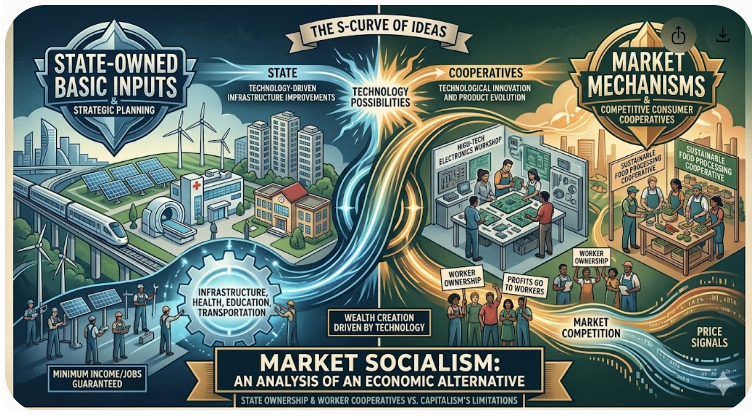
The predominant economic system of the modern era is Capitalism, which allows private individuals and businesses to own the means of production and generate employment, rather than relying on the state. Despite its strengths, capitalism is not without limitations. Moreover, due to the S-curve–like lifecycle of ideas, it may have approached a stage of saturation over its roughly 300-year evolution. As Karl Marx noticed in ancient philosophical writings, human beings possess an inherent tendency to recreate their world by replacing maturing ideas with emerging ones. This raises an important question regarding viable alternatives to capitalism. One promising candidate is market socialism, which seeks to address some of capitalism’s structural limitations. It’s an economic system combining public or cooperative ownership of the means of production with free-market mechanisms for resource allocation. Accordingly, this article presents an analysis of market socialism, drawing on the insights and arguments of one of its prominent proponents, Vivek Chibber. It’s worth noting that such an analysis highly depends on Wealth creation mechanics out of technology possibilities, as outlined at The Waves.
Common Criticisms about Capitalism
Private ownership of productive assets, the centrality of markets, and the profit motive are often at the core of criticisms of capitalism. Critics argue that these features enable capitalists to accumulate disproportionate power over workers and society at large, as they control both wealth, the investable surplus, and employment. Consequently, this concentration of power is seen as allowing capitalists to advance their own interests, often at the expense of broader societal welfare. From this perspective, a humane society would need to move beyond private ownership. Furthermore, the existence of labor markets attracts criticism, as individuals must depend on capitalists for employment and, ultimately, their livelihoods.
However, these criticisms are not without limitations. The pursuit of profit compels firms to offer better-quality goods and services, often at lower prices, enabling people to accomplish tasks more efficiently and with fewer resources. In this way, the drive for profit contributes to improvements in living standards. Moreover, competition ensures that economic surplus is shared between producers and consumers. Producers, in turn, reinvest surplus to enhance product quality and scale up production, thereby increasing both private gains and social surplus. This dynamic lies at the heart of wealth creation driven by technological progress. Additionally, just as workers depend on firms for employment, firms are equally dependent on workers to innovate, replicate, and distribute products in order to generate profit.
Unfolding Structural Limitations of Capitalism
One of the notable internal flaws of capitalism is its tendency to experience recurrent economic slowdowns and, at times, deep depressions. However, such downturns have historically been temporary. More recently, though, capitalism’s core strength—its ability to generate wealth through technological progress driven by profit incentives and competition—has begun to reveal deeper structural weaknesses that are unlikely to dissipate as cyclical crises do within a decade or so.
While capitalism has been highly effective in fostering wealth creation through competitive technological advancement and the provision of better products at lower prices, further progression—and at times the misuse—of technology has exposed several limitations. Notable among these are: (i) the extraction of wealth by a small group of capitalists through valuation gains fueled by narratives of Disruptive Innovation, rather than the delivery of genuinely improved solutions for users; (ii) rising barriers to technological progress due to increasing Reinvention complexity; (iii) the growing concentration of market power and the emergence of monopolies enabled by scale effects; (iv) the “buy-and-bury” strategies of incumbent firms, which suppress new waves of Creative Destruction; (v) the limited effectiveness of antitrust frameworks in addressing technology-driven monopolies; (vi) the increasing necessity of government intervention to catalyze the next long wave of innovation; and (vii) weakening prospects for prosperity in less-developed countries, as demand for factory labor declines due to robotics and automation.
Putting Market into Socialism—Market Socialism
As is widely recognized, among other factors, socialism struggled to keep pace with capitalism largely due to its relatively slow rate of technological advancement in providing improved means for people to accomplish tasks, thereby constraining wealth creation. A key underlying reason is that competition—driven by profit incentives and the freedom to allocate capital—has consistently outperformed systems based on central planning, the absence of profit motives, and restrictions on capital deployment by innovators. Consequently, over the past 300 years, capitalism has largely prevailed, despite experiencing periodic setbacks. However, its core strength—driving prosperity through technological progress—has increasingly begun to manifest as a structural weakness. This has intensified the search for viable alternative economic systems.
One such alternative is market socialism, which seeks to combine fundamental elements of both socialism and capitalism. To mitigate the adverse effects associated with private ownership under capitalism, as well as the inefficiencies of full state ownership under traditional socialism, market socialism envisions a system in which the state owns the means of production at the national level, while firms are organized as worker cooperatives in producing consumer products. In this arrangement, there is no distinct capitalist class owning productive assets; instead, workers themselves hold property rights.
Unlike traditional socialism, however, market socialism does not eliminate markets or replace them entirely with centralized planning for consumer goods. Rather, it retains market mechanisms to foster competition among worker-owned cooperative firms, thereby addressing the innovation deficits associated with centrally planned systems. At the same time, the government plays a strategic role through central planning to ensure the provision of essential goods and services, such as housing, transportation, education, communication, healthcare, and a guaranteed minimum income or jobs.
Thus, while markets continue to operate in response to price signals and demand conditions, control over the means of production shifts from a capitalist class to workers, community boards, or public authorities. In essence, private capitalist ownership is replaced by social ownership, while rigid central planning is complemented—rather than substituted—by market-based competition. These constitute the two defining pillars of market socialism.
Performance Issues of State-owned Production for Basic Inputs
In most capitalist societies, Government has been in charge of offering basic inputs like education, healthcare services and transportation infrastructure. However, due to lack of responsiveness, limitations of regulations, and poor innovation, Governments have been reducing involvement in offering such inputs through the state planning and production. For example, till 1980s, every major country of the world had state-owned telecom monopoly. However, in order to get rid of limitations, they opted to market led reform. On the other hand, to leverage scale effect, Government has been developing transpiration infrastructure, like roads or rail networks, and offering competition among private operators to deliver services. Hence, having a U-turn to such mode of capitalism with state owned planning and production of basic inputs run the risk of moving towards inefficiencies and lack of innovation.
Issues in Cooperative form of Ownership of Firms–Affecting Competition and Technology
It has been proposed that, based on market signals or prevailing demand, firms would be organized as cooperatives, with the government providing the necessary capital. This model may yield better outcomes in sectors where firms primarily engage in the replication or incremental improvement of mature products.
However, wealth creation is driven not only by production or replication but, more fundamentally, by innovation and the continuous evolution of products. In processes of creative destruction, reinvention does not typically originate from existing market signals. On the contrary, virtually all reinvention begins with primitive or experimental forms of products that are often rejected by mainstream markets in their early stages. Consequently, it would be difficult—if not impossible—for governments to allocate resources toward technological possibilities that lack established market demand. This constraint could impede the long-wave dynamics of wealth creation.
Furthermore, the same Creative waves of destruction that generate new growth cycles also render obsolete existing skills and employment structures. In a system based on worker-owned cooperatives, such disruption would directly threaten the interests of the very individuals who control firms. As a result, there would be strong incentives to resist transformative innovation. Over time, this resistance could contribute to economic stagnation.
This form of stagnation would not resemble the cyclical downturns associated with capitalism. Rather, it would stem from structural limitations in state-directed capital allocation and cooperative ownership of firms. Sustained weakening of innovation-driven cycles could therefore lead to prolonged economic stagnation or even persistent recessionary conditions. For these reasons, societies may ultimately be reluctant to adopt the form of market socialism described above.
The next issue is about the underlying dynamics of formation of high-performing firms, as wealth creation engines. Invariably, all those firms star the journey through the creative urge of one or couple of individuals. Even in capitalism, they begin the journey as cooperative through ownership of equity. Due to the farsightedness of these founder innovators, embryonic beginning grows as large firms.
Overall Observations about Market Socialism
Criticism of capitalism, particularly regarding the concentration of ownership of capital and its role as the primary source of employment, has substantial merit. In addition, emerging limitations associated with rapid technological progress and underlying barriers to further progression further strengthen the case for exploring alternative economic systems. Consequently, the examination of candidate models deserves serious attention. However, any viable alternative must demonstrate the capacity to sustain prosperity growth, reduce inequality, and limit excessive wealth extraction.
Market socialism, for instance, appears to aim at reducing inequality and improving income and employment security through state involvement in the provision and distribution of essential inputs, alongside the elimination of private ownership of productive resources. To preserve the efficiency benefits of competition, it retains markets for the production of consumer goods, with firms competing within these markets. At the same time, it replaces private ownership with worker cooperatives. It is also proposed that these firms would not directly own capital; instead, capital would be allocated by the state, and any resulting surplus would be returned to public authority.
As discussed earlier, while this model may help reduce inequality and ensure access to basic necessities, it is likely to face significant limitations in its capacity to generate sustained innovation and long-term wealth creation. As a result, society may risk entering a prolonged period of weak productivity growth and stagnation in prosperity. Consequently, such an outcome would make widespread acceptance of this model unlikely. This underscores the continued need to search for more effective economic alternatives.