

Despite 1.3m deaths in road accidents and 8.8m deaths from air pollution, why is the automobile density increasing? What is the substance of the debate of whether technology is a blessing or a curse? Although our ancestors used to breathe cleaner air, why is our life expectancy higher? What is the underlying importance of technology?
The importance of technology is immense as it helps us in Getting jobs done increasingly better. Technological advancement has enabled us to perform jobs like moving from one place to another, communicating with others, detecting diseases, producing crops, preparing food, and many others more effectively and efficiently. Technology has been helping us get jobs done in less time and in a safer way, involving less effort. As a result, the quality of living standards has been going up.
Due to technology, we have graduated from the slow growth of Wealth creation of the pre-industrial age. Consequentially, along with the population, per capita GDP and life expectance have been growing simultaneously. The importance of technology is paramount for creating increasing wealth from depleting resources to meet the growing consumption of fellow human beings. Due to technological advancement and leveraging, natural resource-poor countries like Japan, Taiwan, South Korea, and others in Europe have reached high-income status.
There is no denying that technology adoption has been the cause of pollution, emissions, and accidents. However, despite the negative effect, the importance of technology is indispensable for increasing life expectancy. Besides, further advancement of technology is the solution for the problems which have emerged due to its adoption. For example, over the last 50 years, the safety and comfort of flying have been increasing while the cost of flying each kilometer has been falling. Similarly, alternative energy technology and growing automation appear to be pollution, emission, and safety solutions.
Examples of the Importance of Technology in Our Daily Lives
Let’s look into our daily lives and assess the role of technology. From having a good night’s sleep to taking a shower, we find the importance of technology. Our bedrooms have electric fans, air conditioners, light bulbs, and many other technology products. Similarly, washrooms and kitchens have many technology products for essential jobs like washing our faces or frying eggs quickly. Among many others, refrigerators and microwave ovens are indispensable tools. Whether sleeping or studying, all the time, we have been busy getting a series of jobs done. In performing all those jobs, we have been deploying products innovated out of technologies.
Benefits of Technology
In understanding the importance of technology, let’s look into the benefits we derive from technological products in performing numerous jobs. Some of the significant benefits are as follows:
1. Less time in getting jobs done
The importance of technology reducing time in serving our purpose is quite immense. We no longer walk to television to change the channel. Within a couple of minutes, we heat food in the Microwave oven. Besides, we do not spend days in ships to cross the Atlantic. Similarly, an elevator takes us to higher building levels in less time than walking up the stairs. And the importance of technology in sending messages worldwide in seconds has immensely helped reduce time in getting communication jobs done.
2. Decreasing demand for effort
One of the critical roles of technological advancement has been reducing our efforts in serving purposes. For example, the effort in starting car engines has been reduced from cranking the engine by hand to pushing a button. Similarly, the effort in watching movies according to our choice has reduced from renting from video stores to clicking a button for selecting from streaming services like Netflix. Similarly, the effort of taking and sharing a photograph with friends has been substantially reduced. We have been advancing technology to meet human beings’ endless urgency of reducing effort in performing diverse jobs.
3. Saving of energy and material
Technology has been pivotal in saving energy and material in getting jobs done. Due to this, we need far less energy than before to cook food or fly. To get further insights, let’s look into the evolution of light bulbs, music players, and television. LED light bulbs take far less energy than ever to produce per light unit. Similarly, since Edison’s Gramophone, music players’ weight has been decreasing. Besides, due to technological advancement, the importance of Microwave has fallen from above 700 lbs to less than 20 lbs. Surprisingly, although successive versions have been consuming decreasing energy and material, they have been serving purposes increasingly better.
4. Comfortable residence
Let’s look into the comfort we get at our residence, whether in sleeping or getting showers. The importance of technology is quite visible in maintaining comfortable temperature or lighting conditions. From cleaning the floor to washing clothes, we see the role of technology. Besides, the importance of technology in improving comfort levels has been steadily increasing.
5. Faster communication
Of course, the role of technology in making communication faster is quite visible. We no longer wait for days or weeks to receive a letter. Due to high mobile phone and internet density, communicating with anybody worldwide takes place instantly.
6. More accurate and faster decision
Technology has been increasing the supply and processing capacity of data. As a result, our decision-making has been getting faster and more accurate. For example, we find the most optimum route to reach the destination by looking into traffic situations in Google Maps. Similarly, doctors have been using technology to improve accuracy and reduce time in diagnosing diseases. Likewise, bank officials take minutes instead of weeks to assess borrowers’ credit risks.
7. Reducing wastage
LED light bulbs waste far less than 85 percent of the electricity used to get wasted by Edison’s incandescent light bulbs—besides, previous light sources like oil lamps or candles used to waste far more than this. Like light source evolution, manufacturing processes have improved precision, reducing waste. For example, cutting fish or peeling fruits with robots reduces 5 to 10 percent wastage.
8. Saving life
Of course, the importance of technology in diagnosis, surgery, and medicine production in saving lives does not face much debate. However, technology like automobiles is a significant source of killing and injuring healthy people. On the other hand, increasing pollution caused by technology has been cause of slow poisoning. Fortunately, technology has been progressing to reduce the deaths caused by technology. For example, cleaner energy sources will reduce pollution, and autonomous vehicles will likely reduce road accidents.
9. Offering entrainment
From music players to television, the role of technology in offering us entertainment is quite visible. All kinds of musical instruments have been having an increasing role in technology. Besides, YouTube and Streaming services have brought a new dimension to offering entertainment.
10. Facilitating knowledge and idea production and sharing
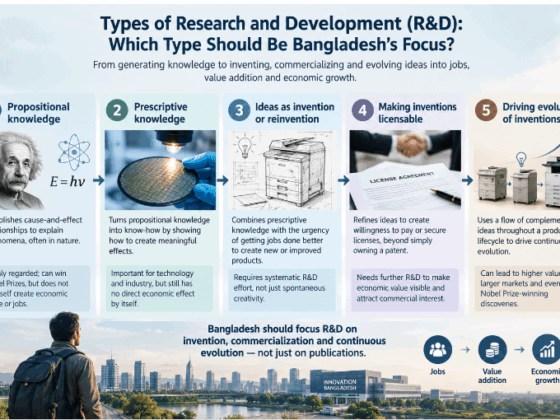
In sustaining our wealth creation from scarce resources, the flow of knowledge is vital. However, the human mind alone is insufficient to create a knowledge flow. We have been relying on increasingly technology-rich scientific instruments, from spectrophotometers to accelerators, to support knowledge production, whether to know quantum dots or energy levels of fundamental particles. This knowledge flow is vital in generating ideas for inventions and innovations. Besides, technology has been playing a crucial role in storing and sharing knowledge. Among many others, the role of cloud computing, the internet, and search engines is quite evident in storing and sharing knowledge.
Technology Drives Innovations
Product and Process Innovation:
Technology empowers innovators to innovate products and processes. For example, image sensor technology is at the core of mobile phone innovations. Besides, technology processes improve through technology invention and advancement. Hence, process machinery has been graduating from power tools to intelligent machines capable of sensing, perceiving, making decisions, and acting independently. Consequently, technology has been driving innovations and evolving existing ones, offering higher efficiency and effectiveness in serving our purposes.
Incremental advancement:
Both products and processes have been incrementally advancing due to technological advancement. For example, camera resolution has been incrementally advancing in subsequent releases of mobile phones. Similarly, production processes have been incrementally advancing due to the rise of sensors, algorithms, and actuating technologies.
Radical Innovations:

For sure, mobile phones, automobiles, computers, and many others are radical innovations. They have transformed jobs, firms, and industries. However, how have they become radical? Invariably, all radical innovations were born in embryonic form. They reach the radical performance stage through evolution due to continued incremental advancement and reinvention because of technological progression.
Reinvention Unleashing Creative Wave of Destruction:
Both innovations and technology power them to have an S-curve-like life cycle. Upon sustaining incremental advancement, they reach saturation. However, the reinvention of matured products by changing the matured technology cores with emerging ones leads to new life cycle waves. Due to the sustained progress of the emerging technology core, those reinvention waves reached the tipping point, unleashing Creative Destruction effect on matured products and jobs in making them.
Disruptive Innovation:
Often, firms profiting from matured products fail to decide to drive reinvention waves as they begin in primitive loss-making form. As a result, opportunities are left to new entrants. Due to the rise of reinvention waves and failure of switching, high-performing incumbent firms suffer from loss of business as customers keep changing to new waves. Such disruptive effect caused by the rise of reinvention wave on incumbent firms is called disruptive innovation. It happens due to the growth of emerging technologies driving reinvention waves.
Scale, Scope, and Positive Externality Effects:

The scale effect of innovations takes place due to quality improvement and cost reduction through leveraging of technological advancement. Innovators succeed to keep adding and enhancing features to products, increasing the scope of purposes to be served by leveraging technology. For example, the scope of smartphones has been growing due to the advancement of technologies like sensors and algorithms. Technology progression also creates a positive Externality Effect, increasing the perceived value due to the growth of the customer base.
Technology Makes Machines Artificially Intelligent
The importance of technology in advancing from power tools to intelligent machines has been paramount. Features like lane change detection and adaptive cruise control have added human-like intelligence to automobiles. It may progress further, making them autonomous driving machines. This trend has been common in more or less all devices. As a result, artificially intelligent machines will serve our purposes more efficiently, effectively, and safely.
Technology Underpins Wealth Creation from Knowledge and Ideas
Sustaining economic growth:
We have a fixed amount of natural resources. Labor supply also faces a limit. Despite this, how is it possible to maintain economic growth? The underlying force has been technology.
Deriving increasing value from natural resources:
In 1984, the weight of a mobile phone handset was 3lb. Like mobile phone handsets, the weight of most of the products has been shrinking. But their ability to serve our purpose has been growing. By consuming decreasing amounts of natural resources, how are these products gaining the capability of offering increasing economic value? The underlying reason has been the growing role of technology. Technology has been substituting material, energy, and labor in providing us with increasing economic benefits.
Empowering low-skilled people to get jobs:
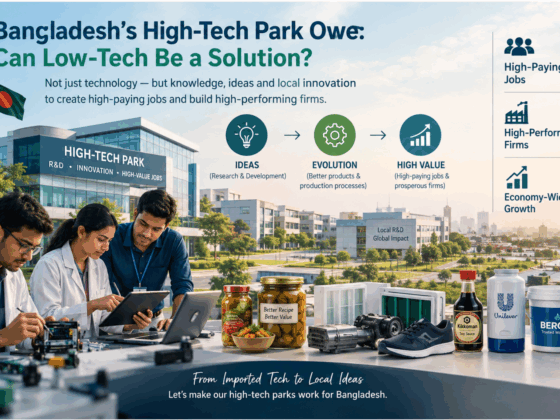
We often think technology kills low-skilled jobs. However, how have a skilled workforce qualified in export-oriented manufacturing jobs in less developed countries? As technology has automated knowledge and high-end skills, leaving only innate abilities to humans to supply, the workforce of Bangladesh and many other less developed countries qualified for manufacturing jobs.
Creating high-income jobs:
Creating high-paying jobs is a burning issue. It depends on empowering individuals to generate proportionate wealth. As technology underpins economic value creation, individuals can demand growing salaries by increasing the flow of knowledge and ideas. Due to the advancement of technology and leveraging it through product and process innovations, producers can earn proportionate revenue from additional flow of knowledge and ideas.
Empowering new entrants to destroy wealth accumulation:
Weakening wealth accumulation at the top and driving economic growth from bottom up and middle out are burning development issues. Despite some success, the trickle-down economy of taxing the top does not address growing inequality. The alternative has been leveraging technology to empower new entrants in driving new waves of reinvention. Once those reinvention waves grow and unleash creative destructive effects, incumbent monopolies and their shareholders will lose wealth, and entrants will get the change of wealth accumulation.
Reaching high-income status:
Invariably, all the countries and individuals aspire to achieve high-income status. However, how can natural resource-poor countries attain such a status? Fortunately, technology offers the solution. Japan, Taiwan, and South Korea have reached the high-income status not due to natural resources or labor supply. They have done it by producing knowledge and ideas in advancing technologies and innovating products and processes out of them.
Importance of technology in addressing sustainable development goals

The human race has been facing sustainable development challenges. It spans from increasing crop yield to reducing road accidents. Fortunately, all 17 sustainable development goals have the opportunity to benefit from technology. Hence, the importance of technology has been rising for the human race to keep progressing.
Despite technology’s tremendous importance, scientific discoveries and inventions alone do not drive prosperity. Even the attainment of technology competence does not end up in proportionate wealth creation. It requires prudent management competence to derive economic value from technology in a competitive market. There has been no natural correlation between STEM competence, technology advancement, and economic benefits.
Please Note:
This article is part of a book, Engineering Economics and Management–Modern Day Perspective.

1 comment
I do agree with all of the ideas you’ve presented in your post. They’re really convincing and will certainly work. Still, the posts are very short for beginners. Could you please extend them a little from next time? Thanks for the post.