THE WAVES
  • Home
  • News
    • Recent Updates
    • Weekly Newsletter
    • Monthly Newsletter
    • Quarterly Newsletter
  • Topics
    • Technology
      • Internet
      • AR/VR & Digital twins
      • Robotics
      • AI & Data Analytics
      • IoT & Wearable
      • Blockchain
      • Computing
      • Sensors & Perception
      • 3D Printing
      • Energy Tech
      • Space
      • Gadgets
    • Transformation
      • Education
      • Health
      • Transportation
      • Farming
      • Energy
      • Security
      • Mining & Blue Economy
      • Food & Living
      • Communication
      • Entertainment
      • Manufacturing
      • Work & Management
      • Public Service
    • Startups
      • Culture
      • Country
      • New Entry
      • Accelerators
      • Incubators
      • Death Valley
      • Investments
      • Exit & IPO
      • Valuation & Financing
      • Idea & IP
    • Education & Research
      • School
      • University
      • Academic Research
      • Corporate Research
      • Public-funded Research
      • Economics of Innovation
      • Growth Economics
      • Training
      • Publications
      • Patents & IP
    • Industrial Revolutions
      • Future of Work
      • Sustainable Development
      • Smart Manufacturing
      • Job Transformation
      • Industry Transformation
      • Competition & Monopoly
      • National Response
      • Education & Skills
      • Social Change
    • Investment & Review
      • Public
      • Corporate
      • Venture Capital
      • Capital Market
      • Philanthropy
      • Personality
    • Inventions
    • Automation
  • Strategy
    • Value Proposition
      • Product
      • Process
      • Sustainability Goals
      • Business Model
      • Complementary
      • Externality
    • Innovation
      • Disruptive Innovation
      • Incremented Innovation
      • Sustaining
      • Schumpeter’s Creative Destruction
      • Redesign for Winning
    • Competition
      • Leading
      • Following
      • Blue Ocean
      • Monopolisation
      • Porter’s Five Forces
      • Business Cycle
    • Intangible Assets
      • Human Capital
      • R&D Management
      • Tripple Helix
      • Intellectual Property
      • Productive Knowledge
      • Technology Managment
    • Competence
      • Organization Agility
      • Innovation Culture
      • Infrastructure
      • R&D facility
      • Great by Choice
      • Build to Last
      • Good to Great
    • Technology Acquisition
      • Scientific discovery
      • Invention
      • Fusion
      • Adaptation & Refinement
      • Licensing
      • Start-up acquisition
  • Policy
    • Technology Development
    • Industry
    • Innovation Diffusion
    • Jobs, Privacy & Security
    • Regulation & Law
    • Sustainability
    • Equity & Inclusiveness
    • Climate Change
    • Environment
  • Opinion
    • Opinion
  • Megatrends
    • Individual Preferences
    • Planet and Society
    • Technology
    • Political Economy
    • Market Power & Monopoly
    • Globalisation
    • Schumpeter’s creative destruction
    • Startups & VC
    • Human Role in Work
    • Value of Natural Resources
    • Patents & Ideas for Redesign
  • Publication
    • Case Studies
    • Magazine
    • Books
    • Reports
    • White Papers
    • Journals
THE WAVES In-depth investigation on Technology, Society, and Policy dynamics for interpreting the past as well as present, and predicting the future so that success rate of pursuing ideas, start-ups, and innovation economy increases.

Technology, Society and Policy

Winning and Losing in Reinvention Race : keeps unfolding: --making America’s innovation bucket leaky, creating prosperity out of reinvention, and turning invention successes transitory
THE WAVES
  • Home
  • News
    • Recent Updates
    • Weekly Newsletter
    • Monthly Newsletter
    • Quarterly Newsletter
  • Topics
    • Technology
      • Internet
      • AR/VR & Digital twins
      • Robotics
      • AI & Data Analytics
      • IoT & Wearable
      • Blockchain
      • Computing
      • Sensors & Perception
      • 3D Printing
      • Energy Tech
      • Space
      • Gadgets
    • Transformation
      • Education
      • Health
      • Transportation
      • Farming
      • Energy
      • Security
      • Mining & Blue Economy
      • Food & Living
      • Communication
      • Entertainment
      • Manufacturing
      • Work & Management
      • Public Service
    • Startups
      • Culture
      • Country
      • New Entry
      • Accelerators
      • Incubators
      • Death Valley
      • Investments
      • Exit & IPO
      • Valuation & Financing
      • Idea & IP
    • Education & Research
      • School
      • University
      • Academic Research
      • Corporate Research
      • Public-funded Research
      • Economics of Innovation
      • Growth Economics
      • Training
      • Publications
      • Patents & IP
    • Industrial Revolutions
      • Future of Work
      • Sustainable Development
      • Smart Manufacturing
      • Job Transformation
      • Industry Transformation
      • Competition & Monopoly
      • National Response
      • Education & Skills
      • Social Change
    • Investment & Review
      • Public
      • Corporate
      • Venture Capital
      • Capital Market
      • Philanthropy
      • Personality
    • Inventions
    • Automation
  • Strategy
    • Value Proposition
      • Product
      • Process
      • Sustainability Goals
      • Business Model
      • Complementary
      • Externality
    • Innovation
      • Disruptive Innovation
      • Incremented Innovation
      • Sustaining
      • Schumpeter’s Creative Destruction
      • Redesign for Winning
    • Competition
      • Leading
      • Following
      • Blue Ocean
      • Monopolisation
      • Porter’s Five Forces
      • Business Cycle
    • Intangible Assets
      • Human Capital
      • R&D Management
      • Tripple Helix
      • Intellectual Property
      • Productive Knowledge
      • Technology Managment
    • Competence
      • Organization Agility
      • Innovation Culture
      • Infrastructure
      • R&D facility
      • Great by Choice
      • Build to Last
      • Good to Great
    • Technology Acquisition
      • Scientific discovery
      • Invention
      • Fusion
      • Adaptation & Refinement
      • Licensing
      • Start-up acquisition
  • Policy
    • Technology Development
    • Industry
    • Innovation Diffusion
    • Jobs, Privacy & Security
    • Regulation & Law
    • Sustainability
    • Equity & Inclusiveness
    • Climate Change
    • Environment
  • Opinion
    • Opinion
  • Megatrends
    • Individual Preferences
    • Planet and Society
    • Technology
    • Political Economy
    • Market Power & Monopoly
    • Globalisation
    • Schumpeter’s creative destruction
    • Startups & VC
    • Human Role in Work
    • Value of Natural Resources
    • Patents & Ideas for Redesign
  • Publication
    • Case Studies
    • Magazine
    • Books
    • Reports
    • White Papers
    • Journals

  • Editor's Pick
  • Great by Choice

Jobs to be done–driving quality of living and prosperity

Observation with empathy and passion for perfection is the key to profitably offer innovation by leveraging technology possibilities

  • Md. Rokonuzzaman
  • Created: October 4, 2023
  • Last updated: October 20, 2023
Jobs to be done better framework begins with observation on how customers perform their jobs with empathy and passion for perfection to profitable leverage technology possibilities in offering better alternative

As Professor Clayton says, “Somewhere between 75 and 85 percent of all new products launched into the market don’t succeed financially” because innovators lack focus on the customer’s necessity of Jobs to be done.

Why do we buy products like Microwave ovens? The answer is simple: to quickly heat and cook food. People buy products to get jobs to be done.  Like heating food, having a good night’s sleep, and making things like cars, we keep facing the urgency of getting jobs to be done. Through performing these jobs, we enjoy living, generate income, and drive prosperity. And in performing these jobs, we deploy products or tools. To serve purposes better, we look for better-performing products costing less. Consequentially, our quality of living standards has been growing, driving prosperity. 

Unlike other living creatures, human beings have a relentless urgency to find improved products to serve their purposes better. However, how can producers offer increasingly better products costing less while paying more for inputs and making a profit? Fortunately, harnessing technology possibilities provides an opportunity to make products better. The cost could also be reduced. By exploiting such possibilities, producers have been making a profit by helping people to get their urgency served better. Consequentially, the quality of living standards and prosperity have been growing up. Hence, to leverage STEM in generating revenue and profit, we need to focus on humans’ relentless urgency to perform jobs better.

Getting clarity about humans’ preferences of products in performing their jobs is crucial to succeed in profiting from inventions and innovations. If there is a mismatch between consumer preferences and the innovations we pursue, well-engineered technology products will result in loss-making revenue. Hence, to drive prosperity from STEM, we need to understand and respond to serve the purpose better.  

Jobs to be done examples

Examples are all around us. Let’s look into a few Innovation stories that have succeeded because of offering improved means.

NetFlix—people would like to have a good collection of movies to choose from to meet their entertainment needs. Indeed, going to video rental stores or waiting for mail delivery was not serving jobs very well. Hence, NetFlix’s steaming service was adopted quickly, causing a disruptive effect on video rental and mailing services.

Microwave Oven—For a long time, preserving food in refrigerators created the demand for a product to do quick heating jobs. Hence, Microwave Oven faced no competition to find its place in our households.

Portable Music Player—People get bored during prolonged travel. But there was not a suitable product to turn the tedious hours into an entertainment experience. Hence, portable music players were appropriate for Getting jobs done.

Jobs to be done theory—leveraging technologies to drive quality of living

Jobs to be done theory refers to understanding why people buy certain products to get their jobs done and what advancement they would find helpful in getting them done better. Human beings have a long list of jobs to be done. They are constantly busy performing these jobs like moving, quenching thrust, protecting the body from excessive heat or cold, or communicating. Through the execution of these jobs, they extract Utility. As utility measures the quality of living, they are after increasing utility.

The utility extraction depends on how well jobs are done and the number of them done. For example, how safely and comfortably we move from one place to another or take a shower affects the utility we extract. How much time and money they cost determines how many jobs we can get done in a day or month. As the total utility depends on the quality of how we perform each position and how many jobs we perform, we are after improving the utility from each job and the number of jobs executed.

The quality and cost of performing jobs depend on the products we deploy. Fortunately, technology, invention, and evolution have been helping us to profitably improve products to help people get jobs done increasingly better. For example, we are serving the urgency of heating cold food in far less time than before due to microwave heating. Similarly, the evolution of lighting technology has offered us better ways to have light in darkness. As technology possibility exploitation can be done profitably, competition in providing better products costing less by taking advantage of technology has intensified.   
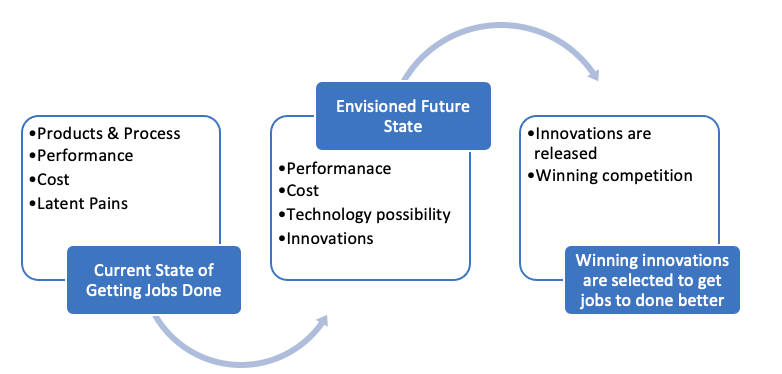
Getting jobs to done better agenda proceeds with feeling latent pains, developing technology possibilities, innovating solutions and winning the competition to get selected
Getting jobs to be done better process proceeds with feeling latent pains, developing technology possibilities, innovating solutions, and winning the competition to get selected.

Jobs to be done framework

The focus should be on observation with empathy to understand the latent desire of customers for better means of performing jobs. For example, Jeffry Hawking observed that target customers of Palm Pilot PDA would prefer to use it using a single hand.  Similarly, Steve Jobs observed that smartphone users were finding stylus and small inconvenient. However, such observations are not good enough in conceiving practical alternatives that could be profitably delivered. Technology possibilities must offer the options. For example, the observation that waste heat from incandescent light bulbs was causing inconvenience. Customers were desperate to get rid of it. But to offer an alternative, LED technology had to grow. Hence, the Jobs to be done framework encourages the blending of empathy with ethnology possibility to detect the latent desire and pursue alternatives.

Here are four major areas to focus on to innovate products:   

1. Observation with Empathy and Passion for Perfection to Feel Latent Urgency  

2. Interpreting the Evolution of Products in Getting Jobs Done Better

3. Technology Possibilities for Incremental Advancement

4. Emerging Technology Cores for Reinvention

5. Competition and Externalities Affecting Profitable Delivery         

Often, customers fail to articulate pains in getting jobs done with existing products. Hence, innovators must observe how are jobs done with current products. Such observation is vital for empathy and passion for perfection to feel latent urgency and create ideas.

The interpretation of the evolution of related products and their attractiveness in getting jobs done will also offer insights into what customers are looking for. Such exercise will offer ideas highly likely to be adopted. Subsequently, the investigation should proceed on whether such ideas will be implemented as incremental advancement of existing products or reinventing them by changing the technology core. Of course, apart from technology possibilities, competition and externalities will affect success.  

Empathy, Passion for Perfection, and Technology Possibilities

Often, well-engineered products out of advanced technologies alone cannot succeed in the market. If that were the case, why did not Apple’s Newton, IBM’s Simon, or Airbuses A380 succeed in sustaining in the market?  Similarly, why could Honda not profit from ASIMO Robot Nurse innovation?

The journey of leveraging technologies should begin with empathy and passion for perfection to figure out better alternatives to help customers get jobs done better. But that understanding is not good enough. It must consider technology possibilities for deliverable innovation through incremental advancement or reinvention.  Furthermore, systematic advancement demands a managed approach to economic value creation from innovations in getting jobs to be done better.

Please Note:

This article is part of a book, Engineering Economics and Management–Modern Day Perspective.
Enlighten others

Subscribe

Subscribe now to our newsletter

You May Also Like

Which Type of R&D Should Be the Focus of Bangladesh and many other less developed countries?
View Post
  • 3 min

Types of Research and Development

Bangladesh can turn its high-tech parks into engines of prosperity by housing R&D wings of local producers
View Post
  • 3 min

Bangladesh’s High-Tech Park Owe: Can Low-Tech Be a Solution?

How speculative markets and continuous storytelling combine to decouple asset valuation from delivery of innovations
View Post
  • 8 min

The Rise of Muskism Turning Musk a Trillionaire: Narrative-Driven Capital Accumulation and the Illusion of Disruptive Innovation

Leave a Reply Cancel reply

Your email address will not be published. Required fields are marked *

Subscribe

Subscribe now to our newsletter

Principles

  • Economics of Technology
  • Innovation Economics
  • Technology & Innovation Policy

History & Observations

  • Technology History
  • Innovation History
  • Strategy & Policy in retrospect
  • Entrepreneurs & Innovators
  • Startups & Corporations
  • Patents & Publications
  • Design & Redesign Thinking

About Us

  • Who we are
  • What we deliver
  • Genesis
  • Mission
  • Scope
  • Editorial & Advisory Board
THE WAVES
  • Contact
  • Advertise

Input your search keywords and press Enter.