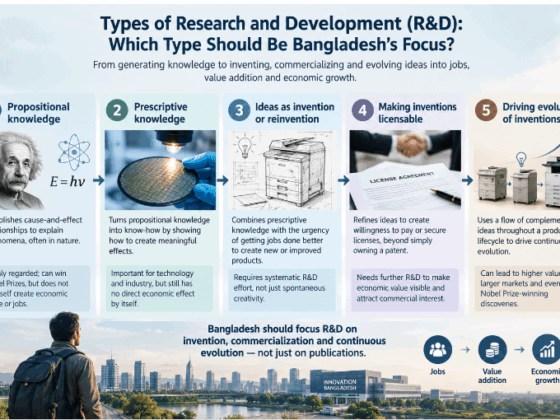
Ideas in Getting jobs done better or technological innovations are at the root of increasing Wealth production from the same amount of natural resources and labor supply. However, although the market plays an important role, ideas are fraught with pervasive uncertainties. Due to the high failure rate and the growing cost of rolling out innovations, innovators need to know the factors affecting the diffusion of their innovations. On the other hand, development professionals are keen to know it as diffusion of Innovation plays a crucial role in addressing diverse development issues. Hence, the importance of innovation diffusion model has been gaining importance.
So far, Rogers innovation diffusion model is the predominant one. However, despite its efficacy in explaining the diffusion of innovations like hybrid seed or public health ideas, Rogers innovation diffusion model suffers from significant limitations in explaining how High-tech innovations diffuse. Underlying causes include disregarding the role of evolution of innovations through incremental advancement and Creative Destruction waves out of Reinvention due to the competition force of the market. The next cause appears to be varying economic benefits derived by different customer groups in adopting the same innovation.
Like hybrid seeds or the idea of boiling water, high-tech innovations are not static. High-tech innovations invariably show up in primitive form. However, they are likely to evolve due to the cumulative effect of a Flow of Ideas—resulting in growing fitness to get jobs done at a decreasing cost. Hence, high-tech innovation diffusion tends to synchronize with the underlying technology life cycle. However, due to disregard of this vital attribute, Rogers model does not offer adequate clarity about how high-tech innovations diffuse. Hence, it’s time to upgrade Rogers model, making it more suitable.
Technological innovations and purposes
Technological innovations refer to new ideas for creating more economic value from the same amount of input—like natural resources, ingredients, and labor. The purpose of technological innovations has been to get jobs done better. Jobs vary from communicating to producing crops. Examples of technological innovations include hybrid seed, television, mobile phones, and electric vehicles.
Defining Rogers innovation diffusion model
Rogers innovation diffusion model is rooted in the dynamics of diffusion of hybrid seed among the American farmers in the 1930s and 1940s. According to Rogers, despite a 20 percent higher yield, it took years for hybrid seeds to diffuse among the farmers. Specifically, it took 13 years for 100 percent adoption of hybrid seed by 259 farmers among two Iowa communities. An average farmer took seven years to adopt it completely. Hence, the obvious question was: despite apparent economic benefit, why did innovation diffusion become a time function? Why did not all the farmers take the same time to adopt it? His investigation led to four factors affecting the innovation diffusion:
- innovation—primarily, the economic benefit it offers. He also noted the importance of (i) relative advantage, (ii) compatibility, (iii) complexity, (iv) trialability, and (v) observability. However, although he underscored the importance of customization on diffusion, his articulation as reinvention appears confusing or inappropriate.
- communication channels—as communication plays a vital role in sharing the benefits of innovations and how to use them, Rogers found communication channels as an important building block.
- time—due to individual farmers’ varying risk management and innovativeness and role of communication, Rogers found the justification of time dependence of the response to adopting innovations by different adopter groups.
- social system—due to the role of lead users, opinion groups, and beliefs, Rogers model identified the social system as an important factor affecting innovation diffusion dynamics.
Rogers experienced limitations of his model in EV diffusion
Rogers developed an innovation diffusion model after studying more than 500 agricultural and public health innovation cases. In the late 1990s, GM embarked on a $2 billion program to develop, manufacture, and market electrical vehicle-Impact. In this program, GM recruited Mr. Rogers as a consultant to drive the diffusion of this technological innovation. Based on the ability to tinker with EVs, innovativeness, and opinion leadership, Rogers advised GM to recruit the first batch of drivers, likely forming the innovator segment of GM’s EV innovation.
However, despite meticulous selection and compliance with all the good practices of Rogers innovation diffusion model, GM’s journey of diffusing EVs was a flop, resulting in sending a large pool of EVs to the junk heap. The underlying cause of failure was not the lack of innovativeness and risk or failure management capability of the first batch of adopters or the weakness of communication channels. Instead, a mere 100km range and the requirement of unique charging stations did not deliver better alternatives for getting the driving jobs done. Hence, a cost-benefit factor of the underlying technology core (battery) and externalities like charging stations determined the fate of the diffusion of GM’s EV innovation.
Ironically, the same EV innovation accelerated in the 2020s, leaving GM in a catchup mood. Even though GM crushed most of its impact, the sale of EVs in 2022 crossed the 10 million mark. Besides, the stock of new entrant Tesla became far more valuable than that of GM due to EV innovation. While adopting a new entrant, Tesla’s EV, why did customers reject proven supplier GM’s impact? It’s about the evolution of battery technology core, increasing the range, reducing the cost, and lowering the charging time, which has been at the core of creating a recent surge in EV diffusion. Hence, the dynamics of the technology core have a decisive role in innovation diffusion.
Nature of high-tech innovations and their diffusions
Some of the characteristics of high-tech innovations, seeding the inefficacy of Rogers innovation model, are as follows:
- embryonic beginning—unlike hybrid seed, high-tech innovations emerge in an embryonic form, offering little or no relative advantage to the users of matured innovations. However, invariably, they offer unique functionality.
- growing economic benefits due to the evolution of technology cores—unlike hybrid seed, they are amenable to progression, making them increasingly better and cheaper—an essential attribute of high-tech diffusion.
- driven by new entrants—due to loss-making beginnings and uncertainty about reaching profit- reputed incumbent firms mostly shy away from pursuing high-tech innovations, leaving to unproven new entrants.
- non-compatible with existing products and infrastructure—due to the change of technology core, high-tech innovations as alternatives to existing products tend to be non-compatible with existing infrastructure.
- forming a creative wave of destruction—hi-tech innovations grow as Creative waves of destruction, creating an S-curve-like growth pattern.
- adoption decisions—the first group of customers adopt high-tech innovations in the primitive stage due to their unique roles in getting specific jobs done, which could not be done with the existing matured counterparts. Time-delayed adoption by the remaining groups has been due to the predominantly increasing economic benefit caused by the evolution of innovation due to the advancement of technology core.
- adoption pattern—as technological advancement, making innovations increasingly economically attractive, plays the most critical role, there seems to be synchronization between the life cycle of the technology core and innovation diffusion. The shapes of adoption patterns, whether like S-curve or others, depend on the growth dynamics of the technology core. Besides, discontinuity, pause, or brief slowdown may occur due to the unfolding complexity of technological advancement. Furthermore, the percentage of adopters belonging to different groups depends on the technology core’s advancement rate. Time needs for diffusion through a certain percentage of customers or customer groups also rely on the advancement nature of the technology core.
Updating needs of Rogers model for high-tech innovations
As explained in the previous sections, cost-benefit plays a vital role in innovation diffusion. As the cost-benefit ratio of high-tech innovations keeps changing with the evolution of technology core, the importance of the factors observed by Rogers innovation diffusion model has an insignificant role to play. Notably, the following issues should be investigated in making the innovation diffusion model appropriate for high-tech:
- Basis of customer segmentation—does segmentation based on innovativeness and risk management capability offer meaningful insights? What about the varying economic benefits derived by different adopters from the deployment of innovations in getting jobs done to consider as a basis for segmentation?
- First group of customers—for high-tech innovations, who belong to the first group of adopters termed innovators or early adopters by Rogers? Will those proficient users of incumbent matured products who are curious to try new things and techies and can deal with technology failure be the first group of adopters of high-tech innovations at an early stage? Or will the people desperately waiting for alternatives to existing matured products as they cannot be cost-effectively deployed in getting their target jobs done be the first adopters of the primitive emergence of high-tech innovations?
- Cause of adoption of innovation as time function—are varying innovativeness of adopters, nature of communication and channels, and social structure only responsible for time-varying adoption? What about the role of the evolution of the underlying technology core, making innovations increasingly cheaper and more suitable in getting jobs done and making innovation adoption a time function?
- Justification of innovation diffusion growth as S-curve—based on the progression of the adoption of hybrid seeds by farmers, Rogers developed an S-curve-like innovation diffusion progression. The underlying cause was the varying innovativeness of adopters. But if cost-benefit plays a vital role in high-tech innovation adoption decisions, what justifies accepting innovation diffusion as an S-curve? As the cost-benefit ratio changes due to technology progression, does the innovation adoption curve tend to synchronize with the advancement dynamics of the technology core?
- Discontinuity in diffusion function—Rogers model of innovation diffusion is a continuous time function. However, as high-tech diffusion tends to synchronize with the advancement of the underlying technology core, does high-tech diffusion function risk suffering from discontinuity—due to the uncertainty of the technology advancement hurdle? Hence, may technology advancement hurdle create a Chasm in high-tech diffusion due to technology?
- Reinvention and a creative wave of destruction—invariably, high-tech innovations are reinvention of existing matured products. Due to loss-making risky beginning, incumbents tend to cause barriers—leaving high-tech innovation persuasion and evolution to Startups. Hence, what are the roles of barriers caused by existing products and producers and startup dynamics in high-tech innovation diffusion?
- Competition, public policy, externalities, and standardization—competition in high-tech innovation leads to subsidies and the release of successive better versions. Besides, public policies, externalities, and standardization also play a vital role in the diffusion of high-tech innovation. Therefore, it’s fair to say that high-tech innovation diffusion faces far more complex issues experienced by the diffusion of hybrid seed and many other agricultural innovations. Hence, how do competition, public policy, externalities, and standardization affect the diffusion of high-tech innovations?
Furthermore, due to the Internet and the availability of video tutorials through channels like YouTube, the role of communication and channels in innovation diffusion has significantly diminished. Unlike hybrid seeds, high-tech innovations show up in primitive form. They emerge as inferior alternatives to existing matured alternatives. However, they tend to be amenable to progression, changing the cost-benefit ratio. Besides, not all adopters deploy an innovation precisely for the same purpose in identical situations. Hence, the economic benefit distilling from high-tech innovation deployment in getting jobs done is not the same for all adopters. As explained above, there have been many other dissimilar issues faced by high-tech innovation diffusion. Hence, despite the efficacy of Rogers model in agricultural and public health innovation diffusion, there has been an urgency to develop a new high-tech innovation diffusion model.
Public disclosure: previous articles published by The Waves, pointing to the limitations of Rogers’ and crossing the chasm models from the perspective of high-tech innovation diffusion, drew the attention of Mr. Walter Robertson of Diffusion Research Institute and Mr. Warren Schirtzinger of High-Tech Strategies. After an intensive e-mail communication, Mr. Schirtzinger referred to the work on updating Rogers’ model was in progress.
Acknowledgment: This write-up immensely benefited from the inputs of Mr. Jim McLaughlin, Pennsylvania, United States, and Dr. Sajjad Zohir, Dhaka, Bangladesh.