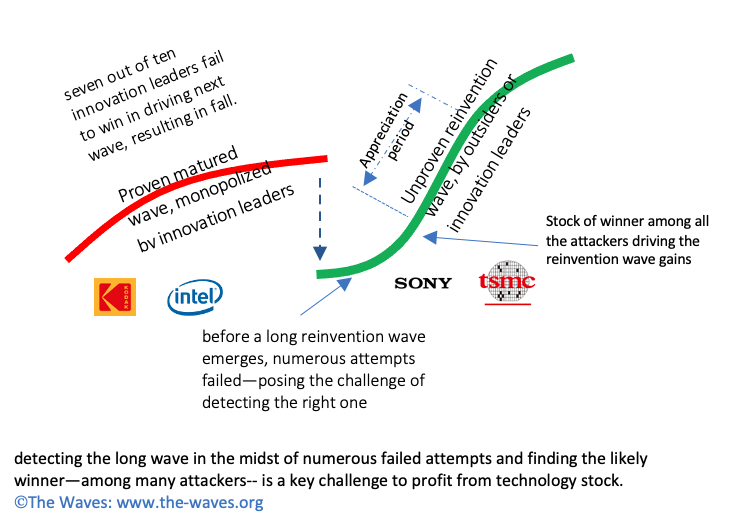
Technology stocks are any stock in the technology sector, from AI machine developers, semiconductor producers, electric vehicle makers to software innovators. Stocks of companies pursuing matured technologies are also technology stocks, as their values are susceptible to the next waves. Besides, some of the incumbent Innovation leaders may also decide to fuel Reinvention waves to recreate them through self-destruction.
Technology stocks are highly volatile due to (i) the growth dynamics and relative economics of competing technologies, (ii) decisions of incumbent innovation leaders, (iii) the relative performance of competing innovators or attackers, (iv) VC-backed push of premature reinventions in the mainstream market for inflating stock price, (v) chasm and hype cycle in technology diffusion and expectation, (vi) emergence of the winner in driving the next waves and (vii) unfolding public policies. Examples of technology stocks are TSMC, ASML, Nvidia, Microsoft, Intel, Apple, and Nokia.
Technology stock quickly appreciates and depreciates—offering an opportunity to make a profit and a risk to lose a fortune by a factor of 10 to 100 over a decade. For example, over just ten years, the stock price of Nvidia grew by a factor of 337, from $0.40 in 2014 to $135 in 2024. On the other hand, after appreciating from EUR 0.1 in 1991 to over EUR 60 in 2000, Nokia’s stock sharply fell to less than EUR 2 in 2012. There have been many such examples. On the other hand, despite being a technology leader once, General Motors’ stock price remained almost flat during this period. Such a high contrast raises an obvious question: is there any underlying reoccurring pattern that causes long waves in technology stock? Or is it just a random process?
Questioning Common Suggestions about Technology Stock Investing
Research and analysis: analyzing company fundamentals through investigating earnings, market share, and growth potentials is a common suggestion of stock advisers. However, knowing growth potential is challenging because it defies many common indicators and perceptions. Besides, both earnings and market share of technology companies rapidly change, affecting the stock price sharply. Hence, knowing the underlying latent causes, as opposed to analyzing financial data, has been a critical challenge in assessing the future of technology stocks.
Industry trends and competitive landscape: following industry trends affected by emerging technologies like AI, cloud computing, and cybersecurity are common advice. However, does it mean that stocks of all the companies pursuing these technologies will experience appreciation? Highly likely, no. Hence, figuring out the winner is a challenge. Besides, can the life cycles of technologies be responsible for the discontinuity of appreciation of tech stock? Furthermore, do decisions of existing innovation leaders in pursuing emerging technologies affect the stock price of new entrants pursuing them?
Diversification and risk management: Assessing the growth potential is challenging in dealing with diversification and coping with risk. As seven out of ten innovation leaders fail to lead the next wave, and over 90 percent of Startups from outside fail to drive the next wave, random distribution of investment in technology stocks is not a remedy.
Long-term vs short-term: once a rally in technology stock starts, short-term investment may be lucrative. However, knowing the peak is a challenge when profiting from short-term investments. The long-term is often less risky, provided we determine the likelihood of long waves in target technology stocks.
Staying informed and screening advice of financial advisors: evaluating information, notably amid the hype cycle, is a critical challenge. Besides, we need to have some reference models to assess the suggestions of financial advisors.
Detecting Underlying Patterns Affecting Technology Stocks
Unlike conventional companies, technology companies aim to pursue technology possibilities in advancing existing products through Incremental innovation or diving into reinventions to offer completely different alternatives. While profiting from incremental advancement at the matured stage, innovation leaders experience stable earnings and steady market growth. However, such technology stocks show sidewise movement during this stage or remain flat. For example, although GM, Toyota, and Canon are technology companies, their stock prices do not show rapid appreciation or depreciation.
It has been found that waves created by reinvention of existing matured products drive rapid change in technology stock instead of incremental advancement. For example, the stock price of GE and other incumbent light bulb innovation leaders suffered due to the rise of the reinvention wave of filament and CFL bulbs as LED. At the same time, little Japanese Nichia experienced a long wave of appreciation. Similarly, while Apple’s stock price skyrocketed, Nokia’s stock plummeted.
There seem to be two opposite long waves in technology stock price; on the backdrop of depreciation of the stock price of a few, others experience gain. Invariably, companies fueling the reinvention waves and showing signs of winning in unleashing Creative Destruction waves rapidly gain stock prices near the inflection point of two waves—maturing and emerging. On the other hand, innovation leaders failing to defend or lead the next wave suffer from stock price depreciation during the same period. Hence, there appears to be a synchronization between the rise and fall of innovation waves and the stock price of participating companies.
Characteristics of Competing Waves Affecting the Technology Stocks
Technology life cycle: how far the candidate technology chosen for reinvention is amenable to progression to cross the performance and cost threshold set by the matured wave has a significant bearing on technology stock. For example, although Tesla’s stock price has gained rapidly due to the signs of EVs taking over gasoline automobiles, it has been failing to sustain itself. On the other hand, the stock price of conventional automobiles did not collapse. Among the two primary reasons, battery technology is yet to be a vital substitute for gasoline. Some of the issues of technology life cycles are:
- Principles of Innovation
- Characteristics of technology life cycle
- Technology life cycle examples
- Technology adoption life cycle
- Rise of radical innovation
- Premature Saturation–death valley
- Not enough quality and cost advantage
- Insufficient scale, scope, and Network effect
The ability of innovation leaders to defend and attack: seven out of ten, innovation leaders fail to switch and drive the reinvention waves of their matured products; switching barriers affect the rise and fall of technology stock of incumbent innovation leaders and new entrants. If technology is not proprietary to new entrants and innovation leaders take necessary steps to defend the current product and fuel the next wave, existing innovation leaders may prevent the collapse of their stock price and prevent the rise of stock of new entrants. For example, as EV technology is not proprietary and gasoline vehicle makers are managing to switch to the EV wave, Tesla stock has been on the downhill. Besides, incumbent innovation leaders like Toyota have gained the stock price. Pertinent issues are:
- Why do innovation leaders fail?
- Ways to avoid the fall of innovation leaders
- The winner takes it all
Attackers’ ability to unleash Disruptive innovation effects and win the race:
Invariably, reinventions emerge as an inferior alternative to matured products. As a result, they get rejected by the mainstream market. Hence, inferior emergence should be nurtured through a Flow of Ideas, making them increasingly better and cheaper. How to finance a long loss-making journey and manage the growth of reinvention waves is a critical challenge. However, although the VC-backed strategy shows early success, it suffers the risk of sudden collapse. It appears that the long-run success is distilled from the IP strategy. Besides, not all attackers will succeed to win the race. Hence, finding the winner among numerous attackers is challenging when picking up the technology stock to invest in. Here are some issues:
- Attacker’s strategy and advantage
- VC-backed startup valuation risk
- Winning the race through disruptive innovation and monopolization
- IP strategy
- Nature of the High-tech market
- Startup scalability
- investing in startups
Technology hype and chasm:
The demonstration of reinventions in the form of minimum viable products, their acceptance by the nonconsumption market due to their uniqueness, and sharp growth trend create the impression of disrupting the mainstream market. As a result, hype is created. However, often, technology faces a hurdle to grow sufficiently to enable reinventions to be better alternatives to mature products serving the mainstream market. Consequentially, as chasm is created in diffusion, technology stocks suffer from rapid fall after quick gain. Additional issues are as follows:
- Technology hype cycle
- Crossing the chasm
- Rogers’ model of innovation diffusion does not work
- Innovation diffusion patten
Innovation evolution and diffusion patterns:
The reinvention waves unleash through the release of successive better versions, affecting the technology stock. The stock of the winner all of a sudden rise or fall. Instead, performance in successive versions plays a vital role. For example, the release of every iPhone version has been affecting Apple’s stock. Hence, the following issues should be taken into consideration in predicting technology stock:
- Innovation diffusion pattern as a series of wavelets
- iPhone diffusion pattern
- Innovation product life cycle
- iPhone life cycle
This article attempts to articulate a theory around the interaction of two technology or invention waves (i.e., maturing and emerging)) that affect the rise and fall of technology stock. This theory is based on multiple attributes of competing innovation waves, resulting in the emergence of winners and failure of innovation leaders. Consequentially, technology stocks rise and fall. This article argues that instead of financial and statistical data, investigation to find potential technology stock should focus on the latent potential of emerging technology core, relative economics of competing technologies, decisions of incumbent innovation leaders and relative performance of competing firms driving the next wave.
The ultimate challenge of finding the lucrative technology stock is to answer two critical questions: (i) which reinvention wave will unfold creative destruction on matured products? and (ii) who will be the winner? Hence, further work is needed to bring additional insights so that underlying factors causing the rise and fall of technology stocks could be interpreted, resulting in predicting the future of technology stock investing.