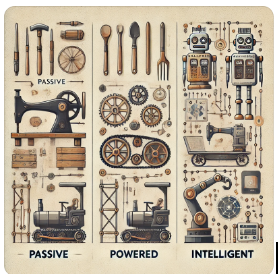
Humans have an endless urge to get jobs done by delegating roles to machines. Hence, Humanity’s relationship with machines has been transformative, reshaping how we work, create, and live. Consequentially, evolving machines have been an integral part of the human journey—marked by the emergence of intelligent machine age from the graduation of passive tools to thinkers. This evolution, from primary passive machines to increasingly autonomous and intelligent machines, reflects humankind’s relentless drive to delegate roles in Getting jobs done better and achieving profitability. With each phase—first focusing on shaping raw materials, then integrating mechanized power, and now programming intelligence—machines have become essential in our pursuit of efficiency, effectiveness, and Innovation. This essay explores this remarkable progression, emphasizing the transition from passive machines to power machines and finally to intelligent machines that herald the dawn of the intelligent machine age.
The Birth of Machines: Passive Tools as Foundational Inventions
Humanity’s quest for smarter machines to get jobs done better is the driving force of evolving machines. The origins of machinery trace back thousands of years to simple passive machines crafted by humans who shaped materials like wood, stone, and metal to aid in daily tasks. These machines—such as levers, wheels, and pulleys—are considered the building blocks of more complex inventions. Although they operated without any internal power source, they enhanced productivity and allowed human societies to undertake more complex tasks. These basic machines laid the groundwork for advancements by reducing the manual effort required for labor-intensive tasks, thereby enabling early agricultural and construction breakthroughs.
Power Machines: Mechanization and the Industrial Revolution
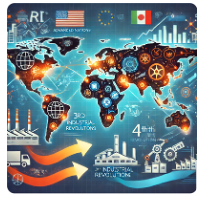
The evolution of machinery took a dramatic turn with the development of power machines during the Industrial Revolution. Unlike passive tools, these machines harnessed energy sources—first from steam and later from electricity and combustion engines—to power tools to perform tasks at previously unimaginable scales. The steam engine, a landmark invention of the 18th century, powered everything from factories to transportation, catalyzing an era of mass production and industrial growth. The capability to mechanize labor-intensive processes amplified productivity, lowered production costs, and increased quality, making consumer goods more appealing and accessible to broader populations.
Power machines fundamentally altered human labor and enterprise, replacing manual jobs with mechanized alternatives and enabling economies to scale. Factories sprang up worldwide, particularly in Western Europe and North America, fostering urbanization as workers flocked to industrial centers. The impact of power machines was vast, creating economic growth, increasing labor productivity, and allowing for specialization. These innovations set the stage for the 20th century, as people sought to improve and optimize machines that could tackle increasingly complex tasks.
The Rise of Intelligent Machines: Automation and Autonomy
As power machines evolved, the next frontier of innovation became evident: intelligent machines capable of performing tasks autonomously without direct human intervention. With the arrival of computers and advancements in robotics, machines began to enter fields previously thought to be the exclusive domain of human intelligence. The rise of artificial intelligence (AI) and machine learning (ML) technologies, especially since the late 20th century, introduced systems that could sense the environment, analyze data, learn from patterns, and make decisions with minimal human oversight.
Intelligent machines have become transformative across a range of industries, from healthcare and transportation to finance and manufacturing. AI algorithms analyze large datasets, providing insights and efficiencies unattainable with human analysis alone. Automation in factories, initially introduced to increase speed and consistency, has now progressed to sophisticated robotic systems capable of adjusting to real-time conditions. Autonomous vehicles and self-driving cars illustrate the pinnacle of intelligent machines, showcasing the potential for AI-driven technology to fundamentally alter industries and everyday life.
Besides, autonomous machines scale up performance by overcoming the limitations imposed by humans’ monitoring, controlling, and supervising roles. For example, human beings need at least 700ms to sense and respond to a situation while driving limits on how fast and safely automobiles can travel. Besides, this delay in responding to sudden occurrences is the main cause of high road accidents. Hence, interest is in graduating automobiles to autonomous vehicles, which have the potential to overcome it—consequentially, increasing speed and safety.
The Enduring Pursuit of Intelligence and Autonomy
The motivations behind developing intelligent machines are clear: by automating tasks and embedding smart technology, machines can vastly improve efficiency, accuracy, and productivity while reducing human labor costs. With cognitive computing and machine vision, machines are increasingly capable of tasks once thought impossible, from diagnosing medical conditions to optimizing supply chains and automating customer service interactions. By integrating advanced sensors, data processing capabilities, and AI algorithms, modern machines can achieve a level of autonomy that continues to push boundaries, though these advances come with unique challenges.
Challenges and Ethical Considerations of Intelligent Machines
The pursuit of machine intelligence brings numerous challenges, particularly around technical limitations, ethical implications, and potential disruptions to employment. Intelligent machines often face technical challenges, especially in tasks requiring contextual awareness and common sense. While AI systems can excel in tasks with well-defined parameters, they often struggle with ambiguity and adaptability, limiting their effectiveness in complex, real-world situations.
The rise of intelligent machines has also sparked significant ethical debates around privacy, autonomy, and job displacement. As machines take on increasingly sophisticated roles, concerns about worker displacement have intensified, especially in sectors susceptible to automation. The ethical design of AI and intelligent machines has become a focal point of discourse, with industry leaders advocating for transparent and responsible AI development to ensure machines benefit society without causing unintended harm.
Another key concern is the potential for widening socioeconomic disparities as High-tech economies reap the benefits of intelligent automation while others are left behind. Societies must navigate these challenges carefully to ensure that intelligent machines contribute positively to human well-being rather than exacerbating inequality.
Conclusion: The Intelligent Machine Age
The evolution from passive to power to intelligent machines represents humanity’s quest for efficiency, control, and productivity. This journey has transformed human enterprise, driving economic growth and reshaping how we interact with the world. While intelligent machines promise unparalleled potential, the transition to autonomous systems calls for thoughtful, responsible innovation to address the technical, ethical, and social challenges ahead.
As we move further into the intelligent machine age, society must balance the benefits of advanced technology with a commitment to human-centered values. This balance requires careful consideration of the role machines play in our lives, ensuring that they complement human skills rather than supplant them. The evolution of machines continues, driven by the unending human desire to accomplish more with less effort, greater precision, and higher efficiency. The ultimate goal is to build a future where intelligent machines enhance human capabilities, enabling us to reach new heights in innovation and creativity.
Key Takeaways
Here are the key takeaways from the essay on the evolution of machines:
- Human Innovation in Machine Development: The drive to delegate tasks efficiently has led humans to advance from simple passive tools to power machines, and ultimately, to intelligent machines capable of autonomy.
- Role of Passive Machines: Initially, passive machines such as levers and pulleys laid the foundation by enhancing productivity without requiring a power source, allowing for the earliest forms of labor-saving technology.
- Impact of Power Machines: The Industrial Revolution marked a leap with power machines, like steam engines, which enabled mass production and reshaped industries, thereby spurring economic growth and productivity.
- Rise of Intelligent Machines: With advancements in AI and machine learning, intelligent machines now perform complex tasks, reducing the need for human supervision and opening new possibilities across various industries.
- Ethical and Socioeconomic Implications: The move toward intelligent machines raises ethical considerations, including job displacement, data privacy, and potential socioeconomic divides, which demand careful, responsible innovation.
- Future of the Intelligent Machine Age: As machines continue to evolve, society must balance technological gains with human-centered values to ensure intelligent machines support rather than disrupt human life.
- Enduring Focus on Efficiency and Productivity: The evolution of machines reflects the perpetual human quest for greater efficiency, precision, and productivity across all facets of work and life.
Research Questions
Here are some research questions based on the essay topic:
- How have different technological advancements in machine evolution contributed to shifts in labor demands and economic structures?
- What are the primary challenges and limitations faced in transitioning from passive to intelligent machines, and how can these be addressed to support both human and economic development?
- How can industries balance the adoption of intelligent machines with ethical considerations like job displacement, data privacy, and equitable access?
- What role do intelligent machines play in redefining productivity and efficiency across various sectors, and what are the implications for future workforce requirements?
- How can regulatory frameworks and public policy support responsible innovation in the era of intelligent machines, considering both social and economic impacts?
These questions can guide deeper exploration into the impacts and implications of machine evolution on the economy, labor, ethics, and future technological innovation.
Outline for the Essay on the Evolution of Machines Toward Intelligence
- Introduction
- Briefly introduce the human pursuit of inventing and refining machines.
- State the purpose of machine evolution: to improve efficiency, productivity, and profitability.
- Emphasize the shift from passive machines to intelligent machines as a reflection of technological progress and ambition.
- Phase 1: Passive Machines (The Foundation of Mechanical Invention)
- Discuss the early phase of passive machines, which were made by shaping wood, stone, and metal.
- Examples: rudimentary tools, levers, wheels, and simple mechanical devices used for tasks like farming, building, and transportation.
- Highlight the importance of these machines in laying the groundwork for all future innovations by simplifying manual labor.
- Phase 2: Power Machines (The Age of Mechanized Power)
- Explain the shift to power machines during the Industrial Revolution.
- Introduce steam engines, electrical machines, and combustion engines that enabled mass production and revolutionized transportation, manufacturing, and daily life.
- Discuss the economic benefits brought by power machines, such as increased productivity and lower production costs, fueling industrial growth.
- Phase 3: Intelligent Machines (Automation and Beyond)
- Describe the transition towards intelligent machines that can operate independently without human supervision.
- Focus on recent advancements, such as computers, robots, and AI-driven systems in various fields.
- Mention AI, machine learning, and autonomous systems as examples of this phase.
- The Continuous Push for Intelligence in Machines
- Explore the motivations driving humans to make machines more intelligent.
- Emphasize increased productivity, error reduction, and cost-efficiency as major goals.
- Address how intelligent machines are becoming integral in healthcare, transportation, manufacturing, and service industries.
- Challenges and Ethical Implications of Intelligent Machines
- Discuss the challenges, including technical barriers, ethical issues, and potential job displacement.
- Briefly touch on debates about AI ethics, machine autonomy, and the implications for human oversight.
- Mention ethical AI development and safeguards as vital to responsibly advancing intelligent machines.
- Conclusion
- Summarize the evolution from passive to power to intelligent machines as an ongoing human endeavor.
- Reinforce the concept that as long as there is a need for efficiency and profitability, innovation in machine intelligence will continue.
- Highlight the importance of a balanced approach that embraces the potential of intelligent machines while addressing the broader implications.