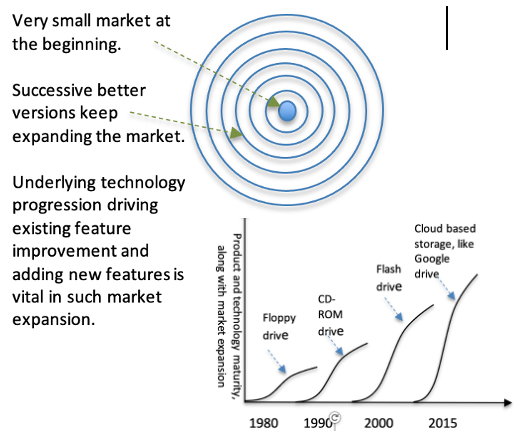
How has portable data storage diffused from the bags of a few scientists and engineers to the pockets of billions of people? Reinvention waves are at the core of market growth, and the rise and fall of products and firms. Hence, riding the waves of reinvention has been drawing increasing importance. This article analyzes the evolution of portable storage Innovation and market expansion through four major reinvention waves and draws lessons for riding the reinvention waves.
The evolution of the portable storage market demonstrates how continuous reinvention drives market expansion through cycles of Creative Destruction, reshaping customer demand and transforming technology. Beginning with the tape drive in the 1970s, the market has seen transformative shifts with floppy disks, CD-ROMs, flash memory, and, most recently, cloud storage, each iteration building on previous limitations and introducing expanded capabilities. This cyclical reinvention highlights a fundamental pattern in technology-driven markets, showing that expansion results not only from gradual improvements but from distinct waves of reinvention that displace outdated technologies while creating broader and more accessible solutions. Such a reality underscores the importance of riding the waves of reinvention to expand the market, resonating with consumer preferences, rising from creative destruction, and sustaining success.
The Origins of Portable Storage: The Tape Drive
The journey of portable storage began with tape drives in the early 1970s, which represented the first attempt at storing data outside a computer. While initially limited to business and specialized industrial use, tape drives laid the groundwork for portable storage by making it possible to store large volumes of data externally. However, tape drives had several limitations, including slow data retrieval and relatively low storage capacity compared to later technologies. As technology advanced, innovators seized on the opportunity to create storage solutions that were faster, more compact, and could be used by a broader range of consumers, eventually resulting in the floppy disk’s introduction.
Floppy Disks: Reinventing Tape Storage
In the 1980s, the introduction of floppy disks marked the first major reinvention in portable storage, making it significantly more accessible to personal and business users alike. Unlike tape drives, floppy disks were compact, portable, and allowed for quicker data access. With a storage capacity that was initially limited but eventually reached up to 1.44 MB, floppy disks revolutionized data storage by making it inexpensive, compact, and user-friendly. They became the standard for file transfers and storage, paving the way for the personal computing revolution. This wave of reinvention underscored the principle that market expansion is fueled by innovation that better meets consumer needs, offering enhanced usability, portability, and speed.
However, by the 1990s, new limitations emerged as file sizes increased and the maturity of the underlying technology core, making floppy disks inadequate for the growing demands of digital media and software applications, leading to a new phase of creative destruction.
CD-ROMs and Optical Storage: The Next Wave
With the introduction of CD-ROMs in the late 1980s and their widespread adoption in the 1990s, the storage industry experienced a significant leap in storage capacity. CD-ROMs offered up to 700 MB of data storage, a substantial increase compared to floppy disks, and provided faster access times. CD-ROMs became the preferred medium for software distribution, multimedia, and data storage, effectively replacing floppy disks and driving market expansion by addressing the limitations of previous technologies.
The reinvention of storage through optical media also fostered the growth of the digital entertainment industry, allowing for the storage and distribution of high-quality media files. However, even as CD-ROMs increased data capacity and durability, they eventually encountered limitations in portability and convenience as consumer preferences shifted toward more compact and resilient solutions due to the emergence of the next-technology possibilities. This phase of creative destruction further illustrates the cycle of innovation: as each solution matures and faces technological limitations, a new wave emerges to meet evolving consumer demands.
Flash Memory: Portable Storage Reinvented
The arrival of flash memory in the early 2000s brought another transformative change, addressing the limitations of both floppy disks and CD-ROMs. Flash storage devices, such as USB drives and SD cards, offered greater durability, faster access speeds, and significantly more storage capacity in a smaller, more portable format. Flash memory’s durability and reliability made it highly popular among consumers, and it quickly became the standard for portable storage.
Flash memory devices not only expanded the consumer base but also accelerated the adoption of digital media by providing a versatile and durable storage medium that could be used in a variety of devices, from digital cameras to smartphones and computers. The expansion of the storage market during this period exemplifies how technological advancements make products more versatile and accessible, thereby broadening their market potential. However, even as flash memory dominated portable storage, new limitations emerged in terms of data security and scalability, leading to yet another wave of reinvention with the advent of cloud storage.
Cloud Storage: The Latest Reinvention Wave
The shift to cloud storage represents the latest reinvention wave in the portable storage market, addressing the constraints of physical storage devices by moving data to virtual servers. Cloud storage offers several key benefits, including unlimited scalability, remote access, freeing from the necessity of carrying storage devices, and improved data security through redundancy. With cloud storage, users no longer need physical devices to carry their data, making data access more convenient and enabling collaborative workflows across locations. Additionally, cloud storage solutions allow for real-time data syncing and sharing, making it ideal for modern business environments and remote work.
Cloud storage has thus expanded the storage market from individual consumers to global organizations, driving demand across industries. However, cloud storage has also introduced new challenges, including privacy concerns, dependence on internet connectivity, and subscription-based pricing models. These limitations suggest that, as with previous storage innovations, the cloud may eventually be succeeded by new technologies that further enhance data accessibility and security.
Key Insights on Market Expansion Through Riding the Waves of Reinvention
The evolution of the portable storage market highlights several key insights into how markets expand through waves of reinvention:
- Addressing Latent Needs: Each reinvention wave not only addressed the limitations of the previous technology but also tapped into latent consumer needs in getting Jobs to be done, making the product more attractive to a broader audience. By continually addressing consumer pain points, companies unlock new market potential.
- Creating and Destroying Markets: As new technologies emerge, they disrupt and eventually replace existing solutions, a process known as creative destruction. This phenomenon drives innovation by pushing outdated technologies out of the market, making way for more advanced and useful solutions.
- Expanding Access and Usability: The reinvention of storage solutions has consistently made data storage more accessible, portable, and user-friendly, enabling a wider array of applications and users. This progression has allowed the storage market to grow from niche business users to billions of consumers globally.
- Increasing Value Through Utility: Each new wave has provided greater value per unit of utility. For example, the transition from floppy disks to cloud storage has allowed consumers to store, access, and share data with unprecedented ease, contributing to the widespread adoption and expansion of data-driven industries.
- Future Reinvention Potential: As cloud storage continues to grow, new limitations will inevitably arise, likely leading to the next wave of reinvention. Emerging technologies, such as quantum storage and decentralized data storage systems, may represent the next phase in portable storage evolution, offering even greater scalability, security, and speed.
Conclusion
The history of portable storage—from tape drives to cloud storage—demonstrates that market expansion is driven by successive waves of reinvention. Each reinvention not only improved on previous limitations but also addressed new consumer needs, making storage solutions more accessible and versatile. This process exemplifies creative destruction, as new technologies replace outdated ones, fueling growth across industries. As technological advancements continue, the next wave of reinvention will likely unlock further market expansion, driving innovation and creating new opportunities in the data storage sector. By understanding the dynamics of reinvention waves, businesses can better anticipate market shifts and develop products that meet the evolving needs of consumers.
Research Questions about Riding the Waves of Reinvention in Portable Storage
Here are some research questions based on the exploration of portable storage evolution and market expansion through reinvention waves:
- How do cycles of creative destruction contribute to market expansion across different technology sectors?
- What are the specific factors that drive each wave of reinvention in the portable storage market, from tape drives to cloud storage?
- How does consumer demand influence technological reinvention, and in turn, how do new technologies shape consumer expectations?
- What role do technological advancements in data storage play in the development and expansion of digital media, cloud computing, and data-driven industries?
- In what ways might future data storage solutions, such as quantum or decentralized storage, represent the next wave of reinvention and disrupt existing storage paradigms?
- What are the key challenges and limitations introduced with each reinvention, and how do these impact the longevity and market adoption of each technology?
- How does creative destruction in data storage influence other technological markets, such as software development, hardware design, and cybersecurity?
- What economic and environmental impacts accompany the cycle of reinvention in storage solutions, particularly in terms of material use, manufacturing, and data center energy consumption?
- How do businesses balance the cost of R&D for storage innovations with the potential market gains from replacing existing storage solutions?
- How do emerging markets respond to the reinvention waves of data storage technology, and what factors influence their adoption rates compared to advanced markets?
These questions encourage exploration into the broader effects of technological reinvention on the economy, society, and ongoing innovation within the portable storage sector.