Industrial revolutions have transformed human civilization by delegating roles to machines, improving efficiency, and opening pathways to previously unimaginable possibilities. The transformative effect causing the rise, fall and migration of economic prosperity raises the questions about the underlying forces driving industrial revolutions.
The core of this transformation lies not solely in scientific advancements but in the profit-making incentives that spur competition to create better tools for Getting jobs done. This interplay of science, Innovation, and profit-seeking has driven not only the historic revolutions of the past but continues to shape the Fourth Industrial Revolution we are now witnessing.
The Human Urge to Innovate and Improve
At the heart of human progress is an innate drive to understand, create, and improve. Human beings possess a unique urge to gather knowledge, generate ideas, and translate them into tools that serve purposes better than ever before. This core capability of invention and innovation has consistently differentiated humans from other living creatures.
Our ancestors demonstrated this ability by creating basic tools for hunting and farming, but the real leap occurred when we began leveraging scientific discoveries to fuel scalable technologies. The invention of the steam engine, for example, didn’t just happen because of technological know-how; it was motivated by the desire to get jobs done more efficiently. This foundational innovation set the stage for the First Industrial Revolution, where human labor began transitioning to machine-based work.
The Three Forces Driving Industrial Revolutions
Across all industrial revolutions, three major forces have consistently driven progress:
- Endless Urge to Delegate Roles to Machines:
Human beings have always sought ways to reduce their physical burden by delegating roles to machines. From simple tools to complex machinery, this urge is fueled by the desire to enhance productivity, reduce effort, and improve quality. For instance, automated telephone systems replaced human operators because they could perform the task more reliably and efficiently. - Profit-Making Incentives:
While scientific advancement provides the foundation, it is profit incentives that turn ideas into reality. Businesses and entrepreneurs compete to offer better tools that cater to the endless human desire for improvement. This competition ensures that innovations are not just theoretical but practical and scalable. Without the potential for profit, many groundbreaking inventions would never have reached the market. - Discovering Deeper Science:
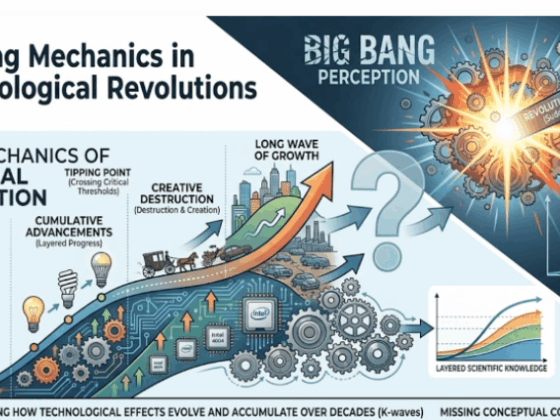
The pursuit of deeper scientific understanding fuels the development of increasingly scalable technologies. Each industrial revolution has built upon scientific discoveries that enabled new capabilities. For example, the invention of the Transistor in 1947, based on quantum mechanics, paved the way for the Third Industrial Revolution, characterized by the rise of electronics and digital technologies.
These three forces have consistently worked in tandem, unfolding one industrial revolution after another, each characterized by new technologies and ways of organizing work.
The Four Industrial Revolutions: A Continuum of Progress
The First Industrial Revolution: Steam Power
The First Industrial Revolution (late 18th century to early 19th century) was triggered by the invention of the steam engine, which revolutionized transportation and manufacturing. Steam power enabled factories to operate on a large scale, marking the beginning of mechanized production. This shift reduced the need for human labor in manual tasks but created new opportunities in machine operation and maintenance.
The Second Industrial Revolution: Electricity and Mass Production
The Second Industrial Revolution (late 19th century to early 20th century) brought about electrical power, the internal combustion engine, and mass production techniques. Innovations like the electric light bulb and motors transformed industries and everyday life. Again, the driving force was the desire to improve efficiency and meet growing consumer demands.
The Third Industrial Revolution: Digital Technology
The Third Industrial Revolution, beginning in the mid-20th century, was characterized by the rise of digital technologies and the development of computers. The invention of the transistor laid the foundation for modern electronics, enabling a shift from analog to digital systems. This era saw a massive increase in productivity as businesses leveraged computers to automate complex tasks and analyze vast amounts of data.
The Fourth Industrial Revolution: Automation and AI
Today, we stand at the dawn of the Fourth Industrial Revolution, marked by the rise of artificial intelligence (AI), robotics, and smart technologies. Machines are becoming capable of performing tasks that were once thought to require human intelligence. This revolution is driven by the same forces as its predecessors: the urge to get jobs done better, profit-making incentives, and deeper scientific discoveries.
Job Loss and Human Concerns
A recurring concern in each industrial revolution has been the threat of job loss. As machines take over tasks previously performed by humans, there is a natural fear of unemployment and social disruption. For example, when telephone systems were automated, thousands of switchboard operators lost their jobs. However, such job loss is an inherent character of industrial evolutions. Fortunately, history shows that while some jobs disappear, new ones are created in their place.
The Fourth Industrial Revolution, with its emphasis on automation and AI, has reignited these concerns. Robotics and machine learning systems are poised to replace jobs in manufacturing, logistics, and even white-collar professions. However, just as previous revolutions created new industries and roles, this one is likely to do the same. The challenge lies in managing the transition and ensuring that workers are equipped with the skills needed for the future.
The Continuation of Human Progress
All four industrial revolutions represent a continuum of human progress, driven by the desire to delegate roles to machines and improve how jobs are done. This progression didn’t start with the industrial age; it has been a part of human civilization since the earliest tools were invented.
The fundamental forces—human ingenuity, profit incentives, and scientific discovery—are not likely to change. What will change are the tools we create and the ways we use them. As we move deeper into the Fourth Industrial Revolution, the focus will shift from simple automation to intelligent systems that can learn, adapt, and improve over time.
Conclusion
The unfolding of industrial revolutions is not a random occurrence but the result of a competitive drive to offer better tools that meet the endless human desire to get jobs done more efficiently. Scientific advancement is essential but insufficient on its own. It is the profit-making incentives that turn ideas into innovations, fueling competition and driving progress.
As history has shown, while each industrial revolution brings concerns about job displacement, it also opens doors to new opportunities. The Fourth Industrial Revolution will be no different. By embracing the forces that have driven progress—human ingenuity, profit motives, and scientific discovery—we can shape a future where technology continues to serve humanity, just as it has done for centuries.
Key Takeaways about Forces Driving Industrial Revolutions
- Human Drive for Better Tools Fuels Progress:
Human beings have an innate desire to improve how jobs are done by delegating roles to machines. This drive has been the core force behind each industrial revolution, from steam engines to AI and robotics. - Profit-Making Incentives Turn Ideas into Innovations:
While scientific discoveries lay the groundwork, it is the profit motive that pushes businesses to develop scalable technologies and offer better tools, driving competition and progress. - Three Major Forces Drive Industrial Revolutions:
Industrial revolutions unfold due to the combination of:- The human urge to delegate tasks to machines.
- The profit motive driving innovation.
- Scientific discoveries enabling new, scalable technologies.
- Job Loss Is a Natural but Manageable Outcome:
Each industrial revolution brings concerns about job displacement, but history shows that new roles and industries emerge, creating opportunities for adaptation and growth. - The Fourth Industrial Revolution Continues the Pattern:
The current wave of automation and AI builds on the same forces as previous revolutions. By embracing innovation and reskilling, society can navigate this transition and unlock new possibilities.
Research Questions about Forces Driving Industrial Revolutions
- How do profit incentives influence the pace and direction of technological innovation during industrial revolutions?
- Investigates the relationship between economic motivations and the commercialization of scientific advancements.
- What role does human desire for improved efficiency play in driving technological adoption across different industries?
- Explores how consumer and business demand for better tools leads to widespread adoption of innovations.
- How have different industrial revolutions affected job displacement and the creation of new employment opportunities?
- Analyzes patterns of job loss and job creation across the four industrial revolutions.
- What are the key factors that enable successful transitions for workers displaced by automation and AI in the Fourth Industrial Revolution?
- Examines strategies for reskilling, upskilling, and workforce adaptation.
- How do advancements in science and technology enable increasingly scalable innovations across industrial revolutions?
- Investigates how deeper scientific discoveries underpin technologies that transform industries and societies.