Industrial revolutions have profoundly reshaped global economic landscapes through successive Reinvention waves, which unleash cycles of Creative Destruction. This process drives the rise of new players, industries, and nations while causing the fall of incumbents unwilling or unable to adapt. Over time, this dynamic has caused significant migration of prosperity across geographical and economic boundaries, reshaping global power structures. From the decline of Southeast Asia’s dominance in preindustrial manufacturing to Japan’s rise in consumer electronics and China’s potential ascendancy in clean energy and intelligent machines, the industrial revolutions have repeatedly shifted the centers of Wealth and influence—through rise, fall, and migration of prosperity.
Creative Destruction and the Reluctance of Incumbents
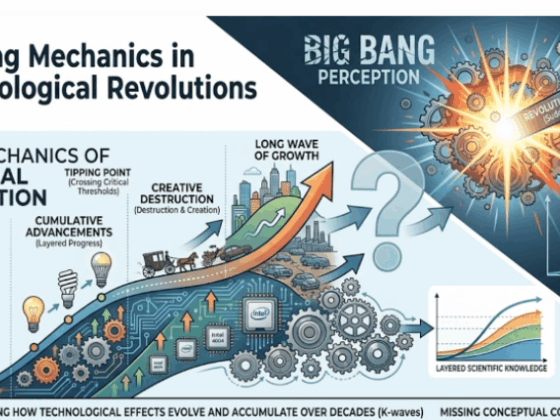
At the heart of every industrial revolution lies the principle of creative destruction, where new inventions render existing products, industries, and even entire economic systems obsolete. Incumbents—whether firms, industries, or nations—often resist these reinvention waves because of their vested interests in matured products and established systems. Pursuing unproven emerging technologies entails significant risk, including the potential obsolescence of profitable products, skilled labor pools, and infrastructure. Hence, responses of incumbents and new entrants to creative destruction underpin the rise, fall, and migration of prosperity.
This reluctance creates opportunities for new entrants, who take risks that incumbents avoid. These entrants, often Startups or firms in less dominant economies, embrace emerging technology cores and innovations, driving the reinvention process. Consequently, industrial revolutions not only disrupt established players but also enable the rise of previously peripheral entities, leading to a migration of prosperity.
The First Industrial Revolution: The Decline of Southeast Asia
The first industrial revolution, driven by reinventions in energy and manufacturing, marked the shift from handmade goods to mechanized production. Southeast Asia, which had contributed approximately 25% of global manufacturing output during the preindustrial era, was severely affected by this wave of creative destruction.
Mechanized manufacturing in UK-led Europe outperformed traditional Craftsmanship, leading to the decline of Southeast Asia’s artisanal industries. The region’s loss of economic dominance was compounded by the effects of colonization, which further exploited local resources and labor while suppressing industrial development. The result was a dramatic shift in global economic power, with Europe emerging as the new center of prosperity.
The Second Industrial Revolution: Migration from the UK to the USA
The second industrial revolution, centered on electrical technologies and Internal Combustion Engines (ICEs), witnessed the migration of prosperity from the United Kingdom to the United States. UK firms, dominant in the mechanical era, were reluctant to embrace the new wave of electrical technologies and ICEs, fearing the obsolescence of their existing capabilities like steam engine based energy production and transportation.
In contrast, American firms aggressively pursued innovations such as electric motors, telecommunication, assembly-line production and ICEs based automobiles. This proactive approach allowed the US to surpass the UK as the world’s leading industrial power, marking a significant migration of prosperity. This shift demonstrated how reluctance to embrace reinvention could lead to the decline of once-dominant nations and industries.
The Third Industrial Revolution: The Semiconductor Era
The third industrial revolution, driven by semiconductors and digital technologies, largely originated in the United States. Innovations such as computers, microprocessors, and communication networks enabled the US to maintain its position as a global economic leader. However, the reluctance of American firms to reinvent certain matured products allowed other nations to rise.
For instance, US firms like RCA and Kodak, dominant in radio, television, and consumer electronics, failed to capitalize on semiconductor-driven reinventions. Japanese companies like Sony, Canon, and Panasonic embraced the opportunity, using semiconductor technologies to produce innovative products. This led to the rise of Japan at the expense of the US in specific industries, demonstrating how targeted reinvention waves could shift prosperity.
Similarly, Taiwan and South Korea leveraged semiconductor technologies to transform their economies, achieving high-income status. The Taiwanese semiconductor giant TSMC and South Korean conglomerates like Samsung epitomize how reinvention waves can enable emerging nations to capture new prosperity.
The Fourth Industrial Revolution: Clean Energy and Intelligent Machines
The ongoing fourth industrial revolution focuses on clean energy, electric vehicles (EVs), and intelligent machines, with artificial intelligence (AI) and robotics playing central roles. China has emerged as a strong contender in this revolution, investing heavily in technologies such as EV manufacturing, renewable energy systems, and AI applications.
China’s proactive stance in embracing these emerging technology cores may position it to capture a significant share of global prosperity. If successful, this could lead to further migration of prosperity from the US, particularly in sectors where American firms are slow to adapt. For example, while Tesla has pioneered the EV revolution, Chinese companies like BYD and NIO are rapidly scaling their production and capturing global markets. Furthermore, Tesla’s EVs are powered by China’s CATL’s battery innovations.
On the other hand, Southeast Asia and many less-developed countries remain largely disconnected from the dynamics of industrial revolutions. Without understanding how reinvention waves drive economic transformations, these regions risk being left behind in the migration of prosperity. Similarly, resource-rich nations like Canada and Australia have yet to position themselves as leaders in leveraging emerging technologies, despite their economic potential.
Lessons and Implications
- Adaptability Determines Economic Resilience:
The ability to adapt to reinvention waves is critical for maintaining or achieving prosperity. Nations and firms that fail to embrace emerging technology cores risk obsolescence, as seen in the decline of Southeast Asia during the first industrial revolution and the UK during the second. - Proactive Investment in Emerging Technologies:
The rise of the US during the second and third industrial revolutions, Japan’s ascent in consumer electronics, and China’s current trajectory underscore the importance of proactive investment in emerging technologies. Nations and firms must allocate resources to research, development, and scaling innovations to stay competitive. - Startups as Catalysts of Reinvention:
Startups and new entrants play a pivotal role in driving reinvention waves. They often take risks that incumbents avoid, enabling the creation of disruptive innovations. Policies fostering entrepreneurship and Innovation ecosystems can accelerate prosperity migration to emerging economies. - Geopolitical Shifts and Sustainability Challenges:
The migration of prosperity often causes geopolitical shifts, as new economic centers emerge. However, these shifts can also exacerbate inequality and environmental challenges. The fourth industrial revolution’s focus on clean energy and intelligent machines presents an opportunity to align prosperity migration with global sustainability goals. - Global Collaboration and Knowledge Sharing:
Countries disconnected from industrial revolution dynamics, such as those in Southeast Asia, must prioritize knowledge sharing and international collaboration to benefit from reinvention waves. Resource-rich nations like Canada and Australia should explore ways to integrate their strengths into global innovation ecosystems.
Conclusion
Industrial revolutions, driven by cycles of creative destruction, have consistently caused the rise, fall, and migration of prosperity. Reluctance to pursue unproven technologies has led to the decline of dominant players, while new entrants embracing reinvention waves have risen to prominence. From Southeast Asia’s decline during the first industrial revolution to China’s potential ascendancy in the fourth, the patterns of prosperity migration highlight the transformative power of industrial revolutions.
To thrive in this ever-changing landscape, nations and firms must prioritize adaptability, invest in emerging technologies, and foster innovation ecosystems. The fourth industrial revolution presents an unparalleled opportunity to drive prosperity while addressing global challenges. However, failure to recognize and adapt to these dynamics risks leaving entire regions and industries behind in the ongoing migration of economic prosperity.
Five Key Takeaways about Rise, Fall, and Migration of Prosperity
- Creative Destruction Drives the Migration of Prosperity:
Industrial revolutions are fueled by reinvention waves that disrupt existing products, industries, and economies. This creative destruction causes the rise of new entrants and the decline of incumbents, leading to a consistent migration of prosperity across regions and nations. - Reluctance of Incumbents Creates Opportunities for New Entrants:
Dominant firms and nations often resist adopting emerging technologies to protect their existing investments in matured products. This opens the door for startups and rising economies to embrace innovation and capture new wealth, as seen with the USA in the second industrial revolution and Japan during the semiconductor era. - Proactive Investment in Emerging Technologies is Essential:
Nations and firms that actively pursue new technology cores, such as the UK during the first industrial revolution or the US during the second and third, gain long-term prosperity. In contrast, those that neglect reinvention, like Southeast Asia or the UK in later waves, experience decline. - The Fourth Industrial Revolution Presents a Critical Opportunity:
The current wave of innovation, driven by clean energy, electric vehicles, and intelligent machines, has the potential to further shift global prosperity. China’s investment in these areas illustrates how emerging players can lead if they prioritize adaptability and reinvention. - Disconnected and Resource-Rich Nations Risk Being Left Behind:
Many less-developed countries and resource-rich nations like Canada and Australia fail to leverage industrial revolutions effectively. Without strategic participation in global innovation ecosystems, they risk missing the opportunity to benefit from the ongoing migration of prosperity.
Five Research Questions about Rise, Fall, and Migration of Prosperity
- Mechanisms of Creative Destruction and Prosperity Migration:
- How does creative destruction during industrial revolutions cause the migration of prosperity across regions, industries, and firms?
- What factors determine whether new entrants can successfully displace incumbents in emerging technology cores?
- Adaptation and Resistance Among Incumbents:
- Why do dominant firms and nations resist reinvention waves, and what strategies can overcome this resistance?
- How can established players in matured industries adapt to emerging technologies to retain their competitive edge?
- Patterns of Prosperity Migration Across Industrial Revolutions:
- What commonalities and differences can be observed in the migration of prosperity during the first, second, third, and fourth industrial revolutions?
- How have geopolitical and economic policies influenced the outcomes of prosperity migration in different eras?
- Opportunities in the Fourth Industrial Revolution:
- What specific technologies and industries within the fourth industrial revolution offer the greatest potential for prosperity migration to new regions?
- How can countries like China, Southeast Asia, and resource-rich nations maximize their participation in this wave?
- Policy and Ecosystem Development for Global Inclusivity:
- What policies can help less-developed countries understand and capitalize on industrial revolution dynamics?
- How can global collaboration and innovation ecosystems be structured to ensure equitable prosperity migration across regions?