THE WAVES
  • Home
  • News
    • Recent Updates
    • Weekly Newsletter
    • Monthly Newsletter
    • Quarterly Newsletter
  • Topics
    • Technology
      • Internet
      • AR/VR & Digital twins
      • Robotics
      • AI & Data Analytics
      • IoT & Wearable
      • Blockchain
      • Computing
      • Sensors & Perception
      • 3D Printing
      • Energy Tech
      • Space
      • Gadgets
    • Transformation
      • Education
      • Health
      • Transportation
      • Farming
      • Energy
      • Security
      • Mining & Blue Economy
      • Food & Living
      • Communication
      • Entertainment
      • Manufacturing
      • Work & Management
      • Public Service
    • Startups
      • Culture
      • Country
      • New Entry
      • Accelerators
      • Incubators
      • Death Valley
      • Investments
      • Exit & IPO
      • Valuation & Financing
      • Idea & IP
    • Education & Research
      • School
      • University
      • Academic Research
      • Corporate Research
      • Public-funded Research
      • Economics of Innovation
      • Growth Economics
      • Training
      • Publications
      • Patents & IP
    • Industrial Revolutions
      • Future of Work
      • Sustainable Development
      • Smart Manufacturing
      • Job Transformation
      • Industry Transformation
      • Competition & Monopoly
      • National Response
      • Education & Skills
      • Social Change
    • Investment & Review
      • Public
      • Corporate
      • Venture Capital
      • Capital Market
      • Philanthropy
      • Personality
    • Inventions
    • Automation
  • Strategy
    • Value Proposition
      • Product
      • Process
      • Sustainability Goals
      • Business Model
      • Complementary
      • Externality
    • Innovation
      • Disruptive Innovation
      • Incremented Innovation
      • Sustaining
      • Schumpeter’s Creative Destruction
      • Redesign for Winning
    • Competition
      • Leading
      • Following
      • Blue Ocean
      • Monopolisation
      • Porter’s Five Forces
      • Business Cycle
    • Intangible Assets
      • Human Capital
      • R&D Management
      • Tripple Helix
      • Intellectual Property
      • Productive Knowledge
      • Technology Managment
    • Competence
      • Organization Agility
      • Innovation Culture
      • Infrastructure
      • R&D facility
      • Great by Choice
      • Build to Last
      • Good to Great
    • Technology Acquisition
      • Scientific discovery
      • Invention
      • Fusion
      • Adaptation & Refinement
      • Licensing
      • Start-up acquisition
  • Policy
    • Technology Development
    • Industry
    • Innovation Diffusion
    • Jobs, Privacy & Security
    • Regulation & Law
    • Sustainability
    • Equity & Inclusiveness
    • Climate Change
    • Environment
  • Opinion
    • Opinion
  • Megatrends
    • Individual Preferences
    • Planet and Society
    • Technology
    • Political Economy
    • Market Power & Monopoly
    • Globalisation
    • Schumpeter’s creative destruction
    • Startups & VC
    • Human Role in Work
    • Value of Natural Resources
    • Patents & Ideas for Redesign
  • Publication
    • Case Studies
    • Magazine
    • Books
    • Reports
    • White Papers
    • Journals
THE WAVES In-depth investigation on Technology, Society, and Policy dynamics for interpreting the past as well as present, and predicting the future so that success rate of pursuing ideas, start-ups, and innovation economy increases.

Technology, Society and Policy

Winning and Losing in Reinvention Race : keeps unfolding: --making America’s innovation bucket leaky, creating prosperity out of reinvention, and turning invention successes transitory
THE WAVES
  • Home
  • News
    • Recent Updates
    • Weekly Newsletter
    • Monthly Newsletter
    • Quarterly Newsletter
  • Topics
    • Technology
      • Internet
      • AR/VR & Digital twins
      • Robotics
      • AI & Data Analytics
      • IoT & Wearable
      • Blockchain
      • Computing
      • Sensors & Perception
      • 3D Printing
      • Energy Tech
      • Space
      • Gadgets
    • Transformation
      • Education
      • Health
      • Transportation
      • Farming
      • Energy
      • Security
      • Mining & Blue Economy
      • Food & Living
      • Communication
      • Entertainment
      • Manufacturing
      • Work & Management
      • Public Service
    • Startups
      • Culture
      • Country
      • New Entry
      • Accelerators
      • Incubators
      • Death Valley
      • Investments
      • Exit & IPO
      • Valuation & Financing
      • Idea & IP
    • Education & Research
      • School
      • University
      • Academic Research
      • Corporate Research
      • Public-funded Research
      • Economics of Innovation
      • Growth Economics
      • Training
      • Publications
      • Patents & IP
    • Industrial Revolutions
      • Future of Work
      • Sustainable Development
      • Smart Manufacturing
      • Job Transformation
      • Industry Transformation
      • Competition & Monopoly
      • National Response
      • Education & Skills
      • Social Change
    • Investment & Review
      • Public
      • Corporate
      • Venture Capital
      • Capital Market
      • Philanthropy
      • Personality
    • Inventions
    • Automation
  • Strategy
    • Value Proposition
      • Product
      • Process
      • Sustainability Goals
      • Business Model
      • Complementary
      • Externality
    • Innovation
      • Disruptive Innovation
      • Incremented Innovation
      • Sustaining
      • Schumpeter’s Creative Destruction
      • Redesign for Winning
    • Competition
      • Leading
      • Following
      • Blue Ocean
      • Monopolisation
      • Porter’s Five Forces
      • Business Cycle
    • Intangible Assets
      • Human Capital
      • R&D Management
      • Tripple Helix
      • Intellectual Property
      • Productive Knowledge
      • Technology Managment
    • Competence
      • Organization Agility
      • Innovation Culture
      • Infrastructure
      • R&D facility
      • Great by Choice
      • Build to Last
      • Good to Great
    • Technology Acquisition
      • Scientific discovery
      • Invention
      • Fusion
      • Adaptation & Refinement
      • Licensing
      • Start-up acquisition
  • Policy
    • Technology Development
    • Industry
    • Innovation Diffusion
    • Jobs, Privacy & Security
    • Regulation & Law
    • Sustainability
    • Equity & Inclusiveness
    • Climate Change
    • Environment
  • Opinion
    • Opinion
  • Megatrends
    • Individual Preferences
    • Planet and Society
    • Technology
    • Political Economy
    • Market Power & Monopoly
    • Globalisation
    • Schumpeter’s creative destruction
    • Startups & VC
    • Human Role in Work
    • Value of Natural Resources
    • Patents & Ideas for Redesign
  • Publication
    • Case Studies
    • Magazine
    • Books
    • Reports
    • White Papers
    • Journals

  • Editor's Pick
  • Schumpeter's Creative Destruction
  • Uncategorized

Great by Choice of Creative Destruction

Sustained high performance in the midst of uncertainty due to rational decision

  • Md. Rokonuzzaman
  • Created: November 3, 2025
  • Last updated: November 22, 2025
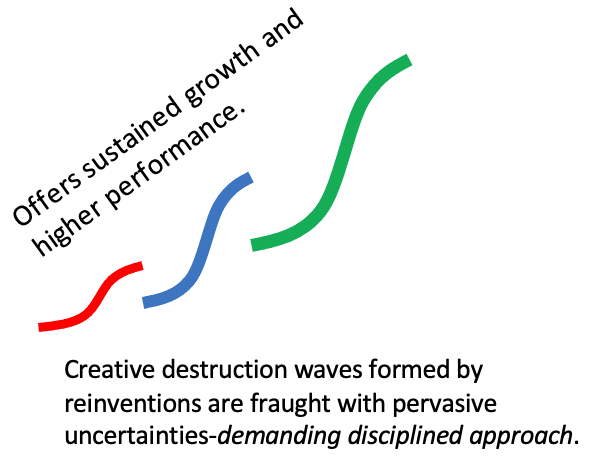
Creative destruction waves offer sustained high-performance over a long period of time—offering the option of great by choice

Surprisingly, during the periods of uncertainty and chaos, some companies thrive while others falter. Jim Collins and Morten T. Hansen have explored it in their famous Book “Great by Choice.” Greatness is achieved through conscious choices rather than sheer luck is the core thesis of this book. Such an observation raises a question about the nature of uncertainty and chaos, as well as conscious choices. Why do companies face such a situation, and what are the choices they make to show great performance? Is it the choice of Creative Destruction that makes firms great and creates chaos in a false sense of stability, safety, and Wealth entitlement of others?

In detecting patterns of 10x performance, they focused on a final list of 7 companies, screened from a shortlist of 20,400 companies. Upon drawing lessons from Amgen, Biomet, Intel, Microsoft, Progressive Insurance, Southwest Airlines, and Stryker, they presented their thesis. They find that success in chaos is the product of excellent choices through disciplined thought, strategic decision-making, and a strong organizational culture. Although it has not been highlighted in their book, both the theory and history suggest that the possibility of reinventing mature products with emerging technologies could be the underlying reason for uncertainty, and companies can achieve greatness by making prudent choices of pursuing creative destruction.

Furthermore, choosing creative destruction may lead to far more than a 10-fold performance improvement. For example, Apple’s stock price rose from less than $3 in 2008 to $270 in 2025—almost 100X performance over 17 years. On the other hand, avoiding the concept of creative destruction may lead to the demise of great firms, as exemplified by Nokia, Kodak, and RIM.

Examples of great by choice of creative destruction

Nichia: Great by Choice of LED light bulb

A little Japanese company, founded in 1956, used to manufacture phosphor for fluorescent lamps and televisions. Unfortunately, the possibility of the LED light bulb and LCD posed a threat to its survival. Despite its stable business during the 1960s and 1970s, the company found the 1980s to be turbulent due to the rapid development of LCD and LED technologies, which were uncontrollable, fast-moving, and uncertain, and potentially harmful to its business, as future light bulbs and television displays would no longer require phosphor.

However, unlike many other companies, Nichia decided to pursue the development of LED light bulbs, resulting in creative destruction on its own phosphor production business. Hence, it began investing in R&D to perfect the development of LED light bulb technology. Consequently, due to the success of creating a perfect white and bright LED light bulb, this small enterprise began its rise to greatness from a position of vulnerability. On the other hand, for not making the choice, great companies like General Electric suffered a burn in its lighting business.

Apple: Sustained performance growth due to making the choice of creative destruction

In 1997, Apple faced near-bankruptcy. Its stock price was $0.15 on 24 October 1997. Although Steve Jobs’ work on restructuring and giving the iMac a new look improved the situation, it was far from making a great choice. Consequently, the stock price did not show a steep rise. It just rose to $0.3 by the end of 2000. Hence, Steve Jobs’ (heroic character) return alone did not do much to make Apple great. The first jump came from Steve Jobs’ choice to pursue the Reinvention of the portable music player.

Its iPod emerged as a creative destruction force on the Walkman and other portable music players. As a result, Apple’s stock price jumped to $7.14 in December 2007—almost 24 times rise over seven years. The subsequent significant rise stemmed from Apple’s decision, which led to creative destruction in iPod and keyboard-centric smartphone designs, causing an increase in Apple’s stock price to $270.37 on October 31, 2025.

Samsung: Great by choice of joining the creative destruction wave

At the dawn of the 21st century, Nokia was the mobile handset king, and Samsung was among the many other handset makers. The emergence of the reinvention of the smartphone, notably with the iPhone in 2007, created an uncontrollable, fast-moving, uncertain, and potentially harmful business environment for mobile handset makers. While Nokia found itself in chaos defending its position, Samsung quietly made a strategic decision to give up its keyboard-centric design and adopt an Android-based imitation of the iPhone. Hence, rather than fending off the unfolding creative destruction of the iPhone, Samsung adopted it to imitate. Such a decision led to the decline of Nokia and many others, and the rise of Samsung, along with Apple, as a dominant mobile handset maker.

TSMC: Emerging as great by choice of unleashing a creative destruction wave

On February 21, 1987, Taiwan Semiconductor Manufacturing Company (TSMC) was founded in Taiwan. In an industry dominated by integrated device makers (IDMs) like Intel, Toshiba, and Texas Instruments, TSMC made a strategic decision not to be another IDM. Instead, it chose to offer the service of printing designs of microchips on wafers. Hence, it focused on developing a culture of improving yield, building trust as a third-party service provider, and rapidly improving process nodes to meet the growing complexity of microchips pursued by fabless companies. Consequently, this decision has unfolded as a creative wave of destruction on the IDM-dominated semiconductor industry. As a result, its stock price has experienced sustained growth from TWD 36 in 2003 to TWD 1,510 in 2025 —almost a 42-fold rise over 22 years.

ASML: Turning vulnerability into a great success

A Dutch photolithography machine maker, ASML, was fighting for its survival in the late 1990s. While many were rejecting the idea of an extreme ultraviolet (EUV) light source for the next-generation machine, ASML took a deliberate decision to pursue it in the midst of extreme uncertainty. To reach its goal of offering a superior photolithography machine, ASML had to stay on course for over 20 years, incurring an R&D cost of € 6 billion, before releasing the first machine in 2019. It required an extremely high-level discipline in decision-making in the midst of uncertainty to unleash a creative destruction wave in the photolithography industry. Consequently, ASML has emerged as a poster child of Great by Choice, exemplifying creative destruction, and its stock price has risen from $10 in 2003 to $ 1,085 in 2024—more than 100 times.

Challenges of choosing the option of creative destruction

For demonstrating great performance, the choice of creative destruction is marked by extreme uncertainty and conflict with the existing way of doing things. One of the underlying causes has been pervasive technology uncertainties. Hence, it requires a deep-down scientific insight, disciplined thought, strategic decision-making, and a strong, but flexible organizational culture to pursue an unproven and uncertain option.
Enlighten others

Subscribe

Subscribe now to our newsletter

You May Also Like

Which Type of R&D Should Be the Focus of Bangladesh and many other less developed countries?
View Post
  • 3 min

Types of Research and Development

Bangladesh can turn its high-tech parks into engines of prosperity by housing R&D wings of local producers
View Post
  • 3 min

Bangladesh’s High-Tech Park Owe: Can Low-Tech Be a Solution?

How speculative markets and continuous storytelling combine to decouple asset valuation from delivery of innovations
View Post
  • 8 min

The Rise of Muskism Turning Musk a Trillionaire: Narrative-Driven Capital Accumulation and the Illusion of Disruptive Innovation

Leave a Reply Cancel reply

Your email address will not be published. Required fields are marked *

Subscribe

Subscribe now to our newsletter

Principles

  • Economics of Technology
  • Innovation Economics
  • Technology & Innovation Policy

History & Observations

  • Technology History
  • Innovation History
  • Strategy & Policy in retrospect
  • Entrepreneurs & Innovators
  • Startups & Corporations
  • Patents & Publications
  • Design & Redesign Thinking

About Us

  • Who we are
  • What we deliver
  • Genesis
  • Mission
  • Scope
  • Editorial & Advisory Board
THE WAVES
  • Contact
  • Advertise

Input your search keywords and press Enter.