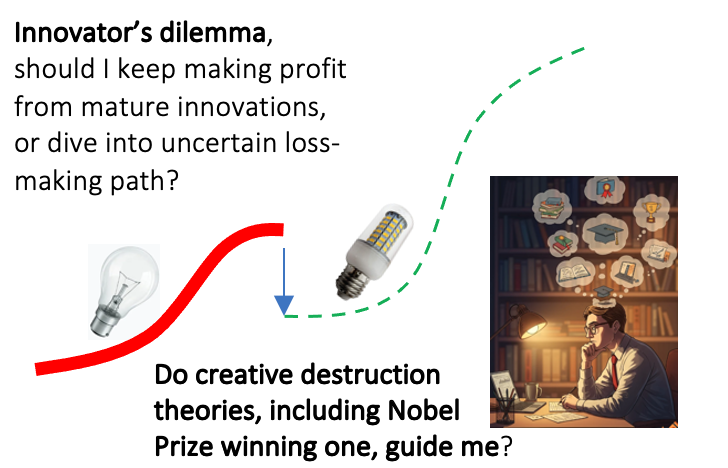
The success of Apple, Sony, Microsoft, and many others indicates that the underlying reason for the rise of tiny Startups into big corporations has been the success of Creative Destruction, which causes the decline of demand for mature innovations. Hence, startups pursue Disruptive Innovation by embracing creative destruction. Unfortunately, more than 90% of them fail within the first three years. On the other hand, seven out of ten innovation leaders suffer significant disruption in their business due to suffering from the Dilemma, called the innovator’s dilemma by Prof. Clayton. Is it due to a lack of ideas, funds, or other facilities? Unfortunately, no. The leading cause has been the complexity of decision-making, which is supposed to be addressed through a sound theory of creative destruction dynamics. Such a reality raises a vital question: Is the creative destruction theory sound enough to interpret, predict, and take informed decisions?
The 2025 Nobel Prize in Economics, awarded to Joel Mokyr, Philippe Aghion, and Peter Howitt for their work on innovation and economic growth, has created renewed interest in creative destruction. However, these Nobel Laureates are not the first to point to the presence of creative destruction in the evolution patterns of inventions and innovations. Even Nobel Laureates Daron Acemoglu, Simon Johnson, and James Robinson have referred to the role of creative destruction in the success or failure of nations to reach high-income status. Prior to them, Prof. Schumpeter coined this term in theorizing the creation of Wealth from ideas, which has its roots in Carl Marx’s theorization. Additionally, Prof. Clayton articulated this effect, which causes the decline of high-performing firms, as disruptive innovation.
It seems that Economists have been after the creative destruction theory for centuries in explaining wealth creation through inventions and their evolution. Does it mean the creative destruction theory has reached maturity to empower management decision-making to avoid the innovator’s dilemma? If not, what are the limitations of these Nobel prize-winning contributions to theorize creative destruction?
Genesis and Overview of Creative Destruction Theory
In ancient philosophical writings, Carl Marx noticed repeated references to human beings’ inherent tendency to recreate to get jobs done. This inherent characteristic appears to be the genesis of creative destruction. Subsequently, in the 1940s, Prof. Schumpeter coined the phrase “creative destruction” to explain how wealth is created through new innovations replacing old ones. The power of Capitalism in driving economic growth lies in its ability to disrupt established markets and businesses, thereby developing new ones, which leads to both wealth accumulation and annihilation. However, he did not go beyond explaining profit-making incentives and technology.
In the 1990s, Prof. Clayton created a buzz of creative destruction in business schools by giving a new name—disruptive innovation. Such disruptive innovation theory was an attempt to explain why high-performing firms fail due to a decision-making dilemma to switch to the next wave of growth, fueled out of the Reinvention of mature products. Although he cited the rejection of the mainstream market as the primitive emergence of reinventions and the marginal cost-benefit analysis decision-making lesson in business school education, he did not go beyond. Hence, managers received little help beyond becoming aware of the power of creative destruction and the excitement it generated.
Since the 1980s, economists have attempted to articulate innovation-led economic growth, resulting in the development of endogenous growth theory. In this endeavor, Paul Romer got recognition for his idea and object theory through winning the Nobel Prize in 2018. However, Paul Romer focused on the role of ideas in increasing innovation population, or counts and diversity. He did not consider the creative destruction effect of new ideas on existing ones, let alone how it takes place.
In 2024, Daron Acemoglu, Simon Johnson, and James Robinson received the Nobel Prize for their work on the role of institutions in facilitating the flow of new ideas, causing destruction to old ones. However, they did not shed light on how creative destruction waves are formed, how they grow, or what the decision-making challenges are to pursue them. Just one year later, Joel Mokyr, Philippe Aghion, and Peter Howitt received the Nobel Prize in Economics in 2025 for their work on innovation-led growth, which builds upon the concept of creative destruction. Joel Mokyr’s work focuses on the study of history and conceiving creative destruction-led growth as well as the unfolding of industrial revolutions as a social phenomenon. On the other hand, Philippe Aghion and Peter Howitt’s theoretical attempt left the issue of pervasive uncertainties creating a decision-making dilemma largely untouched.
Hence, it may not be unfair to say that, despite the recognition through winning Nobel Prizes, the progress made in theorizing creative destruction by economists is still in its early stages.
Creative Destruction Theory Appears to be Premature to Support Management Decision Making
As explained, creative destruction has been an inherent characteristic of the human race. It has been with us from the beginning of the presence of the human race on this planet. In addition to removing barriers to pursuing new ideas as replacements for old ones, the major challenge of driving growth through creative destruction has been the decision-making challenge. If this issue is not addressed, a firm or a nation could become impoverished by pursuing creative destruction. For example, despite more than $80 billion in investment in autonomous vehicle R&D, such creative destruction has yet to unfold. Similarly, by taking a premature decision to pursue electric vehicles, many firms reported massive losses in 2025.
The major challenge of benefiting from creative destruction has been that technological possibilities of reinventions are fraught with pervasive uncertainties. Some of them are (i) primitive emergence, (ii) rejection by the mainstream market and loss-making beginning, (iii) unclear growth path, (iv) misleading early progress, (v) changing relative economics of competing technologies and innovation waves, (vi) lack of clarity about the investment needed to cross the threshold, (vii) scientific discovery needed to cross the local maxima and so on. Additionally, there have been uncertainties regarding consumer preferences, policies and risk capital, infrastructure, ecosystem, and compatibility. Unfortunately, the creative destruction theory has yet to address these significant issues, making it worthwhile to examine the management decision-making challenge in the pursuit of creative destruction.