Abstract:
This article examines why the accumulation of education and knowledge in Bangladesh has not translated into proportionate economic growth, despite historical evidence from Britain that economically meaningful knowledge can sustain long-term prosperity. Drawing on insights from economic history and evolutionary economics of product and process lifecycles, it argues that growth depends not merely on access to science or information, but on the continuous translation of knowledge into productive use to improve quality and reduce costs. While Bangladesh has expanded science and engineering education and benefited from unprecedented access to global knowledge through the internet, the economy lacks institutional mechanisms that connect graduates to Innovation, production, and Reinvention. Rising graduate unemployment is presented as a structural symptom of this disconnect. The analysis highlights the absence of firm-level demand for advanced skills, weak innovation ecosystems, and limited opportunities for learning-by-advancing. The article concludes that closing the gap between knowledge accumulation and economic transformation requires embedding knowledge within productive organizations, experimenting, and creating value through refinement and reinvention.
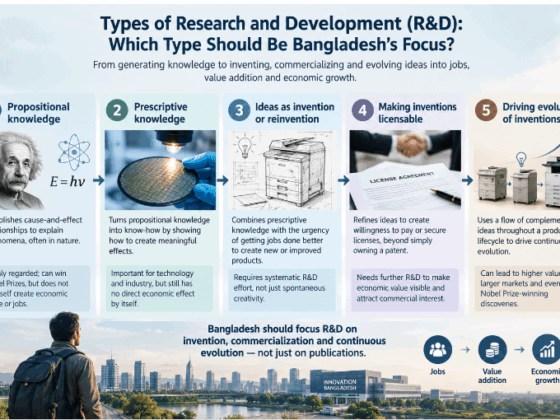
Britain’s long arc of prosperity was not the accidental outcome of industrialization, nor merely the result of capital accumulation and making copies of the same thing or setting a higher price due to colonial power. It was driven by the sustained growth of economically meaningful knowledge—knowledge that explained how natural phenomena work and, crucially, how that understanding could be translated into step-by-step instructions to improve products, processes, and production systems. Over more than a century, this form of applied knowledge continuously fed innovation, raised productivity, and transformed Britain into one of the most prosperous economies of its time.
Economic historian Joel Mokyr famously framed this transformation as the outcome of an expanding stock of “useful knowledge,” embedded in engineers, artisans, institutions, and routines. What mattered was not abstract science alone, but the systematic conversion of scientific insights into operational practices. The steam engine, textile machinery, metallurgy, and chemical processes all evolved through iterative experimentation, recombination, and incremental improvement. Growth emerged not from knowledge in isolation, but from its persistent economic use.
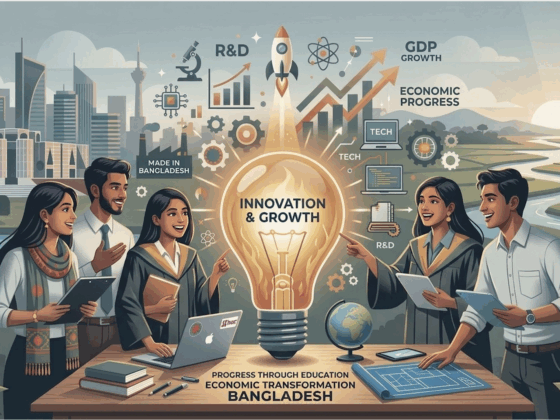
This historical lesson has deeply influenced development thinking. Countries seeking to escape poverty have logically concluded that investing in science, engineering, and higher education is a prerequisite for prosperity. Bangladesh is no exception. Over the past two decades, the country has expanded universities, increased STEM enrollment, and produced a rapidly growing pool of graduates. At the same time, the internet has dramatically reduced barriers to accessing global knowledge. Scientific papers, engineering tutorials, open-source software, and technical manuals are now only a click away.
Yet a troubling paradox persists. Despite rising educational attainment and unprecedented access to knowledge resources, Bangladesh has not experienced proportionate growth in high-productivity sectors. Even more striking is the growing phenomenon of graduate unemployment and underemployment. Engineers drive ride-sharing vehicles; science graduates prepare for unrelated public service exams; technical degrees increasingly fail to translate into productive economic roles. If knowledge accumulation has increased, why have its economic returns remained so limited?
This disconnect suggests that the core challenge is not knowledge scarcity but a missing link between knowledge and economic transformation.
The first part of this missing link lies in the distinction between knowing and doing. Economically meaningful knowledge is not merely theoretical understanding acquired in classrooms. It is knowledge embedded in routines, firms, production networks, and problem-solving practices. In Britain’s industrial ascent, workshops, factories, and professional societies acted as intermediaries that continuously translated ideas into usable techniques. Learning occurred through practice, failure, modification, refinement, and reinvention.
In contrast, much of Bangladesh’s higher education system remains detached from real production environments. Curricula emphasize credential acquisition over problem-solving; examinations reward memorization rather than experimentation. Graduates emerge with certificates but without deep exposure to how knowledge is operationalized under real-world constraints—cost, reliability, scale, and market demand. As a result, knowledge remains inert, unable to generate productivity gains.
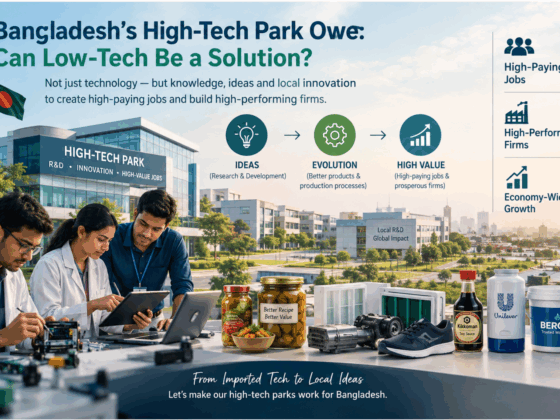
A second missing link is the weakness of domestic innovation ecosystems. In historical growth episodes, economically meaningful knowledge flourished where firms actively demanded it. British manufacturers constantly sought better machines, cheaper inputs, and improved processes. This demand pulled knowledge out of laboratories and into factories. In Bangladesh, however, much of the economy is locked into low-value-added activities with limited incentives to innovate. When firms compete primarily on low wages rather than capability upgrading, the demand for advanced knowledge remains thin. Besides, the labor productivity improvement agenda is dominated by technology imports. To make matters worse, the Government provides subsidies in the form of various incentives to offset eroding global competitiveness.
This creates a vicious cycle. Firms do not innovate because they do not need advanced knowledge, and graduates cannot apply their knowledge because firms do not innovate. The result is credential inflation without productivity transformation.
Third, the absence of reinvention mechanisms constrains growth. Knowledge does not generate prosperity automatically; it must be recombined, adapted, and continuously applied to reinvent and refine existing products and production processes to diffuse more deeply into local and global markets. Britain’s industrial success was not built on copying or making Breakthrough inventions alone, but on localized experimentation—modifying machines, refining processes, and discovering new applications. Economically meaningful knowledge evolved through use.
Bangladesh’s development strategy, by contrast, has often relied on static replication—imported technologies, turnkey factories, and standardized production models. While this approach delivers short-term growth, notably through low-skilled labor-based value addition, it limits learning-by-doing. When technology arrives as a “black box,” local actors gain little insight into its inner workings. Besides, there have been no incentives to advance it. Hence, without refining and reinventing, knowledge accumulation finds no use, and productivity gains reduce local value addition.
Graduate unemployment, therefore, is not merely a labor market problem; it is a symptom of a deeper structural failure. It signals that the economy lacks sufficient pathways to absorb, test, and refine the growing stock of educated human capital. In such a context, education becomes decoupled from economic transformation.
The internet, often celebrated as a great equalizer, does not resolve this problem on its own. While access to information has expanded dramatically, information is not equivalent to economically meaningful knowledge. Watching tutorials or downloading manuals cannot substitute for participation in production systems where knowledge is applied to improve products and processes, contested, and improved. Without institutional mechanisms that connect digital knowledge to real economic activity, online access risks creating an illusion of capability rather than genuine competence.
So where exactly is the missing link?
It lies in the meso-level institutions that connect individuals to markets: innovative firms, applied research centers, vocational experimentation spaces, and problem-driven collaboration between academia and industry. Development success depends not only on educating individuals but on building organizations that can absorb knowledge and convert it into productive outcomes.
For Bangladesh, this implies a strategic shift. The focus must move from expanding enrollment to deepening economic use of knowledge. Universities must become sites of applied problem-solving, not just degree production. Firms must be incentivized to move up value chains, creating demand for advanced skills. Policy must prioritize performance improvement through refinement, experimentation, failure, and reinvention over static efficiency and labor-based value addition in making copies.
History suggests that prosperity does not emerge simply because knowledge exists. It emerges when knowledge is relentlessly tested against reality, refined through use, and embedded in economic structures through improving products and processes. Britain’s lesson is not that education alone drives growth, but that economically meaningful knowledge must be woven into the fabric of refinement, production, and diffusion.
Until Bangladesh closes this gap—between knowing and applying it in advancing performance, between education and innovation, between access and application—the accumulation of knowledge will continue to coexist with graduate unemployment. The real challenge, therefore, is not producing or accessing more knowledge, but making knowledge economically alive.