Abstract
Wealth is not defined by money or natural resources, but by the Utility humans derive from Getting jobs done through products, processes, and systems. This essay develops a knowledge-centered theory of wealth creation, arguing that long-run prosperity emerges from humanity’s ability to transform understanding of natural phenomena into inventions, innovations, and continuous refinement. Pre-industrial growth remained slow due to artisanal, Tacit Knowledge, while modern economic growth accelerated when propositional scientific knowledge merged with prescriptive, step-by-step know-how, a dynamic identified by Joel Mokyr as “useful knowledge.” However, the essay advances a critical extension: waves of Reinvention cause migration of prosperity across firms and nations. The transition from mechanical to electrical technologies illustrates how legacy constraints prevented European incumbents from leading reinvention, enabling the United States to capture the Second Industrial Revolution. While Schumpeterian Creative Destruction explains renewal, it overlooks this spatial relocation of wealth. Understanding prosperity, therefore, requires analyzing reinvention dynamics, not accumulation alone.
Wealth is commonly mistaken for money, land, or natural resources. Yet stripped of social connection and productive systems, these assets are meaningless. A person dropped into a forest with a suitcase of gold or dollars is effectively poor; Adam and Eve, possessing the whole world but no tools, no institutions, and no accumulated know-how, were very poor still. Wealth, in its deepest sense, is the utility humans derive from getting jobs done—bathing, traveling, communicating, healing, producing—ever more effectively. It is not a stock of things but a flow of benefits enabled by knowledge embodied in products, processes, and systems.
Seen through this lens, the long arc of human history is a story of wealth creation through the accumulation of knowledge. Since the emergence of human beings, global wealth has grown as people learned how natural phenomena work, understood the nature of tasks and desires, and translated that understanding into inventions, innovations, and refinements. Each improvement—however small—expanded the supply of “utils” available to society. Wealth, therefore, is best measured not by GDP alone but by the aggregate effectiveness with which humanity accomplishes its innumerable Jobs to be done.
Karl Marx, in his study of ancient philosophical writings, noticed a crucial driver of this process: humanity’s relentless urge to recreate the world by finding alternative means of getting jobs to be done. Even without a formal theory, Marx recognized that economic history is propelled by the search for better methods. Yet for millennia, this search proceeded slowly. Knowledge was largely tacit, artisanal, and intuitive. Invention emerged from tinkering; Innovation advanced through Craftsmanship; production relied on skill transmitted by apprenticeship rather than codified instruction. As a result, living standards during the pre-industrial age improved at a glacial pace.
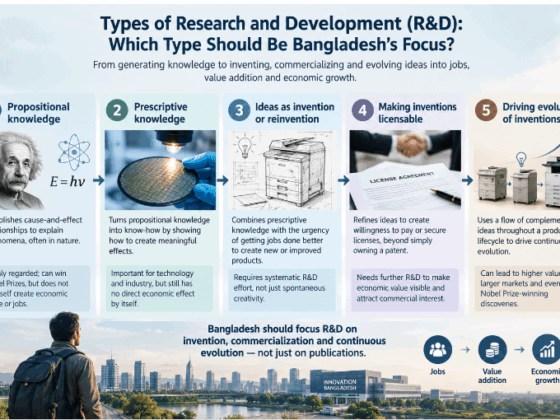
The decisive break came with the rise of propositional knowledge—systematic, testable understanding of natural phenomena—advanced through inductive reasoning. The Islamic Golden Age played a foundational role by formalizing scientific inquiry, preserving classical knowledge, and extending it through experimentation. This epistemic shift quietly planted the seeds of modern economic growth. But seeds alone do not create forests. What mattered next was scale.
That scaling occurred in Europe, particularly in Britain. By the eighteenth century, propositional knowledge increasingly fused with prescriptive knowledge: step-by-step know-how explaining how things could be built, improved, and replicated—seeding industrial enlightenment. This fusion—what Joel Mokyr famously termed “useful knowledge”—created a self-reinforcing engine of refinement. Producers no longer relied solely on trial and error; they could systematically improve products and processes. From around 1750 onward, British and European industries began making goods that were not only better but also cheaper, more reliable, and more widely accessible. Wealth expanded rapidly, living standards rose, and Europe became the global center of prosperity.
Yet this first modern wave of wealth creation did not continue indefinitely. By the mid-to-late nineteenth century, the mechanical paradigm that powered the first Industrial Revolution began to mature. Marginal improvements yielded diminishing returns. Organizational inertia set in. Incumbent firms accumulated assets, routines, and vested interests optimized for yesterday’s technologies. The very success of Europe’s industrial system became a constraint on its future dynamism.
At precisely this moment, a new technological core emerged: electrical science. The discovery of electromagnetism, followed by the invention of generators, motors, and communication technologies, opened the door to a profound reinvention of products and production systems. Electrification was not merely an incremental improvement on steam and mechanics; it was a general-purpose technology that demanded redesign from the ground up. Factories had to be reorganized, products re-architected, and skills redefined.
Here lies the critical but under-theorized mechanism: reinvention triggers migration of prosperity. European firms, burdened by legacy machinery and decision-making dilemmas, largely failed to lead this transformation. The United States, by contrast, possessed younger firms, larger integrated markets, and fewer sunk costs. American producers embraced electrification as a chance to reinvent mature mechanical products rather than merely optimize them. The result was the Second Industrial Revolution—and with it, a decisive shift in global prosperity. By the early twentieth century, the United States had overtaken Britain, not because it invented a new set of products and processes, but because it captured the next reinvention wave.
This migration dynamic exposes a gap in dominant growth theories. Joel Mokyr’s Nobel-winning work brilliantly explains how useful knowledge fuels long-run growth, but it treats economic expansion largely as a cumulative process within societies. What it underplays is that wealth creation is unevenly captured. When a technological paradigm matures, growth slows for incumbents—even as new opportunities arise elsewhere. Prosperity does not merely grow; it moves.
Schumpeterian economics comes closer to this reality. Joseph Schumpeter, and later Philippe Aghion and Peter Howitt, emphasized creative destruction as the engine of renewal. New technologies destroy old structures, freeing resources and enabling growth. But even this framework tends to be spatially neutral. It explains renewal within an economy, yet says little about why renewal so often benefits new firms, regions, or nations rather than incumbents. Creative destruction, in practice, is also creative relocation.
The lesson is stark and contemporary. Wealth creation is inseparable from reinvention, and reinvention rarely favors those most invested in the status quo. Firms and nations that dominate one technological era face structural disadvantages in the next, primarily due to primitive emergence, pervasive uncertainty and rent seeking from mature products. Legacy assets become liabilities; decision processes become rigid; political economy (special interest groups) resists disruption. Meanwhile, latecomers—if they align themselves with the new knowledge core—can leapfrog.
Understanding the mechanics of wealth creation, therefore, requires moving beyond static measures of capital and resources. It demands attention to how knowledge is generated, codified, and—crucially—recombined across technological discontinuities. Prosperity migrates when new general-purpose technologies enable superior ways of getting jobs done, and when incumbents fail to reinvent fast enough.
For today’s developing economies, including Bangladesh and its peers, the implication is not to imitate yesterday’s leaders, but to position themselves for tomorrow’s reinvention cycles. Wealth will not accrue to those who merely accumulate factories or capital, but to those who master emerging knowledge systems and redesign products, services, and institutions around them.
In the end, wealth is not where money is. It is where better ways of doing things are born—and where societies have the courage to abandon the old to build the new.
Key Messages
Legacy is a liability — Dominance in one technological era often hinders leadership in the next, enabling latecomers to leapfrog.
Wealth is utility, not assets — Prosperity comes from how effectively societies get jobs done, not from money or natural resources alone.
Knowledge drives growth — Economic growth accelerates when scientific (propositional) knowledge is converted into scalable, prescriptive know-how.
Reinvention matters more than invention — Major wealth gains arise when mature products and processes are reinvented around new technological cores.
Prosperity migrates, it doesn’t just grow — Waves of reinvention shift wealth from legacy incumbents to new firms, regions, and nations.