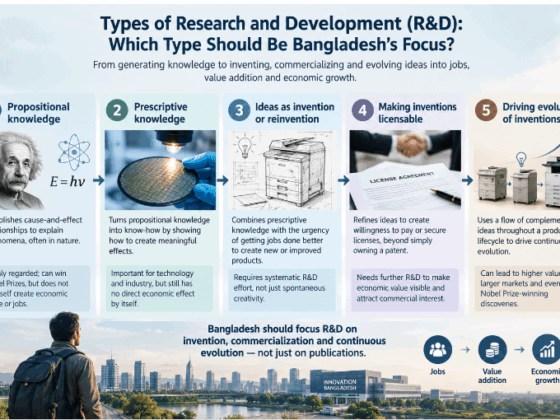
Innovation is the root of waves of prosperity, but its driving force has evolved across history. In the preindustrial era, individual creativity generated localized growth through cottage-based industries and grassroots innovations. With rising technological complexity, innovation shifted to firm-led, team-based systems, enabling scalability through fine tuning and complementary infrastructures, as illustrated by the development of electric power systems around the light bulb. During this period, the state acted as an institutional architect, facilitating idea flow and Creative Destruction—an insight reinforced by the work of Daron Acemoglu, Simon Johnson, and James A. Robinson. Today, however, the next waves of prosperity are emerging from the Reinvention of complex technological systems, demanding coordination beyond individual firms. This transition calls for the state as a creative and strategic lead innovator, capable of orchestrating large-scale transformation while preserving competitive markets. A new Theory of Innovation is therefore needed to explain and guide prosperity in this evolving era.
Innovation has always been the engine of prosperity, but the identity of the innovator has not remained constant. From lone inventors in the preindustrial age to powerful corporations in the twentieth century, the scale and structure of innovation have continually evolved. Today, as technologies become more complex and interconnected, the next waves of prosperity are emerging not from isolated inventions but from large-scale reinvention of entire systems. This shift challenges traditional assumptions about markets, firms, and the role of government. Understanding how innovation leadership is transforming is essential for nations and businesses seeking to shape—and not merely react to—the future of economic growth.
I. Innovation at the Root of Waves of Prosperity
Innovation is at the root of waves of prosperity. Across history, rising income, expanding industries, and the transformation of societies have followed breakthroughs in how we create, produce, and deliver value. In the preindustrial age, innovation was largely an individual act of creativity. A single inventor, artisan, or entrepreneur could imagine a new tool or product, refine it, and bring it to market. That personal ingenuity was often sufficient to generate modest but meaningful prosperity.
Yet such innovation had limits. Because production methods were localized and technologies relatively simple, most breakthroughs led to cottage-based industries—small workshops and localized markets. Prosperity existed, but it was fragmented and difficult to scale. Each innovator operated largely within the boundaries of personal skill, capital, and community demand.
This pattern still survives in what we now call grassroots innovations. Across developing and developed countries alike, individuals continue to devise frugal solutions to local problems. These innovations matter. They improve lives and create micro-level growth. But they rarely generate large, sustained waves of prosperity that transform entire national economies.
The lesson from this era is clear: individual creativity sparks innovation, but by itself it cannot sustain large-scale economic transformation. To generate powerful waves of prosperity, innovation must become systemic, cumulative, and scalable.
II. From Lone Inventors to Corporate Systems of Innovation
As technologies grew more complex, innovators began to recognize the limits of solitary effort. A powerful example lies in Thomas Edison’s light bulb. The bulb, by itself, was a Breakthrough—but its early versions had limited lifespan and little practical value without complementary infrastructure. Illumination required generation, transmission, and distribution of electricity. Without these complementary systems, the invention could not transform society in creating large market.
Edison quickly understood that improving the bulb and building the electrical ecosystem exceeded the capacity of a lone inventor. Innovation required a Flow of Ideas, continuous experimentation, and coordinated problem-solving. This realization marked a turning point: the graduation of the innovator’s role from individual to organized team.
The result was the rise of large corporations and research laboratories. Firms became hubs where engineers, scientists, financiers, and managers collaborated to improve discrete products while also developing systems of complementary innovations. The corporate form enabled scalability. It mobilized capital, standardized production, and created global markets.
Throughout the twentieth century, this firm-led model of innovation dominated the industrial landscape. Major breakthroughs—from automobiles to consumer electronics—emerged from organized research and development within corporations. Prosperity waves were driven by firms competing, improving, and scaling technologies across borders.
Yet even this model had structural assumptions: that firms were the primary engines of innovation and that markets would allocate resources efficiently among them. For decades, this approach appeared sufficient.
III. The State as Institutional Architect of Creative Destruction
While individuals and firms generated innovations, the state played a critical enabling role. Governments built institutions—property rights regimes, patent systems, financial markets, and regulatory frameworks—that facilitated the production and commercialization of ideas. These institutions encouraged experimentation and investment.
But innovation has a disruptive dimension. New technologies often render existing jobs, skills, and firms obsolete. This process—creative destruction—can provoke resistance. Workers fear displacement; firms resist obsolescence; politicians worry about social unrest.
Countries that responded with protectionism and defensive policies often experienced slower growth. Shielding incumbent industries may reduce short-term pain but ultimately constrains renewal. By contrast, countries that allowed institutions to facilitate idea flow and competition experienced stronger long-term prosperity.
The Nobel Prize–winning work of Daron Acemoglu, Simon Johnson, and James A. Robinson demonstrated that inclusive institutions facilitating idea flow and creative destruction are central to national Wealth. Where institutions encouraged entry, competition, and innovation, economies grew faster and became more prosperous. Where elites blocked renewal, stagnation followed.
In this phase of history, the state’s role was largely that of institutional architect—not primary innovator. Governments created the rules of the game; firms and individuals played it.
IV. Beyond Firms: Reinvention and the Expanding Complexity of Innovation
In recent decades, innovation has entered a new phase. The next waves of prosperity are increasingly shaped not by isolated inventions but by the evolution and reinvention of existing technologies, through technologies from deeper layer of science. Societies rarely prosper from entirely new creations alone; instead, they benefit from continuous refinement and system integration.
Consider how prosperity has advanced through the evolution of radio, television, automobiles, telephones, microwave ovens, railways, airplanes, cameras, and music players. These technologies were not one-time inventions. They became platforms for decades of improvement—better performance, lower cost, broader access, and integration with other systems.
This evolutionary dynamic introduces immense complexity. Reinventing major systems such as automobiles—now intertwined with digital technologies, batteries, supply chains, and environmental policy—or transforming energy sources requires coordination beyond any single firm. It demands high-risk capital, advanced scientific research, large-scale infrastructure, and collaboration among multiple industries.
As innovation complexity rises, the traditional firm-led model encounters limits. Individual companies may lack the horizon, resources, or incentives to orchestrate system-wide transitions. The challenge of managing scientific frontiers and infrastructure upgrades points toward a new role: the state as lead innovator.
This does not imply replacing markets. Rather, it suggests that governments must move beyond facilitation and become collective innovators, envisioning and catalyzing large-scale reinvention. The state must define missions, align investments, and coordinate stakeholders while incentivizing firms to compete through performance improvement within that framework.
In this emerging paradigm, prosperity waves are driven by systemic reinvention—requiring strategic vision at the national level.
V. The Geopolitical Shift and the Need for a New Theory of Innovation
This evolving role of innovation has geopolitical implications. Countries where policymakers possess technical expertise and long-term strategic orientation may be better positioned to orchestrate complex reinvention. For example, China’s governance structure, with engineers and scientists in leadership roles, has enabled ambitious industrial strategies in infrastructure, manufacturing, and emerging technologies.
Meanwhile, many Western economies have relied heavily on market mechanisms and institutional frameworks developed in earlier eras. While these institutions remain essential, they may not be sufficient to guide large-scale technological transitions. As new waves of prosperity emerge from reinvention of major systems—energy, mobility, digital infrastructure—there is growing concern about the migration of innovation epicenters from traditional industrial powers to new centers of coordinated state-led strategy.
This shift has puzzled leaders who assumed that markets and existing institutions would automatically generate leadership in every technological frontier. The reality suggests a more complex picture: prosperity today depends on creative and innovative states, not merely enabling ones.
Importantly, state creativity should not eliminate competition. The envisioned model is one where strategic public direction is implemented through profit-making competition among firms. Governments articulate long-term missions and invest in enabling infrastructure; firms innovate within that landscape, striving for efficiency and differentiation.
This emerging reality challenges established economic theories that focus narrowly on institutions or market efficiency. While the insights of Acemoglu, Johnson, and Robinson remain vital, they may not fully capture the demands of system-level reinvention in the twenty-first century.
What is needed is a new theory of innovation-led waves of prosperity—one that integrates individual creativity, corporate capability, institutional design, and strategic state leadership. Such a framework would recognize that innovation has evolved from solitary invention to corporate systems, and now to national-scale reinvention.
The future of prosperity will not be determined solely by inventors in garages or firms in research parks. It will depend on societies capable of envisioning and orchestrating complex transformations—balancing state direction with competitive enterprise.
In this new era, the central question is no longer whether innovation matters. It is who leads innovation, at what scale, and through what coordination mechanisms. Nations that answer this question effectively will shape the next great waves of prosperity.
For additional insights and advisory services, please subscribe to: Waves of Prosperity at Substack.