THE WAVES
  • Home
  • News
    • Recent Updates
    • Weekly Newsletter
    • Monthly Newsletter
    • Quarterly Newsletter
  • Topics
    • Technology
      • Internet
      • AR/VR & Digital twins
      • Robotics
      • AI & Data Analytics
      • IoT & Wearable
      • Blockchain
      • Computing
      • Sensors & Perception
      • 3D Printing
      • Energy Tech
      • Space
      • Gadgets
    • Transformation
      • Education
      • Health
      • Transportation
      • Farming
      • Energy
      • Security
      • Mining & Blue Economy
      • Food & Living
      • Communication
      • Entertainment
      • Manufacturing
      • Work & Management
      • Public Service
    • Startups
      • Culture
      • Country
      • New Entry
      • Accelerators
      • Incubators
      • Death Valley
      • Investments
      • Exit & IPO
      • Valuation & Financing
      • Idea & IP
    • Education & Research
      • School
      • University
      • Academic Research
      • Corporate Research
      • Public-funded Research
      • Economics of Innovation
      • Growth Economics
      • Training
      • Publications
      • Patents & IP
    • Industrial Revolutions
      • Future of Work
      • Sustainable Development
      • Smart Manufacturing
      • Job Transformation
      • Industry Transformation
      • Competition & Monopoly
      • National Response
      • Education & Skills
      • Social Change
    • Investment & Review
      • Public
      • Corporate
      • Venture Capital
      • Capital Market
      • Philanthropy
      • Personality
    • Inventions
    • Automation
  • Strategy
    • Value Proposition
      • Product
      • Process
      • Sustainability Goals
      • Business Model
      • Complementary
      • Externality
    • Innovation
      • Disruptive Innovation
      • Incremented Innovation
      • Sustaining
      • Schumpeter’s Creative Destruction
      • Redesign for Winning
    • Competition
      • Leading
      • Following
      • Blue Ocean
      • Monopolisation
      • Porter’s Five Forces
      • Business Cycle
    • Intangible Assets
      • Human Capital
      • R&D Management
      • Tripple Helix
      • Intellectual Property
      • Productive Knowledge
      • Technology Managment
    • Competence
      • Organization Agility
      • Innovation Culture
      • Infrastructure
      • R&D facility
      • Great by Choice
      • Build to Last
      • Good to Great
    • Technology Acquisition
      • Scientific discovery
      • Invention
      • Fusion
      • Adaptation & Refinement
      • Licensing
      • Start-up acquisition
  • Policy
    • Technology Development
    • Industry
    • Innovation Diffusion
    • Jobs, Privacy & Security
    • Regulation & Law
    • Sustainability
    • Equity & Inclusiveness
    • Climate Change
    • Environment
  • Opinion
    • Opinion
  • Megatrends
    • Individual Preferences
    • Planet and Society
    • Technology
    • Political Economy
    • Market Power & Monopoly
    • Globalisation
    • Schumpeter’s creative destruction
    • Startups & VC
    • Human Role in Work
    • Value of Natural Resources
    • Patents & Ideas for Redesign
  • Publication
    • Case Studies
    • Magazine
    • Books
    • Reports
    • White Papers
    • Journals
THE WAVES In-depth investigation on Technology, Society, and Policy dynamics for interpreting the past as well as present, and predicting the future so that success rate of pursuing ideas, start-ups, and innovation economy increases.

Technology, Society and Policy

Winning and Losing in Reinvention Race : keeps unfolding: --making America’s innovation bucket leaky, creating prosperity out of reinvention, and turning invention successes transitory
THE WAVES
  • Home
  • News
    • Recent Updates
    • Weekly Newsletter
    • Monthly Newsletter
    • Quarterly Newsletter
  • Topics
    • Technology
      • Internet
      • AR/VR & Digital twins
      • Robotics
      • AI & Data Analytics
      • IoT & Wearable
      • Blockchain
      • Computing
      • Sensors & Perception
      • 3D Printing
      • Energy Tech
      • Space
      • Gadgets
    • Transformation
      • Education
      • Health
      • Transportation
      • Farming
      • Energy
      • Security
      • Mining & Blue Economy
      • Food & Living
      • Communication
      • Entertainment
      • Manufacturing
      • Work & Management
      • Public Service
    • Startups
      • Culture
      • Country
      • New Entry
      • Accelerators
      • Incubators
      • Death Valley
      • Investments
      • Exit & IPO
      • Valuation & Financing
      • Idea & IP
    • Education & Research
      • School
      • University
      • Academic Research
      • Corporate Research
      • Public-funded Research
      • Economics of Innovation
      • Growth Economics
      • Training
      • Publications
      • Patents & IP
    • Industrial Revolutions
      • Future of Work
      • Sustainable Development
      • Smart Manufacturing
      • Job Transformation
      • Industry Transformation
      • Competition & Monopoly
      • National Response
      • Education & Skills
      • Social Change
    • Investment & Review
      • Public
      • Corporate
      • Venture Capital
      • Capital Market
      • Philanthropy
      • Personality
    • Inventions
    • Automation
  • Strategy
    • Value Proposition
      • Product
      • Process
      • Sustainability Goals
      • Business Model
      • Complementary
      • Externality
    • Innovation
      • Disruptive Innovation
      • Incremented Innovation
      • Sustaining
      • Schumpeter’s Creative Destruction
      • Redesign for Winning
    • Competition
      • Leading
      • Following
      • Blue Ocean
      • Monopolisation
      • Porter’s Five Forces
      • Business Cycle
    • Intangible Assets
      • Human Capital
      • R&D Management
      • Tripple Helix
      • Intellectual Property
      • Productive Knowledge
      • Technology Managment
    • Competence
      • Organization Agility
      • Innovation Culture
      • Infrastructure
      • R&D facility
      • Great by Choice
      • Build to Last
      • Good to Great
    • Technology Acquisition
      • Scientific discovery
      • Invention
      • Fusion
      • Adaptation & Refinement
      • Licensing
      • Start-up acquisition
  • Policy
    • Technology Development
    • Industry
    • Innovation Diffusion
    • Jobs, Privacy & Security
    • Regulation & Law
    • Sustainability
    • Equity & Inclusiveness
    • Climate Change
    • Environment
  • Opinion
    • Opinion
  • Megatrends
    • Individual Preferences
    • Planet and Society
    • Technology
    • Political Economy
    • Market Power & Monopoly
    • Globalisation
    • Schumpeter’s creative destruction
    • Startups & VC
    • Human Role in Work
    • Value of Natural Resources
    • Patents & Ideas for Redesign
  • Publication
    • Case Studies
    • Magazine
    • Books
    • Reports
    • White Papers
    • Journals

  • Editor's Pick
  • National Response
  • Schumpeter's creative destruction

Why Nations Fail: Is Trump’s Response to EV to repeat the history?

  • Md. Rokonuzzaman
  • Created: May 22, 2026
  • Last updated: May 22, 2026
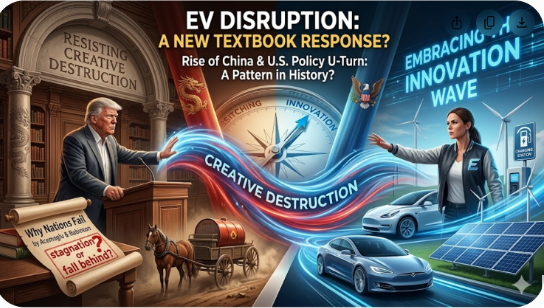
Nations fail in econimic prosperity due to resistance to creative destructions terming them as threat

In their widely discussed thesis Why Nations Fail, Nobel laureate Daron Acemoglu and James A. Robinson argue that the rise and fall of nations is fundamentally shaped by their responses to Creative Destruction. Drawing on anecdotal evidence spanning over 2,000 years of human history, they conclude that countries with institutions that support the emergence of better alternatives—while allowing old products, skills, and jobs to be displaced—tend to grow significantly faster than others.

As a result, even nations with similar natural endowments often experience widening economic disparities over time.

This framework raises an important question about the Trump administration’s response to the wave of creative destruction represented by electric vehicles (EVs). Rather than facilitating this transition, various policy measures have been seen as creating barriers to EV adoption and expansion.

Does this imply that such a response risks repeating the historical pattern in which societies that resist creative destruction ultimately stagnate or fall behind, even as technological waves continue to advance?

Rise of EV as a creative destruction wave

The term ” creative destruction ” was coined by Professor Schumpeter in his 1942 book Capitalism, Socialism and Democracy. Using examples such as the replacement of horse-drawn wagons by automobiles, he argued that capitalism, driven by profit incentives, encourages the displacement of mature products and processes by superior alternatives. This attribute is the core strength of capitalism in creating Wealth and driving prosperity. However, the diffusion of these better alternatives also leads to the destruction of skills, jobs, and industries associated with the older technologies. He therefore termed this process “creative destruction.”

The underlying driver of creative destruction is the Reinvention of established inventions through changes in their technological core. For instance, horse-drawn wagons were transformed when the source of propulsion shifted from animal power to the internal combustion engine. Such transitions occur through advances in science that enable the development of more efficient technologies.

Although internal combustion engines, which power automobiles, have evolved over more than a century, they are now showing signs of saturation. In addition, they contribute to air pollution and depend on finite supplies of fossil fuels such as gasoline. Continued scientific progress has therefore opened the door to a new reinvention of mobility, replacing internal combustion engines with electric propulsion systems and giving rise to electric vehicles (EVs). However, the growth of EVs also entails the displacement of jobs, manufacturing facilities, and entire industries tied to internal combustion engine production and its supply chains. In this sense, EVs represent a classic example of creative destruction.

America’s initial response to EV

Due to the environmental and health impacts of automobile pollution, the U.S. government began introducing increasingly stringent emissions regulations in the 1990s. As a result, in addition to improving the efficiency and emissions performance of internal combustion engine vehicles, American automobile manufacturers began experimenting with battery-powered and fuel cell–based electric vehicles.

To encourage this transition, the U.S. government provided strong policy support. Early federal support for electric vehicles (EVs) was formally strengthened through the Energy Independence and Security Act of 2007, followed by the American Recovery and Reinvestment Act (ARRA) of 2009. The ARRA allocated approximately $2.4 billion specifically for advanced battery manufacturing and electric drive component development, helping to lay the foundation for the EV supply chain and supporting infrastructure. In addition, the Energy Improvement and Extension Act of 2008 introduced a federal income tax credit of up to $7,500 for the purchase of a new electric vehicle, further stimulating consumer adoption.

Rise of China led EV wave and Trump administration’s U-Turn to EV

Although rising fuel prices are prompting more American consumers to take a second look at electric vehicles, the Trump administration has pursued multiple measures to slow their diffusion. Donald Trump’s approach to the electric vehicle (EV) industry has centered on protectionism, deregulation, and the rollback of state-driven clean energy incentives. Rather than viewing the EV transition as an inevitable technological evolution to be accelerated, his administration has treated it as a threat. This raises a critical question: why this reversal, and what are its likely consequences?

Following General Motors’ abandonment of its EV initiative in the 1990s, Tesla revived the effort in 2003. However, until around 2019, there were not strong indications that EVs would emerge as a force of creative destruction against gasoline vehicles. Limitations such as weak battery performance, long charging times, and high costs constrained their appeal. Consequently, apart from Tesla, most incumbent automakers and oil companies remained largely unconcerned. This began to change rapidly as key performance thresholds were crossed, triggering a surge in confidence—reflected in the sharp appreciation of Tesla’s stock price.

Although Tesla became an icon of EV success, it did not establish a deeply non-replicable technological core. Moreover, despite offering subsidies, the U.S. government did not initially treat EV development as a strategic national priority.

In contrast, the Chinese government designated EVs as a national priority as early as 2012, aiming to build an Innovation-driven automobile industry. It implemented a coordinated national strategy driven by competition among private firms, with a focus on developing non-replicable battery capabilities, securing supply chains—including mining and refining of critical raw materials—and promoting widespread adoption through targeted incentives.

Despite Tesla’s early success in capturing niche markets, since 2024 the global landscape has shifted, with China’s EV industry emerging as a formidable force of creative destruction in the automotive sector. As a result, both American automakers and oil companies have increasingly viewed China-led EV expansion as a serious threat to their long-term survival. Besides, the rise of China’s EV and renewable energy to charge them also poses a threat to American dollar dominance due to the weakening of the petrodollar. In response, the Trump administration has taken a policy U-turn on EVs, prioritizing the protection of the oil and internal combustion engine–based automobile industries.

Trump’s response to EV is likely to repeat the history

In addition to discouraging EV adoption and erecting barriers to the entry of Chinese EVs into the American market, the Trump administration has also focused on securing oil reserves and exerting influence over global oil trade through assertive geopolitical actions. Ironically, rising oil prices and increasing supply uncertainty have accelerated the adoption of Chinese EVs and renewed momentum for energy innovation. At the same time, the struggles of Western-backed initiatives such as Northvolt suggest that Chinese capabilities in battery technology may be more difficult to replicate than often assumed, despite frequent allegations of imitation or intellectual property appropriation.

Such a response by the Trump administration appears to align closely with the textbook behavior of incumbent actors confronting creative destruction, as described in Why Nations Fail by Daron Acemoglu and James A. Robinson, and in Clayton Christensen’s The Innovator’s Dilemma. Consequently, it is plausible that the world will witness the continued rise of electric vehicles and renewable energy as disruptive forces—potentially undermining the long-standing dominance of the American automobile and oil industries, and even eroding the global influence of the U.S. dollar as the petro-dollar system weakens.

Enlighten others

Subscribe

Subscribe now to our newsletter

You May Also Like

Which Type of R&D Should Be the Focus of Bangladesh and many other less developed countries?
View Post
  • 3 min

Types of Research and Development

Bangladesh can turn its high-tech parks into engines of prosperity by housing R&D wings of local producers
View Post
  • 3 min

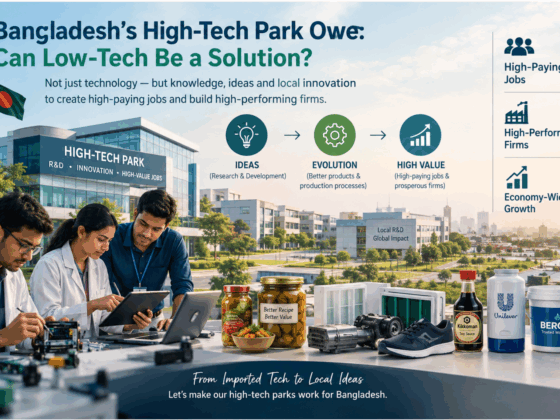
Bangladesh’s High-Tech Park Owe: Can Low-Tech Be a Solution?

How speculative markets and continuous storytelling combine to decouple asset valuation from delivery of innovations
View Post
  • 8 min

The Rise of Muskism Turning Musk a Trillionaire: Narrative-Driven Capital Accumulation and the Illusion of Disruptive Innovation

Leave a Reply Cancel reply

Your email address will not be published. Required fields are marked *

Subscribe

Subscribe now to our newsletter

Principles

  • Economics of Technology
  • Innovation Economics
  • Technology & Innovation Policy

History & Observations

  • Technology History
  • Innovation History
  • Strategy & Policy in retrospect
  • Entrepreneurs & Innovators
  • Startups & Corporations
  • Patents & Publications
  • Design & Redesign Thinking

About Us

  • Who we are
  • What we deliver
  • Genesis
  • Mission
  • Scope
  • Editorial & Advisory Board
THE WAVES
  • Contact
  • Advertise

Input your search keywords and press Enter.