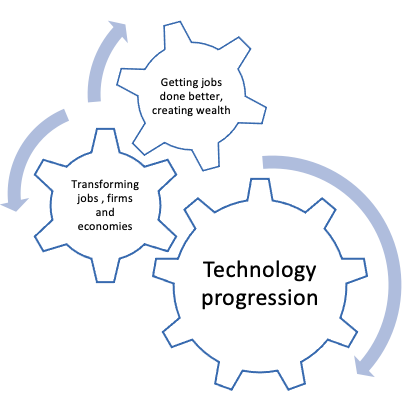
Technological progression reshapes society by enabling people and organizations to accomplish tasks more efficiently, at lower cost, and with greater comfort. This continuous advance forms the foundation of long-term prosperity. Yet technological change is rarely smooth. It unfolds amid uncertainty, disruption, and painful adjustments, often displacing existing skills, firms, and industries. When poorly managed, these transitions can intensify inequality and economic insecurity. This reality underscores the importance of deliberately shaping technological transformation to maximize value for both consumers and producers, reduce risk for entrepreneurs, improve predictability, and increase net benefits for society as a whole.
A central challenge is ensuring that the gains from technology are broadly shared and sustainably generated. Innovation must not only raise productivity but also create viable pathways for participation across different economies. In this context, developing countries face a pivotal opportunity. Rather than relying primarily on labor, raw materials, or physical capital, they can contribute meaningfully to global progress by creating and commercializing innovative ideas, notably by winning the global race to develop inventions and innovations.
By educating entrepreneurs, engineers, and policymakers to develop, refine, and trade ideas in competitive markets, developing economies can integrate into technology-led growth on more equal terms. Empowered by knowledge and innovation capabilities, they can overcome structural growth barriers and open an essentially unlimited frontier of prosperity driven by ideas rather than factor endowments alone.
Sustained prosperity in a technology-driven world depends not on labor or resources alone, but on consciously shaping innovation so that ideas—created, evolved, and traded—become the primary engine of inclusive growth for all economies.
Technological Progression Examples
A few notable examples are as follows:
Light bulb evolution
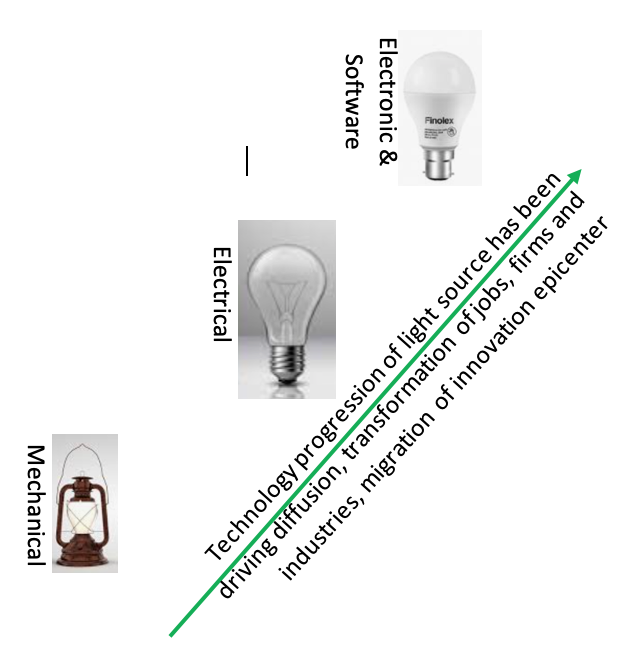
Producing light from electricity emerged as a transformative alternative to candles, oil lamps, and hurricane lanterns, fundamentally changing how society confronted darkness and created economic value. Electric lighting improved efficiency, safety, and productivity, becoming a powerful engine of Wealth creation. Yet this progress came with disruption. Firms producing oil and hurricane lamps declined, and jobs tied to older technologies disappeared, illustrating the unavoidable costs of technological change. Importantly, the evolution of light sources did not end with the incandescent bulb. Continuous improvement eventually gave way to Reinvention, most notably through LED lighting. By replacing heating filaments with energized semiconductor junctions, LEDs delivered dramatic gains in efficiency, durability, and quality, opening new avenues for value creation.
As with earlier transitions, these advances reshaped industries, altered skill requirements, and redistributed economic power. They also triggered a migration of innovation epicenters. Edison’s incandescent bulb shifted leadership in light source innovation from Europe to the United States, while the reinvention embodied in LED technology moved the epicenter again, this time to Japan. Together, these shifts illustrate how technological evolution and reinvention continually redefine prosperity, firms, and global innovation leadership.
The evolution and reinvention of electric lighting—from incandescent bulbs to LEDs—demonstrate how technological progress simultaneously creates wealth, disrupts jobs and firms, and shifts global innovation leadership across nations.
Evolution of the Camera
In 1888, George Eastman invented the box camera, which built upon the core of imaging technology on film. Over the past 100 years, advancements in film technology have enabled the human race to capture increasingly better images at a decreasing cost. Along the way, Kodak succeeded in creating numerous jobs in the USA and the rest of the world. However, further advancements in imaging technology led to the replacement of film cameras, giving rise to digital cameras. Consequently, along with offering better imaging means, digital cameras destroyed jobs and pushed Kodak toward bankruptcy. However, Canon not only survived but also continued to flourish. Besides, the camera innovation epicenter migrated from the USA to Japan.
Invention and evolution of Automobiles
In 1886, automobiles emerged as a potentially better alternative to horse-drawn wagons. Its rise led to the loss of jobs for horses. Of course, upskilling empowered Coachmen to switch jobs to driving automobiles. Besides, due to the scope of advancement, automobile technology created high-paying R&D jobs. Furthermore, the rapid adoption of automobiles created far more jobs in automobile manufacturing than those lost in horse carriage making.
However, its reinvention as an electric vehicle (EV) will likely have net-negative implications for jobs. Besides, due to the rise of EVs, automobile innovation epicenters will likely migrate from Europe and America to Japan, South Korea, and China. Hence, technological progression does not repeat the history of job market transformation and the means to cope with it.
Furthermore, the emergence of autonomous vehicles is likely to have a significant negative impact on automobile driving jobs. However, autonomous vehicles are likely to create far more high-paying R&D jobs than were needed for previous automobile advancements. It appears that continued progression has been creating increasingly high-paying jobs.
Technology progression phases
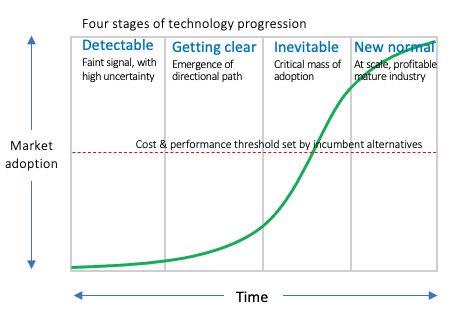
Despite the remarkable implications of technology, it does not happen all at once. Typically, technology has an S-curve-like life cycle. Technological progression occurs through four distinct phases. It begins as a faint signal caught in high-level noise. However, additional knowledge makes the possibility clear, leading to the adoption of the critical mass. Eventually, technology progression reaches creating a new normal state.
Implications
Technology progression creates implications for jobs, firms, and industries. Along with the creation, it also unleashes destruction on existing products, jobs, and businesses, creating a new normal.
Job creation and destruction due to technological progress
Of course, technological progress creates jobs for conducting R&D, manufacturing, and operations. As progression diffuses innovations deeper, more jobs are created for making additional copies. However, due to growing automation, jobs in manufacturing continue to decline. For example, in the 1920s, human workers used to perform 85 percent of automobile-making tasks, which has shrunk to 15 percent. Furthermore, the rise of reinvention waves led to the migration of jobs from one area to another. For example, the rise of EVs will likely lead to a shift in jobs from manufacturing internal combustion engines to producing batteries, electrical motors, and electronics. Besides, technological progress continues to delegate more roles to ideas or machines, rather than humans. Notably, the rise of machine intelligence, or AI, is likely to have a dramatic negative impact on the role of humans in operations. For example, autonomous vehicles are likely to have a significant negative impact on driving jobs.
Transforming the economy and migrating epicenters
In the pre-industrial age, productive activities were organized as cottage industries. Inventions and innovations were not scalable. Thus, Economies of Scale, scope, and externalities were very limited. As a result, economic growth was slow, and there was very little income gap. However, due to the progression of the steam engine and mechanization, the UK led Europe to experience high economic growth during the first Industrial Revolution. Consequently, disparity grew, and the production epicenter migrated to the UK and Europe.
Further advancements in technology led to a shift from mechanical to electrical technology as the core of products and production processes. America rose, and the UK suffered from a slowdown. Due to the rise of ICE vehicles and automobiles, the Middle Eastern economy experienced growth, driven by the increasing demand for hydrocarbons. Additionally, due to its superior performance in semiconductor technology, Japan, followed by South Korea and Taiwan, has achieved a high-income status. Along the way, innovation epicenters of notable products, such as radio, Television, cameras, light bulbs, displays, and many more, have migrated.
Getting clarity about technology transformation as recurring patterns
The breadth, depth, and direction of transformation are influenced by technological progression. Of course, policies, rational decisions, and competition highly matter to leverage it. Acquiring the capability in the midst of uncertainty and the ability to manage risk and culture are vital for benefiting and preventing loss. Moreover, there is no natural correlation between well-accepted indicators like R&D investments, publications, patents, STEM graduates, creativity, and profitable exploitation of intellectual assets. Oftentimes, we perceive technological innovation driving the transformation as a random phenomenon. We term it the magical acts of creative genius. Surprisingly, certain recurring patterns seem to emerge. Detection of these patterns provides better clarity about the relationships among underlying factors. Consequently, we succeed in interpreting the past, comprehending the present, and predicting the likely future.
Our Mission
The mission of The WAVES has been to provide an in-depth analysis of the past and present dynamics of technology innovation to develop the foundation for predicting the unfolding future, so that we can respond appropriately to cope with as well as leverage unfolding opportunities and challenges–making the technology-led transformation of the society more predictable and less painful, offering more secured, inclusive and equitable sustainable growth opportunities.