THE WAVES
  • Home
  • News
    • Recent Updates
    • Weekly Newsletter
    • Monthly Newsletter
    • Quarterly Newsletter
  • Topics
    • Technology
      • Internet
      • AR/VR & Digital twins
      • Robotics
      • AI & Data Analytics
      • IoT & Wearable
      • Blockchain
      • Computing
      • Sensors & Perception
      • 3D Printing
      • Energy Tech
      • Space
      • Gadgets
    • Transformation
      • Education
      • Health
      • Transportation
      • Farming
      • Energy
      • Security
      • Mining & Blue Economy
      • Food & Living
      • Communication
      • Entertainment
      • Manufacturing
      • Work & Management
      • Public Service
    • Startups
      • Culture
      • Country
      • New Entry
      • Accelerators
      • Incubators
      • Death Valley
      • Investments
      • Exit & IPO
      • Valuation & Financing
      • Idea & IP
    • Education & Research
      • School
      • University
      • Academic Research
      • Corporate Research
      • Public-funded Research
      • Economics of Innovation
      • Growth Economics
      • Training
      • Publications
      • Patents & IP
    • Industrial Revolutions
      • Future of Work
      • Sustainable Development
      • Smart Manufacturing
      • Job Transformation
      • Industry Transformation
      • Competition & Monopoly
      • National Response
      • Education & Skills
      • Social Change
    • Investment & Review
      • Public
      • Corporate
      • Venture Capital
      • Capital Market
      • Philanthropy
      • Personality
    • Inventions
    • Automation
  • Strategy
    • Value Proposition
      • Product
      • Process
      • Sustainability Goals
      • Business Model
      • Complementary
      • Externality
    • Innovation
      • Disruptive Innovation
      • Incremented Innovation
      • Sustaining
      • Schumpeter’s Creative Destruction
      • Redesign for Winning
    • Competition
      • Leading
      • Following
      • Blue Ocean
      • Monopolisation
      • Porter’s Five Forces
      • Business Cycle
    • Intangible Assets
      • Human Capital
      • R&D Management
      • Tripple Helix
      • Intellectual Property
      • Productive Knowledge
      • Technology Managment
    • Competence
      • Organization Agility
      • Innovation Culture
      • Infrastructure
      • R&D facility
      • Great by Choice
      • Build to Last
      • Good to Great
    • Technology Acquisition
      • Scientific discovery
      • Invention
      • Fusion
      • Adaptation & Refinement
      • Licensing
      • Start-up acquisition
  • Policy
    • Technology Development
    • Industry
    • Innovation Diffusion
    • Jobs, Privacy & Security
    • Regulation & Law
    • Sustainability
    • Equity & Inclusiveness
    • Climate Change
    • Environment
  • Opinion
    • Opinion
  • Megatrends
    • Individual Preferences
    • Planet and Society
    • Technology
    • Political Economy
    • Market Power & Monopoly
    • Globalisation
    • Schumpeter’s creative destruction
    • Startups & VC
    • Human Role in Work
    • Value of Natural Resources
    • Patents & Ideas for Redesign
  • Publication
    • Case Studies
    • Magazine
    • Books
    • Reports
    • White Papers
    • Journals
THE WAVES In-depth investigation on Technology, Society, and Policy dynamics for interpreting the past as well as present, and predicting the future so that success rate of pursuing ideas, start-ups, and innovation economy increases.

Technology, Society and Policy

Winning and Losing in Reinvention Race : keeps unfolding: --making America’s innovation bucket leaky, creating prosperity out of reinvention, and turning invention successes transitory
THE WAVES
  • Home
  • News
    • Recent Updates
    • Weekly Newsletter
    • Monthly Newsletter
    • Quarterly Newsletter
  • Topics
    • Technology
      • Internet
      • AR/VR & Digital twins
      • Robotics
      • AI & Data Analytics
      • IoT & Wearable
      • Blockchain
      • Computing
      • Sensors & Perception
      • 3D Printing
      • Energy Tech
      • Space
      • Gadgets
    • Transformation
      • Education
      • Health
      • Transportation
      • Farming
      • Energy
      • Security
      • Mining & Blue Economy
      • Food & Living
      • Communication
      • Entertainment
      • Manufacturing
      • Work & Management
      • Public Service
    • Startups
      • Culture
      • Country
      • New Entry
      • Accelerators
      • Incubators
      • Death Valley
      • Investments
      • Exit & IPO
      • Valuation & Financing
      • Idea & IP
    • Education & Research
      • School
      • University
      • Academic Research
      • Corporate Research
      • Public-funded Research
      • Economics of Innovation
      • Growth Economics
      • Training
      • Publications
      • Patents & IP
    • Industrial Revolutions
      • Future of Work
      • Sustainable Development
      • Smart Manufacturing
      • Job Transformation
      • Industry Transformation
      • Competition & Monopoly
      • National Response
      • Education & Skills
      • Social Change
    • Investment & Review
      • Public
      • Corporate
      • Venture Capital
      • Capital Market
      • Philanthropy
      • Personality
    • Inventions
    • Automation
  • Strategy
    • Value Proposition
      • Product
      • Process
      • Sustainability Goals
      • Business Model
      • Complementary
      • Externality
    • Innovation
      • Disruptive Innovation
      • Incremented Innovation
      • Sustaining
      • Schumpeter’s Creative Destruction
      • Redesign for Winning
    • Competition
      • Leading
      • Following
      • Blue Ocean
      • Monopolisation
      • Porter’s Five Forces
      • Business Cycle
    • Intangible Assets
      • Human Capital
      • R&D Management
      • Tripple Helix
      • Intellectual Property
      • Productive Knowledge
      • Technology Managment
    • Competence
      • Organization Agility
      • Innovation Culture
      • Infrastructure
      • R&D facility
      • Great by Choice
      • Build to Last
      • Good to Great
    • Technology Acquisition
      • Scientific discovery
      • Invention
      • Fusion
      • Adaptation & Refinement
      • Licensing
      • Start-up acquisition
  • Policy
    • Technology Development
    • Industry
    • Innovation Diffusion
    • Jobs, Privacy & Security
    • Regulation & Law
    • Sustainability
    • Equity & Inclusiveness
    • Climate Change
    • Environment
  • Opinion
    • Opinion
  • Megatrends
    • Individual Preferences
    • Planet and Society
    • Technology
    • Political Economy
    • Market Power & Monopoly
    • Globalisation
    • Schumpeter’s creative destruction
    • Startups & VC
    • Human Role in Work
    • Value of Natural Resources
    • Patents & Ideas for Redesign
  • Publication
    • Case Studies
    • Magazine
    • Books
    • Reports
    • White Papers
    • Journals

  • Inventions

Invention and Innovation-let’s demystify them

Innovations of purpose specific products around an invention creates confusion about these two commonly used terms

  • Md. Rokonuzzaman
  • Created: January 17, 2022
  • Last updated: December 17, 2022
Innovations keep emerging and growing out of an invention and its continued advancement

Is there an ambiguity in defining invention and Innovation? We look for names of the inventors of Automobile, Television, Camera, Computers and many others products we use. But, are television or smartphone companies after invention or innovation? Often, we interchangeably use these two crucial words: invention and innovation. If innovation is the practical implementation of ideas that result in introducing new goods or services, what is an invention? Well, someone may say, “an invention is a unique or novel device.” But in the absence of novelty, how does an idea qualify to be innovation? Hence, is there an ambiguity in defining inventions, innovations and imitations? Furthermore, how science, technology, and engineering relate to invention and innovation is also intriguing. s

Besides, if we say that a specific product model such as the C Class Sedan of Mercedes Benz is the fusion of both invention and innovation, shall we be wrong? Does it make sense that all automobile makers have been in the race of advancing Carl Benz’s invention and innovating products using it as the core? Furthermore, even though Thomas Alva Edison is credited for inventing the electric light bulb, should we define the LED light bulb as an invention or innovation?  

Questioning common believes about invention and innovation:

The invention is about the idea for a product or process that has never been made is an invention, and the first-time implementation of an idea is innovation. This definition seems to be highly confusing. If the idea is not for the first time, how will it be innovation? Another one is that invention requires scientific skills, and innovation is a broad set of marketing, technical and strategic skills. Does it mean that developing next-generation automobiles or digital cameras do not require scientific skills? Among many others, there is a belief that inventions can be patented. Does it mean that innovative ideas are not patentable? If that is true, how are automobile makers securing thousands of patents for doing business out of Carl Benz’s patented concept of automobile invention? There are numerous such believes creating confusion. Hence, it’s time to have a fresh look.  

The genesis of invention and innovation:

A single invention is at the core of many innovative products

Human beings have the inherent ability to gather knowledge out of observation. They have a curiosity to get to how things work. They can also manipulate observations to imagine situations that do not exist. Through the gathered knowledge and imagination, they develop ideas of Getting jobs done better. To begin with, with the help of Craftsmanship ability, they also implement those ideas into practical mechanisms. To scale up the ideation, they transfer intuitive observation into scientific knowledge and craftsmanship into engineering. Of course, those practical tools or mechanisms are better alternatives than the existing way of doing things. Some of those ideas are having new tools or reinventing existing tools, or improving the core ability of those tools. And some others are for improving existing mechanisms, either by adding features or improving existing features, for making them usable effectively and efficiently for serving purposes in varying situations. 

Ideas for developing core tools or techniques are inventions. We also need a flow of inventive ideas for fine-tuning those tools. To use those mechanisms in serving target purposes, we need ideas for usable products out of them. We need ideas for the overall design and each feature. This latter category of ideas is innovation. 

Examples:

For instance, Carl Benz invented the idea of the automobile. Similarly, Michael Faraday invented the idea of an electric motor. But those inventions emerged in primitive form. Hence, the race started developing ideas for fine-tuning those core ideas. Ideas also started flowing for developing products, targeting different market segments. Therefore, ideas for both invention and innovation are novel. Nobody came out with them before. But they could be for inventing new mechanisms, fine-tuning existing ones, or innovating products out of them. For example, despite the invention of the automobile by Carl Benz, automobile companies are both in the race of fine-tuning the core invention and pursuing ideas for adding or improving features for developing more appropriate customer segment-specific products out of them.

Similarly, Chester Carlson invented the idea of photocopying in 1938. To get the inventive idea, he fed the knowledge of the photoelectric effect and urgency of finding better means to make copies of documents to his creative mind. Since then, Xerox and other companies have been fine-tuning core photocopying ideas. Furthermore, they have been developing ideas of product features for meeting market segment-specific requirements, resulting in rolling out customer segment-specific innovative products. Hence, an innovative product contains both the core invention and innovative features for meeting the requirements of target market segments.   

Continuous flow of inventive and innovative ideas:      

 Although we tend to believe that an invention is an act of developing entirely new tools, the invention does not stop at any particular movement. It keeps progressing through a Flow of Ideas. On the other hand, innovative ideas for developing new products around them also keep coming. Summarily, ideas of adding or improving features to an already developed product keep flowing too. Hence, there is a continuous flow of inventive and innovative ideas around an invention. Inventive ideas are for advancing the core invention, while innovative ideas are for developing and advancing products around them. Hence, although we give credit to particular individuals for inventions, an invention keeps growing with a flow of additional novel ideas. Besides, novel ideas keep flowing for innovating a series of products around the same invention. Besides, those products also keep improving with innovation ideas, either as new features or advancement of existing features.  

Inventions get reinvented:

At the maturity, many inventions get reinvented by changing the core technology with an emerging one. For example, the electric vehicle is a Reinvention by changing gasoline engine technology core with electric battery and motor. Similarly, the digital camera is a reinvention due to the replacement of film by the electronic image sensor. There have been many such examples. Hence, perhaps, we should take into consideration of a new type of novel idea—reinvention.    
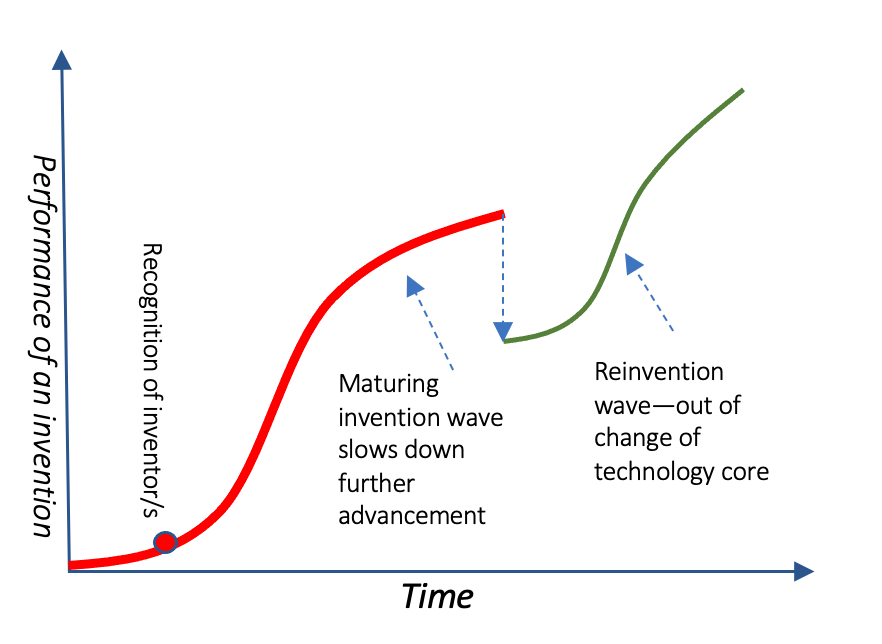
At the maturity, inventions get reinvented out of the change of technology core

Reinventions fuel reinnovation:

The change of technology core of the invention demands the redesign of existing products—creating new waves of reinnovation of already innovated products. Reinvention also opens new windows of innovating products to meet unserved requirements. For example, the reinvention of the camera by changing film technology core with electronic image sensors has opened the window of innovating smartphone cameras. But, in some instances, these innovation opportunities affect the appeal of existing innovations. Even upon reinnovation, certain products lose market value due to the emergence of new products out of reinvented technology core.

It appears that both inventions and innovations are out of novel ideas. They require intuitive observation and scientific research. Besides, along with innovations, inventions also keep growing. Although we tend to credit particular individuals as inventors, the invention of the core concept keeps evolving with the subsequent contributions from numerous individuals and firms. Often, further advancement or fine-tuning of invention demands far deeper R&D than the initial invention needed. On the other hand, innovators keep innovating purpose-specific products and their features by leveraging inventions. With a flow of ideas, innovators keep improving inventions and innovations.     

...welcome to join us. We are on a mission to develop an enlightened community by sharing the insights of Wealth creation out of technology possibilities as reoccuring patters. If you like the article, you may encourage us by sharing it through social media to enlighten others. 
Enlighten others

Subscribe

Subscribe now to our newsletter

You May Also Like

As great inventions are fraught with uncertainties, how to transfer latent potential of invention into profitable business demands knowing wealth creation dynamics out of technology possibilities.
View Post
  • 7 min

Great Inventions Alone Aren’t Enough for Financial Success: Lessons from Shockley, Edison, and the Entrepreneurial Journey

Reinvention wave grows causing destruction and migration
View Post
  • 6 min

Reinvention effect — causes destruction and migration

Evolution of microprocessor from its embryonic invention reaching to highly complex system on chip is driven by two major waves: PC and Smartphone
View Post
  • 8 min

Microprocessor Evolution Fueling Disruptive Innovations

Leave a Reply Cancel reply

Your email address will not be published. Required fields are marked *

Subscribe

Subscribe now to our newsletter

Principles

  • Economics of Technology
  • Innovation Economics
  • Technology & Innovation Policy

History & Observations

  • Technology History
  • Innovation History
  • Strategy & Policy in retrospect
  • Entrepreneurs & Innovators
  • Startups & Corporations
  • Patents & Publications
  • Design & Redesign Thinking

About Us

  • Who we are
  • What we deliver
  • Genesis
  • Mission
  • Scope
  • Editorial & Advisory Board
THE WAVES
  • Contact
  • Advertise

Input your search keywords and press Enter.