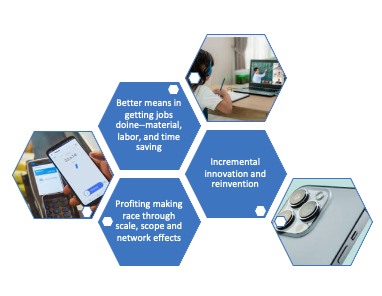
THE WAVES
  • Home
  • News
    • Recent Updates
    • Weekly Newsletter
    • Monthly Newsletter
    • Quarterly Newsletter
  • Topics
    • Technology
      • Internet
      • AR/VR & Digital twins
      • Robotics
      • AI & Data Analytics
      • IoT & Wearable
      • Blockchain
      • Computing
      • Sensors & Perception
      • 3D Printing
      • Energy Tech
      • Space
      • Gadgets
    • Transformation
      • Education
      • Health
      • Transportation
      • Farming
      • Energy
      • Security
      • Mining & Blue Economy
      • Food & Living
      • Communication
      • Entertainment
      • Manufacturing
      • Work & Management
      • Public Service
    • Startups
      • Culture
      • Country
      • New Entry
      • Accelerators
      • Incubators
      • Death Valley
      • Investments
      • Exit & IPO
      • Valuation & Financing
      • Idea & IP
    • Education & Research
      • School
      • University
      • Academic Research
      • Corporate Research
      • Public-funded Research
      • Economics of Innovation
      • Growth Economics
      • Training
      • Publications
      • Patents & IP
    • Industrial Revolutions
      • Future of Work
      • Sustainable Development
      • Smart Manufacturing
      • Job Transformation
      • Industry Transformation
      • Competition & Monopoly
      • National Response
      • Education & Skills
      • Social Change
    • Investment & Review
      • Public
      • Corporate
      • Venture Capital
      • Capital Market
      • Philanthropy
      • Personality
    • Inventions
    • Automation
  • Strategy
    • Value Proposition
      • Product
      • Process
      • Sustainability Goals
      • Business Model
      • Complementary
      • Externality
    • Innovation
      • Disruptive Innovation
      • Incremented Innovation
      • Sustaining
      • Schumpeter’s Creative Destruction
      • Redesign for Winning
    • Competition
      • Leading
      • Following
      • Blue Ocean
      • Monopolisation
      • Porter’s Five Forces
      • Business Cycle
    • Intangible Assets
      • Human Capital
      • R&D Management
      • Tripple Helix
      • Intellectual Property
      • Productive Knowledge
      • Technology Managment
    • Competence
      • Organization Agility
      • Innovation Culture
      • Infrastructure
      • R&D facility
      • Great by Choice
      • Build to Last
      • Good to Great
    • Technology Acquisition
      • Scientific discovery
      • Invention
      • Fusion
      • Adaptation & Refinement
      • Licensing
      • Start-up acquisition
  • Policy
    • Technology Development
    • Industry
    • Innovation Diffusion
    • Jobs, Privacy & Security
    • Regulation & Law
    • Sustainability
    • Equity & Inclusiveness
    • Climate Change
    • Environment
  • Opinion
    • Opinion
  • Megatrends
    • Individual Preferences
    • Planet and Society
    • Technology
    • Political Economy
    • Market Power & Monopoly
    • Globalisation
    • Schumpeter’s creative destruction
    • Startups & VC
    • Human Role in Work
    • Value of Natural Resources
    • Patents & Ideas for Redesign
  • Publication
    • Case Studies
    • Magazine
    • Books
    • Reports
    • White Papers
    • Journals
THE WAVES In-depth investigation on Technology, Society, and Policy dynamics for interpreting the past as well as present, and predicting the future so that success rate of pursuing ideas, start-ups, and innovation economy increases.

Technology, Society and Policy

Winning and Losing in Reinvention Race : keeps unfolding: --making America’s innovation bucket leaky, creating prosperity out of reinvention, and turning invention successes transitory
THE WAVES
  • Home
  • News
    • Recent Updates
    • Weekly Newsletter
    • Monthly Newsletter
    • Quarterly Newsletter
  • Topics
    • Technology
      • Internet
      • AR/VR & Digital twins
      • Robotics
      • AI & Data Analytics
      • IoT & Wearable
      • Blockchain
      • Computing
      • Sensors & Perception
      • 3D Printing
      • Energy Tech
      • Space
      • Gadgets
    • Transformation
      • Education
      • Health
      • Transportation
      • Farming
      • Energy
      • Security
      • Mining & Blue Economy
      • Food & Living
      • Communication
      • Entertainment
      • Manufacturing
      • Work & Management
      • Public Service
    • Startups
      • Culture
      • Country
      • New Entry
      • Accelerators
      • Incubators
      • Death Valley
      • Investments
      • Exit & IPO
      • Valuation & Financing
      • Idea & IP
    • Education & Research
      • School
      • University
      • Academic Research
      • Corporate Research
      • Public-funded Research
      • Economics of Innovation
      • Growth Economics
      • Training
      • Publications
      • Patents & IP
    • Industrial Revolutions
      • Future of Work
      • Sustainable Development
      • Smart Manufacturing
      • Job Transformation
      • Industry Transformation
      • Competition & Monopoly
      • National Response
      • Education & Skills
      • Social Change
    • Investment & Review
      • Public
      • Corporate
      • Venture Capital
      • Capital Market
      • Philanthropy
      • Personality
    • Inventions
    • Automation
  • Strategy
    • Value Proposition
      • Product
      • Process
      • Sustainability Goals
      • Business Model
      • Complementary
      • Externality
    • Innovation
      • Disruptive Innovation
      • Incremented Innovation
      • Sustaining
      • Schumpeter’s Creative Destruction
      • Redesign for Winning
    • Competition
      • Leading
      • Following
      • Blue Ocean
      • Monopolisation
      • Porter’s Five Forces
      • Business Cycle
    • Intangible Assets
      • Human Capital
      • R&D Management
      • Tripple Helix
      • Intellectual Property
      • Productive Knowledge
      • Technology Managment
    • Competence
      • Organization Agility
      • Innovation Culture
      • Infrastructure
      • R&D facility
      • Great by Choice
      • Build to Last
      • Good to Great
    • Technology Acquisition
      • Scientific discovery
      • Invention
      • Fusion
      • Adaptation & Refinement
      • Licensing
      • Start-up acquisition
  • Policy
    • Technology Development
    • Industry
    • Innovation Diffusion
    • Jobs, Privacy & Security
    • Regulation & Law
    • Sustainability
    • Equity & Inclusiveness
    • Climate Change
    • Environment
  • Opinion
    • Opinion
  • Megatrends
    • Individual Preferences
    • Planet and Society
    • Technology
    • Political Economy
    • Market Power & Monopoly
    • Globalisation
    • Schumpeter’s creative destruction
    • Startups & VC
    • Human Role in Work
    • Value of Natural Resources
    • Patents & Ideas for Redesign
  • Publication
    • Case Studies
    • Magazine
    • Books
    • Reports
    • White Papers
    • Journals

  • Editor's Pick
  • Technology
  • Transformation

Technology Transformation–driving innovations and posing uncertainty

  • Md. Rokonuzzaman
  • Created: October 28, 2023
  • Last updated: October 29, 2023
Technology transformation progresses from incremental innovation to reinvention, leading to destroying products, jobs and firms and recreating them.

The first industrial revolution unfolded due to technology transformation.  Since then, it has been intensifying in recreating products and how we get our jobs done. Due to this, little Startups have been attaining market power and dislodging incumbent behemoths. Innovation epicenters have been migrating, causing a rise and slowing down economies.  Technology transformation refers to leveraging technology possibilities to benefit from Getting jobs done better by transforming products, production processes, delivering channels, business models, employment, and market positions.   

Examples of technology transformation

Notable examples of technology transformation are mobile phones, smartphones, word processors, digital cameras, smart television, automation & robotics, e-mail, and the World Wide Web. Emerging technology transformations include electric vehicles, autonomous vehicles, digital currency, working and socialization in the metaverse, hydrogen fuel, renewable energy, and many more.    

Due to technology transformation, existing jobs and skills have become obsolete. For example, due to e-mail, there has been no demand for telegram services. Hence, related jobs have disappeared. Similarly, jobs for making and printing films for photography are no longer available. Technology transformation also creates jobs–new types of jobs. Notably, high-paying R&D and innovation jobs are created to advance technology transformation.  

Technology transformation offers the opportunity for startups to reinvent mature products. Ironically, frequently, incumbent profit-making firms from matured products avoid Reinvention possibilities. Consequentially, they suffer from Disruptive innovation effects while startups rise by embracing technology transformation. For example, while Sony rose, Kodak, RCA, and others suffered.      

How does technology transformation take place?

Technology transformation unfolds in the form of Incremental innovation and reinvention. Although reinvention is at the core, incremental innovation plays a vital role. The cumulative effect of the gradual advancement of technology possibilities often leads to a transformative impact. For example, Toyota’s approach of leveraging batteries in a step-wise manner has been leading to making the internal combustion engine obsolete.   

Creative Destruction, disruptive innovation, and radical innovation are natural outcomes of technology transformation.  For example, the transformation of mobile handsets has led to the rise of smartphones as an example of creative destruction and disruptive innovation. Similarly, the word process has been a radical innovation due to the unleashing of its creative destruction force on typewriters and manual page setups. And it has become a disruptive innovation as new entrants like Microsoft and Apple succeeded in unleashing its radical transformative power.   
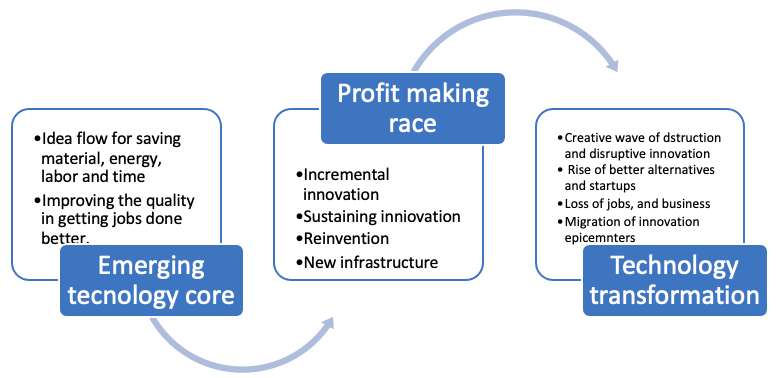
Technology transformation take place due to profit making race of offering better alternatives by leveraging emerging technology cores
Technology transformation takes place due to profit-making race to offer better alternatives by leveraging emerging technology cores

Digital transformation

Digital transformation is taking place due to profit making race from more effective and labor, time, energy and material saving ideas
Digital transformation is taking place due to profit profit-making race from ideas of more effective means of getting jobs done through labor, time, energy, and material savings.

Digital transformation is the adoption of digital technology in products and processes to fundamentally changing the way we create, deliver, and capture value. Instead of a suddenly occurring phenomenon, it unfolds as a process, from incremental change to disruptive consequence. Digital transformation is a process of advancing products, production processes, and delivery channels from incremental innovation to reinvention by adopting digital technologies to help customers in getting jobs done better. It offers entry opportunities, advancing competitiveness, creating a flywheel effect, and unleashing disruptive innovation. Due to the zero cost of copying software and digital assets, and labor, material, energy, and time-saving roles, it’s a tool for making business scalable. Hence, from a humble beginning, digital transformation unfolds as radical innovations.

Furthermore, due to high Economies of Scale, scope, and network effects, winners in digital transformation may take all. Due to the amenability of making products better and cheaper, the winner may succeed in attaining market power for monopolizing the market. For example, Microsoft has a monopoly in office computing due to digital transformation. Similarly, due to leveraging digital transformation, Amazon has attained market power in e-books, cloud computing, e-commerce, and a few other businesses.     

AI transformation

Artificial Intelligence technology is the fusion of a series of component technologies like sensors, data science, software, learning algorithms like deep neural networks, low latency communication, and so on.  To offer better alternatives, AI transformation targets to take over the human cognitive role in the operation and production of goods and services. For example, by replacing humans in driving, AI technology would like to transform how we use automobiles. Similarly, by replacing the cognitive role of human doctors, AI would like to offer more accurate disease diagnoses and prescriptions. Consequentially, AI will transform jobs and the ways we serve diverse purposes.      

Customer experience transformation in getting jobs done

At the core of the success of technology transformation has been the resonance between technology possibilities and urgency in meeting unfolding customer preferences. For example, Apple’s Macintosh computer became a typical example of technological transformation because there was a response between customer preferences in using GUI and the rise of microchip power to support it. Similarly, the iPhone’s success is rooted in this reality.

Technology transformation causes rise and slowdown of firms and nations

The effect of technology transformation is not only limited to the transformation of products and processes in offering better means to customers in getting jobs done. It has strong implications on the rise of startups and the slowdown of incumbent behemoths. It happens due to the behemoth’s profit-making success from matured products and processes and the inherent high risk of unproven technology possibilities. Thus, there is a natural tendency for migration of innovation epicenters across the boundaries of firms and nations, resulting in a rise and slowdown. For example, due to the transformative effect of semiconductors, the innovation epicenter of consumer electronics migrated from the USA and Europe to Japan and South Korea. Similarly, the rise of electric vehicles will likely migrate the automobile innovation epicenter from Europe and the USA to China and Japan. Due to this reality, Japan, South Korea, and Taiwan have risen to high-income status.     

Winning the technology transformation race

Here are seven steps for winning the technology transformation race:

  1. Target technology core at the early stage: technology core should be amenable to progression, and entry must be made at the early stage.
  2. Paying attention to customer preferences: the focus should be on understanding customer preferences and leveraging technology possibilities to address them better.
  3. Picking suitable timing and creating a Flow of Ideas: suitable time is vital for leveraging externalities. A flow of ideas must be created to create the snowball or flywheel effect for unleashing radical innovations.
  4. Ensuring synchronized response: multiple stakeholders, including component technology suppliers, infrastructure developers, products and process innovators, and policymakers, must synchronize response.     
  5. Creating scale, scope, and positive externalities: To win the competition, the focus must be on creating scale, scope, and positive externalities from technology transformation.
  6. Detecting and crossing the chasm and avoiding the hype cycle: in pursuing technology transformation, the risk of getting caught in the chasm is relatively high. It happens due to getting stuck to progress further. Such a reality creates a hype cycle, which must be avoided or overcome.
  7. Attaining market power for price-setting capability: for winning the technology transformation race, market power must be attained so that profit-making price-setting capability surfaces.

Technology transformation drives innovations and creates Wealth by offering better alternatives. Consequentially, skills, jobs, firms, industries, and the economy keep experiencing creation and destruction. Hence, uncertainty is an inherent attribute of technology transformation.
Enlighten others

Subscribe

Subscribe now to our newsletter

You May Also Like

Which Type of R&D Should Be the Focus of Bangladesh and many other less developed countries?
View Post
  • 3 min

Types of Research and Development

Bangladesh can turn its high-tech parks into engines of prosperity by housing R&D wings of local producers
View Post
  • 3 min

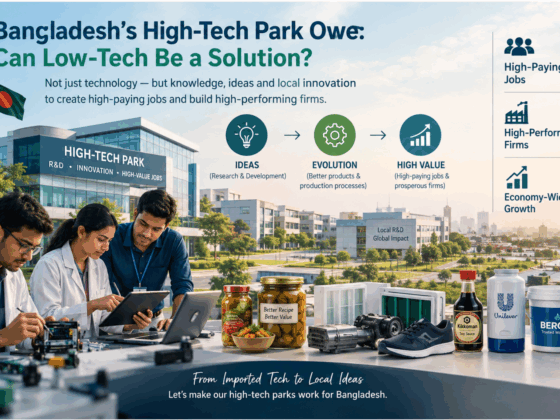
Bangladesh’s High-Tech Park Owe: Can Low-Tech Be a Solution?

How speculative markets and continuous storytelling combine to decouple asset valuation from delivery of innovations
View Post
  • 8 min

The Rise of Muskism Turning Musk a Trillionaire: Narrative-Driven Capital Accumulation and the Illusion of Disruptive Innovation

Leave a Reply Cancel reply

Your email address will not be published. Required fields are marked *

Subscribe

Subscribe now to our newsletter

Principles

  • Economics of Technology
  • Innovation Economics
  • Technology & Innovation Policy

History & Observations

  • Technology History
  • Innovation History
  • Strategy & Policy in retrospect
  • Entrepreneurs & Innovators
  • Startups & Corporations
  • Patents & Publications
  • Design & Redesign Thinking

About Us

  • Who we are
  • What we deliver
  • Genesis
  • Mission
  • Scope
  • Editorial & Advisory Board
THE WAVES
  • Contact
  • Advertise

Input your search keywords and press Enter.