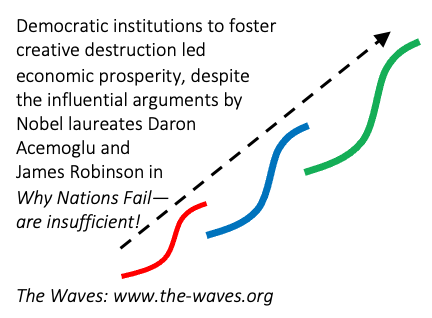
The offering of the Nobel Prize in Economic Sciences in 2024 underscores the importance of democratic and fair institutions for driving economic prosperity from ideas through Creative Destruction. However, like in the past, those institutions are not sufficient enough. Hence, this article will address the critical limitations of relying solely on democratic institutions to foster sustainable, Innovation-driven economic prosperity, despite the influential arguments by Nobel laureates Daron Acemoglu and James Robinson in Why Nations Fail. Acemoglu and Robinson argue that inclusive political and economic institutions foster development by offering profit-making opportunities out of ideas to the mass population, even at the cost of rent-seeking of the special interest groups.
However, this model doesn’t fully account for the nuanced needs of Wealth creation by leveraging unfolding technology possibilities in the globalized economy. Drawing insights from The Waves and other economic theories, we will argue that without a sophisticated understanding of wealth creation out of technology possibilities in the globally connected competitive market, rapid technological changes, relative economics of competing technology waves, limits of the market, and support for sustaining the growth of ideas to cross the threshold and winning the global race, democratic institutions alone cannot drive the economic growth envisioned through creative destruction.
Here are five key takeaways from the article:
- Innovation and Market Dynamics are Essential for Prosperity: Prosperity in the modern economy relies heavily on fostering innovation and understanding market dynamics, particularly in technology-driven sectors. Democratic norms alone are insufficient without aligning these norms with strategies that support technological advancement and win the global race.
- High Failure Rates and Long-Term Support for Innovation: Breakthrough ideas often experience high failure rates and initially require sustained, loss-making investment. Effective innovation ecosystems, strategy, education about innovation dynamics as long waves, and rational decisions tolerate these setbacks, which are critical for creative destruction and long-term success.
- Globalization and the Winner-Takes-All Phenomenon: Globalization has intensified competition, allowing a few dominant players to capture most of the market share. This challenges democratic systems prioritizing open competition, as market consolidation often stifles innovation from smaller players. Notable, such a reality has been a formidable challenge for less developed countries, as ideas pursued by their firms need to outperform competitors of advanced countries.
- Importance of Systematic Idea Flow: The continuous exchange of ideas between industries and research institutions is beneficial but insufficient to drive innovation. Instead, winning ideas need a systematic flow to create a cumulative effect to cross the threshold and win the global race. Hence, economic prosperity from ideas demands environments where knowledge does not flow freely; more importantly, they flow systematically, creating a directional effect, enabling the ideas to grow to reach the state of commercialization.
- Role of Patient Capital and Policy Alignment: For innovations to grow and exploit profit-making opportunities, there is a need for patient capital and strategic alignment between public policy and emerging technologies. Effective economic growth models must prioritize long-term investment over short-term gains, which democratic institutions may struggle to provide without specific mechanisms.
These points highlight the complex interplay of democratic principles, economic strategy, understanding of the dynamics of wealth creation out of technology possibilities, and innovation ecosystems needed to drive economic prosperity through creative destruction.
Research Questions about Economic Prosperity
Here are five research questions that could guide further exploration based on the themes of the article:
- What institutional, economic conditions and strategies most effectively support high-risk, innovative ventures in technology-driven markets?
- How does the winner-takes-all dynamic in globalized markets impact the ability of democratic institutions to foster long-term innovation and competition?
- What specific policy mechanisms can democratic systems adopt to enhance patient capital support for high-risk ventures and mitigate short-term economic pressures?
- How do countries with varying levels of economic freedom and institutional openness manage the flow of knowledge and early signals across sectors, and how does this influence innovation rates?
- What role does government intervention play in fostering or inhibiting competition and innovation in winner-takes-all markets dominated by a few tech giants?
These questions can help uncover the nuanced role of innovation policies, global market dynamics, and institutional structures in driving economic prosperity.
Getting Further Insights about Economic Prosperity from Creative Destruction
1. The Dynamics of Wealth Creation in Technology-driven Competitive Markets
In the modern economy, wealth creation increasingly hinges on emerging technologies and globalized markets, where the ability to identify, cultivate, and capture value from technological advancements is essential. Democratic norms emphasize accessibility and inclusion but often overlook the need for systematic support mechanisms that help translate technological possibilities into economic prosperity.
For example, Silicon Valley’s success wasn’t built solely on the democratic values of the U.S.; it involved targeted support for research and risk capital, industry-academia partnerships, and a culture that tolerates high failure rates. The Waves emphasizes the importance of “technology life cycles,” where countries succeed by encouraging open competition and strategically aligning public and private resources to support these cycles to grow and unleash Creative waves of destruction.
In contrast, countries lacking synchronized responses to technological opportunities often struggle to maintain innovation-driven growth. The United Kingdom, a democratic nation, faced stagnation in some tech sectors due to a focus on basic research and inventions during most of the 20th century, falling behind global competitors like the U.S. and South Korea, which effectively used public and private sector alignment to drive technology-focused wealth creation.
2. High Failure Rates and Loss-Making Beginnings
Innovative ideas often experience high initial failure rates and require sustained investment despite low returns. Venture capital data reveals that only about 10% of Startups bring substantial returns, with most new ventures either failing or breaking even. However, high-risk ideas are essential in creating breakthrough innovations that drive significant economic growth. In many democratic systems, public funding and political cycles tend to favor short-term returns, often neglecting the necessary support structures for high-risk, high-reward projects.
In contrast, countries like Israel and China, where startup incubation is robustly supported by both public funds and private investment, have developed a culture that values risk and failure as part of the innovation process. This mindset fosters an ecosystem where loss-making ideas are given room to grow. In democracies focused primarily on political stability and broad participation, this tolerance for failure is not readily achievable, often resulting in an ecosystem that favors lower-risk projects over Disruptive innovation.
3. Globalization and Winner-Takes-All Dynamics
Globalization has intensified competition, creating a winner-takes-all environment where only a few dominant players capture most market value. This concentration of power, especially in technology, tends to lock out competitors and stifle innovation. For instance, companies like Google, Amazon, and Facebook dominate digital advertising globally, making it difficult for smaller players to enter the market. These firms leverage data networks and Economies of Scale, creating barriers that traditional antitrust frameworks in democracies struggle to address. As a result, firms from less developed countries faced high barriers to profit from innovation through winning the idea race.
In non-democratic systems like China, where the government directly supports strategic industries, companies like Alibaba, Tencent, CATL, Huawei, SMIC, ZT, and a few smartphone makers have been able to maintain competitiveness against U.S. tech giants, owing in part to the Chinese government’s selective support. Although democratic norms promote fair competition, they may inadvertently reinforce monopolistic tendencies, as incumbents grow powerful enough to block new entrants and dampen innovation.
4. Sustaining a Systematic Flow of Ideas for Creating a Cumulative Effect
The continuous flow of ideas, knowledge, and innovation is essential to driving creative destruction, where new technologies disrupt established markets and replace old products. Silicon Valley is a prime example of a thriving innovation ecosystem built on the continuous exchange of ideas, where researchers, engineers, and entrepreneurs share knowledge that leads to faster technological advancement. This “flow” is crucial for innovation, as it allows new ideas to spread quickly and reach commercialization. Besides, this flow must be systematic to create a cumulative effect so that great ideas grow, cross the threshold, and win the global race.
However, countries relying on democratic norms alone often lack specialized innovation ecosystems that enable this continuous and systematic flow of ideas. Japan, for example, struggled with technology diffusion during its lost decade as knowledge sharing between industries stagnated. In contrast, South Korea’s government-supported technology clusters facilitated cross-industry collaborations, which played a significant role in the growth of its tech industry. Similarly, Taiwan has succeeded in creating a semiconductor success story through a systematic flow of ideas in collaboration with critical building blocks of the ecosystem.
5. Patient Capital and Support for Long-Term Innovation
Many transformative ideas require patient capital—funding that sustains innovation efforts through extended periods of loss-making development. Amazon’s success story is a testament to this, as it remained unprofitable for years before becoming the e-commerce giant it is today. In democratic institutions, the political and funding cycles often favor short-term returns, leaving long-term innovation projects without the necessary support.
Germany’s public-private partnerships offer an alternative model, particularly in advanced manufacturing. By supporting loss-making early phases, these partnerships enable innovations that later drive competitiveness. Democratic systems prioritizing rapid returns and fiscal responsibility often lack the means to support sustained investments in loss-making ideas, hindering the success of potentially groundbreaking ventures.
Conclusion: Beyond Democratic Norms—A Model for Economic Prosperity out of Ideas
While democratic institutions provide a foundation for inclusive participation, they do not inherently offer the mechanisms to drive prosperity through creative destruction. Unlike in the past, a single idea is not good enough to profitably unleash creative destruction. Due to the high maturity of most products, invariably, all great ideas begin the journey at a loss. They need a systematic flow of ideas to cross the threshold and win the global race. Besides, the winner takes all, leaving the competing firms at a loss.
Nobel laureates Acemoglu and Robinson emphasize the role of inclusive institutions in economic growth, yet the specific needs of modern technology-driven economies require more than democratic ideals alone.
Prosperity fueled by innovation and creative destruction demands:
- Strategic alignment between public policy and emerging technologies.
- Early detection capability and failure absorption capacity are needed to accommodate the high-risk nature of innovation.
- Mechanisms to combat monopolistic consolidation in winner-takes-all markets.
- Ecosystems for continuous and systematic idea flow facilitate knowledge exchange and the growth of ideas through cumulative effects to commercialize new technologies.
- Long-term funding to support loss-making ventures that have the potential to disrupt industries.
Countries that have successfully embraced these dynamics—like the U.S. with Silicon Valley’s innovation hub, South Korea with its technology clusters, and Israel with its startup ecosystem—demonstrate the limitations of democratic norms alone. To drive economic growth in a world where technological innovation is both the engine of prosperity and a threat to incumbents, institutions must go beyond inclusion and fairness to foster a competitive, risk-tolerant, and knowledge-rich environment. By integrating these elements, nations can effectively harness creative destruction to achieve sustainable economic prosperity in a rapidly evolving global economy.