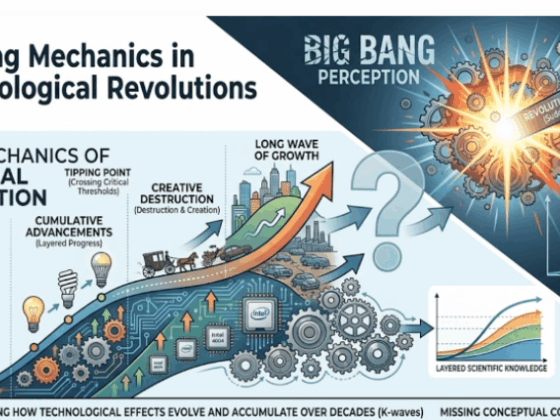
Industrial revolutions have always been characterized by significant shifts in technologies, economic structures, and societal impacts. These revolutions occur when new scientific knowledge and innovative technologies replace older systems, resulting in the Reinvention of products and processes. The cycle of technological maturity, stagnation, and reinvention is not only a central theme in these revolutions, but also a driving force behind economic growth, Innovation, and the rise and fall of national powers. By examining the key characteristics of industrial revolutions, we can better understand how they shape prosperity, inequality, and economic development.
The Cycle of Technological Maturity and Stagnation
Technologies that drive major products and production processes inevitably follow a life cycle of growth, saturation, and eventual stagnation. During the early phases of innovation, new technologies lead to significant improvements in productivity, cost efficiency, and market reach. These advancements contribute to rapid economic growth and significant social changes. However, as these technologies mature, their potential for further improvement begins to slow. This saturation leads to diminishing returns on investment in existing technologies, which can result in economic stagnation and reduced innovation.
When technological progress stagnates, economic growth slows down as firms and economies continue to rely on existing processes. This is often described as the period of technological maturity, where incremental improvements slowed down, and radical shifts in productivity are rare. This stagnation can lead to periods of economic sluggishness, where firms may struggle to find new sources of growth.
The Role of Paradigm Shifts in Scientific Knowledge
The Breakthrough that triggers a new industrial revolution often comes from a paradigm shift in scientific knowledge. A paradigm shift represents a fundamental change in the underlying understanding of natural laws or processes that govern technological development. For instance, the transition from classical science to quantum science represents a shift that opens the door to more scalable technologies with far-reaching applications.
New scientific paradigms typically provide the foundation for the development of new technology cores—fundamental technologies that act as the building blocks for future innovation. These new cores are often more scalable and versatile than their predecessors, allowing for faster and more expansive applications in industries ranging from manufacturing to energy and communication. As the technological core of an industry shifts, it opens up opportunities for reinvention and the creation of new products and processes.
Reinvention and the Disruption of Matured Technologies
As new scientific knowledge enables the development of scalable technologies, industries begin to reinvent their major products and processes. This reinvention often involves replacing outdated technology cores with those that are based on newer scientific paradigms. These new technologies disrupt the status quo by offering more efficient, cost-effective, and scalable alternatives to matured products.
For example, in the case of the Second Industrial Revolution, the rise of electrical technologies revolutionized industries that had previously been dependent on steam and mechanical power. This reinvention disrupted the traditional manufacturing processes and led to the rise of new industries, such as electrical engineering and telecommunications. As industries evolve and new technology cores take over, the demand for outdated products and skills that were designed for the old core declines, leading to the destruction of these markets. This phenomenon is often referred to as Creative Destruction, a process where the failure to adapt to new technologies leads to the collapse of existing firms and industries.
The Migration of Prosperity Across Firm Boundaries–a key attribute of Characteristics of Industrial Revolutions
As new technologies emerge, incumbent innovators—those firms or individuals who were once leaders in a previous wave of innovation—often struggle to switch to the next wave. This difficulty in transitioning to new technology cores is a key feature of industrial revolutions. Historical patterns show that 7 out of 10 incumbent innovators fail to successfully pivot to the new wave of innovation, leading to their disruption and eventual decline. This failure results in the migration of prosperity from established firms to new entrants that can harness the potential of emerging technologies.
One historical example of this migration of prosperity is the rise of the United States during the Second Industrial Revolution. As the US harnessed electrical technologies, it outpaced the United Kingdom, which had been the dominant industrial power during the First Industrial Revolution. The transition from steam to electricity as the new technology core led to the decline of older industries and the rise of new ones, with the United States becoming the world’s leading economic power, while the UK’s dominance waned.
Wealth Accumulation and Annihilation: The Effects of Creative Destruction
The processes of creative destruction and Disruptive innovation have profound effects on wealth distribution at multiple levels—individual, firm, and national. As new technologies replace older ones, wealth is both accumulated and annihilated. New industries, driven by emerging technologies, create vast amounts of wealth for individuals and firms that can adapt and innovate. At the same time, older industries, unable to keep pace with technological advancements, experience a loss of wealth, leading to job losses, firm closures, and economic decline in certain regions or sectors.
At the individual level, workers who possess skills relevant to outdated technologies may face unemployment or the need to retrain for new roles in the emerging economy. At the firm level, companies that fail to invest in R&D and adapt to new technology cores often find themselves overtaken by more innovative competitors. National economies also feel the effects of creative destruction, as countries that fail to lead in emerging technologies risk losing their economic prowess to nations that are at the forefront of innovation.
Long Waves of Growth and the Rise of Exponential R&D Investment
The stagnation of technological progress during periods of maturity is followed by what can be described as a long wave of growth. This phase represents the economic expansion driven by the successful adoption of new technologies. As industries adopt the new technology core, they experience significant increases in productivity, leading to economic growth and the creation of new markets. This period of growth is often accompanied by a demand for exponential growth in R&D investment, as firms seek to push the boundaries of what is possible with new technologies.
Each industrial revolution is characterized by the increasing complexity and scale of the technologies involved, requiring substantial growth of investments in research and development to maximize their potential. This leads to a continual cycle of innovation, where each successive revolution pushes economic prosperity to new heights.
The Impact on Inequality
One of the unintended consequences of industrial revolutions is the increase in inequality. As new technologies emerge, certain countries, firms, and individuals are able to exploit these advancements to gain significant economic advantages. For example, nations that lead in the development of new scientific paradigms and the creation of scalable technologies are able to capture a disproportionate share of the wealth generated by these innovations. This inequality is not just confined to the global stage but is also evident within nations, as idea-supplying nations—those that pioneer new technologies—benefit from increasing economic opportunities.
As the gap between innovators and laggards grows, so too does the disparity in wealth, education, and opportunity. While those who can access the benefits of new technologies thrive, those left behind experience economic hardship.
Conclusion
Industrial revolutions are periods of profound transformation, driven by the maturation of technologies, paradigm shifts in scientific knowledge, and the reinvention of products and processes. These revolutions are marked by the rise and fall of economic powers, the creation and destruction of wealth, and the migration of prosperity across firms and nations. While each revolution brings about periods of stagnation followed by long waves of growth, they also exacerbate inequality, as nations and firms that fail to adapt to new technology cores fall behind. Ultimately, industrial revolutions push economic prosperity to new heights, but they also highlight the dynamic nature of innovation, where the future is determined by the ability to harness new scientific paradigms and technological breakthroughs.
Key Takeaways of Characteristics of Industrial Revolutions
Here are five key takeaways from the essay on industrial revolutions:
- Technological Maturity Leads to Stagnation: As technologies mature, their potential for growth and innovation slows down, leading to economic stagnation. This sets the stage for the need for disruptive innovation to break the cycle of stagnation.
- Paradigm Shifts Drive New Technology Cores: Breakthroughs in scientific knowledge, like the shift from classical to quantum science, provide the foundation for the development of new, scalable technology cores that lead to the reinvention of industries and products.
- Reinvention Disrupts Mature Technologies: New technology cores replace outdated systems, causing the destruction of old products, processes, and skillsets. This reinvention often leads to creative destruction, where incumbents who fail to adapt face disruption, while new entrants gain prosperity.
- Wealth Migration and Disruption: Prosperity migrates across firm and national boundaries, as new entrants harness emerging technologies. Incumbent innovators often fail to pivot to the next wave, resulting in their decline, and the rise of new economic powers, as seen with the shift from the UK to the USA during the Second Industrial Revolution.
- Exponential Growth and Inequality: Industrial revolutions require exponential growth in R&D investment and labor-saving technologies. While these revolutions push economic prosperity to new heights, they also contribute to rising inequality, as idea-supplying nations and firms capture the majority of the wealth created.
Research Questions about Characteristics of Industrial Revolutions
Here are five research questions based on the characteristics of industrial revolutions discussed in the essay:
- How do paradigm shifts in scientific knowledge influence the scalability and adoption of new technology cores during industrial revolutions?
- What factors determine the success or failure of incumbent innovators in transitioning to new technology cores during periods of reinvention and disruption?
- How does creative destruction during industrial revolutions impact income inequality at the individual, firm, and national levels?
- What role do R&D investment and labor-saving technologies play in driving long-term economic growth during industrial revolutions?
- How do industrial revolutions contribute to the global migration of economic prosperity, and what factors determine the rise of new economic powers and the decline of old ones?