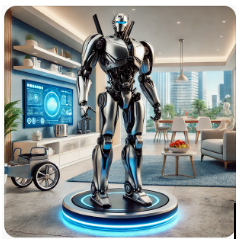
Elon Musk’s recent Innovation excitement revolves around the Optimus Humanoid Robot, also known as the Tesla Bot. As widely reported in the media, Musk envisions Optimus as a groundbreaking product capable of performing a wide range of everyday tasks in and outside the home. According to Musk, the economic potential of Optimus could far exceed that of Tesla’s $1.4 trillion valuation, with claims that it “has the potential to be more significant than [Tesla’s] vehicle business over time.”
Historical Context of Humanoid Robots
The fascination with humanoid robots is not new. From the 17th to the 19th century, the technological core of clockmaking, consisting of gears, cams, and springs, enabled the creation of marvels like Japan’s humanoid tea-serving dolls, or automata. In the last century, this fascination evolved significantly with the development of humanoid robots such as Eric, a British robot described by The New York Times as a “perfect gentleman,” and more contemporary examples like ASIMO and Sophia. Over the decades, the technological core expanded to include sensors, software, and, more recently, teleoperation capabilities. These advancements aimed to replicate human-like perceptions and responses, paving the way for robots that could potentially handle manual jobs, particularly household chores.
Despite these advancements, humanoid robots have struggled to cross critical barriers, particularly those related to mimicking human innate abilities such as touch, feel, and dexterity. Honda’s iconic robot ASIMO, for example, faced an insurmountable barrier after 28 years of R&D, ultimately failing to achieve the required level of human-like abilities to make it commercially viable. Besides, several dead robots have left the message that dull jobs are highly difficult to automate and they are left for human.
Optimus: A New Sensation in Humanoid Robots
In the race to develop humanoid robots for household chores, the Tesla Bot has emerged as a new sensation. The second-generation Optimus has showcased notable features such as walking, dancing, and even poaching an egg. These demonstrations were heavily featured at Tesla’s “We, Robot” event in October 2024. However, critics have pointed out that many of these feats were achieved through teleoperation, rather than fully autonomous operation. In response, competitors have also released videos highlighting how their humanoid robots could complete similar tasks autonomously.
Optimus, it seems, represents an integration of existing component technologies rather than a revolutionary leap. While its demonstrations have captured public imagination, they fall short of demonstrating the capability to overcome barriers faced by predecessors. The reliance on teleoperation raises concerns about the robot’s readiness to perform complex household tasks independently.
Barriers to Market Viability
To truly revolutionize household automation, Optimus Humanoid Robot must address several critical barriers:
- Innate Abilities: Human beings possess 52 innate abilities across cognitive, sensory, physical, and psychomotor domains. For example, tasks such as cooking, cleaning, or caregiving require not only physical dexterity but also nuanced cognitive and sensory inputs, such as the ability to judge texture or adjust grip strength delicately. Existing technology cores—comprising sensors, software, connectivity, teleoperation, and mechanical movements—lack the sophistication to replicate these capabilities.
- Autonomy vs. Teleoperation: While teleoperation allows for impressive demonstrations, it limits scalability and practical Utility. For widespread adoption in 120 million households in the USA alone, Optimus must achieve a level of autonomy that eliminates the need for constant human oversight.
- Cost-Effectiveness: At a projected price of $30,000 per unit, Optimus must justify its cost by delivering a superior value proposition compared to existing household solutions, such as human labor or specialized machines like robotic vacuums.
- Durability and Reliability: Household robots must endure regular wear and tear, operate in diverse conditions, and adapt to unstructured environments—challenges that even the most advanced robots struggle to overcome.
The Need for a New Technology Core
To succeed in the ambitious goal of creating a mass market for Optimus, Tesla must pioneer a new and proprietary technology core that transcends existing limitations. This core should focus on:
- Advanced Sensors and Actuators: These components must mimic human-like tactile feedback, enabling the robot to perform tasks requiring precision and subtlety.
- AI-Powered Cognitive Systems: Optimus needs AI systems capable of context-aware decision-making, allowing it to adapt to dynamic and unstructured environments without human intervention.
- Innovative Materials: Lightweight, durable materials could enhance the robot’s efficiency, durability, and safety in household settings.
- Human-Like Dexterity: Breakthroughs in robotic hands and grippers are crucial for performing delicate tasks like folding laundry or handling fragile items.
Economic Potential and Risks
The economic prospects of humanoid robots like Optimus are immense. In the United States alone, the demand for such robots could arise from over 120 million households seeking solutions for cooking, cleaning, and eldercare. Globally, this demand could translate into hundreds of millions of units, creating a multi-trillion-dollar market.
However, the risks are equally significant. Without a groundbreaking technology core, Optimus risks following the fate of ASIMO and similar robots, which failed to achieve widespread adoption despite decades of R&D. Furthermore, the high expectations set by Elon Musk’s bold claims could lead to investor disappointment if these technological and market challenges remain unaddressed.
Innovation Magic Box
Through the process of developing Optimus, Elon Musk may further enhance his reputation for skyrocketing the valuation of his ventures, including Tesla, SpaceX, and XAI. Adding Optimus to this innovation magic box aligns with Musk’s strategy of pursuing audacious, high-impact projects that capture public imagination and drive investment.
However, for Optimus to achieve its full potential and become a bigger success than Tesla’s EVs, it must deliver tangible value that goes beyond hype. This requires not only addressing the technical barriers outlined above but also crafting a compelling narrative around its utility and economic benefits.
Conclusion
The Optimus Humanoid Robot represents an exciting step forward in the quest to develop humanoid robots capable of taking over household chores. However, its current reliance on existing component technologies, including teleoperation, limits its ability to fulfill Musk’s bold vision of mass-market adoption and economic dominance.
To tap into the enormous potential market of household automation and achieve the lofty goal of becoming a trillion-dollar product, Tesla must invent and refine a new technology core. This core must empower Optimus to replicate and exceed human innate abilities in cognitive, sensory, physical, and psychomotor domains. Without such breakthroughs, the dream of a humanoid robot revolution may remain elusive, leaving Optimus as another impressive yet commercially limited demonstration of robotic innovation.
As history has shown, breakthroughs in technology core are essential to transforming exciting demonstrations into practical, scalable solutions. For Optimus to succeed, Tesla must pioneer innovations that not only address current limitations but also redefine the possibilities of humanoid robotics. In doing so, Elon Musk could cement his position as a visionary leader while opening the door to a new era of automation and economic opportunity.
Five key takeaways about Optimus Humanoid Robot:
- Optimus Has Immense Potential but Faces Critical Barriers
While the Optimus Humanoid Robot has captured public imagination and boasts significant economic prospects, its reliance on existing technology cores, such as sensors, software, and teleoperation, limits its ability to independently perform complex household tasks. - Human Innate Abilities Are the Benchmark
To succeed in automating household chores, Optimus must replicate and exceed human innate abilities in cognitive, sensory, physical, and psychomotor domains. Current technology has yet to cross this threshold. - Teleoperation Limits Scalability
The demonstrations of Optimus at Tesla’s “We, Robot” event relied heavily on teleoperation, raising concerns about the robot’s readiness for autonomous operation in real-world, unstructured environments. - A New Technology Core Is Essential
To achieve its market potential and compete with human efficiency, Tesla must develop a new technology core. This includes breakthroughs in tactile sensors, AI-driven cognitive systems, innovative materials, and human-like dexterity. - Market Potential is Vast but Demands Tangible Value
The U.S. alone has over 120 million households seeking solutions for dull chores, creating a multi-trillion-dollar market. However, Optimus must demonstrate clear value and autonomy to justify its $30,000 price point and deliver on Musk’s vision of creating a bigger success than Tesla’s EVs.
Five research questions about Optimus Humanoid Robot:
- What technological breakthroughs are required to replicate human innate abilities in humanoid robots?
This question explores the technological gaps in mimicking human cognitive, sensory, physical, and psychomotor abilities, which are essential for robots like Optimus to perform household tasks autonomously. - How can humanoid robots overcome reliance on teleoperation to achieve full autonomy?
This investigates the limitations of teleoperation and what advancements in AI, machine learning, and robotics are needed to enable real-time decision-making and adaptation in unstructured environments. - What are the cost-to-value trade-offs for household humanoid robots like Optimus?
This focuses on assessing whether a $30,000 humanoid robot can provide sufficient economic and practical value to households compared to other alternatives like human labor or specialized machines. - What role do innovative materials play in enhancing the efficiency and durability of humanoid robots?
This question addresses the importance of lightweight and durable materials in improving the robot’s performance, safety, and energy efficiency for long-term use in household settings. - What is the market readiness and consumer acceptance of humanoid robots for household chores?
This examines consumer expectations, usability, and trust factors, as well as how cultural and regional differences may impact the adoption of robots like Optimus across global markets.