Abstract
Bangladesh’s industrial growth strategy, rooted in importing mature technologies and relying on labor-centric value addition, has reached a point of structural decline. Drawing on the theory of product evolution, this article argues that sustainable Wealth creation arises not from replication, but from catching the next wave through continuous product renewal, deeper diffusion, and industrial Reinvention. As products mature, value shifts away from labor and Codified Knowledge toward embedded technologies and ecosystem leaders, explaining declining profits, factory layoffs, and rising graduate unemployment in Bangladesh. Industrial history shows that reinvention waves drive the rise and fall of firms and nations, relocate industrial epicenters, and create windows of opportunity for latecomers that enter early in catching the next wave. Bangladesh’s dependence on conventional economic policy frameworks and lender-driven infrastructure investment has locked the economy into the late stages of product life cycles. To become an industrial powerhouse, catching the next wave is vital; the country must develop intellectual and institutional competence to identify reinvention opportunities, mobilize ecosystems around emerging product waves, and convert scientific knowledge into scalable technologies. Early ecosystem response to reinvention, rather than replication, offers Bangladesh a viable path to Innovation-led industrial transformation for catching the next wave.
Bangladesh’s industrial growth strategy remains dominated by a replication mindset: importing mature technologies, capital machinery, and product designs, and adding value primarily through labor. This approach once delivered rapid export growth, particularly in ready-made garments and import substitution. However, the same strategy is now producing diminishing returns. The reason is not poor execution, but a deeper structural force explained by the theory of product evolution and industrial reinvention. Wealth is not created indefinitely by replication; it is created through the continuous evolution of products, renewal along the product life cycle, and the deepening of scientific knowledge that powers scalable technologies. However, to leverage knowledge and ideas, the focus should be on catching the next wave.
- Replication-led industrialization has reached its limit
- Cheap labor no longer creates prosperity
- Diminishing returns to labor-centric value addition
At the heart of industrial prosperity lies the evolution of products. As products evolve, they diffuse deeper into society—reaching new users, new use cases, and new geographies. This deeper diffusion creates wealth because it expands markets and invites complementary innovations. Early in a product’s life cycle, uncertainty is high and scientific knowledge is still fluid. Firms experiment, design choices matter, and human judgment plays a central role. As the product matures, knowledge becomes codified, embedded in machines, software, and standards. Costs fall, quality stabilizes, and production becomes scalable. At this stage, value creation migrates away from labor and routine knowledge toward technology owners and ecosystem leaders.
Bangladesh entered global markets largely at the mature stage of the product life cycle. In garments, footwear, furniture, and light manufacturing, the dominant technologies were already standardized. Consequently, the scope for value addition through labor has steadily shrunk. Today, labor-based value addition in most industrial activities accounts for less than 10 percent of total production cost; in some firms, it is closer to 6 percent. Automation and embedded technologies now determine quality, cost, and delivery speed. Producing the same volume of exports with 40–50 percent fewer workers over 10 years is not a temporary shock—it is the logical outcome of product maturity and the growing role of process technology.
The same logic explains graduate unemployment. Education systems produce codified knowledge suitable for routine tasks, but mature industries have already automated those tasks. Graduates find themselves irrelevant not because education is unnecessary, but because the economy is positioned too late in the product life cycle. When products are mature, knowledge no longer creates rents; it merely maintains operations. Thus, replication economies experience falling profits, layoffs, and shrinking opportunities for both workers and graduates.
Product life cycle theory also explains why industrial reinvention causes the rise and fall of firms, nations, and even entire industrial regions. When a new reinvention wave emerges—through new materials, emerging technology cores, architectures, energy sources, or scientific breakthroughs—the competitive landscape resets. Incumbents tied to old designs struggle, while new entrants, by catching the next wave, gain the opportunity to shape standards, ecosystems, and value chains, leading to the migration of the industry’s epicenter.
History offers repeated evidence of this migration. Britain lost industrial leadership as technologies matured and diffused. The United States rose by mastering new waves of industrial reinvention, only to see manufacturing shift toward East Asia as products standardized. Japan transformed itself by entering reinvention waves in electronics and precision manufacturing, while later losing ground in consumer electronics as new digital platforms emerged. More recently, China has captured the reinvention wave in electric vehicles and batteries by aligning policy, research, industry, and market formation early in the cycle.
This framework reveals Bangladesh’s strategic Dilemma—and its opportunity. Replication of mature products cannot make Bangladesh an industrial powerhouse, regardless of how much infrastructure or how many incentives are offered. Replication locks the economy into the late stage of the product life cycle, where margins are thin, labor is dispensable, and learning opportunities are limited. External lenders and development partners reinforce this trap by promoting infrastructure-heavy, debt-driven growth and vague promises of “leapfrogging” without engaging with the realities of product evolution.
True leapfrogging is not skipping stages of development; it is entering the right stage of the product life cycle at the right time. That requires industrial reinvention. Reinvention does not mean inventing everything from scratch. It means identifying the next wave of mature products—where existing technologies are about to be reconfigured through new scientific knowledge—and positioning national ecosystems early enough to shape outcomes.
The deeper layer of scientific knowledge is critical here. Scalable technologies are powered not merely by engineering skills, but by advances in materials science, energy systems, data architectures, and production processes. When an economy participates early in translating such scientific knowledge into products, it captures learning rents, design influence, and ecosystem leadership. As products scale, these advantages compound. When an economy joins late, it receives only low-value assembly and routine tasks.
Ecosystem response at the early stage of a reinvention wave determines whether an agrarian or labor-centric replication economy can be uplifted into an industrial powerhouse. Such a response includes coordinated investment in problem-oriented research, experimental manufacturing, risk-sharing finance, adaptive regulation, and demand creation. It also requires intellectual competence—an understanding of how products evolve, how labor and knowledge roles change along the life cycle, and how to detect signals of impending reinvention.
This is where Bangladesh faces its most serious gap. Economists dominating policy discourse lack theories of product evolution and industrial reinvention. Their models treat technology as an exogenous input and assume that education automatically raises productivity. Science, engineering, and business communities, meanwhile, are rarely trained to think in terms of product life cycles, ecosystem strategy, or global competitive timing. As a result, massive investments in education and infrastructure fail to translate into industrial renewal.
- Real leapfrogging starts early, not late
- Knowledge must create products, not certificates
- Industrial power comes from timing, not size
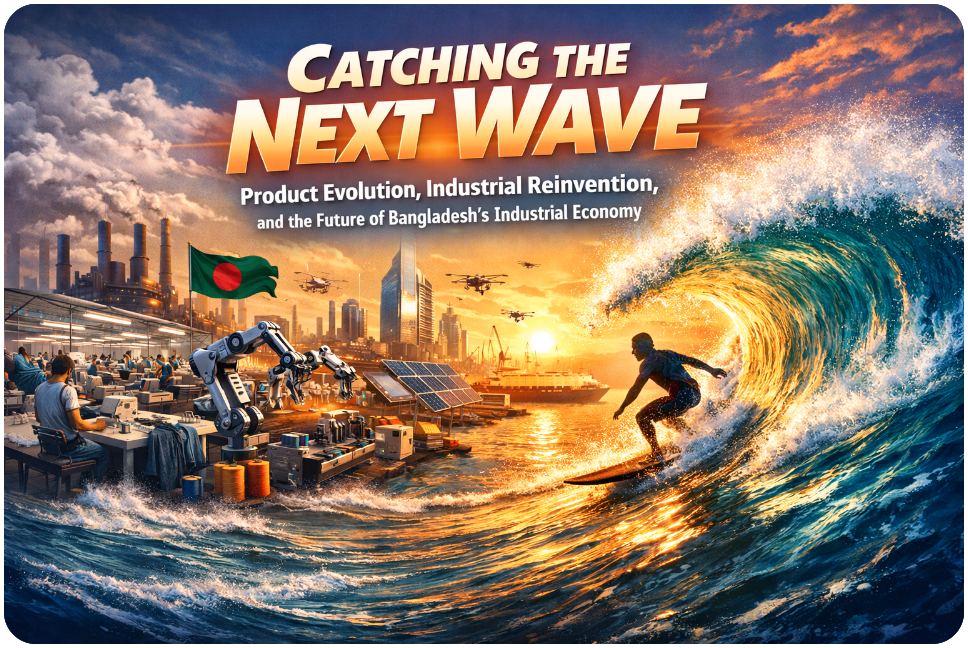
- Bangladesh must catch the next wave, not chase the last
To become an industrial powerhouse, Bangladesh must shift its growth strategy from replication to reinvention. This means prioritizing intellectual capability over physical accumulation, and strategic choice over generic incentives. The central questions should be: which reinvention waves align with Bangladesh’s latent capabilities, when is the window of entry, and how can ecosystems be mobilized to compete globally?
Lessons from China’s electric vehicle push or Japan’s transformation of firms like Sony show that industrial power is not built by cheap labor or scale alone. It is built by understanding product evolution, entering reinvention waves early, and orchestrating ecosystems that convert scientific knowledge into scalable technology for catching the next wave. If Bangladesh can internalize this logic, it can redirect its graduates from unemployment toward value creation, transform labor from a cost into a learning asset, and reposition itself from a replication economy into a true industrial powerhouse–by catching the next wave.
Key Messages
Strategic reinvention is the path forward
By building national capability to detect reinvention opportunities and mobilize ecosystems—learning from cases like China’s EVs or Japan’s industrial renewal—Bangladesh can convert graduates’ knowledge into value creation and emerge as a true industrial powerhouse.
Replication has reached its limit
Bangladesh’s industrial strategy—replicating mature products using imported technology and cheap labor—cannot sustain growth. As products mature, value shifts away from labor toward embedded technologies, compressing margins and employment.
Wealth is created through product evolution, not static production
Economic prosperity comes from continuous product evolution, deeper diffusion, and renewal along the product life cycle—not from producing the same mature products more efficiently.
Product maturity explains job losses and graduate unemployment
Automation and codified knowledge embedded in machines reduce the role of both labor and graduates in mature industries. This is a structural outcome of late entry in the product life cycle, not a failure of workers or education alone.
Industrial reinvention drives rise, decline, and relocation of industries
New reinvention waves reset global competition, causing the rise and fall of firms and nations and shifting industrial epicenters across regions and time.
Early entry into reinvention waves is the real ‘leapfrogging’
Leapfrogging means entering the early stage of the next product wave—when scientific knowledge is still fluid—not skipping development stages or relying on infrastructure-led growth.
Deep scientific knowledge underpins scalable industrial power
Long-term industrial leadership depends on linking science (materials, energy, data, processes) to product design and manufacturing, not on assembly or routine engineering alone.
Ecosystem response determines industrial transformation
Coordinated action—research, experimentation, finance, regulation, and market creation—at the early stage of reinvention can uplift an agrarian or labor-centric economy into an industrial powerhouse.
Conventional economics and external lenders reinforce the trap
Dominant policy frameworks lack theories of product evolution and reinvention, while lender-driven infrastructure and incentive policies lock Bangladesh deeper into mature, low-value industries.
Bangladesh’s core deficit is intellectual, not physical
Despite heavy investment in education and infrastructure, the absence of competence in choosing what to reinvent, when to enter, and how to win weakens industrial outcomes.